
Underwater robotics has moved from a specialist offshore niche to a tool used across inspection, survey, salvage, renewables, science and defence. It is also one of the few areas in the marine sector where demand is clearly outrunning the supply of trained people. Here is what the work is and how to get into it.
What is actually in the water
Four categories of vehicle, with genuinely different jobs.
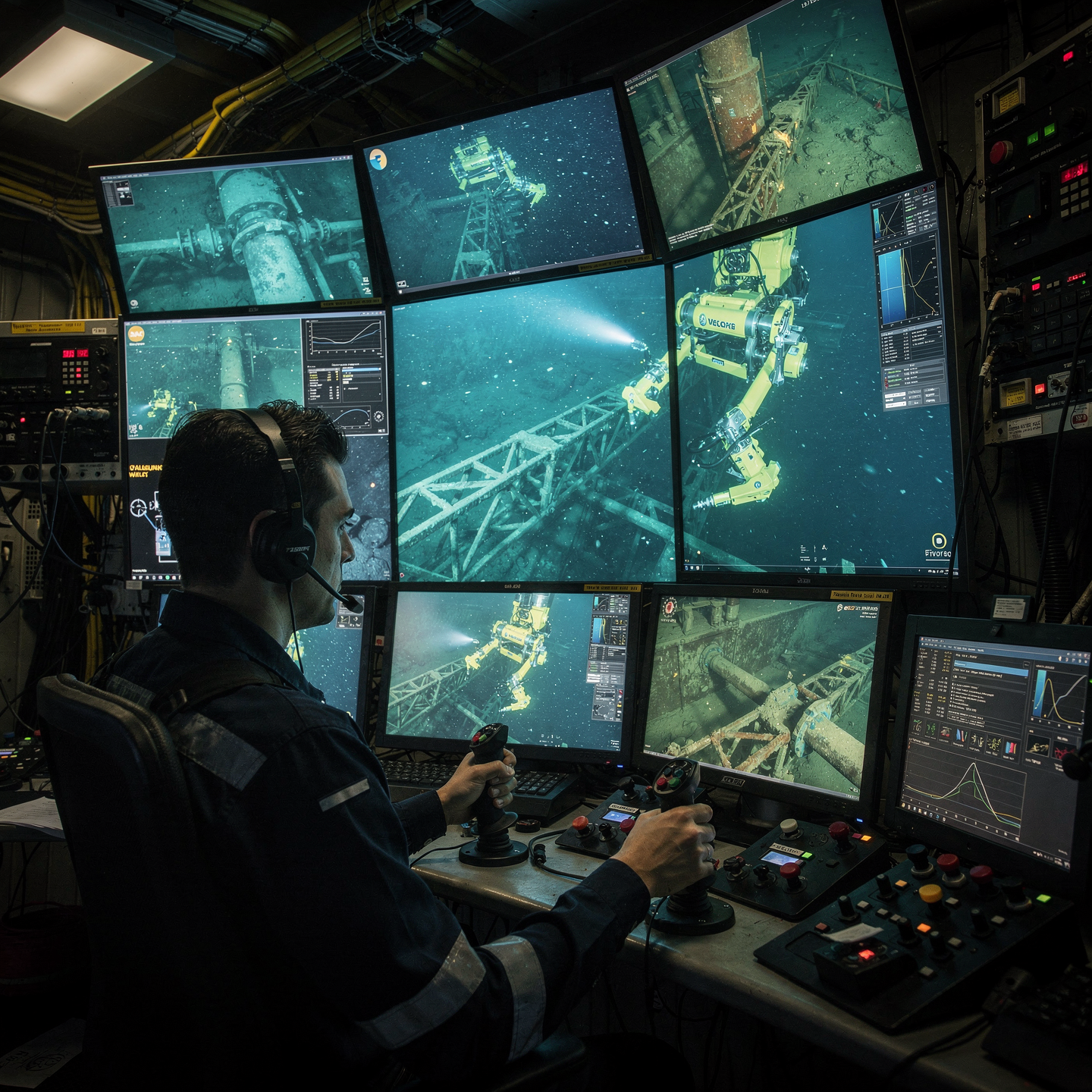
Remotely operated vehicles (ROVs) are tethered. The umbilical carries power, control signals and data, which means unlimited endurance and the ability to carry manipulators and do real work. The tether is also the main constraint: it limits range and it snags.
ROVs scale from small observation units a single person can carry to work-class vehicles the size of a van, with hydraulic manipulators and the power to cut, torque and lift.
Autonomous underwater vehicles (AUVs) carry their own power and follow a pre-programmed mission with no tether. They cover ground efficiently, which makes them the tool of choice for survey over area, and they cannot intervene: they observe, record and come back.
Hybrid and resident systems live on a subsea installation or in a seabed garage and deploy on demand, often controlled from shore. This is where offshore inspection is heading, because it removes the vessel from the equation and the vessel is most of the cost.
Surface and aerial platforms complete the picture: uncrewed surface vessels acting as a mother ship, and aerial drones doing the above-water half of an inspection.
The ROV (Remotely Operated Vehicle) Course is the standard practical introduction, and the Diploma in Applied Underwater Robotics takes the subject to the level most employers expect of an operator.
What the work actually involves
Inspection is the largest single application. Hulls, offshore structures, wind turbine foundations, pipelines, harbour walls, dams. The task is to detect and record defects: corrosion, cracking, coating breakdown, marine growth, scour around foundations.
Increasingly this means producing not video but measurement: photogrammetry and sonar data that generate a dimensioned model which can be compared against the previous survey. The Diploma in Inspection with ROVs and Submersible Vehicles is built around this work.
Intervention means doing something rather than looking at it: operating valves, replacing components, cutting, connecting. This is work-class ROV territory and it is the most demanding piloting.
Survey and mapping covers the seabed itself for route planning, resource assessment and scientific purposes, mostly AUV work with sonar and sub-bottom profiling.
Construction support is the eyes and hands for subsea installation: guiding a structure to the seabed, confirming connections, documenting as-built condition.
Search and recovery is exactly what it sounds like, and includes some of the most publicly visible work in the field.
The sectors hiring, and how they differ
Offshore energy. Historically oil and gas, increasingly offshore wind. Wind has shifted the demand profile: more structures, shallower water, higher volume of routine inspection, more pressure on cost per inspection. That pressure is what is driving resident and autonomous systems.
Subsea cables. A quietly enormous sector. Telecommunications and power interconnectors need route survey, installation support, burial verification and fault location. It is specialised, long-term and less exposed to the energy price cycle than offshore oil. The Master’s in Submarine Cable Engineering covers this area specifically.
Ports and infrastructure. Quay walls, lock gates, intakes, bridge foundations. Less glamorous, steady, and often closer to home than offshore rotations.
Science and exploration. Research institutions, seabed mapping, geology. The Master’s in Underwater Geology and Ocean Floor Exploration sits here, as does the Master’s in Exploration of Submarine Mineral Resources, where the commercial questions are still developing and the environmental ones are substantial.
Defence and security. Mine countermeasures, harbour protection, surveillance, infrastructure monitoring. Growing, and with its own clearance and nationality requirements. The Master’s in Submarine Defense and Naval Warfare Technologies and the Master’s in Automation and Naval Surveillance Drones cover this territory.
Media and documentation. Underwater filming is a genuine profession with its own technical demands, covered by the Master’s in Underwater Photography and Filmmaking.
What an ROV pilot technician actually does
The title is accurate and the second half is the larger part. Flying the vehicle is a skill learned in weeks. Keeping it working is the job.
A typical offshore rotation involves pre-dive checks, launch and recovery in whatever sea state is permitted, flying the task, and then maintenance: hydraulics, electrical terminations, connectors, thrusters, cameras, the tether management system. Fault-finding on deck at three in the morning with the client waiting is the characteristic experience of the role.
The people who progress are the ones who are strong on the maintenance side, because a pilot who can fix the vehicle is worth far more than one who can only fly it.
Work is often rotational, offshore, and physically demanding. The money is good and the lifestyle is not for everyone, which is a large part of why the sector is short of people.
Where the field is going
Autonomy is increasing incrementally. Not driverless submarines so much as vehicles that handle station-keeping, navigation and routine survey patterns themselves, leaving the operator to supervise and handle exceptions.
Operations are moving ashore. Remote operations centres controlling vehicles over satellite or cable links, with a smaller crew offshore. This creates shore-based jobs in the sector for the first time at scale.
The data is becoming the product. Clients increasingly want an analysed condition assessment rather than hours of video. That shifts value towards people who can process and interpret, which is a different skill from piloting and often a different person.
Underwater intervention is expanding. Welding, cutting and repair work that previously required divers is moving to remote systems where it can be. The Diploma in Underwater Welding is worth noting here, because the underlying trade remains in demand whether performed by a diver or supported remotely.
Getting in
There are three realistic routes.
From a technical trade. Electrical, electronic, hydraulic or mechanical background, then vehicle-specific training. This is the most common and the most robust, because the maintenance competence is already there.
From the marine sector. Seafarers and divers who already understand offshore operations, vessel routines and the safety regime, adding the robotics layer.
From engineering or science. Graduates entering on the data, survey or systems engineering side rather than as pilots.
Whichever route, the sequence that works is the same: get the technical fundamentals, get hands on a vehicle, then specialise. The Course on Robotics Projects Applied to the Ocean is a short practical starting point, the Diploma in Applied Underwater Robotics is the operator-level qualification, and the Master’s in Underwater Robotics and Marine Drone Engineering and Master’s in Underwater Technology and Autonomous Underwater Vehicles (AUV/ROV) are aimed at people moving towards systems engineering, project management or autonomy work.
Worth being realistic about
Offshore work is rotational and the rotations are long. Weather stops operations and nobody is paid for the view. Vehicles break constantly and the client is always waiting. Certification and medical requirements for offshore work are real and have to be maintained.
Against that: demand is strong, the work is genuinely interesting, the skills transfer between sectors, and the shift towards remote operations is beginning to offer shore-based careers that did not exist five years ago.
Note also that commercial diving, offshore survival and offshore medical certificates come from approved centres under their own regimes. No academic programme substitutes for them, and if your intended role requires them, obtain them from a centre approved to issue them.
The physics that shapes every design decision
Four constraints explain why underwater vehicles look and behave the way they do, and why solutions that work in air do not transfer.
Pressure. Roughly one additional atmosphere for every ten metres of depth. At three thousand metres everything must either withstand around three hundred atmospheres or be filled with oil and pressure-compensated. This is why deep-rated equipment is expensive and why depth rating is the first number in any specification.
Radio does not work. Seawater absorbs radio frequencies almost immediately, which is why there is no underwater GPS and no wireless video. Communication is acoustic, which is slow and low-bandwidth, or it is down a cable. Every architectural choice in the field follows from this one fact.
Navigation is dead reckoning plus acoustics. Position comes from inertial sensors corrected by Doppler velocity logs and acoustic positioning from a surface vessel or seabed transponders. Error accumulates with time, which is why long autonomous missions need periodic position fixes.
Light and visibility. Water absorbs light rapidly and unevenly by wavelength, and suspended particles scatter what remains. Visibility of a few metres is normal and sometimes it is centimetres. This is why sonar does so much of the work that cameras would do in air.
Reading a specification without being misled
If you end up specifying or buying this equipment, four numbers carry most of the meaning.
Depth rating determines where it can work and most of the cost. Thrust and power determine whether it can hold position in current, which is usually the binding constraint on a real site rather than depth. Payload capacity determines what sensors and tools it can carry simultaneously. Endurance matters for autonomous vehicles and is irrelevant for tethered ones.
The specification trap is current. A vehicle that performs beautifully in a test tank may be unable to hold station in two knots of tide, and a great deal of real inspection work happens in exactly those conditions.
Safety, and why launch and recovery is the dangerous part
The vehicle is not the hazard. The operation around it is.
Launch and recovery involves a heavy object swinging on a crane or A-frame over a moving deck, with a tether that can snag and personnel working close to the edge. Most serious injuries in the field happen in this phase, not during the dive.
The other recurring hazards are stored energy in hydraulic systems, high voltage in the power path down the umbilical, and the simple fact of working on an open deck offshore in weather. The procedures that cover these are not paperwork, and the operators with the best safety records are usually also the ones that run the most efficient operations, which is not a coincidence.
One honest note on recognition
Recognition of a qualification depends on the programme completed and on the regulations of each country. The programmes referenced here are professional training; they are not statutory certificates of competency, and they do not replace one where a flag state or regulator requires it. If the role you want is gated by a specific certificate or professional body, check what that body requires before choosing a programme. Our recognition and accreditations page sets out more detail.
Where to go next
Fees and start dates are published on every programme page, and the course catalogue, diploma catalogue and master’s catalogue let you compare side by side. Study is online, and each programme page shows its next start date.
If you would rather talk it through, the application process starts with a short form and a conversation with an academic adviser, normally within 24 to 48 hours, at no cost and with no obligation.
Related reading: nine maritime careers you can move into from sea and decarbonising shipping: rules, levers and careers.