
Decarbonisation stopped being a policy conversation and became an operational one somewhere around the point where fuel choices started showing up on the balance sheet and in port state inspections. This is a working guide to what the rules actually require, which levers genuinely move the numbers, and what the shore and seagoing jobs created by all of it look like.
The shape of the problem
Shipping is efficient per tonne-mile and enormous in aggregate. That combination is why it is hard to decarbonise and why it attracts regulatory attention anyway. A container ship is one of the least carbon-intensive ways to move a box across an ocean, and the global fleet still emits at the scale of a mid-sized industrial economy.
What has changed in the last few years is not the physics. It is that the obligations have become measurable, dated and enforceable, with consequences that land on identifiable people: a master who has to justify a passage plan, a superintendent who has to defend a rating, a commercial manager who has to price a surcharge.
That shift is why this is now a career area rather than a corporate social responsibility slide.
The instruments that actually bite
You do not need to memorise the regulatory architecture, but you do need to understand what kind of obligation each instrument creates, because they behave very differently.
Design-based requirements set a minimum technical efficiency for a ship as built or as modified. They are one-off: you comply, you are issued the certificate, and the obligation sits with the vessel rather than with its daily operation. Where a ship cannot comply as built, the usual routes are engine power limitation or a technical modification, both of which have operational consequences the crew lives with afterwards.
Operational-intensity requirements are the ones that change daily life. These measure how much carbon a ship actually emits relative to the transport work it actually does, over a year, and give it a rating. The thresholds tighten on a schedule, which means a ship that is comfortably compliant this year can drift below the line in two or three years with no change in how it is operated. That ratchet is the single most important thing to understand about this regime.
Reporting obligations require fuel consumption and activity data to be collected, verified and submitted. Unglamorous, and the foundation of everything else: if the data is wrong, the rating is wrong, and the commercial consequences follow from the rating.
Market-based measures put a price on emissions, either through a trading scheme or a fuel standard with penalties. Regional schemes apply to voyages touching a particular region, which creates an immediate practical question nobody had to answer before: who pays, the owner or the charterer, and what does the charterparty say about it?
One important caveat. Thresholds, phase-in dates and the exact scope of regional schemes change, and they have changed repeatedly. Treat specific numbers you read anywhere, including here, as needing confirmation against current guidance from your flag state, class society or the relevant authority before you rely on them commercially.

What it means on board
For the bridge team, the practical change is that passage planning now has a fuel dimension with a regulatory consequence attached. Speed is the dominant variable, and the relationship is not linear: the power required rises roughly with the cube of speed, so a modest speed reduction produces a disproportionate fuel saving. The constraint, obviously, is the charterparty, the berth window and the next port’s congestion.
This is where just-in-time arrival stops being a slogan. A ship that steams at full speed to wait at anchor off the breakwater has burned fuel to buy nothing. Getting the arrival time right requires information from the port that was not historically shared, which is a coordination problem as much as a technical one.
For the engine room, it means performance monitoring moves from a nice-to-have to a reporting obligation. Fuel consumption against a baseline, main engine condition, auxiliary load management, and the perennial question of how much of a deterioration is hull fouling and how much is machinery.
For both, it means more paperwork, and paperwork that is audited. The Marine Emissions Reduction Course is the short route into the technical fundamentals behind all of this, and is pitched at people who need to understand the measures rather than design them.
The levers, honestly ranked
There is a hierarchy here that is often presented in the wrong order, because the exciting options are at the bottom and the effective ones are at the top.
Operational measures come first, because they are available now, cost little and have the best return. Speed management, trim optimisation, routing with weather and current, auxiliary load discipline, and reducing time at anchor. None of it is glamorous. All of it works, and most of it can be implemented this quarter.
Hull and propeller condition is second, and routinely underestimated. Fouling degrades performance continuously and invisibly between dockings. A fouled propeller can cost more in fuel than a fouled hull, for a fraction of the cleaning effort, which makes propeller polishing one of the highest-return interventions available to a technical manager.
Energy efficiency equipment is third. Waste heat recovery, shaft generators, variable frequency drives on pumps and fans, LED lighting, improved insulation. Individually small, collectively meaningful, and mostly retrofittable at a known cost with a calculable payback.
Wind assistance and hull modifications are fourth. Rotor sails, suction wings, bulbous bow replacement for a changed operating profile. Real savings in the right trade, highly dependent on route and speed profile, and capital-intensive enough to require a proper business case.
Alternative fuels are last in sequence, not last in importance. They are where the deep reductions eventually come from, and they are also where the uncertainty is: availability, bunkering infrastructure, price, crew competence and safety regimes all vary by fuel and by region. Committing a newbuild to a fuel is a twenty-five year bet.
If you take one thing from this section: the order is operations, maintenance, equipment, then fuel. Most of the money that gets wasted in this field is spent at the bottom of that list by organisations that have not done the work at the top.
The data problem nobody warns you about
Every obligation above depends on measurement, and measurement on a ship is harder than it sounds.
Flow meters drift. Noon reports are manually entered and carry transcription errors. Bunker delivery notes and actual quantities received do not always agree. Sea conditions vary enough that comparing two voyages tells you very little unless you normalise for them. Hull performance analysis is a statistical exercise on noisy data, not a reading off a gauge.
This is why the people who become valuable in decarbonisation roles are rarely the ones who know the most about regulation. They are the ones who can look at a fleet performance dashboard and say, with reasons, which number is real and which is an artefact of how it was collected.
That skill is learnable, and it is the subject of the Diploma in Energy Efficiency Models for Ships, which sits deliberately at the intersection of naval architecture and data analysis. For the fleet-wide monitoring layer, the Digital Fleet Management Course is a shorter introduction to the same territory.
What happens ashore
Ports have their own version of this problem, and it is not the same problem.
A port authority is dealing with emissions from ships at berth, from cargo handling equipment, from road haulage in and out, and from its own buildings. Shore power is the headline intervention, and it is genuinely effective where the grid connection supports it, but it requires investment on both sides and standardisation that is still uneven between regions.
Beyond shore power there is equipment electrification, yard optimisation to cut idle running, and the unglamorous business of measuring a baseline that nobody measured before. Many ports are at the stage of discovering what their emissions actually are, which is a project management job as much as a technical one.
That is the territory of the Diploma in Port Sustainability Projects, which is aimed at people running these programmes rather than at vessel-side specialists.
Offshore energy: the adjacent industry hiring the same people
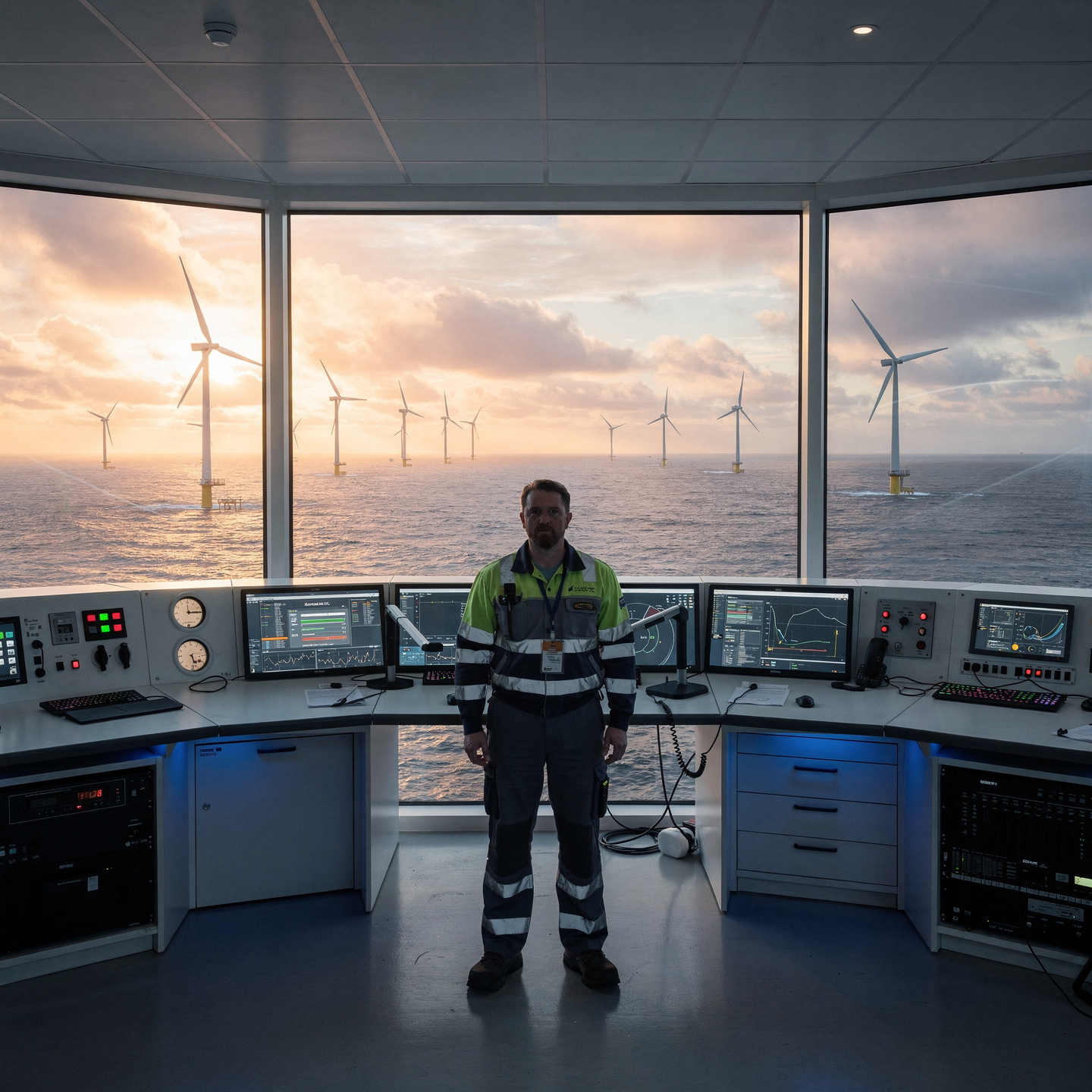
Worth separating out, because it is a different market that draws on the same skills. Offshore wind, tidal and emerging hydrogen projects need people who understand marine operations: vessel coordination, weather windows, lifting at sea, subsea work, and the safety case for all of it.
For a mariner, the transferability is high and the demand is less cyclical than shipping. The gap is usually the energy engineering itself rather than the marine side. The Master’s in Offshore Renewable Energies covers tidal, offshore wind and blue hydrogen together, which is useful because most employers in this space work across more than one.
If you want to test the water before committing to a full programme, the Diploma in Renewable Energies at Sea or the shorter Renewable Energy Systems Maintenance Course are proportionate first steps.
Who is actually hiring, and for what
Four distinct employer types, wanting four different things.
Shipowners and managers want people who can keep a fleet compliant and explain the numbers to charterers and banks. The profile is usually an ex-superintendent or a technical manager who has learned the regulatory framework and the data side.
Charterers and cargo owners want people who can assess whether a vessel they are about to fix will create an emissions liability, and who can negotiate the clauses that allocate it. This is a commercial role with a technical foundation.
Ports and terminals want project managers who can deliver infrastructure and measure the result. Less regulatory, more capital projects and stakeholder management.
Class societies, consultancies and verifiers want people who can audit a claim. Here the regulatory depth matters most, and the ability to write a finding that holds up.
Across all four, the recurring complaint from employers is the same: plenty of candidates who know the regulations, far fewer who also understand how a ship actually works. If you are coming from the operational side, that is your advantage, and it is worth being explicit about it rather than apologising for not having an environmental science degree.
Choosing where to start
A rough decision rule.
If you are still sailing and want the fastest useful addition to your CV, take a short course on emissions fundamentals and start paying attention to the performance data on your own ship. That combination is worth more in an interview than a certificate alone.
If you are already ashore in a technical role and want to move into the compliance or performance function, a diploma in energy efficiency or port sustainability is the proportionate step, depending on which side of the quay you work.
If you are making a deliberate career change into offshore energy, a master’s programme is the realistic route, because you are being asked to demonstrate breadth in a field you have not worked in.
Fees are published on each programme page. Short courses in this area start around £395, diplomas around £1,145, and the offshore energy master’s is £4,095. The full range is in the course catalogue, and study is online, with start dates shown on each programme page.
What to be sceptical about
Three things worth holding at arm’s length, because this field attracts overclaiming.
Single-technology silver bullets. Any proposal that promises a large percentage saving without specifying the route, speed profile and baseline is marketing. Savings in this field are route-specific and additive in small increments.
Percentage figures with no baseline. A thirty per cent improvement against what, measured how, over what period, normalised for what conditions? If the answer is not immediate, the number is decorative.
Training that promises compliance. No course makes a ship compliant or a person certified to verify compliance. Courses give you the understanding; certification regimes are separate and have their own requirements.
One honest note on recognition
Recognition of a qualification depends on the programme completed and on the regulations of each country. The programmes referenced here are professional training. They are not statutory certificates of competency, and they are not a verifier accreditation. If your target role requires a specific credential from a flag state, a class society or a professional body, find out what that body requires before you choose a programme.
Tell an academic adviser which country and which role you are aiming at, and they will tell you what a programme does and does not cover. Further detail is on our recognition and accreditations page.
Where to go next
If you already know which side you are on, the programme pages linked above have fees, structure and start dates. If you are weighing options across levels, the diploma catalogue and the master’s catalogue show them side by side.
If you would rather talk it through first, the application process begins with a short form and a conversation with an adviser, usually within 24 to 48 hours, at no cost and with no obligation.
And if you are moving ashore more broadly rather than specifically into this field, our guide to nine maritime careers you can move into covers the other routes alongside this one.