
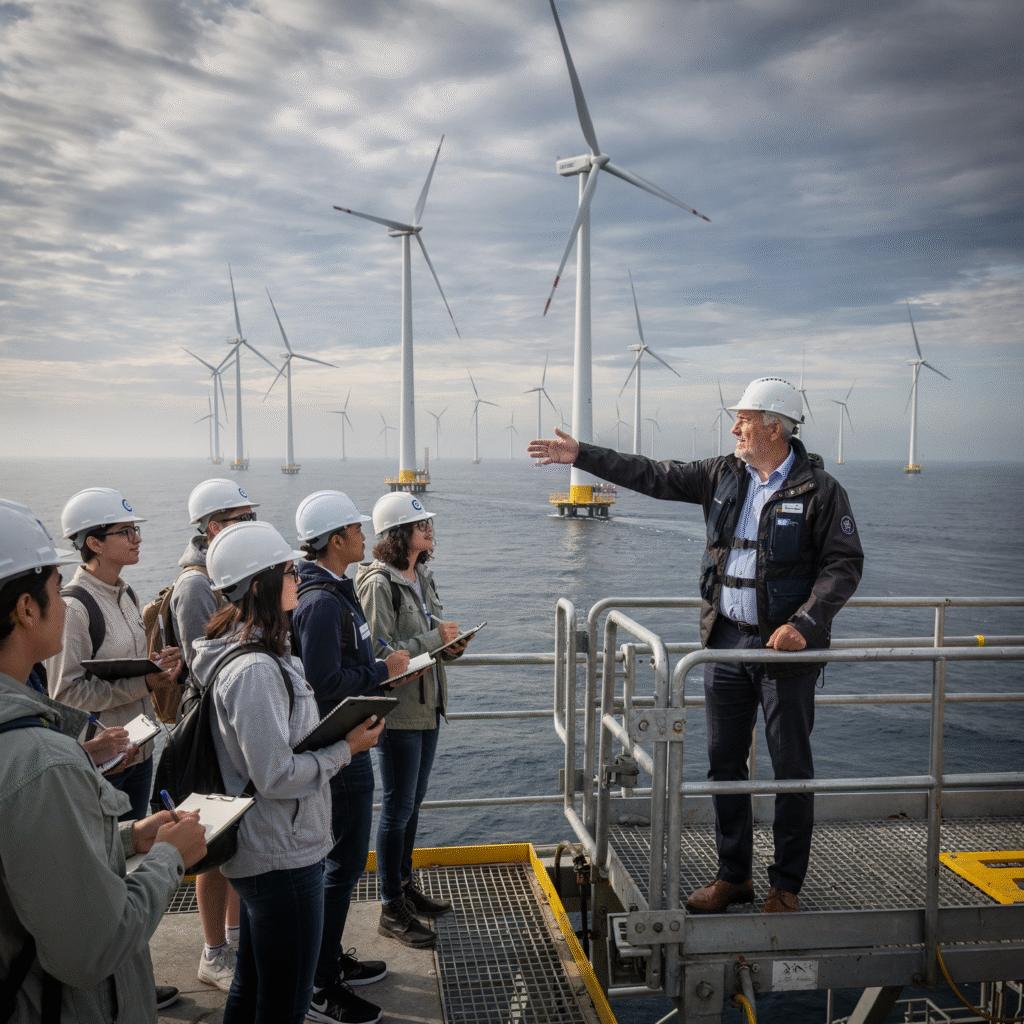
This question costs people money, which is the main reason it is worth answering properly.
Someone wants to work in offshore wind. They search for the training, find two acronyms, and cannot tell whether they need one, the other, or both. They either buy the wrong course and have to buy the right one as well, or they buy both when they only needed one.
The short answer: STCW is about the vessel. GWO is about the turbine. Which you need depends on where you will physically be standing, and quite a few people need both.
The two systems
STCW
The International Convention on Standards of Training, Certification and Watchkeeping for Seafarers. An International Maritime Organization convention, administered in the UK by the Maritime and Coastguard Agency, and the legal basis for working aboard a commercial vessel.
STCW Basic Safety Training is the entry bundle: personal survival techniques, fire prevention and firefighting, elementary first aid, and personal safety and social responsibilities. Roughly five days. Above it sits the whole ladder of certificates of competency.
Its logic is maritime. It assumes you are on a vessel at sea, the hazards are fire, flooding, abandonment and immersion, and no help is coming quickly.
GWO
The Global Wind Organisation. Not a convention and not a government body — an industry association of wind turbine owners and manufacturers that sets common safety training standards so a technician trained for one operator is accepted by another.
GWO Basic Safety Training has five modules: working at height, manual handling, fire awareness, first aid, and sea survival. The sea survival module is required for offshore wind specifically; onshore wind technicians take the other four.
Its logic is industrial. It assumes you are climbing a 100-metre structure, working with heavy components at height, and will be rescued from a confined space in a nacelle.
The one question that decides it
You work on the vessel and stay on the vessel. Master, officer, engineer, DP operator, deckhand, cook. You need STCW. You generally do not need GWO, because you are never on the turbine.
You work on the turbine. Wind turbine technician, blade inspector, electrical or mechanical technician, commissioning engineer. You need GWO Basic Safety Training including the sea survival module. You generally do not need full STCW, because you are a passenger on the vessel rather than crew.
You do both. Marine crew who also transfer to turbines, some surveyors, some supervisors and project staff. You need both.
That is the whole decision. The confusion comes from job adverts that list requirements without explaining which role they attach to.
Where they overlap, and why that helps less than you would hope
Both systems cover sea survival and both cover first aid. The content genuinely overlaps.
But the certificates are issued under different schemes, to different standards, by differently approved providers. Holding STCW Personal Survival Techniques does not automatically satisfy GWO Sea Survival, and vice versa.
Some training providers offer combined or bridging courses that reduce duplication for people who need both. These exist, they save time and money, and they are worth asking about explicitly before you book separate courses. Ask the provider directly whether what they offer is recognised for both schemes.
What you should not do is assume the overlap means you are covered. Turn up with the wrong certificate and you do not sail.
Validity and refreshers
STCW. Personal Survival Techniques and Fire Prevention and Fire Fighting require refresher training every five years. Elementary First Aid and Personal Safety and Social Responsibilities do not carry the same requirement.
GWO. Shorter cycle — GWO standards require refresher training every two years, and this catches people out badly. A GWO certificate from three years ago is not current, and operators check.
The practical consequence: if you hold both, you are managing two different renewal clocks. Diarise them.
The other certificates in play
GWO Advanced Rescue Training — for people who may have to rescue a colleague from a turbine, a nacelle, a hub or a blade. Required for many technician roles.
GWO Enhanced First Aid — a step up from the basic module.
GWO Slinger Signaller and Control of Hazardous Energies — for specific technical tasks.
Offshore medical. A seafarer ENG1 covers marine roles. Turbine technician roles often require a different medical, commonly an offshore medical to the energy industry standard. These are not the same examination and one does not substitute for the other.
Dynamic Positioning — for SOV, cable lay and installation vessel officers. See our guide to becoming a DP operator.
Company and site inductions. Every operator and every wind farm has its own, they are mandatory, and they are not transferable between operators.
The practical advice
Read the job advert properly, then ring them. The single most reliable way to know what you need is to ask the employer. They will tell you, because it costs them nothing and saves them an unusable candidate.
Do not buy training speculatively. The most common expensive mistake is buying a full stack of certificates before having a role in mind, then discovering half of them were not required and the other half were the wrong variant.
Check the provider is properly certified. For GWO, the provider must be a GWO-certified training provider — GWO maintains a public register. For STCW, the provider must be MCA-approved. An uncertified provider’s paperwork is worthless.
Check whether the employer pays. Many offshore wind employers fund the training for people they take on, particularly for technician roles where they are recruiting from other trades.
Mind the refresher clocks. Especially GWO’s two-year cycle.
Which route into the sector
The turbine technician route. Usually an electrical or mechanical background — often from another industry entirely, such as aviation, automotive or the armed forces. GWO Basic Safety Training plus technical training. No maritime background required. Growing fast.
The marine route. Certificated seafarer moving across from merchant shipping or other offshore work. STCW and certificates of competency, plus DP for the larger vessels. Our article on moving from the merchant navy to offshore wind covers this in detail.
They pay differently, they progress differently, and they are not really the same industry despite sharing a wind farm.
How Navalis UK fits
Neither GWO nor STCW certification comes from us. Both require physical training at approved centres — you cannot learn to escape from a nacelle or right a liferaft online, and anyone claiming otherwise is selling you paper that will be refused.
What we teach is the layer above the safety certificates: how offshore renewables actually work as an industry, the regulatory and environmental framework, marine operations planning, and the commercial structure of the sector. That is what distinguishes someone with a stack of certificates from someone with a career, and it is what the supervisor, coordinator and management roles recruit on.
Our renewable energies and efficiency and maritime safety and survival programmes are the usual fits. Recognition depends on which programme you complete and on the regulations of the country where you intend to work, and we set that out in writing before you enrol — see recognition and accreditations.
Frequently asked questions
Does STCW cover me for GWO requirements?
No. There is content overlap in sea survival and first aid, but the certificates are issued under separate schemes. Some providers offer combined courses that reduce duplication — ask explicitly.
I am a wind turbine technician. Do I need STCW?
Generally no. You travel as a passenger on the vessel rather than as crew. You need GWO Basic Safety Training including the sea survival module.
I am a vessel officer. Do I need GWO?
Only if you will physically transfer on to turbines. If you stay aboard, STCW and your certificates of competency are what apply.
How often do I renew?
GWO every two years. STCW survival and firefighting every five years. Two separate clocks.
Is GWO recognised internationally?
Yes, within the wind industry. That is the entire purpose — a common standard accepted across operators and countries.
Does ENG1 cover offshore wind work?
For marine roles on vessels, yes. Turbine technician roles commonly require an offshore medical to a different standard. Confirm which your role needs.
The next step
Decide first whether you are heading for the vessel or the turbine. Everything else follows from that, and getting it right saves you a course you did not need.
Then build the sector understanding the certificates do not cover. Browse our programmes by level and field, or ask an adviser which fits your background.