
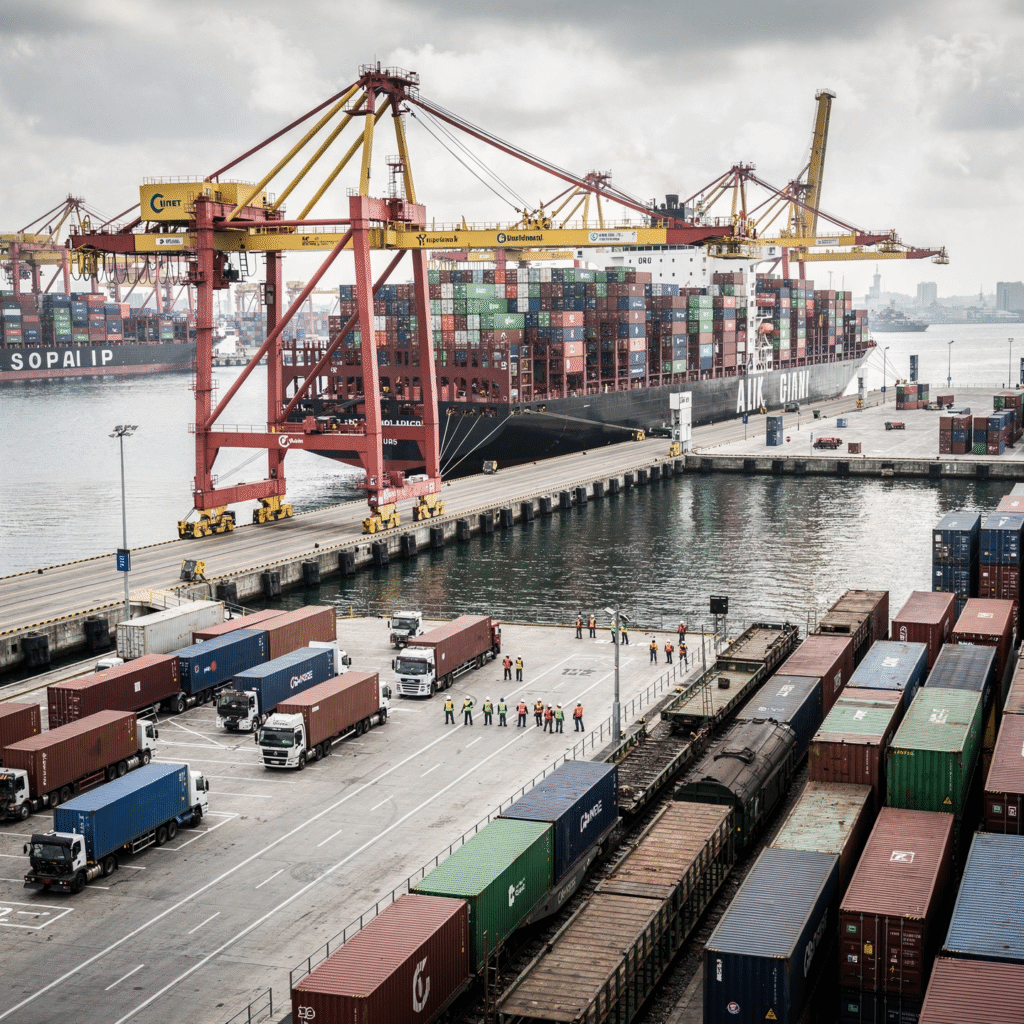
The overwhelming majority of British imports and exports arrive and leave by ship. Behind every one of those movements is a chain of people who never go to sea: planners, forwarders, terminal operators, customs specialists, port engineers, analysts.
This is the largest part of the maritime employment picture and the least visible. It is also the most accessible — most of these roles do not require sea time, a maritime degree, or a medical certificate. They require understanding how the chain works, and that can be learned.
The roles
Freight forwarding
The forwarder arranges the movement of a client’s goods from origin to destination, assembling the pieces: inland haulage, customs clearance, the ocean leg, documentation, insurance.
They are intermediaries rather than carriers, and the skill is knowing the options, the costs, the realistic transit times and the pitfalls. Entry-level roles are genuinely entry-level, which makes this a common first job in the industry.
Terminal and port operations
Running the physical interface between ship and shore. Berth planning, yard planning, crane and equipment allocation, labour scheduling, and vessel turnaround.
A container terminal is a complex optimisation problem running in real time with weather, equipment failures and late vessels. Roles run from operations coordinator to terminal manager. Our article on how port operations work covers the detail.
Shipping line operations
Working for a carrier: vessel scheduling, cargo bookings, equipment management — the enormous logistical problem of getting empty containers to where the next export is — and network planning.
Equipment management in particular is a bigger job than outsiders expect. Containers accumulate in importing regions and run short in exporting ones, and repositioning them is a permanent, expensive problem.
Customs and trade compliance
Since the UK left the EU this has become a substantially larger and better-paid specialism. Customs declarations, tariff classification, origin rules, duty relief regimes, sanctions screening, and the various UK border systems.
It is detailed, rules-based work and there is a persistent shortage of people who are genuinely good at it.
Supply chain analysis and planning
The data side. Network design, cost modelling, demand forecasting, inventory positioning, carbon accounting across the chain. Growing fast as shippers try to understand and reduce both cost and emissions.
Warehousing and distribution
The inland end. Facility operations, inventory, fulfilment, and the interface with ports.
Project and heavy lift logistics
A specialism: moving things that do not fit in a container. Wind turbine components, transformers, industrial plant, modules. Route surveys, lift planning, specialist vessels. Growing directly with offshore wind construction.
Why this sector is worth entering
Scale. The volume of UK trade moving by sea makes this a large employment base that is not going to disappear.
Accessibility. No sea time, no medical, no certificate of competency. A graduate or a career changer can start.
Progression is fast for the competent. Operations roles reward people who solve problems reliably, and that is visible quickly.
It is genuinely international. Counterparties across every time zone, and real mobility if you want it.
Resilience has become a board-level subject. Recent years delivered a pandemic, a Suez blockage, Red Sea diversions and container rate volatility that reached mainstream news. Supply chain stopped being a back-office function.
Where demand is growing
Customs and trade compliance. Post-Brexit complexity created permanent demand.
Carbon accounting and reporting. Shippers increasingly need emissions reported across their supply chain, and maritime emissions regulation now feeds directly into freight cost. Our article on decarbonising shipping sets out the framework.
Offshore wind project logistics. Turbine components are enormous and the installation schedule is unforgiving. This is a specialist, well-paid niche growing with the build-out. See also our article on offshore wind careers.
Port digitalisation. Port community systems, electronic documentation, terminal automation, data integration.
Resilience and risk. Scenario planning, alternative routings, nearshoring analysis.
How people get in
Graduate entry
Logistics, supply chain, business, geography and economics degrees are common. Major forwarders, carriers and port groups run graduate schemes. A specific maritime degree helps but is not required.
Direct operational entry
Many people start in an operational role — a forwarding desk, a terminal control room, a customs team — and learn the industry from inside. This remains the most common route and it does not require a degree.
From sea
Officers coming ashore have a real advantage in operational and technical roles: they know what a vessel can do, how cargo behaves and why schedules slip. What they usually lack is the commercial and contractual framework. Our article on moving from sea to shore covers the transition.
From adjacent industries
Road haulage, rail freight, warehousing, procurement and manufacturing operations all translate.
Professional qualifications
The Chartered Institute of Logistics and Transport is the main professional body for the sector. For the shipping-specific commercial side, the Institute of Chartered Shipbrokers qualification is the recognised credential — see our article on chartering and port agency.
What it pays
Entry-level operational roles start modestly. Specialists and managers earn considerably more, and the premium attaches to scarce competencies: customs and trade compliance, project logistics, and carbon reporting are all currently paid above the general run of logistics roles because the people are hard to find.
As always, look at current advertised positions and the salary guidance published by CILT rather than a figure in an article.
How Navalis UK fits
This is where online study makes the most obvious sense, because almost everyone in this sector is already working and cannot stop to attend a campus.
The knowledge that distinguishes a competent operator from someone who will be promoted is understanding the whole chain: how vessels actually work and what constrains them, how ports and terminals function, the legal and contractual framework, customs and trade rules, and increasingly the emissions and environmental dimension.
Our logistics and fleet management and port and marina management programmes are built exactly for that, and finance and the blue economy covers the commercial and investment side for those moving toward management.
Two common profiles: people already working in logistics who want the maritime depth they lack, and people moving in from another industry who need the whole picture quickly.
Recognition depends on which programme you complete and on the regulations of the country where you intend to work, and we set that out in writing before you enrol — see recognition and accreditations.
Frequently asked questions
Do I need to have worked at sea?
No. The overwhelming majority of people in maritime logistics have never worked on a ship. Sea experience helps in some operational roles but is not required anywhere in this part of the industry.
What degree do I need?
None specifically, and many roles do not require one at all. Logistics, supply chain, business and economics are common among graduate entrants.
Is this a good career for the long term?
The volume of trade moving by sea is structural. The roles will change with automation and digitalisation, but the sector is not going away.
Where are the UK jobs?
Around the major ports — Felixstowe, Southampton, London Gateway, Liverpool, Immingham, Tees, Bristol — and in inland distribution hubs, plus London for the commercial and financial side.
Which specialism pays best?
Customs and trade compliance, project and heavy lift logistics, and increasingly carbon accounting, because in each case demand has outrun the supply of experienced people.
Can I move into this from road or rail freight?
Yes, readily. The disciplines overlap and the maritime-specific knowledge is the part to add.
The next step
If you want into the maritime industry and do not want to go to sea, this is the largest door and the easiest to open.
Start with an operational role if you can get one, and build the maritime depth alongside it — that combination is what gets people promoted. Browse our programmes by level and field, or ask an adviser which fits your background.