
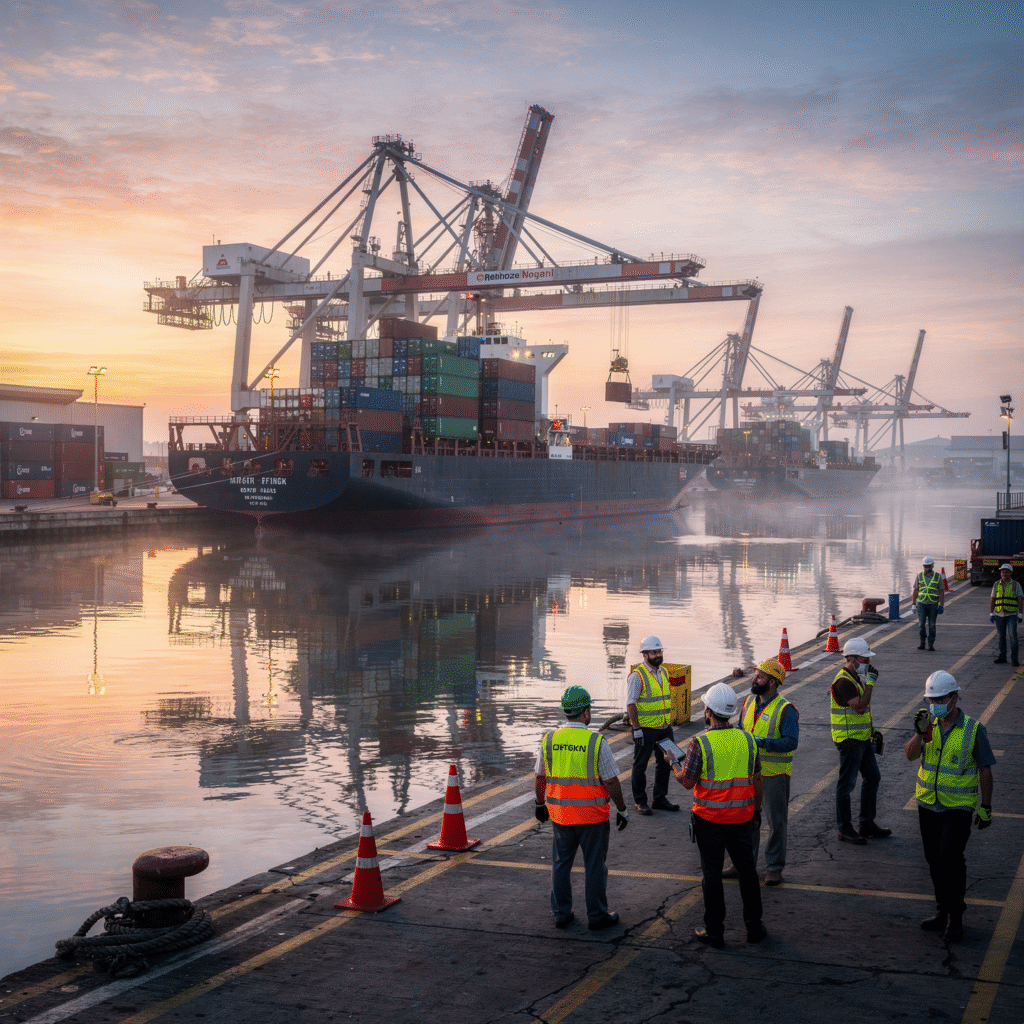
A container ship spends perhaps twenty hours alongside. In that window a few thousand moves have to happen in the right order, with equipment that breaks, labour that is finite and a tide that does not negotiate. This is what actually happens between arrival and departure, and why port operations has become a specialism in its own right.
Before the ship arrives
The work starts days out. The line sends a stowage plan and an estimated time of arrival; the terminal responds with a berth window. Neither is a promise. Both will move.
From that plan the terminal builds a discharge and load sequence, which is a constrained optimisation problem dressed up as a spreadsheet. Containers must come off in an order that keeps the ship stable and does not require moving the same box twice. Boxes going on must be available in the yard, in the right sequence, at the right time. Reefers need power. Dangerous goods need segregation. Out-of-gauge cargo needs a crane that can take it.
Meanwhile the pilot, tugs and linesmen are booked, customs and border formalities are pre-cleared where possible, and the agent has filed the paperwork that lets the ship do anything at all on arrival.
Most delays that look like they happened during the call were actually created here, in planning, days before the ship was visible from the breakwater.
Arrival, berthing and the first hour
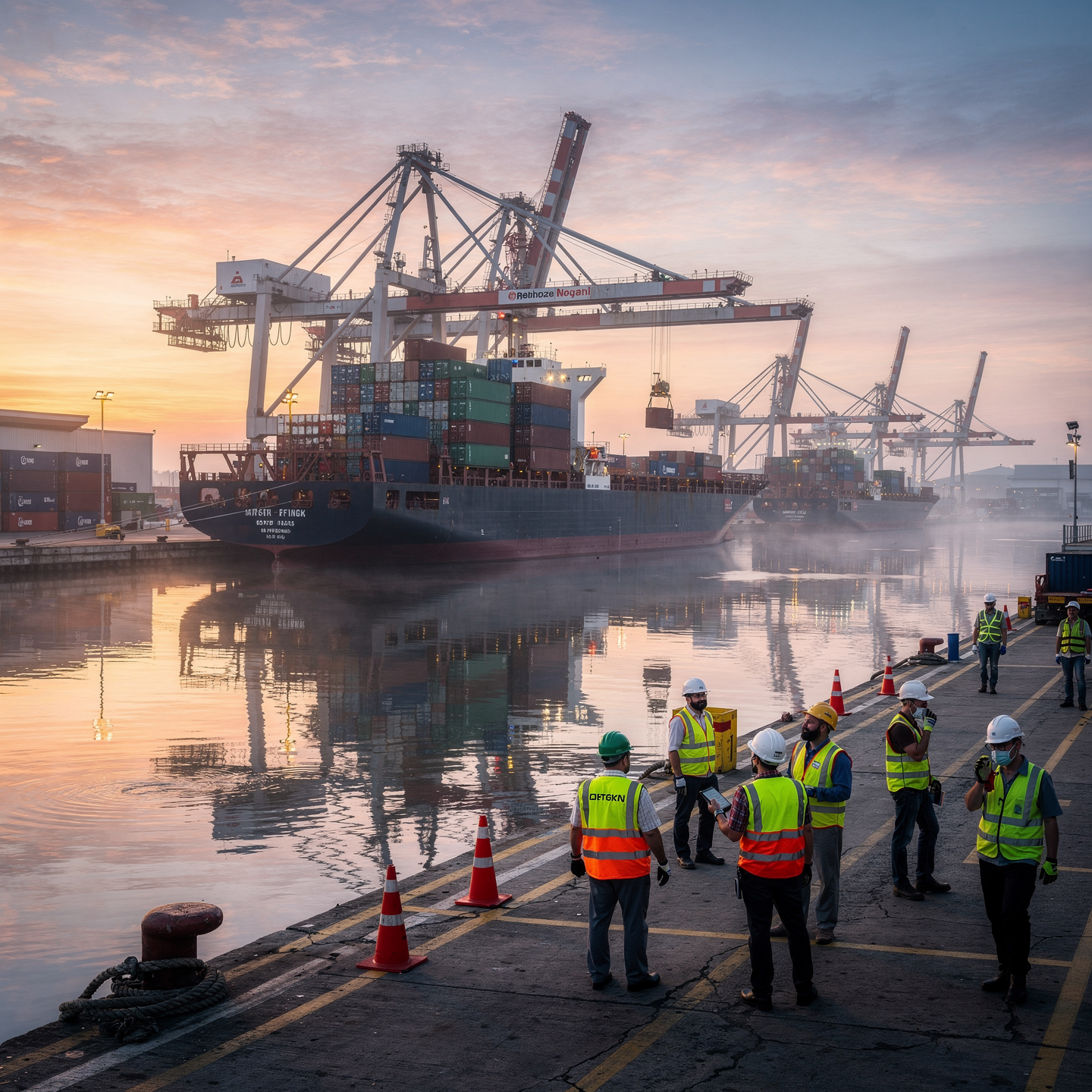
Pilot boards at the pilot station. Tugs make fast. The ship is brought alongside and moored, and the gangway goes down. Within the first hour the terminal wants cranes working.
What slows this down is rarely the ship handling. It is the paperwork and the interfaces: a draught survey that disagrees with the declared figures, a hold that is not ready, a crane driver shift change landing at exactly the wrong moment, or a discrepancy between the stowage plan sent and the stowage actually loaded at the last port.
That last one is more common than outsiders expect, and it is expensive. A plan that does not match reality means the sequence has to be rebuilt while the clock runs.
Working cargo: the numbers that matter
Four measures run a container terminal, and they pull against each other.
Crane intensity is how many cranes are working the ship at once. More cranes means faster turnaround, and also more congestion on the quay, more interference between crane paths and more horizontal transport needed to keep them fed.
Moves per hour per crane is the productivity measure everyone quotes. It is heavily dependent on whether the crane is waiting for a truck. A crane that cycles in ninety seconds and waits two minutes for transport is not a ninety-second crane.
Yard density is how full the stacking area is. A full yard is efficient use of space and a slow yard, because every retrieval needs more shuffling to get at the box underneath.
Dwell time is how long a box sits before it leaves. Longer dwell raises density, which lowers productivity, which raises dwell. This is the loop that quietly strangles terminals that are growing faster than their land.
The craft of terminal management is holding these four in balance rather than maximising any one of them. That is the core of the Port Logistics Course, which is a short and inexpensive way into the subject, and it is developed much further in the Diploma in Terminal Management and Maritime Logistics.
The horizontal transport problem
Between the quay crane and the stack, containers move by tractor-trailer, straddle carrier, shuttle carrier or automated guided vehicle. This layer decides whether the cranes achieve their rated productivity or spend a third of the shift idle.
It is also where automation has advanced furthest, and where the operational discipline is least forgiving. Automated yards are remarkably efficient when every assumption holds and remarkably brittle when one does not: a misdeclared container weight, a damaged twistlock, a vehicle fault in the wrong aisle.
Terminals that automate successfully usually spend more effort on exception handling than on the automation itself. That is the unglamorous truth of the field, and it is where experienced operations people earn their keep.
Departure, and the handover nobody plans
Loading finishes, lashings are checked, the final stowage and stability condition are confirmed, documentation is completed and the ship sails. Then the terminal turns the berth around for the next arrival, often within hours.
The handover between a ship’s departure and the next arrival is where slack lives or dies. A terminal running at high utilisation has almost none, which is why a single delayed sailing cascades down the berth schedule for the rest of the day.
The wider chain: why the terminal is not the whole story
A terminal that works perfectly and sits behind a congested road network has not solved anything; it has moved the queue. Rail connections, inland depots, customs capacity and haulier availability all determine whether boxes actually leave.
This is why port operations increasingly blurs into multimodal transport planning. If you are aiming at management rather than shift supervision, this is the territory that matters, and it is covered by the Master’s in Port Management and Multimodal Transport and the Master’s in Multimodal Maritime-Land-Air Transport.
Where the jobs are, and what they want
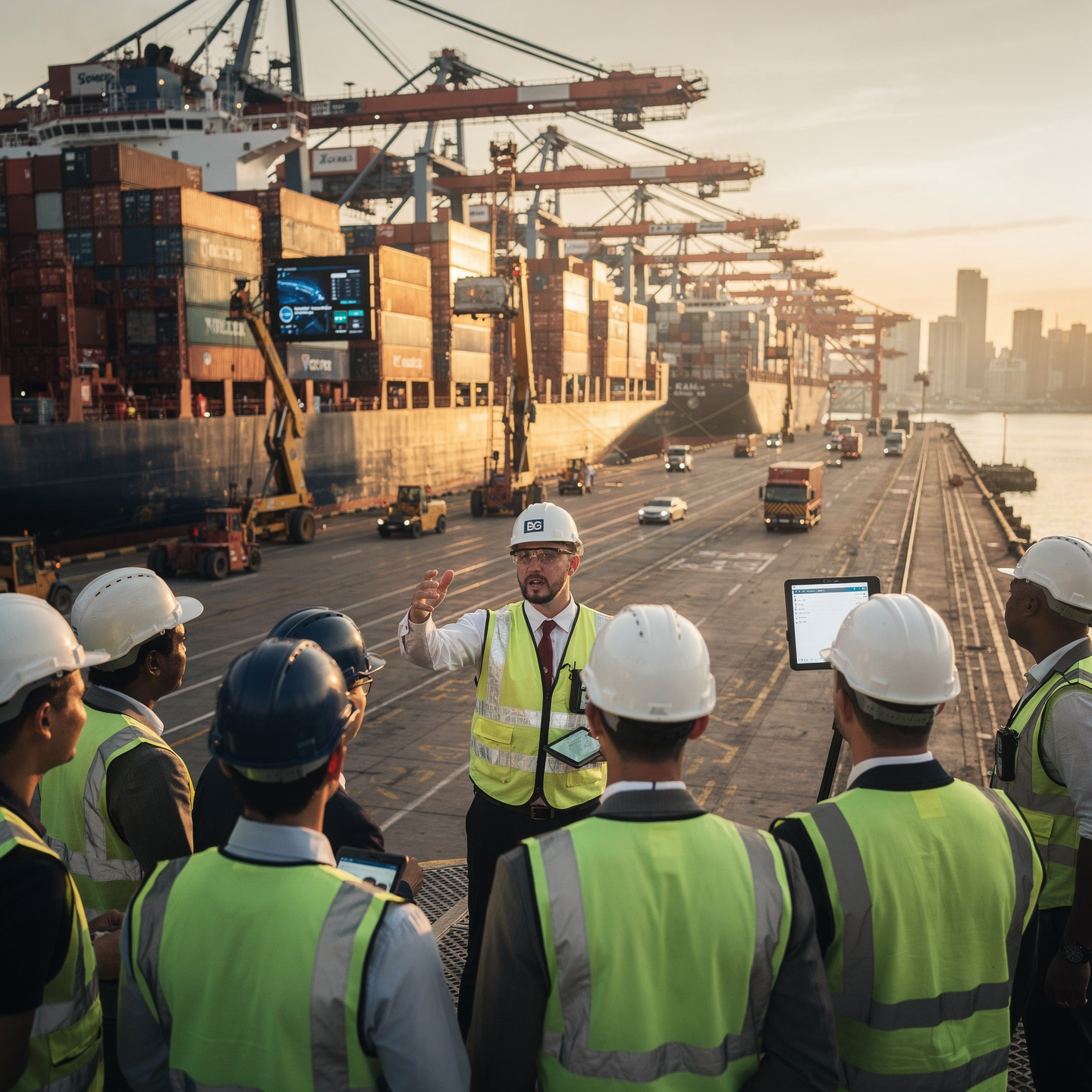
Shift and operations supervision. Entry point for most people with an operational background. Judgement under time pressure matters more than qualifications here, but qualifications are what get you the interview.
Vessel and yard planning. The analytical core of a terminal. Requires comfort with the planning software and the constraints behind it.
Terminal and port management. Commercial, financial and stakeholder responsibility on top of the operational base. This is where a full programme such as the Master’s in International Port Management earns its cost.
Engineering and infrastructure. Cranes, civil works, automation projects. The Master’s in Container Terminal Engineering is aimed squarely at this.
What to study, and in what order
If you are testing the field, start short: the Port Logistics Course at £425 tells you quickly whether the subject holds you.
If you are already working in or around a terminal and want to move up, a diploma is the proportionate step. The Diploma in Terminal Management and Maritime Logistics covers the operational and logistics layer together.
If you are aiming at management of a port or terminal, or at the multimodal side, a master’s programme is the realistic route. The Master’s in Port Terminal Management is the most directly targeted at terminal operations; the Master’s in International Port Management takes a wider view of port administration.
Not every terminal is a container terminal
Containers dominate the conversation because they dominate the trade press, but a great deal of port work happens elsewhere, and the operating logic is different in each case.
Dry bulk is about flow rate rather than discrete moves. Grabs, conveyors, hoppers and the permanent problem of dust and spillage. Productivity is tonnes per hour and the constraints are stockpile capacity and weather: you do not load grain in the rain.
Liquid bulk is a pipeline and safety problem. Transfer rates, tank availability, product segregation, vapour recovery and a safety case that dominates everything. The cargo operation is simpler to describe and far less forgiving of error.
Ro-ro looks easy and is not. Units drive on and off, which removes the crane bottleneck and introduces a traffic management one. Stowage still has to balance the ship, lashing still has to hold in a seaway, and the deck is full of moving vehicles and people at the same time.
Cruise is a passenger operation with a ship attached. Thousands of people, their luggage, provisioning, waste and border formalities, in a tight window, with a customer experience standard that cargo terminals never have to think about.
If you are choosing where to specialise, this matters: the skills transfer between these, but the daily work does not feel remotely alike.
Safety on the quay
A working quay is one of the more hazardous industrial environments there is: suspended loads, heavy vehicles, rail traffic, confined spaces, work at height, and an edge with deep water beyond it.
Most serious incidents in terminals cluster around a small number of recurring situations. People on foot in vehicle operating areas. Lifting over an area that was not properly cleared. Lashing work on a moving deck. Energy isolation that was assumed rather than verified.
What makes terminal safety distinctive is the interface problem: the ship’s crew, the terminal’s staff, stevedoring contractors, hauliers and surveyors are all working the same space under different employers, different procedures and sometimes different languages. The ship-shore safety checklist exists precisely because that interface is where assumptions go unchallenged.
For anyone moving into supervision, this is the part of the job that carries personal consequence, and it is worth taking seriously before you are responsible for it rather than after.
What a day actually looks like
A shift supervisor arrives to a handover: what is alongside, what is due, what broke overnight, which crane is on reduced capacity, who has called in sick.
Then the day is interruptions. A reefer alarms. A truck breaks down in a lane and blocks two blocks of the yard. A box is found damaged and has to be surveyed before it moves. The ship reports a stability concern and wants a change to the load sequence. The next vessel announces it is four hours early and would like the berth.
None of these is dramatic. All of them have to be resolved in minutes while the main operation keeps running, and every resolution has a knock-on effect somewhere else. People who enjoy this describe it as the closest thing ashore to standing a watch. People who do not describe it as being nibbled to death.
It is worth being honest with yourself about which of those you are before committing to the field.
Three mistakes people make moving into port operations
Assuming sea experience is enough. It gets you taken seriously and it does not get you the job. The planning software, the commercial framework and the terminal’s own KPIs all have to be learned, and nobody will assume you know them because you sailed.
Underestimating the commercial layer. Terminals are businesses with contracts, service level commitments and penalty clauses. An operations decision that ignores the contract can be operationally correct and commercially expensive.
Going straight for a management qualification. If you have never worked a terminal, a master’s in port management can leave you fluent in the vocabulary and unable to run a shift. Where you can, pair study with exposure to the operation, even informally.
One honest note on recognition
Recognition of a qualification depends on the programme completed and on the regulations of each country. The programmes referenced here are professional training; they are not statutory certificates of competency, and they do not replace one where a flag state or regulator requires it. If the role you want is gated by a specific certificate or professional body, check what that body requires before choosing a programme. Our recognition and accreditations page sets out more detail.
Where to go next
If you know the area you want, the programme pages linked above have the detail. Fees and start dates are published on every programme page, and the course catalogue, diploma catalogue and master’s catalogue let you compare side by side. Study is online, and each programme page shows its next start date.
If you would rather talk it through, the application process starts with a short form and a conversation with an academic adviser, normally within 24 to 48 hours, at no cost and with no obligation.
Related reading: nine maritime careers you can move into from sea and decarbonising shipping: rules, levers and careers.