
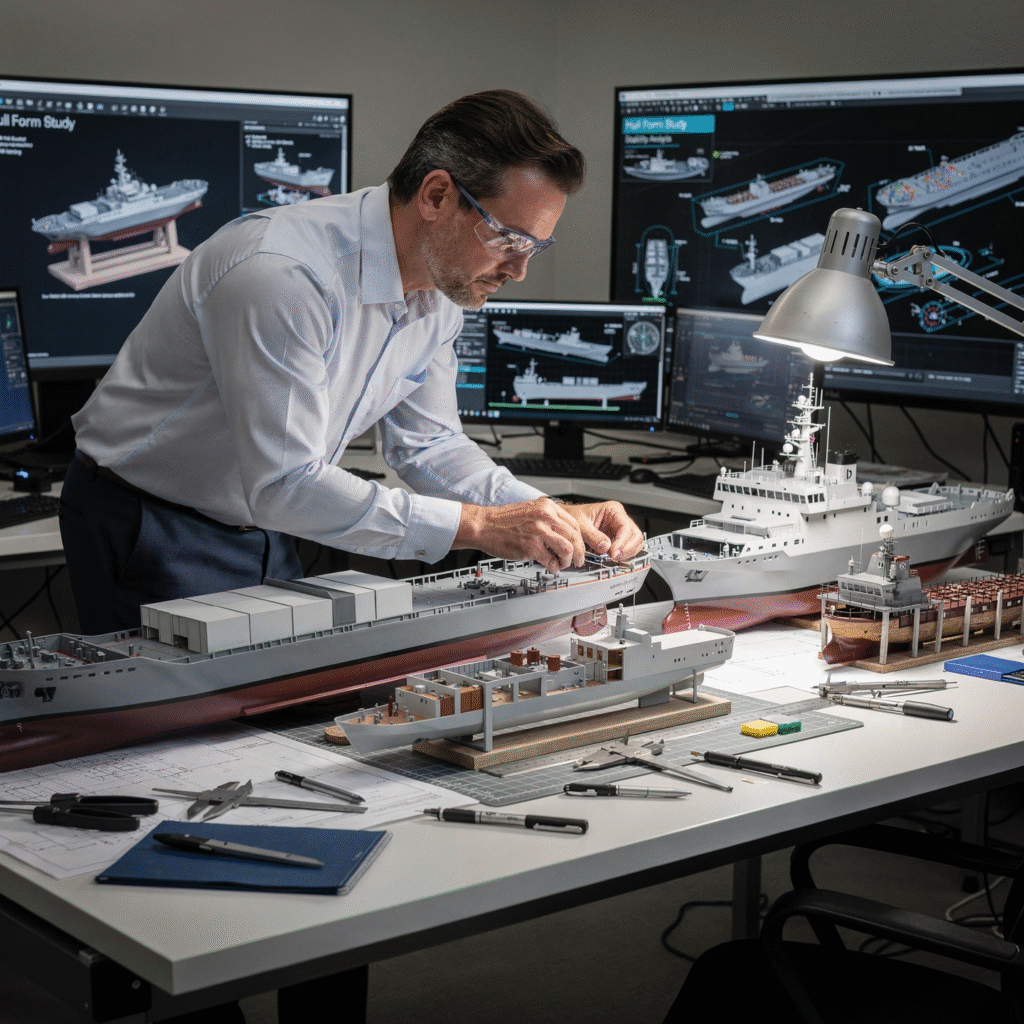
A naval architect is the engineer responsible for the vessel as a whole: its shape, its structure, its stability, its strength, its behaviour in a seaway, and whether it does the job it was built for without sinking, breaking, or being unusable.
It is one of the oldest engineering disciplines and one of the least visible. Most people have no idea it exists as a profession, which is unhelpful given the UK has a persistent shortage of them and the roles pay well.
What naval architects actually do
Hull form and hydrodynamics. The shape of the hull and how it moves through water. Resistance, propulsion efficiency, wake, manoeuvrability. This is where fuel consumption is largely determined, and it is now where most of the commercial pressure sits.
Stability. Whether the vessel stays upright, in intact condition and after damage. Loading conditions, free surface effect, damage stability calculations against regulatory criteria. Our article on ship stability covers the principles.
Structural design. The steel: scantlings, framing, plating thickness, fatigue life, and the loads a hull experiences in waves over twenty-five years. Working to classification society rules.
General arrangement. Where everything goes. Machinery, tanks, holds, accommodation, access routes, escape routes. Constrained by regulation, operation and physics simultaneously.
Seakeeping. How the vessel behaves in waves — motions, accelerations, slamming, green water on deck. Critical for crew safety and for vessels like SOVs where motion determines whether work can happen at all.
Conversion and retrofit. Increasingly significant. Existing vessels being modified for new fuels, scrubbers, ballast water treatment, battery hybrid systems, or new roles entirely.
The tooling is computational: CAD, computational fluid dynamics, finite element analysis, specialised stability and structural software. But the discipline is judgement about trade-offs. Every gain in one area costs something in another, and the naval architect decides where the balance sits.
Where UK naval architects work
Design consultancies. Independent firms designing vessels for clients, from workboats to large commercial ships and superyachts.
Shipyards. Design offices attached to building and repair yards.
Classification societies. Lloyd’s Register, DNV, Bureau Veritas and others. Plan approval, rule development, survey. One of the larger employers of naval architects in the UK and a strong career route.
Defence. Warship and submarine design and support, with the prime contractors and in the Ministry of Defence. Substantial UK employment, usually requiring security clearance and therefore nationality restrictions.
Offshore and renewables. Floating foundations, installation vessels, service operation vessels. One of the fastest growing areas — floating offshore wind in particular is a naval architecture problem more than a wind problem. See how the offshore wind sector works.
Superyachts. A distinct, demanding sector with extreme aesthetic and performance requirements.
Regulators and flag states. The Maritime and Coastguard Agency and equivalents.
Insurance, forensic and expert work. Investigating why a structure failed or a vessel capsized.
The route in
The degree
Unlike most maritime careers, this one has a conventional academic entry. An accredited degree in naval architecture, ship science or marine engineering is the standard route. UK provision includes Strathclyde, Southampton, Newcastle, UCL and others.
Strong maths and physics at A-level or equivalent is effectively required. The degree is a proper engineering degree — structures, fluid mechanics, thermodynamics, materials, dynamics — with maritime application.
Conversion from other engineering
Mechanical, civil, structural and aerospace engineers do move into naval architecture, usually via a master’s conversion or through employment at a consultancy or class society that trains them. The fundamentals transfer; the maritime regulation and the specific behaviour of floating structures do not, and have to be learned.
Chartership
The professional destination is Chartered Engineer status, achieved through the Royal Institution of Naval Architects or the Institute of Marine Engineering, Science and Technology. It requires an accredited degree, a period of structured professional development, and a professional review. It takes several years post-graduation and it is what senior roles and independent consultancy effectively require.
From sea
Deck and engineering officers do move into naval architecture, but usually into applied roles — surveying, technical superintendence, conversion project management — rather than first-principles design work, unless they add the engineering degree. The sea experience is genuinely valuable in those applied roles, because designers who have never operated a vessel design things that are awkward to operate.
Our article on becoming a marine surveyor covers the most common of those crossover routes.
Where demand is growing
Decarbonisation. This is the big one. Alternative fuels change the vessel fundamentally. Ammonia and hydrogen have very different storage volumes, densities and hazard profiles from heavy fuel oil. Tanks get bigger, arrangements change, safety cases get rewritten. Batteries and hybrid propulsion change weight distribution and electrical architecture. Every one of these is a naval architecture problem, and the existing fleet needs converting as well as the new one designing — see decarbonising shipping.
Floating offshore wind. Floating foundations are novel marine structures in deep water with twenty-five year fatigue lives, dynamic mooring and cable systems, and installation methods nobody has done at scale. The UK and Scotland have significant floating wind ambitions and the engineering capacity to deliver them is a recognised constraint.
Autonomous and remotely operated vessels. Removing the crew removes the accommodation, the lifesaving arrangements and much of the general arrangement logic. It is a redesign from first principles.
Ageing fleet and life extension. Assessing residual structural life and designing modifications is steady, unglamorous, well-paid work.
What it pays
Engineering salaries, with a premium for chartership and for specialisms in short supply. Defence and class society roles tend to be stable; consultancy varies with the project pipeline; offshore renewables currently pays well because the competition for people is real.
For current ranges, look at advertised positions with class societies, defence primes and the main consultancies, and at the salary guidance published by RINA and IMarEST.
How Navalis UK fits
An accredited naval architecture degree is a university product and we do not offer one. If you want to be a chartered naval architect doing first-principles design, that is the route, and it runs through an accredited engineering degree.
For people working around naval architects. Surveyors, superintendents, operations managers, port engineers and project managers who need to understand structural and stability principles well enough to have an informed conversation, assess a proposal, or spot a problem.
For officers moving into technical shore roles. The technical superintendent and conversion project roles that sit between the design office and the operating fleet.
Our naval engineering and technology and renewable energies and efficiency programmes cover that ground. Recognition depends on which programme you complete and on the regulations of the country where you intend to work, and we set that out in writing before you enrol — see recognition and accreditations.
Frequently asked questions
Do I need a naval architecture degree specifically?
For design work, effectively yes — an accredited naval architecture, ship science or marine engineering degree. Other engineering disciplines convert, usually via a master’s or employer training.
Is it the same as marine engineering?
No. Naval architecture is the vessel as a whole — hull, structure, stability, hydrodynamics. Marine engineering is the machinery and systems inside it. They work closely together and some degrees combine them.
Can I become one after a career at sea?
Into applied technical roles, yes. Into first-principles design, generally only by adding the engineering degree.
Is chartership necessary?
Not to start, but it is what senior roles and independent practice expect, and it takes several years to achieve.
Which sectors are hiring?
Offshore renewables, defence, classification and the decarbonisation retrofit market are the strongest UK areas at present.
Does defence work require UK nationality?
Security-cleared roles generally have nationality and residency requirements. Check with the specific employer.
The next step
If you are at school or deciding on a degree and you like maths, physics and the sea, this is a profession worth knowing exists. The accredited degree is the route.
If you already work in the industry and need to understand the engineering well enough to do your job properly, that is what our programmes are for. Browse by level and field, or ask an adviser which fits your background.