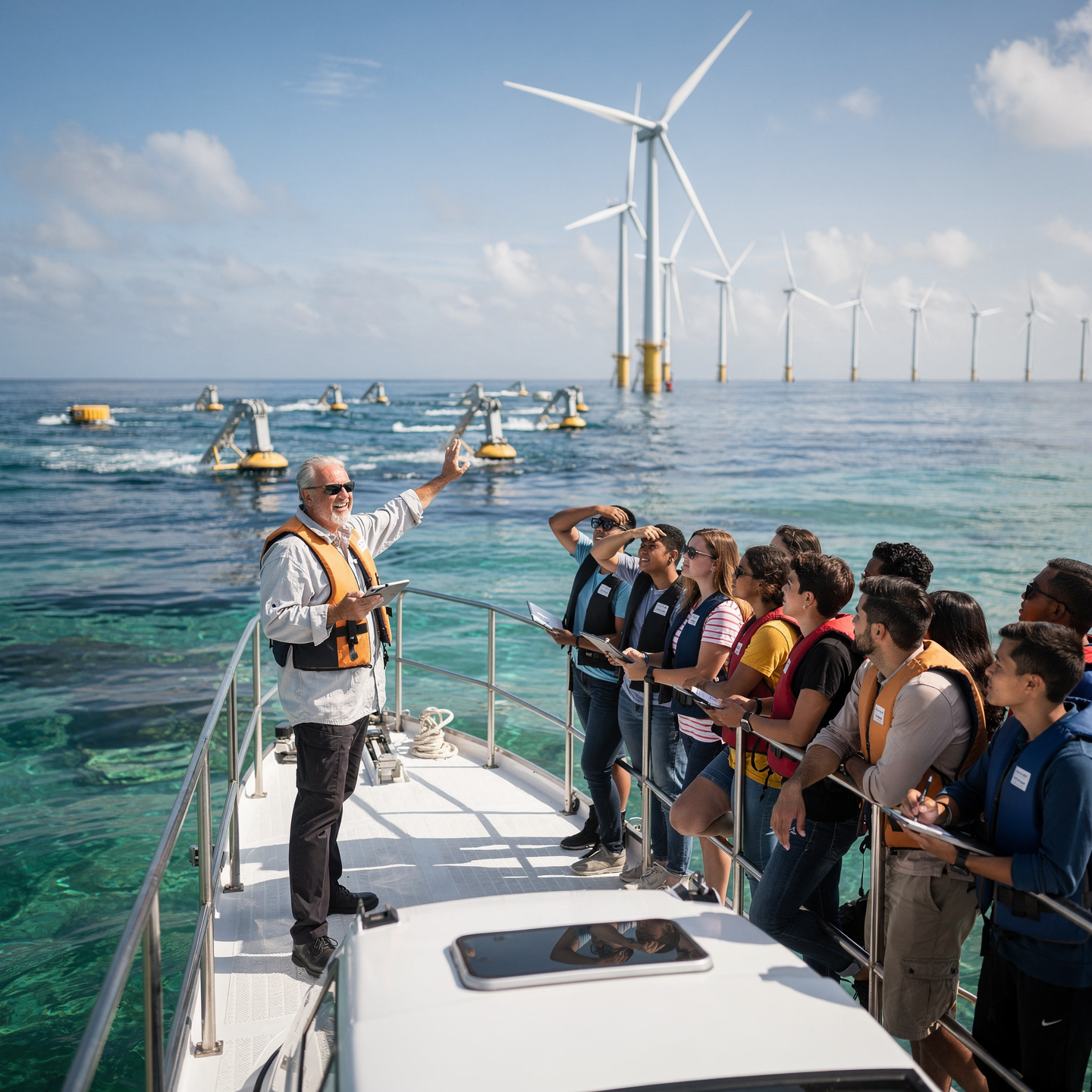
Diploma in Renewable Energies at Sea
Why this certificate program?
The Diploma in Renewable Energies at Sea
This program prepares you to lead the energy transition in the maritime sector. Learn to design, implement, and manage offshore wind, floating solar, wave, and tidal energy projects. Master the technologies, regulations, and environmental challenges associated with harnessing ocean resources. This program provides you with a comprehensive overview, from energy potential assessment to grid connection and facility maintenance.
This program prepares you to lead the energy transition in the maritime sector. Learn to design, implement, and manage offshore wind, floating solar, wave, and tidal energy projects.
Differential Advantages
- Real-world case studies: analysis of successful projects and lessons learned globally.
- Project simulation: tools for design optimization and economic feasibility.
- Networking with experts: access to leading professionals in the marine energy sector.
- Legal and regulatory framework: understanding the policies and permits required for project development.
- Sustainability and environmental impact: minimizing the effects on the marine ecosystem.
- Modality: Online
- Level: Diplomado
- Hours: 800 H
- Start date: 19-06-2026
Availability: 1 in stock
Who is it aimed at?
- Engineers and technicians seeking to specialize in the design, installation, and maintenance of marine renewable energy systems.
- Energy professionals interested in expanding their knowledge of the opportunities and challenges of offshore wind, wave, and tidal energy.
- Consultants and project managers wishing to lead sustainable development initiatives in the maritime sector.
- Researchers and academics seeking to delve into the latest technologies and trends in ocean renewable energy.
- Students of engineering, environmental science, and related fields aspiring to an innovative career in the marine clean energy sector.
Flexibility Study:
 Access the content from anywhere, with live online classes and supplementary material available 24/7 to adapt to your pace.
Objectives and competencies

Develop and implement offshore wind projects:
Manage the installation of wind turbines and underwater infrastructure safely and efficiently, minimizing environmental impact and complying with current regulations.

Assessing the environmental impact of marine facilities:
“Identify and mitigate sources of underwater noise pollution.”

Managing and optimizing wave energy production:
“Implement predictive models of wave action and energy performance, adjusting operating parameters in real time to maximize efficiency and minimize environmental impact.”

Design and maintain tidal energy conversion systems:
“Optimize converter efficiency, considering environmental conditions and predictive maintenance cycles.”

Monitor and ensure safety in marine renewable energy operations:
“Implement safety protocols (PTW, LOTO, confined spaces) adapted to offshore wind and substations, prioritizing risk prevention and emergency response.”

Leading innovation projects in blue energy technologies:
“To define R&D strategies, mobilize resources and multidisciplinary teams to develop innovative solutions in wave, ocean thermal and offshore wind energy, overcoming technical and regulatory challenges.”
Curriculum - Modules
- Comprehensive Maritime Incident Management: protocols, roles, and chain of command for coordinated response
- Operational Planning and Execution: briefing, routes, weather windows, and go/no-go criteria
- Rapid Risk Assessment: criticality matrix, scene control, and decision-making under pressure
- Operational Communication: VHF/GMDSS, standardized reports, and inter-agency liaison
- Tactical Mobility and Safe Boarding: RHIB maneuvers, approach, mooring, and recovery
- Equipment and Technologies: PPE, signaling, satellite tracking, and field data logging
- Immediate Care of the Affected: primary assessment, hypothermia, trauma, and stabilization for evacuation
- Adverse Environmental Conditions: swell, Visibility, flows, and operational mitigation
Simulation and training: critical scenarios, use of VR/AR, and exercises with performance metrics
Documentation and continuous improvement: lessons learned, indicators (MTTA/MTTR), and SOP updates
- Introduction to Offshore Wind Energy: Current and Future Outlook
- Aerodynamics Fundamentals: Airfoils, Lift, Drag, and Angle of Attack
- Offshore Wind Turbine Components: Blades, Nacelle, Tower, and Foundation
- Types of Offshore Support Structures: Monopiles, Jackets, and Floating Platforms
- Offshore Substation Design: Energy Transformation and Transmission
- Submarine Cables: Types, Installation, and Protection
- Regulations and Standards: IEC 61400-3, DNV GL, etc.
- Feasibility Studies: Wind Resource Assessment, Risk and Cost Analysis
- Environmental Impact: Assessment and Mitigation of Effects on Wildlife marine
- Safety in offshore wind farms: procedures and equipment
‘
- Introduction to the Offshore Industry: Overview, sectors (oil and gas, offshore wind, etc.)
- Marine Geology and Geotechnics: Study of the seabed, stability, geological risks
- Offshore Design and Structures: Types of platforms, foundations, structural analysis
- Drilling and Production Equipment: Drilling systems, Christmas trees, separators
- Lifting Systems and Cranes: Types of offshore cranes, safe lifting procedures
- Subsea Pipelines and Cables: Design, installation, inspection, and repair
- ETA Calculation, fuel, and operational constraints
- Dynamic Positioning (DP) Systems: Principles, sensors, operating modes
- Control and monitoring: Real-time adjustments, ECDIS + visual
- Post-trip reports and lessons learned
‘
- Introduction to offshore energy: wind, solar, and tidal. Potential and Challenges.
- Fundamentals of Offshore Wind Energy: aerodynamics, turbine design, and wind farms.
- Offshore Solar Technologies: floating platforms, materials, and efficiency.
- Tidal Energy: converter types, location, and environmental impact.
- Offshore Civil Engineering: foundations, structures, and submarine cables.
- Connection to the Electrical Grid: offshore substations, transmission, and regulation.
- Environmental Impact of Offshore Energy: studies, mitigation, and sustainability.
- Economic Aspects of Offshore Projects: investment, return, and maintenance costs.
- Legislation and Regulation: permits, safety, and international standards.
- Future of Renewable Energy Offshore: Innovation, Development, and Opportunities.
‘
- Introduction to offshore renewable energies and their potential.
- Marine geotechnics: Subsurface investigation, testing, and characterization.
- Single-pile foundations: Design, installation, and challenges.
- Jacket foundations: Structural analysis, fabrication, and assembly.
- Gravity base foundations: Stability, ballasting, and deployment.
- Floating wind turbines: Platform types, hydrodynamic stability, and integrated design.
- Anchoring systems: Types of anchors, chains, mooring lines, and prestressing.
- Calculation of environmental loads: Waves, wind, currents, and their impact on structures.
- Installation and maintenance of offshore infrastructure: Techniques and equipment specialized.
- Structural integrity monitoring and control: Inspection, sensors, and data analysis.
‘
- System Architecture and Components: Structural design, materials, and subsystems (mechanical, electrical, electronic, and fluid) with selection and assembly criteria for marine environments
- Fundamentals and Principles of Operation: Physical and engineering foundations (thermodynamics, fluid mechanics, electricity, control, and materials) that explain performance and operating limits
- Safety and Environmental (SHE): Risk analysis, PPE, LOTO, hazardous atmospheres, spill and waste management, and emergency response plans
- Applicable Regulations and Standards: IMO/ISO/IEC requirements and local regulations;
- Conformance criteria, certification, and best practices for operation and maintenance
- Inspection, testing, and diagnostics: Visual/dimensional inspection, functional testing, data analysis, and predictive techniques (vibration, thermography, fluid analysis) to identify root causes
- Preventive and predictive maintenance: Hourly/cycle/seasonal plans, lubrication, adjustments, calibrations, consumable replacement, post-service verification, and operational reliability
- Instrumentation, tools, and metrology: Measuring and testing equipment, diagnostic software, calibration and traceability; selection criteria, safe use, and storage
- Onboard integration and interfaces: Mechanical, electrical, fluid, and data compatibility; Sealing and watertightness, EMC/EMI, corrosion protection, and interoperability testing.
Quality, acceptance testing, and commissioning: process and materials control, FAT/SAT, bench and sea trials, go/no-go criteria, and evidence documentation.
Technical documentation and integrated practice: logs, checklists, reports, and a complete case study (safety → diagnosis → intervention → verification → report) applicable to any system.
- Introduction to Environmental Impact Assessment (EIA): Key concepts and legal framework.
- Marine EIA: Specific methodologies for marine ecosystems.
- Wind Energy EIA: Particularities of assessment in onshore and offshore wind projects.
- Identification and assessment of impacts: Methodologies and criteria.
- Impacts on marine biodiversity: Seabirds, marine mammals, fish, and invertebrates.
- Impacts on water and sediment quality: Pollution, eutrophication, turbidity.
- Socioeconomic impacts: Fishing, tourism, navigation.
- Preventive, corrective, and compensatory measures: Mitigation hierarchy.
- Environmental Monitoring: Design of monitoring and control plans.
- Public Participation and Consultation: Processes and tools.
‘
Career opportunities
- Offshore Wind Turbine Maintenance Technician: Inspection, repair, and maintenance of offshore wind turbines.
- Offshore Wind Farm Project Engineer: Design, planning, and management of offshore wind energy projects.
- Energy Consultant specializing in marine renewables: Technical and economic consulting for marine renewable energy projects.
- Offshore Wind Farm Manager: Monitoring and optimization of offshore wind farm performance.
- Researcher in Marine Renewable Energy Technologies: Development of new technologies and improvement of existing ones in the field of marine renewable energy.
- Wave/Tidal Energy Technician: Installation, operation, and maintenance of wave and tidal energy systems.
- Marine Environmental Impact Specialist: Assessment and mitigation of the environmental impact of marine renewable energy projects.
- Marketing and Business Development in the Marine Renewable Energy Sector: Promotion and sale of products and services related to marine renewable energy.
“`
Admission requirements

Academic/professional profile:
Degree/Bachelor's degree in Nautical Science/Maritime Transport, Naval/Marine Engineering, or a related field; or proven professional experience in bridge/operations.

Language proficiency:
Recommended functional maritime English (SMCP) for simulations and technical materials.

Documentation:
Updated resume, copy of degree or seaman's book, ID card/passport, letter of motivation.

Technical requirements (for online):
Equipment with camera/microphone, stable connection, ≥ 24” monitor recommended for ECDIS/Radar-ARPA.
Admission process and dates

1. Online
application
(form + documents).

2. Academic review and interview
(profile/objectives/schedule compatibility).

3. Admission decision
(+ scholarship proposal if applicable).

4. Reservation of place
(deposit) and registration.

5. Induction
(access to campus, calendars, simulator guides).
Scholarships and grants
- Mastery of Offshore Technologies: Delve into offshore wind, wave, and tidal energy, understanding their potential and challenges.
- Regulatory and Environmental Framework: Learn about current legislation and best practices for the sustainable development of offshore energy projects.
- Energy Project Management: Acquire skills to plan, execute, and monitor renewable energy projects in marine environments.
- Economic and Financial Analysis: Evaluate the economic viability of projects, identifying investment opportunities and mitigating risks.
- Case Studies and Simulations: Apply your knowledge through real-world exercises and Project simulations in the marine environment. Boost your career in a sector with great growth potential and contribute to a sustainable energy future.
Testimonials
The Diploma in Renewable Energies at Sea provided me with the tools and knowledge necessary to lead the development of a wave energy pilot project at my company. Thanks to the training I received, I was able to design an efficient and sustainable system, securing funding and overcoming the technical challenges inherent in this type of project. Currently, the pilot is in the testing phase with promising results, opening new business opportunities and positioning us as pioneers in the sector.
This diploma program provided me with the necessary tools to lead the implementation of an environmental management system in my shipping company, reducing our fuel consumption by 12% and CO2 emissions by 15% in just six months. Furthermore, the maritime sustainability training enabled me to develop an onboard recycling program that has been recognized by the industry and replicated by other companies.
The Diploma in Renewable Energies at Sea provided me with the tools and knowledge necessary to lead the development of a wave energy pilot project at my company. Thanks to the training I received, I was able to assess the project’s technical and economic feasibility, manage the necessary permits, and coordinate the installation of the first prototype in Chilean waters, positioning us as pioneers in the region.
This diploma program exceeded my expectations. I gained in-depth knowledge of various marine renewable energy technologies, from offshore wind to wave energy. The practical case studies and the focus on the economic viability of projects proved especially valuable for my professional development. I now feel prepared to contribute to the development of this key sector for the energy transition.

Frequently asked questions
Offshore wind energy (via wind turbines), wave energy, tidal energy, ocean current energy, and ocean thermal energy.
Yes. The itinerary includes ECDIS/Radar-ARPA/BRM with harbor, ocean, fog, storm, and SAR scenarios.
Online with live sessions; hybrid option for simulator/practical placements through agreements.
Offshore wind energy, wave energy, tidal energy, ocean current energy, ocean thermal energy, and salinity gradient energy.
Recommended functional SMCP. We offer support materials for standard phraseology.
Yes, with a relevant degree or experience in maritime/port operations. The admissions interview will confirm suitability.
Optional (3–6 months) through Companies & Collaborations and the Alumni Network.
Simulator practice (rubrics), defeat plans, SOPs, checklists, micro-tests and applied TFM.
A degree from Navalis Magna University + operational portfolio (tracks, SOPs, reports and KPIs) useful for audits and employment.
- Introduction to Offshore Wind Energy: Potential, Advantages, and Challenges
- Aerodynamics of Offshore Wind Turbines: Blade Design, Pitch Control, and Performance
- Design and Foundations of Offshore Wind Farms: Foundation Type Selection, Stability, and Durability
- Offshore Wind Power Generation Systems: Synchronous and Asynchronous Generators, Power Converters
- Submarine Cables: Design, Installation, Protection, and Maintenance
- Offshore Substations: Functions, Main Components, and Protection Systems
- Planning and Development of Offshore Wind Projects: Environmental Impact Assessments, Permitting, and Financing
- Integrating Offshore Wind Energy into the Electrical Grid: Grid Stability, Demand Management, and Energy Storage
- Operation and Offshore wind farm maintenance: strategies, techniques, and tools
Regulations and standards applicable to offshore wind energy
‘
Request information
Complete the Application Form.
Attach your CV/degree certificate (if you have it to hand).
Indicate your preferred cohort (January/May/September) and whether you would like the hybrid option with simulator sessions.
An academic advisor will contact you within 24–48 hours to guide you through the admission process, scholarships, and compatibility with your professional schedule.
Faculty
Eng. Tomás Riera
Full Professor
Eng. Tomás Riera
Full Professor
Eng. SofĂa Marquina
Full Professor
Eng. SofĂa Marquina
Full Professor
Eng. Javier Bañuls
Full Professor
Eng. Javier Bañuls
Full Professor
Dr. Nuria Llobregat
Full Professor
Dr. Nuria Llobregat
Full Professor
Dr. Pau Ferrer
Full Professor
Dr. Pau Ferrer
Full Professor
Cap. Javier Abaroa (MCA)
Full Professor
Cap. Javier Abaroa (MCA)
Full Professor

