
Underwater welding is one of the most searched-for trades in the marine sector and one of the most misunderstood. It is not a welding course you take and then work underwater. It is two separate professions stacked on top of each other, with a specific order, a real cost and a genuinely demanding entry route. Here is how it actually works.
The single most important thing to understand
You are a commercial diver who can weld, not a welder who can dive.
That order is not a technicality. The diving qualification is the gatekeeper: it is what employers require, what insurers require and what the law requires in most jurisdictions for commercial underwater work. Welding skill without it is unemployable underwater. Diving qualification without welding skill still gets you work.
Almost every disappointed enquiry in this field comes from someone who did it in the wrong order, or who assumed a welding certificate would be enough.
The two routes into the work
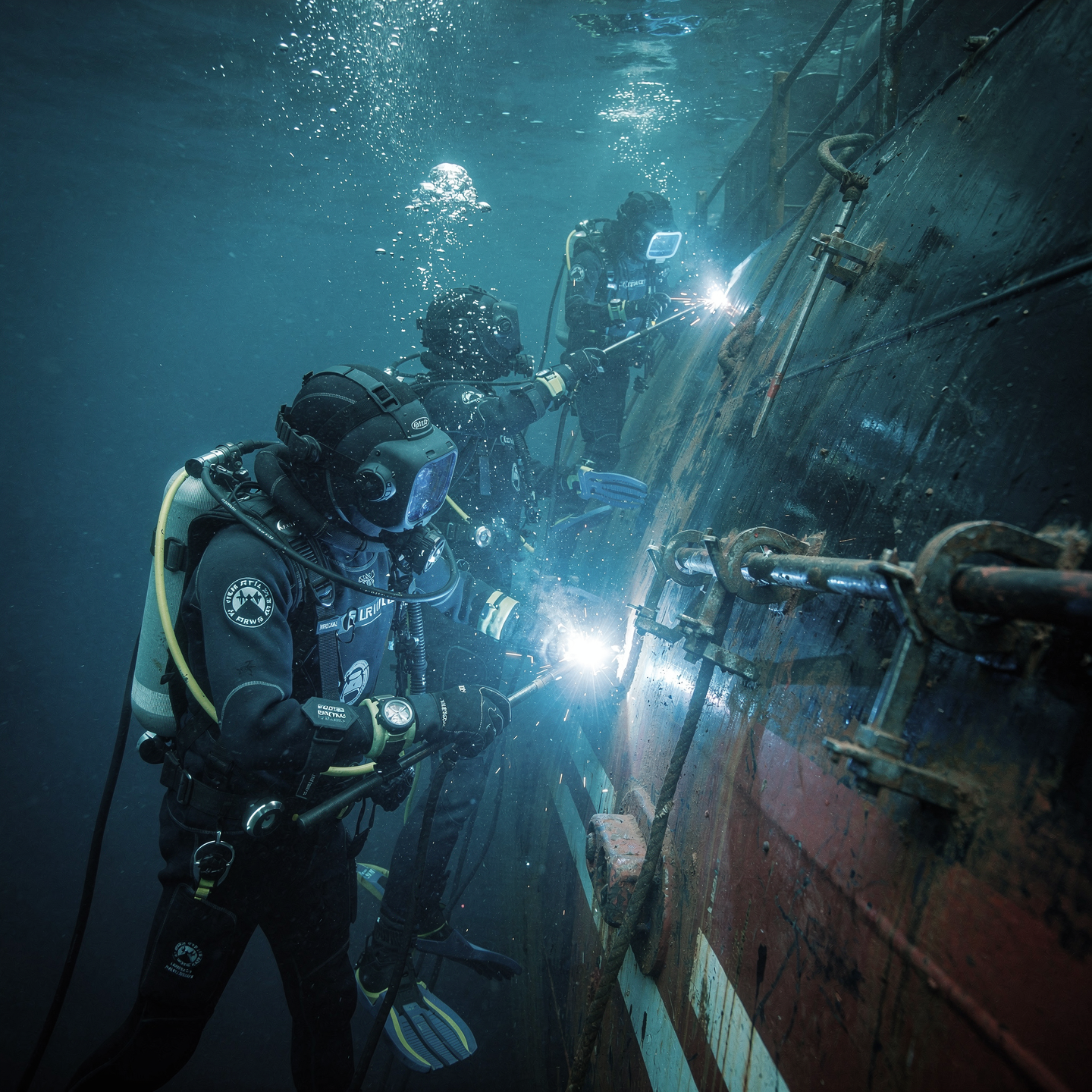
Wet welding is performed directly in the water, with the arc shielded by the gas bubble its own coating produces. It is faster and cheaper to deploy and produces a weld of lower quality, because the surrounding water quenches the metal rapidly and introduces hydrogen into the structure. It is used for repairs where the structural demand is moderate.
Dry hyperbaric welding is performed inside a habitat sealed around the work area and filled with gas, so the welder works in a dry environment at ambient pressure. The weld quality approaches surface standards. It is also far more expensive, requires substantially more equipment and support, and is used where the structure is critical: pipelines, offshore structural members, some ship repairs.
The distinction matters for your career, because the two sit at different ends of the market. Wet welding is more accessible and more common in inshore and ship repair work. Hyperbaric welding is specialist, offshore and much better paid.
What you actually need, in order
1. Physical and medical fitness. A commercial diving medical examination, repeated annually. This is a genuine filter: ear and sinus function, lung function, cardiovascular health and a range of other criteria. Take the medical before spending anything else, because failing it after paying for training is an expensive way to find out.
2. A commercial diving qualification. In the United Kingdom, commercial diving is regulated and the recognised qualifications are issued by training establishments approved by the Health and Safety Executive. Other countries have their own schemes, and international recognition between them is not automatic. If you intend to work in a specific region, confirm which scheme employers there accept before you book anything.
The progression typically runs from surface-supplied diving in shallow water, through deeper surface-supplied work, to closed bell and saturation diving. Each level opens a different part of the market.
3. Welding competence. Surface welding skill to a tested standard first. You cannot learn to weld underwater if you cannot weld well in a workshop, because the water removes your visibility, your stability and most of your feedback.
4. Underwater welding training and qualification. The specific techniques, procedures and the welder qualification testing that a client will require for structural work.
5. Offshore survival and medical certificates if you intend to work offshore, which have their own validity periods and renewal requirements.
That is the real sequence, and it takes time and money. Anyone describing a short route to underwater welding is describing something other than commercial practice.
What it costs
Be prepared for the diving qualification to be the dominant cost. Commercial diving training is expensive because it is equipment-heavy, instructor-intensive and conducted in small groups for safety reasons. Costs vary substantially by country, by level and by school, and the full progression to the deeper qualifications is a significant investment made in stages rather than all at once.
Alongside that sit the medical, the equipment you are expected to provide, offshore certificates, and the living costs of being away at a training centre.
The sensible financial approach is staged: qualify at the entry level, work, then fund the next level from earnings. Most people in the industry did it this way, and it also means you discover early whether the work suits you before committing to the whole path.
What you can expect to earn, and why figures vary so wildly
You will find salary figures for underwater welding online that differ by an order of magnitude. They are not all wrong; they are measuring different things.
Pay in this field is usually structured as a day rate rather than a salary, with additions for depth, for the type of diving and for conditions. That produces a very high headline figure per working day and a highly variable annual total, because the number of working days varies enormously with the market, the weather and your willingness to travel.
Three factors drive the difference between a modest income and a very good one. Inshore versus offshore: offshore work pays substantially more and demands much more of your life. Qualification level: saturation diving sits at the top of the pay scale for good reason. Utilisation: an excellent day rate on sixty days a year is a moderate annual income.
Treat any figure quoted without specifying day rate, utilisation and qualification level as decorative.
The risks, stated plainly
This is a hazardous profession and the industry does not pretend otherwise.
Diving itself carries decompression illness, barotrauma and the consequences of equipment failure in an environment where you cannot simply stop. Adding an electric arc introduces electric shock risk, which is managed with direct current, specific equipment and strict procedure, and the risk of explosion from hydrogen and oxygen accumulating in pockets within a structure.
There are also long-term considerations. The cumulative effects of repeated decompression are a subject of ongoing occupational health attention, and the career is physically demanding in a way that affects how long people stay in it.
None of this means it should be avoided. It means the safety culture, the procedures and the medical regime exist for substantive reasons and are not bureaucracy. The people who last in this industry are the conservative ones.
Where the work is
Offshore energy. Historically oil and gas, increasingly offshore wind. Inspection, repair and maintenance of structures, with underwater welding a part of the repair scope.
Ship repair. Hull repairs, propeller and rudder work, in-water surveys. More accessible and usually closer to home.
Civil and port infrastructure. Quay walls, piles, lock gates, intakes, bridge foundations. Steady work, often inshore, less exposed to energy price cycles.
Salvage. Irregular, demanding and often the most interesting work in the field.
It is worth noting a structural trend: remotely operated vehicles are taking over an increasing share of inspection work, and some intervention tasks with it. That does not remove the diver, because many repair tasks still require hands, but it does change the mix. Divers who also understand remote systems are better positioned than those who do not.
Where academic study fits, and where it does not
This is the part to be exact about.
No academic programme, ours included, makes you a commercial diver or issues a diving qualification. That comes from an approved diving school under the relevant national scheme, and it is non-negotiable.
What academic study does is cover the technical and management layer that sits around the practical work: the metallurgy of welding in a wet environment, procedure qualification, inspection and non-destructive testing, project and operations management, and the hyperbaric medicine that underpins the safety regime.
That matters at two points in a career. Early, as the theoretical foundation that makes you better at the practical work and more useful to a supervisor. Later, when the physical career has a natural end and the move is into supervision, inspection, project management or training.
The Diploma in Underwater Welding covers the welding discipline specifically. The Master in Advanced Welding and Naval Assembly Techniques goes wider into advanced welding and naval assembly for people moving towards technical roles. For the operations and management side of diving work, the Master’s in Management of International Diving Centers is aimed at supervisors and project managers rather than practitioners, and the Master’s in Hyperbaric and Underwater Medicine covers the medical and physiological side for those moving towards the safety and medical support function. The Master’s in Innovation in Underwater Activities and Professional Diving is broader, covering developments across underwater activity including the remote systems reshaping the field.
An honest summary for anyone considering this
If you want to do this, the sequence is: medical first, then a recognised commercial diving qualification from an approved school, then welding competence, then underwater welding qualification. Academic study strengthens the technical foundation and opens the later career; it does not substitute for any step in that sequence.
If you are told otherwise by anyone, including a training provider, that is the point to ask harder questions.
Frequently asked, honestly answered
Can I learn underwater welding without learning to dive? No, not for commercial work. There are hobby and introductory experiences that involve welding underwater; they do not lead to employment.
How long does the whole route take? The entry-level commercial diving qualification is measured in weeks of full-time training. Becoming genuinely employable, with welding competence and some experience behind you, is better measured in a year or two. Reaching the top qualification levels takes several years and is usually funded from earnings along the way.
Do I need existing welding experience first? It helps enormously and it saves money. Welding is a motor skill built over hundreds of hours. Acquiring it in a workshop is far cheaper than acquiring it in a diving school.
Is there an age limit? Not formally in most schemes, but the medical is demanding and becomes more so with age. People do enter the industry in their thirties and forties; few start later.
Can I work internationally with one qualification? Not automatically. Recognition between national schemes varies, and some regions accept qualifications that others do not. Decide where you want to work, then choose the scheme accordingly. This is the most common and most expensive planning mistake in the field.
Is the work seasonal? Inshore and civil work often is, weather-dependent and concentrated in better months. Offshore work is less seasonal and more rotational.
The skills that matter beyond welding
Ask supervisors what separates a diver they will rehire from one they will not, and welding quality is rarely the first answer.
Working methodically in zero visibility. A great deal of this work happens in water where you cannot see your own hands. The job is done by touch, to a sequence you memorised on the surface. People who need to see what they are doing struggle.
Communication discipline. You are on an umbilical with voice communication to a supervisor who cannot see you and is responsible for you. Clear, calm, structured reporting is a safety-critical skill.
Mechanical aptitude generally. Most underwater work is not welding. It is rigging, cutting, cleaning, bolting, inspecting and documenting. Divers who are broadly capable get more days of work than specialists.
Temperament. Long periods of boredom, cold, and discomfort, punctuated by situations requiring calm. The industry self-selects fairly quickly.
If the physical career is not for you
It is worth saying that a large share of the people who search for this career do not end up doing it, and a good proportion of those find something adjacent that suits them better.
Underwater inspection using remote systems covers much of the same ground without the diving. Welding inspection and non-destructive testing is a skilled, well-paid profession that works alongside divers rather than in the water. Diving supervision and project management are where many experienced divers end up anyway. Hyperbaric medicine and diving safety support is a specialist field in its own right.
None of these are consolation prizes. Several of them pay better over a full career than diving does, precisely because they do not have a physical expiry date.
One honest note on recognition
Recognition of a qualification depends on the programme completed and on the regulations of each country. The programmes referenced here are professional training; they are not statutory certificates of competency, and they do not replace one where a flag state or regulator requires it. If the role you want is gated by a specific certificate or professional body, check what that body requires before choosing a programme. Our recognition and accreditations page sets out more detail.
Where to go next
Fees and start dates are published on every programme page, and the course catalogue, diploma catalogue and master’s catalogue let you compare side by side. Study is online, and each programme page shows its next start date.
If you would rather talk it through, the application process starts with a short form and a conversation with an academic adviser, normally within 24 to 48 hours, at no cost and with no obligation.
Related reading: nine maritime careers you can move into from sea and decarbonising shipping: rules, levers and careers.