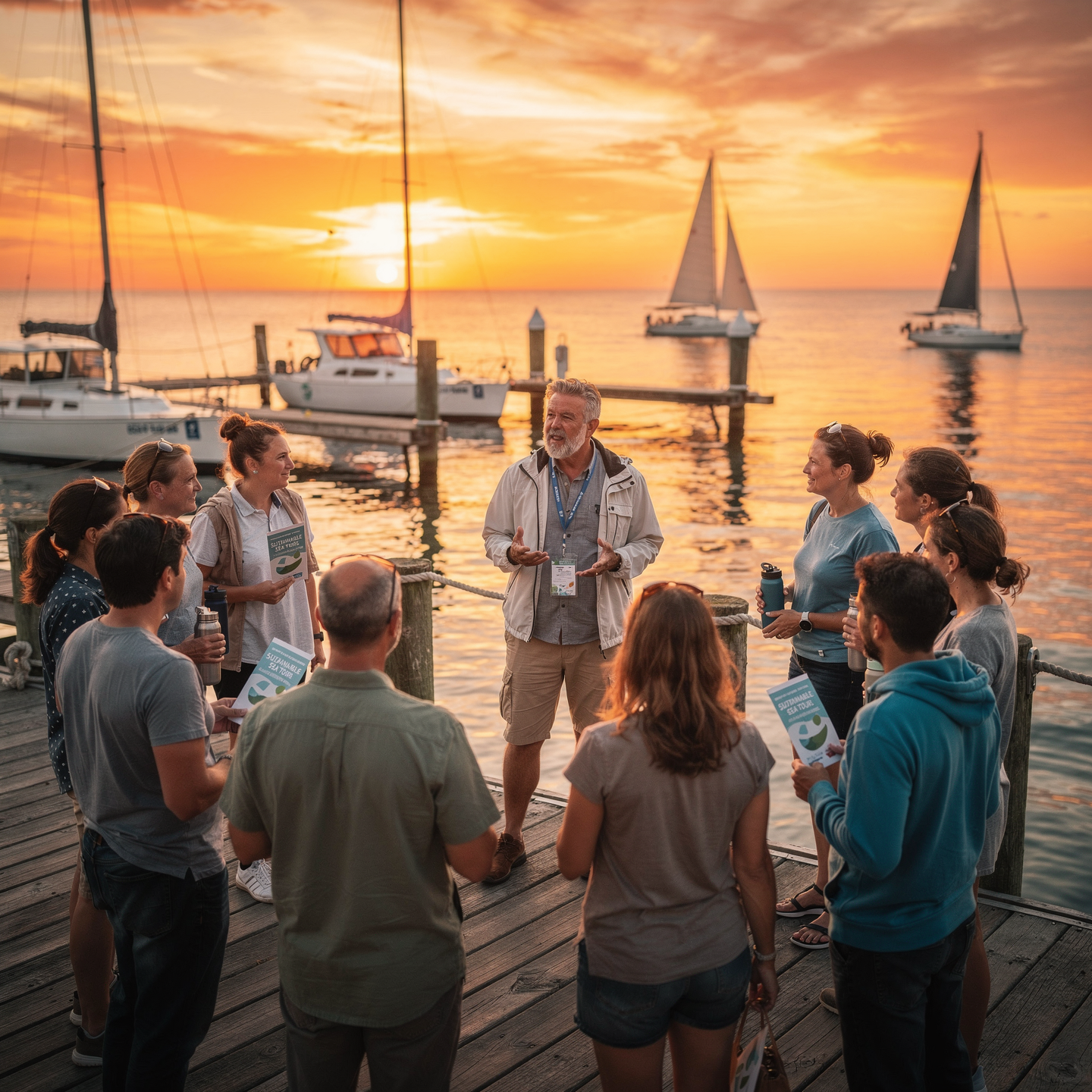
Sustainable Tourism Course on Coasts
Why this course?
The Sustainable Coastal Tourism course
This course provides you with the tools and knowledge necessary to promote responsible tourism that respects the marine environment. You will learn to minimize the environmental impact of tourism activities, promote the conservation of coastal ecosystems, and generate economic and social benefits for local communities. This program will enable you to develop sustainable management strategies, design innovative tourism products, and contribute to creating a more prosperous and balanced future for coastal tourism.
Differential Advantages
- Practical Approach: Case studies, assessment tools, and examples of best practices at a global level.
- Strategy Development: Design of sustainable tourism plans adapted to different coastal contexts.
- Community Engagement: Techniques for involving local communities in tourism planning and management.
- Responsible Marketing: Strategies for promoting tourism that respects the environment and local culture.
- Networking: Opportunities to connect with leading professionals and organizations in sustainable tourism.
- Modality: Online
- Level: Cursos
- Hours: 150 H
- Start date: 25-10-2026
Availability: 1 in stock
Who is it aimed at?
- Tourism professionals seeking to integrate sustainable practices into their coastal businesses and operations.
- Tourism destination managers wishing to implement sustainable development strategies in coastal areas.
- Tourism entrepreneurs aspiring to create responsible businesses with the environment and local coastal communities.
- Students and academics interested in sustainable tourism and coastal conservation for their professional and/or research development.
- NGOs and environmental organizations working to protect coastal ecosystems and promote responsible tourism practices.
Learning flexibility Adapted to your pace: materials accessible online 24/7 interactive discussion forums and personalized tutoring to answer your questions.
Objectives and competencies

Minimize the environmental impact of coastal tourism activities:
Implement waste and wastewater management systems in tourist facilities, promoting reuse and proper treatment to prevent marine pollution.

Promote the participation of local communities in the management and benefits of sustainable coastal tourism:
Create consultation and co-management mechanisms with residents, fishermen and other key stakeholders, ensuring that their voices are heard in the planning and equitable distribution of income generated by tourism.

Promote responsible practices in the consumption of natural resources in the coastal tourism sector:
Implement water and energy management systems, promoting reuse and the use of renewable sources, monitoring consumption and training staff in good environmental practices.

Promoting the conservation and restoration of coastal ecosystems through sustainable tourism:
“To promote responsible tourism practices that minimize environmental impact, encourage community participation, and generate local economic benefits linked to the health and resilience of coastal ecosystems.”

Develop and implement climate change mitigation and adaptation strategies for coastal tourism resilience:
“To assess the vulnerability of coastal tourism infrastructure and integrate nature-based solutions and innovative technologies to strengthen its capacity to respond to extreme weather events.”

Certify coastal tourism destinations and businesses under recognized sustainability standards:
Implement environmental and social management systems, verifiable through audits, that ensure continuous improvement in the use of resources, the protection of natural and cultural heritage, and the benefit to local communities.
Curriculum - Modules
- Comprehensive Maritime Incident Management: protocols, roles, and chain of command for coordinated response
- Operational Planning and Execution: briefing, routes, weather windows, and go/no-go criteria
- Rapid Risk Assessment: criticality matrix, scene control, and decision-making under pressure
- Operational Communication: VHF/GMDSS, standardized reports, and inter-agency liaison
- Tactical Mobility and Safe Boarding: RHIB maneuvers, approach, mooring, and recovery
- Equipment and Technologies: PPE, signaling, satellite tracking, and field data logging
- Immediate Care of the Affected: primary assessment, hypothermia, trauma, and stabilization for evacuation
- Adverse Environmental Conditions: swell, Visibility, flows, and operational mitigation
Simulation and training: critical scenarios, use of VR/AR, and exercises with performance metrics
Documentation and continuous improvement: lessons learned, indicators (MTTA/MTTR), and SOP updates
- Introduction to Sustainable Coastal Tourism: Key Concepts and Challenges
- Coastal Environment Analysis: Ecosystems, Natural Resources, and Vulnerabilities
- Strategic Planning: Objectives, Indicators, and Sustainable Management Frameworks
- Environmental Legislation and Policies: Applicable National and International Regulations
- Community Engagement: Stakeholder Involvement and Partnership Building
- Environmental Impact Management: Mitigation, Adaptation, and Ecosystem Restoration
- Responsible Tourism: Promoting Ethical Practices and Conscious Consumption
- Marketing and Communication: Strategies for Promoting Sustainable Tourism
- Monitoring and Evaluation: Indicator Tracking and Continuous Improvement
- Case Studies: Success Stories and Lessons learned in sustainable coastal tourism management.
‘
- Introduction to Coastal Ecotourism: Definition, principles, and benefits.
- Coastal Environmental Legislation and Policies: Local, national, and international regulations.
- Coastal and Marine Biodiversity: Key ecosystems, protected species, and conservation.
- Ecotourism Development Planning: Environmental impact studies, zoning, and carrying capacity.
- Ecotourism Product Design: Routes, activities, accommodation, and sustainable services.
- Natural Resource Management: Water, energy, waste, and land use.
- Community Participation and Local Development: Community involvement, benefits, and empowerment.
- Ecotourism Marketing and Promotion: Responsible communication, certification, and market segmentation.
- Monitoring and evaluation of ecotourism impact: Sustainability indicators, audits, and continuous improvement.
- Climate change and adaptation in coastal tourism: Vulnerability, mitigation strategies, and resilience.
‘
- Introduction to Coastal Tourism: Characteristics and Global Trends
- Sustainable Development: Principles, Dimensions (Environmental, Social, Economic)
- Coastal Ecosystems: Biodiversity, Ecosystem Services, Vulnerability
- Legal Framework and Coastal Management Policies: Planning Instruments
- Sustainable Tourism Planning: Supply and Demand Analysis, Scenarios
- Tourism Product Design: Segmentation, Experiences, Innovation
- Digital Tourism Marketing: Online Promotion Strategies, Social Networks
- Quality Management: ISO Standards, Certification Systems, Customer Satisfaction
- Community Participation: Involvement, Social Benefits, Empowerment
- Impact Assessment Environmental and eco-labeling: indicators, methodologies
‘
- Introduction to Ecotourism: Definition, principles, and evolution.
- Coastal Biodiversity: Coastal ecosystems (mangroves, reefs, beaches), representative flora and fauna.
- Impacts of Tourism: Evaluation of the environmental, social, and economic effects of tourism in coastal areas.
- Planning and Design of Ecotourism Products: Sustainability, accessibility, and safety criteria.
- Environmental Interpretation: Effective communication techniques to educate and raise awareness among visitors about conservation.
- Waste Management and Minimizing the Environmental Impact of Tourism Operations.
- Legal and Regulatory Framework for Ecotourism and Coastal Conservation: Environmental legislation, protected areas, and tourism regulations.
- Participation Community-Based: Strategies for involving local communities in ecotourism development and conservation.
Monitoring and Evaluation of Ecotourism Projects: Sustainability indicators, impact tracking, and continuous improvement.
Case Studies: Analysis of successful and unsuccessful experiences in ecotourism and coastal conservation.
‘
- System Architecture and Components: Structural design, materials, and subsystems (mechanical, electrical, electronic, and fluid) with selection and assembly criteria for marine environments
- Fundamentals and Principles of Operation: Physical and engineering foundations (thermodynamics, fluid mechanics, electricity, control, and materials) that explain performance and operating limits
- Safety and Environmental (SHE): Risk analysis, PPE, LOTO, hazardous atmospheres, spill and waste management, and emergency response plans
- Applicable Regulations and Standards: IMO/ISO/IEC requirements and local regulations;
- Conformance criteria, certification, and best practices for operation and maintenance
- Inspection, testing, and diagnostics: Visual/dimensional inspection, functional testing, data analysis, and predictive techniques (vibration, thermography, fluid analysis) to identify root causes
- Preventive and predictive maintenance: Hourly/cycle/seasonal plans, lubrication, adjustments, calibrations, consumable replacement, post-service verification, and operational reliability
- Instrumentation, tools, and metrology: Measuring and testing equipment, diagnostic software, calibration and traceability; selection criteria, safe use, and storage
- Onboard integration and interfaces: Mechanical, electrical, fluid, and data compatibility; Sealing and watertightness, EMC/EMI, corrosion protection, and interoperability testing.
Quality, acceptance testing, and commissioning: process and materials control, FAT/SAT, bench and sea trials, go/no-go criteria, and evidence documentation.
Technical documentation and integrated practice: logs, checklists, reports, and a complete case study (safety → diagnosis → intervention → verification → report) applicable to any system.
Plan de estudio - Módulos
- Comprehensive Maritime Incident Management: protocols, roles, and chain of command for coordinated response
- Operational Planning and Execution: briefing, routes, weather windows, and go/no-go criteria
- Rapid Risk Assessment: criticality matrix, scene control, and decision-making under pressure
- Operational Communication: VHF/GMDSS, standardized reports, and inter-agency liaison
- Tactical Mobility and Safe Boarding: RHIB maneuvers, approach, mooring, and recovery
- Equipment and Technologies: PPE, signaling, satellite tracking, and field data logging
- Immediate Care of the Affected: primary assessment, hypothermia, trauma, and stabilization for evacuation
- Adverse Environmental Conditions: swell, Visibility, flows, and operational mitigation
Simulation and training: critical scenarios, use of VR/AR, and exercises with performance metrics
Documentation and continuous improvement: lessons learned, indicators (MTTA/MTTR), and SOP updates
- Introduction to Sustainable Coastal Tourism: Key Concepts and Challenges
- Coastal Environment Analysis: Ecosystems, Natural Resources, and Vulnerabilities
- Strategic Planning: Objectives, Indicators, and Sustainable Management Frameworks
- Environmental Legislation and Policies: Applicable National and International Regulations
- Community Engagement: Stakeholder Involvement and Partnership Building
- Environmental Impact Management: Mitigation, Adaptation, and Ecosystem Restoration
- Responsible Tourism: Promoting Ethical Practices and Conscious Consumption
- Marketing and Communication: Strategies for Promoting Sustainable Tourism
- Monitoring and Evaluation: Indicator Tracking and Continuous Improvement
- Case Studies: Success Stories and Lessons learned in sustainable coastal tourism management.
‘
- Introduction to Coastal Ecotourism: Definition, principles, and benefits.
- Coastal Environmental Legislation and Policies: Local, national, and international regulations.
- Coastal and Marine Biodiversity: Key ecosystems, protected species, and conservation.
- Ecotourism Development Planning: Environmental impact studies, zoning, and carrying capacity.
- Ecotourism Product Design: Routes, activities, accommodation, and sustainable services.
- Natural Resource Management: Water, energy, waste, and land use.
- Community Participation and Local Development: Community involvement, benefits, and empowerment.
- Ecotourism Marketing and Promotion: Responsible communication, certification, and market segmentation.
- Monitoring and evaluation of ecotourism impact: Sustainability indicators, audits, and continuous improvement.
- Climate change and adaptation in coastal tourism: Vulnerability, mitigation strategies, and resilience.
‘
- Introduction to Coastal Tourism: Characteristics and Global Trends
- Sustainable Development: Principles, Dimensions (Environmental, Social, Economic)
- Coastal Ecosystems: Biodiversity, Ecosystem Services, Vulnerability
- Legal Framework and Coastal Management Policies: Planning Instruments
- Sustainable Tourism Planning: Supply and Demand Analysis, Scenarios
- Tourism Product Design: Segmentation, Experiences, Innovation
- Digital Tourism Marketing: Online Promotion Strategies, Social Networks
- Quality Management: ISO Standards, Certification Systems, Customer Satisfaction
- Community Participation: Involvement, Social Benefits, Empowerment
- Impact Assessment Environmental and eco-labeling: indicators, methodologies
‘
- Introduction to Ecotourism: Definition, principles, and evolution.
- Coastal Biodiversity: Coastal ecosystems (mangroves, reefs, beaches), representative flora and fauna.
- Impacts of Tourism: Evaluation of the environmental, social, and economic effects of tourism in coastal areas.
- Planning and Design of Ecotourism Products: Sustainability, accessibility, and safety criteria.
- Environmental Interpretation: Effective communication techniques to educate and raise awareness among visitors about conservation.
- Waste Management and Minimizing the Environmental Impact of Tourism Operations.
- Legal and Regulatory Framework for Ecotourism and Coastal Conservation: Environmental legislation, protected areas, and tourism regulations.
- Participation Community-Based: Strategies for involving local communities in ecotourism development and conservation.
Monitoring and Evaluation of Ecotourism Projects: Sustainability indicators, impact tracking, and continuous improvement.
Case Studies: Analysis of successful and unsuccessful experiences in ecotourism and coastal conservation.
‘
- System Architecture and Components: Structural design, materials, and subsystems (mechanical, electrical, electronic, and fluid) with selection and assembly criteria for marine environments
- Fundamentals and Principles of Operation: Physical and engineering foundations (thermodynamics, fluid mechanics, electricity, control, and materials) that explain performance and operating limits
- Safety and Environmental (SHE): Risk analysis, PPE, LOTO, hazardous atmospheres, spill and waste management, and emergency response plans
- Applicable Regulations and Standards: IMO/ISO/IEC requirements and local regulations;
- Conformance criteria, certification, and best practices for operation and maintenance
- Inspection, testing, and diagnostics: Visual/dimensional inspection, functional testing, data analysis, and predictive techniques (vibration, thermography, fluid analysis) to identify root causes
- Preventive and predictive maintenance: Hourly/cycle/seasonal plans, lubrication, adjustments, calibrations, consumable replacement, post-service verification, and operational reliability
- Instrumentation, tools, and metrology: Measuring and testing equipment, diagnostic software, calibration and traceability; selection criteria, safe use, and storage
- Onboard integration and interfaces: Mechanical, electrical, fluid, and data compatibility; Sealing and watertightness, EMC/EMI, corrosion protection, and interoperability testing.
Quality, acceptance testing, and commissioning: process and materials control, FAT/SAT, bench and sea trials, go/no-go criteria, and evidence documentation.
Technical documentation and integrated practice: logs, checklists, reports, and a complete case study (safety → diagnosis → intervention → verification → report) applicable to any system.
- Introduction to Sustainable Coastal Tourism: Key Concepts and Evolution
- Environmental Legal Framework: Applicable International, National, and Regional Legislation
- Sustainable Tourism Planning: Methodologies and Tools for Management
- Environmental Impact Assessment: Identification, Analysis, and Mitigation of Effects
- Coastal Natural Resource Management: Conservation of Ecosystems and Biodiversity
- Development of Sustainable Tourism Products: Ecotourism, Rural Tourism, and Cultural Tourism
- Community Participation and Local Empowerment: Involvement of the Local Population
- Sustainability Indicators: Measurement and Monitoring of Environmental Performance and socioeconomic.
- Climate Change and Coastal Tourism: Adaptation and risk mitigation.
- Financing for Sustainable Tourism: Investment options and sources of funding.
‘
- Introduction to Environmental Management: Key Concepts, Principles, and Historical Evolution
- Coastal Ecosystems: Characteristics, Biodiversity, Ecological Functions, and Ecosystem Services
- Environmental Impacts of Tourism: Assessment, Mitigation, and Prevention Strategies in Coastal Areas
- Legal and Regulatory Framework: National and International Environmental Legislation Applicable to Coastal Tourism
- Sustainable Tourism Planning: Tools, Methodologies, and Citizen Participation
- Environmental Certifications and Labels: Criteria, Benefits, and Application in the Tourism Sector
- Waste Management and Energy Efficiency: Best Practices in Accommodation and Tourism Activities
- Environmental Education and Awareness: Communication and Promotion Strategies Sustainability.
Community-based tourism and local development: empowering communities and conserving heritage.
Climate change and adaptation: risks, vulnerability, and strategies for resilient coastal tourism.
‘
- Introduction to ecotourism: Definition, principles, and benefits.
- Coastal analysis: Physical, biological, and socioeconomic characteristics.
- Environmental legislation and regulatory frameworks for sustainable tourism.
- Strategic planning for ecotourism: Objectives, goals, and strategies.
- Design of ecotourism products: Activities, services, and infrastructure.
- Environmental interpretation: Communication and education techniques for sustainability.
- Natural resource management: Biodiversity conservation and sustainable use.
- Community participation: Involvement of local communities in ecotourism.
- Marketing and promotion of ecotourism: Communication and Marketing.
Evaluation and monitoring of the impact of ecotourism: Sustainability indicators and continuous improvement.
‘
- Introduction to Sustainable Coastal Tourism: Concepts, Evolution, and Challenges
- Legal and Regulatory Framework: Coastal Planning and Management Instruments
- Coastal Analysis: Geomorphology, Ecosystems, and Natural Resources
- Tourism Carrying Capacity Assessment: Methodologies and Tools
- Planning Sustainable Tourism Infrastructure: Design, Construction, and Maintenance
- Waste and Discharge Management: Minimization, Treatment, and Recovery
- Renewable Energies in Coastal Tourism: Energy Efficiency and Alternative Sources
- Ecotourism and Nature Tourism: Best Practices and Certification
- Community Participation and Governance: Collaborative Management Models
- Indicators of tourism sustainability: monitoring, evaluation and continuous improvement
‘
Career opportunities
- Sustainable Tourism Destination Manager: Planning and management of natural and cultural resources in coastal areas, minimizing environmental impact and maximizing benefits for local communities.
- Sustainable Tourism Consultant: Advising tourism businesses, public administrations, and non-governmental organizations on the implementation of sustainable practices.
- Environmental Educator in Tourism: Development and implementation of educational programs to raise awareness among tourists and residents about the importance of conserving coastal ecosystems.
- Sustainable Tourism Researcher: Studying the impacts of tourism on coastal areas and developing strategies for more responsible and sustainable tourism.
- Coastal Ecotourism Tour Guide: Leading tourist groups on ecotourism activities, promoting respect for the environment and local culture.
- Area Management Technician
Coastal Protected Areas: Collaboration in the management and conservation of protected natural areas in coastal zones, such as national parks and marine reserves.
Sustainability Manager in Tourism Businesses: Implementation and monitoring of sustainability policies in hotels, restaurants, travel agencies, and other businesses in the tourism sector.
Sustainable Tourism Entrepreneur: Creation of innovative and sustainable tourism businesses, such as eco-lodges, rural tourism activities, and ecotourism companies.
“`
Admission requirements

Academic/professional profile:
Degree/Bachelor's degree in Nautical Science/Maritime Transport, Naval/Marine Engineering, or a related field; or proven professional experience in bridge/operations.

Language proficiency:
Recommended functional maritime English (SMCP) for simulations and technical materials.

5. Induction
Updated resume, copy of degree or seaman's book, ID card/passport, letter of motivation.

Technical requirements (for online):
Equipment with camera/microphone, stable connection, ≥ 24” monitor recommended for ECDIS/Radar-ARPA.
Admission process and dates

1. Online
application
(form + documents).

2. Academic review and interview
(profile/objectives/schedule compatibility).

3. Admission decision
(+ scholarship proposal if applicable).

4. Reservation of place
(deposit) and registration.

5. Induction
(access to campus, calendars, simulator guides).
Scholarships and grants
- Discover: the principles of sustainable tourism and their application in coastal environments.
- Learn: how to minimize environmental impact and maximize socioeconomic benefits for local communities.
- Implement: innovative strategies for the responsible management of natural and cultural resources.
- Develop: tourism projects that promote the conservation and sustainable development of coastlines.
- Become: an agent of change for a more responsible and resilient tourism future.
Testimonials
I successfully implemented a sustainable tourism program on the coast of Oaxaca, Mexico, which increased local community income by 30% in the first year, while reducing environmental impact by 20% through the implementation of waste management practices and the promotion of coastal ecosystem conservation. The program also fostered active community participation in protecting their natural and cultural heritage.
During the Tourism and Nautical Experiences course, I acquired a solid foundation in navigation, maritime safety, and tourism activity management. I applied these skills to the design of an innovative nautical route combining whale watching with paddle surfing, receiving excellent feedback from a pilot group of tourists. This allowed me to secure a position with a leading nautical tourism company even before completing the course.
I implemented a waste management system in a small coastal town that reduced pollution by 60% in one year, while empowering the local community through the creation of recycling cooperatives and increasing the area’s tourist appeal thanks to cleaner beaches and a healthier environment.
I implemented a waste management system at a small coastal hotel that reduced waste by 60% in six months, while also training the local community in recycling and composting practices, generating new sources of income for families. This attracted a new segment of environmentally conscious tourists, increasing hotel occupancy by 20% during the off-season.

Frequently asked questions
The negative impact of tourism on coastal ecosystems.
Yes. The itinerary includes ECDIS/Radar-ARPA/BRM with harbor, ocean, fog, storm, and SAR scenarios.
Online with live sessions; hybrid option for simulator/practical placements through agreements.
Environmental degradation and loss of biodiversity.
Recommended functional SMCP. We offer support materials for standard phraseology.
Yes, with a relevant degree or experience in maritime/port operations. The admissions interview will confirm suitability.
Optional (3–6 months) through Companies & Collaborations and the Alumni Network.
Simulator practice (rubrics), defeat plans, SOPs, checklists, micro-tests and applied TFM.
A degree from Navalis Magna University + operational portfolio (tracks, SOPs, reports and KPIs) useful for audits and employment.
- Introduction to Sustainable Coastal Tourism: Concepts, Evolution, and Challenges
- Legal and Regulatory Framework: Coastal Planning and Management Instruments
- Coastal Analysis: Geomorphology, Ecosystems, and Natural Resources
- Tourism Carrying Capacity Assessment: Methodologies and Tools
- Planning Sustainable Tourism Infrastructure: Design, Construction, and Maintenance
- Waste and Discharge Management: Minimization, Treatment, and Recovery
- Renewable Energies in Coastal Tourism: Energy Efficiency and Alternative Sources
- Ecotourism and Nature Tourism: Best Practices and Certification
- Community Participation and Governance: Collaborative Management Models
- Indicators of tourism sustainability: monitoring, evaluation and continuous improvement
‘
Request information
- Complete the Application Form
- Attach your CV/Qualifications (if you have them to hand).
- Indicate your preferred cohort (January/May/September) and whether you want the hybrid option with simulator sessions.
Teachers
Eng. Tomás Riera
Full Professor
Eng. Tomás Riera
Full Professor
Eng. Sofía Marquina
Full Professor
Eng. Sofía Marquina
Full Professor
Eng. Javier Bañuls
Full Professor
Eng. Javier Bañuls
Full Professor
Dr. Nuria Llobregat
Full Professor
Dr. Nuria Llobregat
Full Professor
Dr. Pau Ferrer
Full Professor
Dr. Pau Ferrer
Full Professor
Cap. Javier Abaroa (MCA)
Full Professor
Cap. Javier Abaroa (MCA)
Full Professor

