Diploma in Regatta and Competition Organization

Why this certificate program?

The Diploma in Regatta and Competition Organization

This program provides you with the essential tools and knowledge to manage high-level sailing events, from strategic planning to flawless execution. Learn to master international regulations, course design, safety management, and effective promotion of your regattas. Become a leader in the sailing world and raise the bar for competitions.

This program provides you with the essential tools and knowledge to manage high-level sailing events, from strategic planning to flawless execution. Learn to master international regulations, course design, safety management, and effective promotion of your regattas. Become a leader in the sailing scene and raise the bar for competitions.

Differentiating Advantages

  • Mastery of the Regulations: Gain in-depth knowledge of the Racing Rules of Sailing (RRS) and World Sailing guidelines.
  • Comprehensive Event Management: Learn to plan budgets, coordinate teams, and manage logistics efficiently.
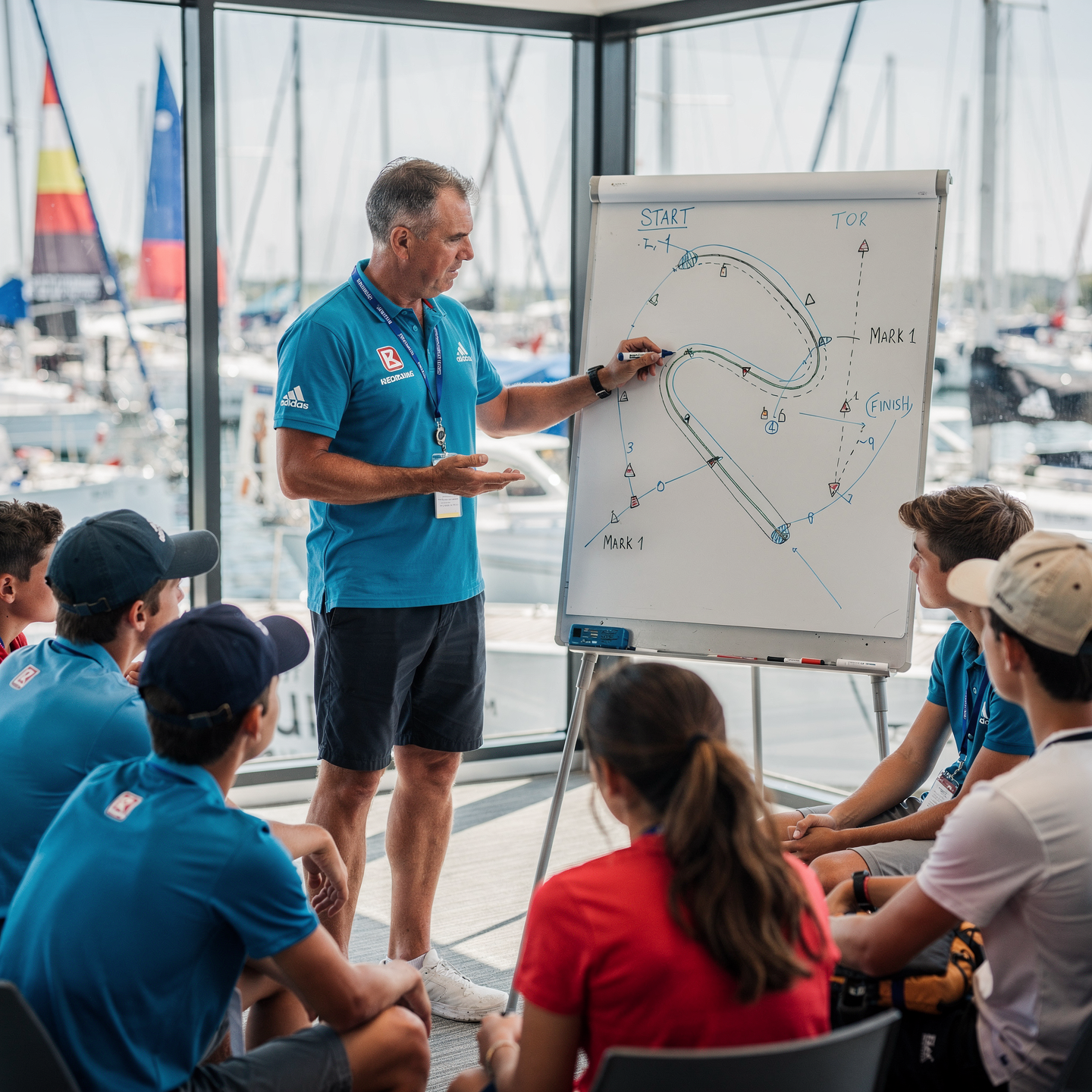
  • Optimized Course Design: Create challenging and safe courses, adapted to weather conditions and the skill level of the competitors.
  • Safety and Emergency Response: Implement effective safety protocols and manage emergency situations with confidence.
  • Marketing and Communication: Promote your regattas attractively and generate interest among participants, sponsors, and the general public.
Organización

Diploma in Regatta and Competition Organization

Availability: 1 in stock

Who is it aimed at?

  • Sports event organizers looking to professionalize regatta management, optimize resources, and maximize profitability.
  • Sailing clubs and federations wanting to raise the technical and organizational level of their competitions, attracting more participants and sponsors.
  • Coaches and athletes aspiring to in-depth understanding of the regulations, logistics, and strategic planning of high-level regattas.
  • Sports marketing professionals interested in specializing in the sailing niche, developing successful campaigns, and managing sponsorships.
  • Experienced sailing enthusiasts seeking to acquire the tools and knowledge to organize local regattas or participate on racing committees regatta.

Flexibility and applicability
Ā Designed for professionals and enthusiasts: asynchronous online format, real-world case studies, and downloadable tools for immediate implementation.

Organización

Objectives and competencies

Effectively manage logistical resources:

“Optimize route planning and fuel consumption, considering factors such as weather, currents, and port restrictions.”

Mastering the rules and regulations of regattas:

“To know and apply the Racing Rules of Sailing (RRS) and the relevant class rules.”

Designing and managing successful nautical events:

To effectively manage logistics, security and communication, ensuring a memorable experience for participants and spectators.

Optimize communication between participants and organizers:

Establish clear communication channels and efficient response protocols (e.g., WhatsApp, email, online platform) and assign follow-up personnel for inquiries and problems.
Assessing and mitigating risks in nautical competitions:

Identify meteorological hazards, equipment failures and human errors, implementing contingency plans and safety protocols pre-competition and during the regatta.

Promote and market regatta events:

“Develop digital and traditional marketing strategies to increase the visibility and reach of the regattas, attracting participants, sponsors and the public.”

Curriculum - Modules

  1. Comprehensive Maritime Incident Management: protocols, roles, and chain of command for coordinated response
  2. Operational Planning and Execution: briefing, routes, weather windows, and go/no-go criteria
  3. Rapid Risk Assessment: criticality matrix, scene control, and decision-making under pressure
  4. Operational Communication: VHF/GMDSS, standardized reports, and inter-agency liaison
  5. Tactical Mobility and Safe Boarding: RHIB maneuvers, approach, mooring, and recovery
  6. Equipment and Technologies: PPE, signaling, satellite tracking, and field data logging
  7. Immediate Care of the Affected: primary assessment, hypothermia, trauma, and stabilization for evacuation
  8. Adverse Environmental Conditions: swell, Visibility, flows, and operational mitigation

    Simulation and training: critical scenarios, use of VR/AR, and exercises with performance metrics

    Documentation and continuous improvement: lessons learned, indicators (MTTA/MTTR), and SOP updates

  1. Introduction to Nautical Sports Events: Types and Characteristics.
  2. Legal and Regulatory Framework: Federations, Licenses, Insurance, and Permits.
  3. Strategic Planning: Defining Objectives, Scope, and Resources.
  4. Budget Management: Preparation, Control, and Optimization.
  5. Marketing and Communication: Promotion, Sponsorship, and Public Relations.
  6. Logistics and Infrastructure: Venues, Transportation, Accommodation, and Equipment.
  7. Safety and Risk Management: Emergency Plans, First Aid, and Rescue.
  8. Volunteer Management: Recruitment, Training, and Coordination.
  9. Evaluation and Analysis Post-event: Performance indicators and continuous improvement.

    Sustainability and legacy: Environmental, social, and economic impact.

  1. Introduction to Nautical Event Management: Typology and Trends
  2. Legal and Regulatory Framework: Licenses, Permits, Safety, and Insurance
  3. Event Design: Objectives, Target Audience, Format, and Program
  4. Financial Planning: Budget, Financing, Sponsorship, and Ticketing
  5. Comprehensive Logistics: Transportation, Accommodation, Catering, and Equipment
  6. Marketing and Communication: Strategy, Promotion, Social Media, and Public Relations
  7. Risk Management: Identification, Assessment, Mitigation, and Contingency Plans
  8. Staff and Volunteers: Selection, Training, Coordination, and Leadership
  9. Applied Technology: Timing, Tracking, Communication, and Ticketing Systems
  10. Evaluation Post-event: results analysis, feedback, and continuous improvement

  1. Introduction to Regatta Logistics: Peculiarities and Challenges
  2. Regulations and Standards: Federations, Classes, Racing Rules
  3. Maritime Safety: Mandatory Equipment, Inspections, Communications
  4. Pre-Regatta Logistics Planning: Transport, Accommodation, Supplies
  5. Boat Management: Maintenance, Repairs, Insurance
  6. Equipment and Materials: Inventory, Storage, Transport, Customs
  7. Meteorology and Oceanography: Forecasts, Impact on Logistics
  8. Waste Management and Marine Environmental Protection
  9. Regatta Logistics: Monitoring, Support, Emergencies
  10. Post-Regatta Analysis: Evaluation, Improvements, Lessons Learned

  1. Introduction to Regatta Logistics: Types of Events, Participants, and Roles.
  2. Pre-Regatta Logistics Planning: Transportation, Accommodation, and Supplies.
  3. Safety on the Water: Mandatory Equipment, Emergency Protocols, and Communications.
  4. Protocol in Nautical Events: Etiquette, Public Relations, and Guest Management.
  5. Risk Management: Identifying, Assessing, and Mitigating Risks in Regattas.
  6. Logistics of Materials and Equipment: Storage, Maintenance, and Transportation.
  7. First Aid and Emergency Response: Basic Training, First Aid Kit, and Procedures.
  8. Communication and Coordination: Channels, Protocols, and Roles During the Regatta.
  9. Food safety and hygiene: Food handling, allergen control.
  10. Post-regatta evaluation: Incident analysis, safety and logistics improvements.

  1. System Architecture and Components: Structural design, materials, and subsystems (mechanical, electrical, electronic, and fluid) with selection and assembly criteria for marine environments
  2. Fundamentals and Principles of Operation: Physical and engineering foundations (thermodynamics, fluid mechanics, electricity, control, and materials) that explain performance and operating limits
  3. Safety and Environmental (SHE): Risk analysis, PPE, LOTO, hazardous atmospheres, spill and waste management, and emergency response plans
  4. Applicable Regulations and Standards: IMO/ISO/IEC requirements and local regulations;
  5. Conformance criteria, certification, and best practices for operation and maintenance
  6. Inspection, testing, and diagnostics: Visual/dimensional inspection, functional testing, data analysis, and predictive techniques (vibration, thermography, fluid analysis) to identify root causes
  7. Preventive and predictive maintenance: Hourly/cycle/seasonal plans, lubrication, adjustments, calibrations, consumable replacement, post-service verification, and operational reliability
  8. Instrumentation, tools, and metrology: Measuring and testing equipment, diagnostic software, calibration and traceability; selection criteria, safe use, and storage
  9. Onboard integration and interfaces: Mechanical, electrical, fluid, and data compatibility; Sealing and watertightness, EMC/EMI, corrosion protection, and interoperability testing.

    Quality, acceptance testing, and commissioning: process and materials control, FAT/SAT, bench and sea trials, go/no-go criteria, and evidence documentation.

    Technical documentation and integrated practice: logs, checklists, reports, and a complete case study (safety → diagnosis → intervention → verification → report) applicable to any system.

  1. Introduction to Competition Management: Evolution, Types, and Current Trends
  2. Regulatory Framework: National and International Sports Federations, Associations, and Laws
  3. Rule Design: Structure, Essential Clauses, Interpretation, and Application
  4. Registration and Accreditation: Participant Management, Documentation, and Insurance
  5. Sports Facilities: Requirements, Safety Regulations, and Adaptations
  6. Logistical Planning: Transportation, Accommodation, Food, and Medical Services
  7. Human Resources Management: Volunteers, Technical Staff, Judges, and Referees
  8. Communication and Marketing: Strategies, Social Media, Press, and Sponsorships
  9. Monitoring and Evaluation: Performance Indicators, Reports, and Lessons Learned
  10. Sports Ethics and Fair Play: Prevention of Fraud, Doping, and Violence

Career opportunities

  • Nautical Event Organizer: planning, logistics, and management of regattas and competitions.
  • Regatta Director: application of the rules, safety, and real-time decision-making.
  • Measurement Officer: verification and control of the characteristics of participating vessels.
  • Communications and Marketing Manager: promotion and dissemination of events, sponsorship management.
  • Nautical Facility Manager: administration and maintenance of marinas and yacht clubs.
  • Sports Event Organization Consultant: advising sports entities and federations.
  • Technical Advisor for Nautical Federations and Associations: development of sports programs and competitions.
  • Judge/Referee of Regattas: application of the rules, conflict resolution, and performance evaluation.

    “`

Admission requirements

Academic/professional profile:

Degree/Bachelor's degree in Nautical Science/Maritime Transport, Naval/Marine Engineering, or a related field; or proven professional experience in bridge/operations.

Language proficiency:

Recommended functional maritime English (SMCP) for simulations and technical materials.

Documentation:

Updated resume, copy of degree or seaman's book, ID card/passport, letter of motivation.

Technical requirements (for online):

Equipment with camera/microphone, stable connection, ≄ 24ā€ monitor recommended for ECDIS/Radar-ARPA.

Admission process and dates

1. Online
application

(form + documents).

2. Academic review and interview

(profile/objectives/schedule compatibility).

3. Admission decision

(+ scholarship proposal if applicable).

4. Reservation of place

(deposit) and registration.

5. Induction

(access to campus, calendars, simulator guides).

Scholarships and grants

  • Comprehensive Regatta Management: Master the planning, logistics, and execution of high-level sailing competitions.
  • Rules and Regulations: Delve into the rules of World Sailing and their application in regattas.
  • Safety and First Aid: Learn maritime safety protocols and emergency response techniques at sea.
  • Marketing and Communication: Develop effective strategies to promote sailing events and attract participants and sponsors.
  • Team Management: Lead and coordinate teams for the successful organization of the regatta.
Boost your career in the world of professional sailing with specialized, cutting-edge training.

Testimonials

Frequently asked questions

To ensure the safety of the participants and the fair and efficient development of the competition, in accordance with the established rules and regulations.

Yes. The itinerary includes ECDIS/Radar-ARPA/BRM with harbor, ocean, fog, storm, and SAR scenarios.

Online with live sessions; hybrid option for simulator/practical placements through agreements.

Recommended functional SMCP. We offer support materials for standard phraseology.

Yes, with a relevant degree or experience in maritime/port operations. The admissions interview will confirm suitability.

Optional (3–6 months) through Companies & Collaborations and the Alumni Network.

Simulator practice (rubrics), defeat plans, SOPs, checklists, micro-tests and applied TFM.

A degree from Navalis Magna University + operational portfolio (tracks, SOPs, reports and KPIs) useful for audits and employment.

  1. Introduction to Event Logistics: Key Concepts and Their Importance
  2. Basic Protocol: Precedence, Addressing Authorities, and National Symbols
  3. Types of Events: Corporate, Social, Cultural, Sporting, and Academic
  4. Logistics Planning: Event Design, Schedule, and Budget
  5. Participant Management: Registrations, Confirmations, Accreditations, and Databases
  6. Communication with Participants: Message Design, Channels, and Customer Service
  7. Supplier Management: Selection, Contracting, and Supervision of Services (Catering, Transportation, etc.)
  8. Venue Management and Setup: Layout, Security, Signage, and Accessibility
  9. Table Etiquette: Place Setting, Cutlery, Glassware, and Wine Pairing Basic.
  10. Post-event evaluation: Satisfaction surveys, results analysis, and continuous improvement.

Request information

  1. Complete the Application Form.

  2. Attach your CV/degree certificate (if you have it to hand).

  3. Indicate your preferred cohort (January/May/September) and whether you would like the hybrid option with simulator sessions.

    An academic advisor will contact you within 24–48 hours to guide you through the admission process, scholarships, and compatibility with your professional schedule.

Please enable JavaScript in your browser to complete this form.
Click or drag a file to this area to upload.

Faculty

0
    0
    Tu carrito
    Tu carrito esta vacĆ­oRegresar a la tienda
    Scroll to Top