
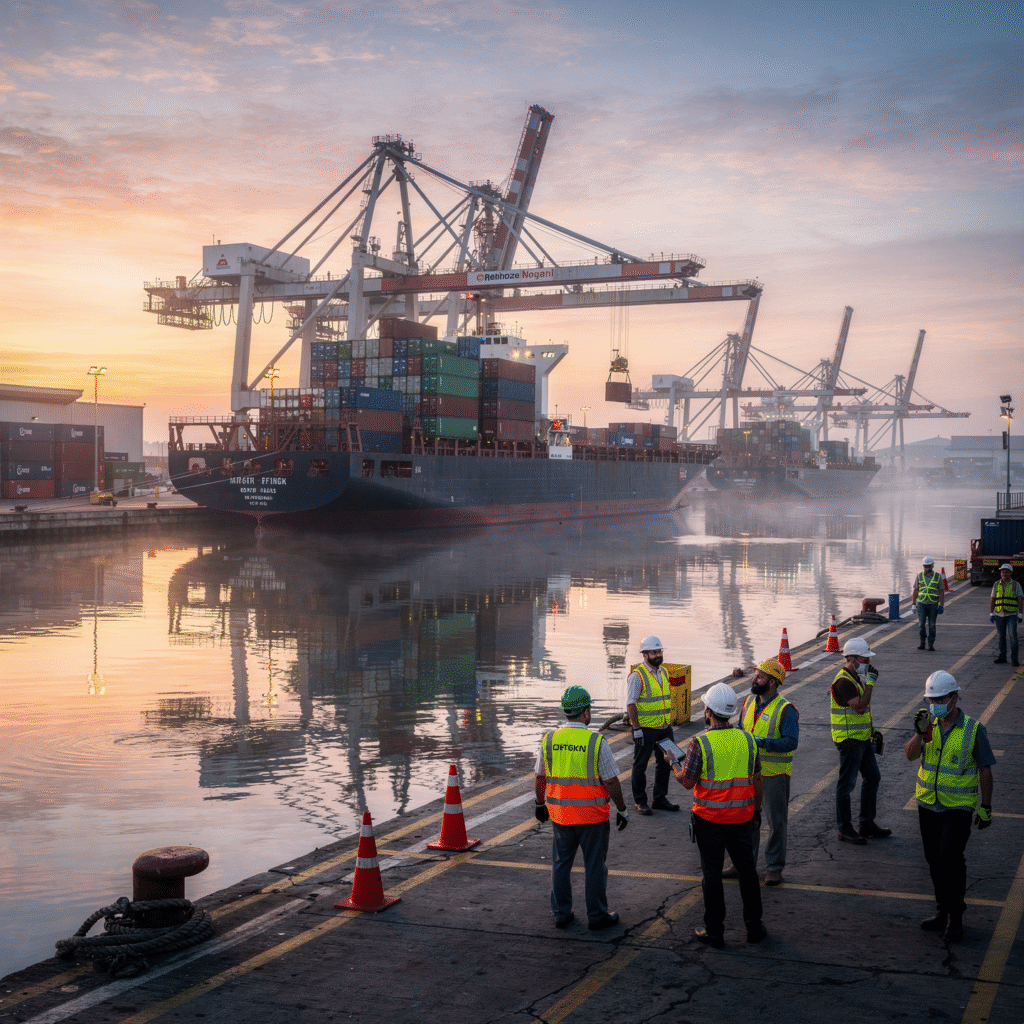
“How do I become a ship’s captain” is one of the most searched questions in the maritime sector, and most of the answers online are either vague or wrong about the one thing that matters: the route is a statutory certification path, not a degree, and it runs through sea time you cannot shortcut.
The honest headline
Command of a merchant ship requires a Certificate of Competency as Master, issued by a national maritime administration. In the United Kingdom that is the Maritime and Coastguard Agency. Other countries have their own administrations, and all of them operate within the international framework for training, certification and watchkeeping.
That certificate is earned through a defined combination of approved training, examined knowledge and documented sea service. There is no academic programme anywhere, ours included, that substitutes for it.
Everything else in this article is about how that route works in practice, what it demands, and where additional study genuinely helps rather than duplicating what the certification already covers.
The ladder, in order
Cadet. You enter as an officer cadet, usually through a sponsoring shipping company or a training provider linked to one. The training alternates between college phases and sea phases, with a structured record book documenting what you have done aboard.
Officer of the watch. The first certificate of competency. You are now qualified to take charge of a navigational watch, which means the ship is yours for four hours at a time. This is the step that takes most people the longest to get used to.
Chief mate. More sea time, further examination, and a change in the nature of the job. The chief mate is responsible for cargo operations, stability and the deck department as a working organisation. It is the first management role.
Master. The final certificate. Overall command, with legal responsibility for the vessel, the crew, the cargo and the environment, and ultimate authority that cannot be delegated.
The pace through this is governed by sea time, not ambition. Typical progression from cadet to master takes the better part of a decade for someone moving steadily, and longer for many.

What the job is actually like at each stage
As a watchkeeper, the work is navigation, collision avoidance and the routine of the watch, with cargo and maintenance duties outside it. The responsibility is considerable and the autonomy is high: at three in the morning there is nobody else on the bridge.
As a chief mate, the balance shifts to planning and people. Stability calculations, cargo plans, maintenance scheduling, and managing a department that includes people with much more sea time than you.
As a master, the technical work largely disappears and is replaced by judgement, commercial pressure and administration. You are the interface between the ship and everyone ashore who wants something from it: owners, charterers, agents, port authorities, inspectors. The hardest part of the job is not ship handling; it is deciding when to say no to commercial pressure, and being the only person who can.
What nobody mentions in the recruitment material
Time away. Rotations vary by trade and company, and several months aboard is normal. This is the single factor that ends most seagoing careers, and it does so in people’s thirties, when the calculation changes.
Administration. The volume of inspections, audits, reporting and record-keeping has grown substantially and is a recurring complaint from serving masters.
Legal exposure. A master carries personal legal responsibility in a way that most shore managers do not, including in jurisdictions where the consequences of an incident can be severe.
The trade matters enormously. Deep sea tankers, short sea container feeders, offshore support and cruise are different jobs that happen to share a certification route. Choose the trade as deliberately as you choose the career.
Where additional study genuinely helps
This is the part worth being precise about, because a great deal of training is sold to seafarers that duplicates what their certification already covers.
Study adds value in three situations.
Specialising into a trade the certification does not cover in depth. High-latitude operations are the clearest example: ice navigation demands knowledge that general certification touches only lightly, and it is a scarce and well-compensated specialism. The Master’s in Polar Exploration and Ice Navigation and the Diploma in Oceanography Applied to Maritime Operations cover this territory.
Preparing for the management part of command. Certification examines your technical competence thoroughly and your management capability much less. Leadership, decision-making under pressure and the commercial framework are where new masters most often feel underprepared. The Master’s in Advanced Training for Captains and Bridge Officers is aimed squarely at this transition, and the Leadership Course in Maritime Operations and Course on Budgeting and Costs in Maritime Operations cover the leadership and commercial sides in shorter form.
Preparing to come ashore. Most people who go to sea eventually leave it, and the move is far easier if you have built a second specialism while still sailing. Our guide to nine maritime careers ashore covers the realistic options.
Where technology is reshaping the role, the Master’s in AI applied to Autonomous Navigation covers autonomous and assisted navigation, which is where a meaningful share of future bridge-adjacent work will sit.
A realistic financial picture
Seagoing officer pay is competitive, particularly relative to the cost of living while aboard, where accommodation and food are provided. It also varies enormously between trades, flags and companies, and between a cadet and a master the difference is substantial.
What makes the comparison with shore careers misleading in both directions is the structure: periods of full pay with almost no living costs, alternating with periods of leave. The right comparison is annual earnings against annual earnings, including the value of leave, not daily rate against daily rate.
Specific figures date quickly and vary by company and flag, so check current data from a union, a maritime careers service or recruitment listings in your target trade rather than relying on any general figure.
If you are starting from scratch
The practical first steps are the same everywhere. Confirm you can pass the seafarer medical, because it is a genuine filter. Identify the administration whose certificate you want, since recognition between countries is not automatic and the choice shapes everything afterwards. Find a cadetship or an approved training route through a sponsoring company. Then accept that the timetable belongs to the sea time, not to you.
If you are already sailing and wondering how to get ahead, the answer from most experienced masters is the same: be the officer whose paperwork is right, whose handover is complete and who calls early. Technical skill is assumed; reliability is what gets noticed.
Deck or engine: the choice people make too casually
Cadets usually choose a department before they understand what either involves, and the choice is difficult to reverse.
Deck leads to navigation, cargo and ultimately command. The work is operational and increasingly administrative as you rise. The ceiling is master.
Engine leads to machinery, systems and technical management. The work stays technical for longer and the ceiling is chief engineer, a position of equivalent seniority and often equivalent pay.
The useful question is not which has more status, because they are peers. It is which kind of problem you want to spend your life solving: a situation developing in three dimensions over the next twenty minutes, or a system that is behaving in a way it should not.
Shore prospects differ too. Deck officers move naturally into operations, port work, pilotage, survey and chartering. Engineers move into superintendency, technical management, class, equipment manufacturers and energy. Engineering skills are, on balance, more portable outside the marine sector entirely.
Pilotage: the route people forget
For deck officers who want to stop going away but keep handling ships, pilotage is the obvious destination and is rarely mentioned early enough.
A pilot boards a vessel and conducts it through confined waters using local knowledge the ship’s own master cannot be expected to have. It is highly skilled, well paid, and performed from home, which is the attraction.
Entry is competitive and controlled by individual port authorities, who set their own requirements. Command experience is typically expected, as is a demanding period of local training and examination. It is a destination to plan towards from mid-career rather than discover at the end of one.
Four questions worth answering before you commit
Can you pass the medical, now and in fifteen years? Eyesight and colour vision standards end deck careers before they start, and ongoing fitness requirements end them later.
How do you actually handle being away? Not the idea of it. Four months is a long time, and nobody knows how they will find it until they have done it twice.
Which administration’s certificate do you want? This determines where you can work and how easily, and changing later is expensive.
What is the plan for coming ashore? Most people do. The ones who manage it well started thinking about it a decade earlier, usually by building a second specialism while still sailing.
What a master actually does in a day alongside
At sea the job is quieter than people expect. In port it is relentless, and it is worth knowing which one you are signing up for.
A port call brings agents, surveyors, port state control, class, charterers’ representatives, stevedore supervisors, bunker suppliers, stores, crew changes and immigration, most of them wanting the master personally and several of them at once. Meanwhile cargo operations are running, the chief mate needs decisions, and the departure time is fixed.
Underneath that sits a constant stream of correspondence with the office, much of it asking for information that is already in a report somebody has not read. Masters consistently describe this, rather than ship handling or heavy weather, as the part of the job that wears them down.
The capability that matters here is delegation, and it is the hardest adjustment for officers promoted from roles where they did everything themselves.
Five things experienced masters say they wish they had learned sooner
How to write. A clear report protects you, and an unclear one creates work and suspicion in equal measure.
The commercial framework. Understanding laytime, off-hire and the charterparty changes how you read an instruction from the office and when you push back on it.
How to run a meeting. Pre-arrival briefings, toolbox talks and handovers are meetings, and most are conducted badly.
When to call. Early. Every investigation that criticises a master for calling the office too soon has yet to be written.
How to say no. Clearly, in writing, with the reason stated. The authority exists precisely so it can be used, and a company worth working for will support it.
One honest note on recognition
Recognition of a qualification depends on the programme completed and on the regulations of each country. The programmes referenced here are professional training; they are not statutory certificates of competency, and they do not replace one where a flag state or regulator requires it. If the role you want is gated by a specific certificate or professional body, check what that body requires before choosing a programme. Our recognition and accreditations page sets out more detail.
Where to go next
Fees and start dates are published on every programme page, and the course catalogue, diploma catalogue and master’s catalogue let you compare side by side. Study is online, and each programme page shows its next start date.
If you would rather talk it through, the application process starts with a short form and a conversation with an academic adviser, normally within 24 to 48 hours, at no cost and with no obligation.
Related reading: nine maritime careers you can move into from sea and decarbonising shipping: rules, levers and careers.