
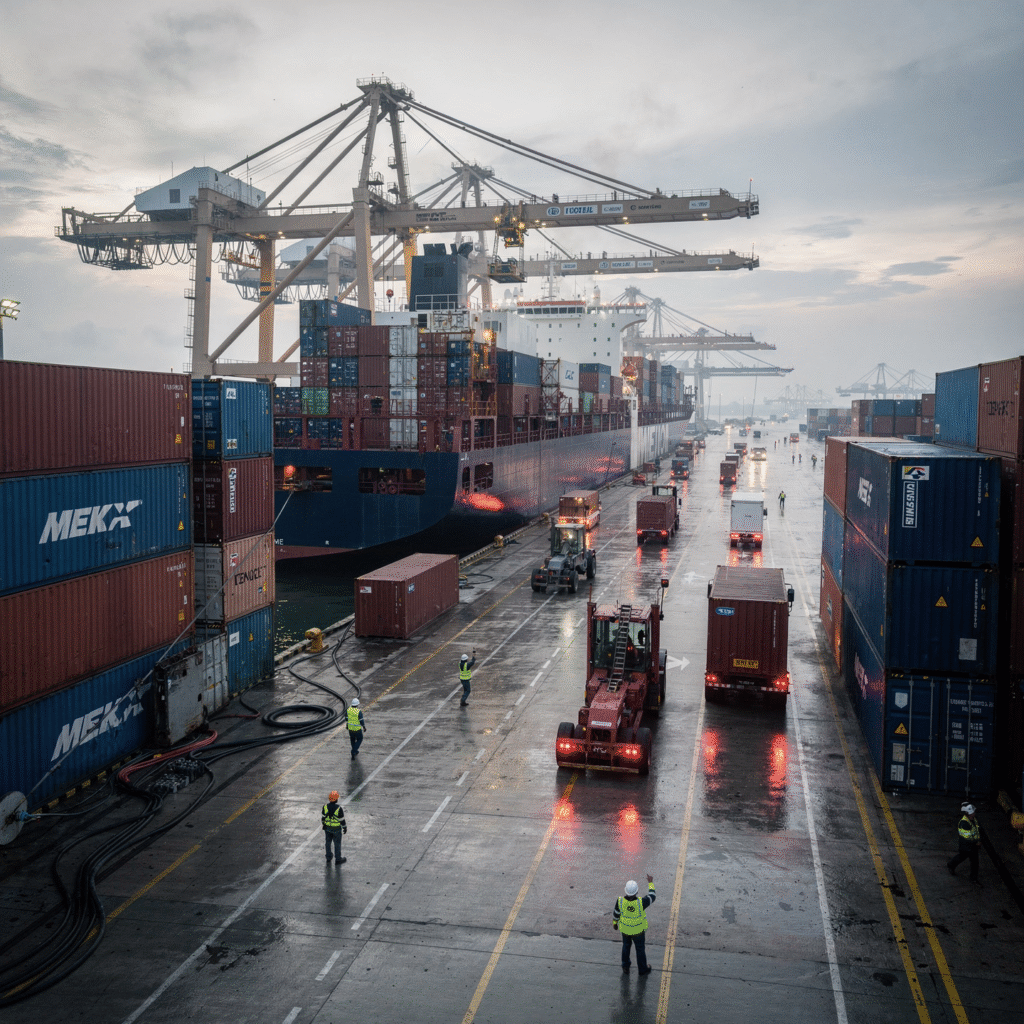
The harbour master is the person legally responsible for the safety of navigation inside a port. Not the commercial manager, not the terminal operator — the person who can direct a vessel to move, refuse it entry, close the port in bad weather, and answer for what happens on the water.
It is one of the most senior operational roles in the UK maritime sector, and one of the least understood from outside. People imagine a ceremonial job in a nice office overlooking the water. The reality is statutory responsibility for a confined, congested, commercially pressured piece of water where a single bad decision puts lives, cargo and infrastructure at risk.
What the job actually involves
The title varies — harbour master, port marine operations manager, director of marine — but the function is consistent.
Safety of navigation. The core duty. Who moves, when, under what conditions, with what tug assistance, under whose pilotage. You set and enforce the rules of the port.
Statutory powers. A harbour master in a UK statutory harbour authority holds real legal powers under harbour legislation: to give directions to vessels, to require movement, to detain in defined circumstances, to control dangerous goods. These are powers exercised over commercial operators with strong financial incentives to disagree with you, which is why the role requires authority as much as technical knowledge.
The Port Marine Safety Code. The framework that governs how UK harbour authorities manage marine safety. It requires a formal safety management system, risk assessment of marine operations, a designated person providing independent assurance, and a duty holder accountable at board level. Much of a modern harbour master’s work is operating and evidencing this system.
Emergency response. Collision, grounding, fire, pollution, search and rescue in harbour limits, severe weather. You are the marine incident commander, coordinating with the coastguard, emergency services and salvors.
Pilotage. In most UK ports the harbour authority is the competent harbour authority for pilotage: authorising pilots, setting pilotage directions, issuing Pilotage Exemption Certificates to qualifying masters.
Conservancy. The physical state of the water — dredging and maintained depths, buoyage and aids to navigation, wrecks and obstructions, moorings and berths.
Everything else that floats. Recreational craft, fishing vessels, passenger launches, events, swimmers, paddleboarders. Mixing a 200-metre container ship with a sailing regatta is a real and recurring problem.
The career route
There is no direct entry. You do not leave university and become a harbour master. The route runs through sea command and then port operations.
Sea time and command experience
Almost every UK harbour master has been to sea, and most have held or come close to command. The usual profile is a Master Mariner — somebody who holds a Master Certificate of Competency — or a senior deck officer with substantial watchkeeping and ship handling experience.
The reason is practical. You will be making decisions about whether a particular vessel can safely make a particular manoeuvre in particular conditions, and arguing about it with the master of that vessel. Credibility requires having done the job.
Many harbour masters come via marine pilotage, which is the most natural feeder role: pilots already know the port intimately, handle ships in confined water daily, and understand the interaction between commercial pressure and safety. Our guide to becoming a maritime pilot covers that route.
Port-side experience
From sea or pilotage, the step is into port marine operations — deputy harbour master, marine operations manager, assistant harbour master at a smaller port.
Smaller ports and trust ports are the usual entry point for a first harbour master post. A small harbour authority might cover fishing vessels, leisure craft and coastal commercial traffic, with a small team and a wide remit. It is a genuine harbour master role with the full statutory weight, at a scale where you can learn it.
The qualifications ports ask for
- Familiarity with the Port Marine Safety Code and the ability to run a marine safety management system.
- Risk assessment competence — formal, documented, defensible.
- Incident command training.
- Understanding of harbour legislation and the authority’s own local powers.
- Increasingly, environmental and conservancy knowledge, because ports sit in designated habitats and under tightening regulation.
Postgraduate study in port management, maritime operations or shipping is common among candidates for larger ports, though it does not substitute for sea experience.
What is changing
Environmental regulation. Ports sit at the collision point between heavy industry and protected habitat. Dredging consents, water quality, air quality, underwater noise, and now shore power provision for berthed vessels. A growing share of a harbour master’s time is spent on environmental compliance.
Decarbonisation and new fuels. Methanol, ammonia and hydrogen bunkering in a port raises safety questions nobody had to answer a decade ago. Ammonia in particular is acutely toxic. Harbour authorities are writing the operating rules for these fuels now, and the people writing them are harbour masters. Our article on decarbonising shipping sets out the regulatory drivers.
Offshore wind. Ports along the UK east coast and elsewhere have become bases for installation and maintenance fleets, bringing high volumes of crew transfer vessels and service operation vessels with movement patterns conventional port rules were not designed for — see how the offshore wind crossover works.
The parts people do not expect
It is political. A port has commercial tenants, a board, a local authority, recreational users, fishing interests, environmental groups and residents. The harbour master is in the middle. Saying no to a berth movement that costs a terminal money requires the ability to hold a position under pressure.
The hours are unpredictable. Tides and weather do not respect a working week. Incidents happen at night.
The accountability is personal. When something goes wrong in a port, the investigation examines whether the marine safety management system was adequate and whether it was followed. That is your system.
How Navalis UK fits
We do not make harbour masters — only sea time, command experience and port operations do.
Where online study is useful is the management and regulatory layer that sits on top of the seagoing competence, and which officers generally do not acquire on a bridge: port operations, marine safety management systems, risk assessment methodology, maritime law, environmental regulation and the commercial structure of ports.
That is the gap our port and marina management and maritime law and regulation programmes are built for, and the typical student is exactly the profile described above: a senior officer or pilot preparing for a shore-side marine operations role.
Recognition depends on which programme you complete and on the regulations of the country where you intend to work, and we set that out in writing before you enrol — see recognition and accreditations.
Frequently asked questions
Do I need to be a Master Mariner?
Most UK harbour masters hold or have held senior deck certification, and a Master ticket is the common standard for larger ports. Smaller harbour authorities are sometimes more flexible, particularly where the traffic is fishing and leisure rather than large commercial vessels.
Can I become a harbour master without going to sea?
It is very unusual. The role requires making and defending judgements about ship handling in confined water, and port authorities recruit people who have done it.
What is the difference between a harbour master and a port manager?
The harbour master is responsible for safety of navigation and holds statutory powers over vessel movement. A port or terminal manager is responsible for the commercial operation. Different jobs, sometimes in tension.
Is pilotage a good route in?
It is the most natural one. Pilots handle ships in the port daily, know the water and the authority, and the step to deputy harbour master is a recognised progression.
What does it pay?
It varies widely with the size of the port. Major port harbour masters are senior executives; a small trust port role is paid accordingly. Look at current advertised positions rather than any figure quoted in an article.
Which legislation matters most?
The Port Marine Safety Code is the central framework, alongside your authority’s own harbour legislation and the Pilotage Act provisions where the authority is a competent harbour authority.
The next step
If you are at sea and thinking about coming ashore, pilotage and port marine operations are the two routes worth investigating, and both reward understanding the regulatory side before you apply.
Browse our programmes by level and field, or ask an adviser which fits the sea time and certificates you already hold.