
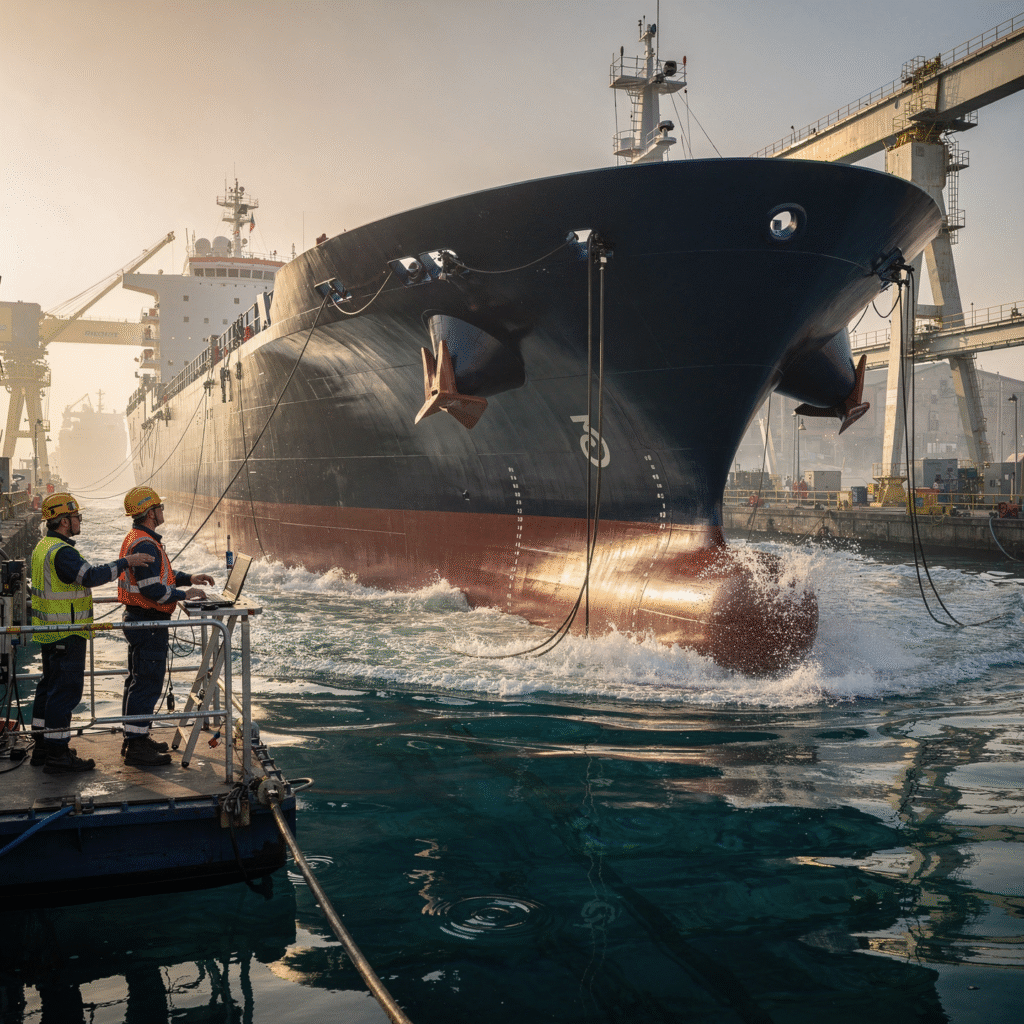
A marine pilot boards a ship from a small boat in open water, often at night, often in weather, climbs a rope ladder up the side of a moving vessel, walks on to a bridge full of people they have never met, and takes navigational charge of a hundred thousand tonnes of ship through water narrow enough to see both banks.
Then they do it again, several times a shift, for a career.
It is among the best-paid maritime careers in the UK, it lets you sleep at home, and it is one of the hardest to get into. There is no application route for people without substantial sea command experience, and there never will be.
What a pilot actually does
A pilot is an expert in a specific piece of water. That is the whole proposition.
A ship’s master may be exceptional and may have commanded for twenty years, but they have never been into this particular port, do not know that the ebb sets hard across the entrance for two hours after high water, do not know that the berth has a shoal patch off the eastern dolphin, and do not know how this class of vessel behaves in that channel at that state of tide.
The pilot does. They board, advise and conduct the vessel in. In UK law the master retains overall command, but in practice the pilot has the conduct of the navigation, and the relationship between those two facts is one of the more interesting things about the job.
Ship handling in confined water. Bank effect, squat, interaction between passing vessels, the behaviour of a loaded versus a ballasted hull, the effect of wind on a high-sided container ship or car carrier.
Tug work. Directing tugs — how many, where made fast, what power, when to push and pull. On large vessels this is most of the skill.
Berthing and unberthing. Bringing a vessel alongside with centimetres of control at the end of hundreds of metres of approach.
Passage through the district. Every pilotage district has its own hazards, traffic patterns and rules.
Bridge team management. Arriving among strangers with varying English and varying competence, establishing what the team can do, and running the passage with them.
The route in
You need to have commanded ships
Almost every UK pilot holds a Master Mariner certificate — the top of the deck ladder — or at minimum senior command-level certification with substantial ship handling experience. Our article on how the MCA Certificate of Competency ladder works sets out that path.
Some ports accept a Chief Mate ticket with strong relevant experience, particularly smaller ports with smaller vessels. But the general rule holds: you cannot become a pilot without first having been responsible for handling ships.
Ports recruit pilots, not a national body
This is the structural point people miss. There is no central UK pilot service. Competent harbour authorities authorise pilots for their own district, individually. That means vacancies arise port by port, unpredictably, often with no advance notice; each port runs its own selection process; and your authorisation is specific to that district and does not transfer.
You watch the ports you want and apply when a vacancy appears. Trust ports, major port operators and the larger estuarial authorities all recruit separately.
Selection
Typically a strong field of experienced mariners. Expect scrutiny of your sea service and command experience, a technical interview on ship handling, collision regulations and local conditions, simulator assessment, medical and eyesight to the required standard — a valid ENG1 and often more — and psychometric testing at some ports.
The thing being assessed is judgement under pressure with incomplete information, because that is the job.
Training and authorisation
Once selected, you train for that district specifically. Supervised trips with authorised pilots, building up through vessel size and complexity. Local knowledge examination. Simulator work. Progressive authorisation: you start restricted to smaller vessels and work up through classes as your experience is signed off.
Full authorisation for the largest vessels takes years from the start of training.
What the life is like
You live at home. After a seagoing career of months away, this is frequently the entire motivation.
But the hours are brutal in a different way. Ships arrive on the tide, not during office hours. Pilots work rosters covering nights, weekends and holidays, and are called out. Broken sleep is the standard complaint.
The boarding is genuinely dangerous. Transferring from a pilot launch to a moving ship by rope ladder in a swell is the most hazardous routine activity in the industry. Pilots are injured and occasionally killed doing it. Ladder rigging standards exist precisely because of this, and pilots refuse non-compliant ladders.
The responsibility is concentrated. Each act of pilotage is short and consequential. There is little margin and the whole thing is over in an hour or two, then you do the next one.
It is weather-dependent and unpredictable. Fog closes the port. A vessel is delayed six hours. The shift you planned evaporates.
What it pays
Pilotage is well paid — among the highest-earning maritime roles available in the UK without going into senior shore management.
Rates vary substantially by port, by vessel traffic, by whether you are employed or self-employed, and by your authorisation class. A pilot at a major container or tanker port handling the largest vessels is in a different bracket from one at a small harbour. For current figures, look at advertised vacancies and the guidance published by the United Kingdom Maritime Pilots’ Association.
Pilotage Exemption Certificates
A Pilotage Exemption Certificate allows a qualifying master or chief mate of a vessel that regularly uses a port to navigate without a pilot, having demonstrated sufficient local knowledge. Ferries and regular liner traffic use PECs extensively.
PECs reduce pilotage demand on regular routes, which is one reason pilot numbers at some ports are flat even where traffic has grown. It is a live commercial and safety debate within the industry.
Where it leads
Pilotage is a destination career for most who enter it. But it is also the most natural feeder into port management. Pilots know the water, the authority, the operators and the commercial pressures better than anyone. The step to deputy harbour master and then harbour master is a well-worn path — see our guide to becoming a harbour master.
Others move into simulator training, pilotage consultancy, incident investigation, or expert witness work.
How Navalis UK fits
Nobody makes a pilot online. The qualification is command experience plus district-specific authorisation from a competent harbour authority, built on supervised trips in real water.
Before. Officers working toward Master and thinking about pilotage benefit from depth in ship handling theory, hydrodynamics in confined water, bridge resource management and the legal framework of pilotage — more depth than the certificate syllabus requires.
After. Pilots moving toward harbour management need the port operations, safety management and regulatory knowledge that pilotage itself does not teach.
Our navigation and operations and port and marina management programmes are built for exactly those two moments. Recognition depends on which programme you complete and on the regulations of the country where you intend to work, and we set that out in writing before you enrol — see recognition and accreditations.
Frequently asked questions
Do I need a Master Mariner certificate?
Most UK ports require it or equivalent command-level certification and experience. Some smaller ports accept a Chief Mate ticket with strong relevant ship handling experience.
Can I apply without going to sea?
No. Pilotage is the application of ship handling experience to a specific district. There is no entry route that bypasses sea service.
Is my authorisation valid at other ports?
No. Authorisation is district-specific. Moving ports means training and qualifying again for that district.
How long does training take?
Initial authorisation for smaller vessels takes months. Progressing to the largest vessel classes takes years.
How do I find vacancies?
Ports recruit individually and often sporadically. Watch the harbour authorities you are interested in, and the UK Maritime Pilots’ Association.
Is the boarding really that dangerous?
Yes. Pilot ladder transfer is the most hazardous routine activity in the industry and there is an active international safety campaign about ladder standards. Pilots are trained and expected to refuse unsafe ladders.
The next step
If you are working toward Master, pilotage is worth planning for early — not because you can apply early, but because the ports you want to work at should be on your radar years before a vacancy appears.
In the meantime, depth in ship handling and port operations is what separates candidates. Browse our programmes by level and field, or ask an adviser which fits the certificates you already hold.