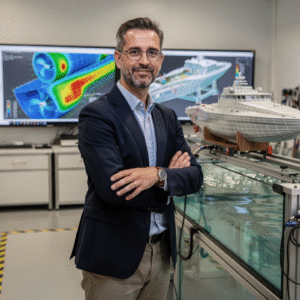
Diploma in Marine Energy Project Management

Why this certificate program?

The Diploma in Marine Energy Project Management

This program prepares you to lead the development of sustainable projects in the maritime sector. Learn to master the complete project lifecycle, from strategic planning to implementation and closure, with a focus on the specific characteristics of ocean renewable energies: offshore wind, wave, and tidal. Acquire the tools and knowledge to assess technical and economic feasibility, manage environmental risks, and optimize the energy efficiency of projects.

Key Benefits

  • Specialized Knowledge: Gain in-depth knowledge of marine energy technologies and their specific challenges.
  • Comprehensive Project Management: Apply agile and traditional methodologies adapted to the energy sector.
  • Financial and Risk Analysis: Evaluate profitability and mitigate risks associated with marine projects.
  • Sustainability and Regulatory Compliance: Integrate environmental criteria and comply with current regulations.
  • Networking: Interact with experts and professionals in the sector through case studies and forums.

Gestión

Diploma in Marine Energy Project Management

Availability: 1 in stock

Who is it aimed at?

  • Energy engineers and managers seeking to specialize in the development of offshore wind, wave, and tidal energy projects.
  • Maritime and port professionals interested in diversifying their expertise towards the new opportunities in ocean renewable energy.
  • Environmental and sustainability consultants needing to deepen their understanding of the impacts and regulations of marine energy projects.
  • Investors and project financiers wishing to assess risks and opportunities in the emerging ocean energy market.
  • Graduates in engineering, environmental science, or economics seeking advanced and applied training in energy project management Marina.

Flexibility and applicability
Ā Adapted for working professionals: 24/7 accessible online content, real case studies, and networking with industry experts.

Gestión

Objectives and competencies

Optimizing efficiency in infrastructure installation:

Implement Lean Construction and BIM methodologies to minimize waste, anticipate problems, and optimize coordination between teams.

Effectively manage the specific risks of the marine environment:

“Assess threats (weather, traffic, restricted areas) and act proactively to minimize risk exposure.”

Ensuring regulatory and environmental compliance in marine projects:

“Implement marine environmental management plans, monitor emissions and discharges, and coordinate with environmental authorities to obtain permits and comply with local and international regulations.”

Leading and coordinating multidisciplinary teams in marine projects:

“Managing conflicts, promoting effective communication and consensus-based decision-making to achieve project objectives, considering the diverse perspectives and experiences of the team.”

Monitor and maintain the integrity of marine assets:

“Implement inspection and predictive maintenance routines, correcting deviations and reporting anomalies in a timely manner.”

Develop investment strategies in marine energy projects:

Evaluate the technical, economic and environmental feasibility, considering the risk-return and the optimization of resources within a clear and adaptable regulatory framework.

Curriculum - Modules

  1. Comprehensive Maritime Incident Management: protocols, roles, and chain of command for coordinated response
  2. Operational Planning and Execution: briefing, routes, weather windows, and go/no-go criteria
  3. Rapid Risk Assessment: criticality matrix, scene control, and decision-making under pressure
  4. Operational Communication: VHF/GMDSS, standardized reports, and inter-agency liaison
  5. Tactical Mobility and Safe Boarding: RHIB maneuvers, approach, mooring, and recovery
  6. Equipment and Technologies: PPE, signaling, satellite tracking, and field data logging
  7. Immediate Care of the Affected: primary assessment, hypothermia, trauma, and stabilization for evacuation
  8. Adverse Environmental Conditions: swell, Visibility, flows, and operational mitigation

    Simulation and training: critical scenarios, use of VR/AR, and exercises with performance metrics

    Documentation and continuous improvement: lessons learned, indicators (MTTA/MTTR), and SOP updates

  1. Introduction to offshore wind energy: global potential and benefits
  2. Regulatory framework and permits: national and international legislation, environmental impact assessment
  3. Offshore wind farm design: site selection, wind and wave studies
  4. Offshore wind turbine technology: types, components, and efficiency
  5. Foundations: monopiles, jackets, floating platforms; Design and Installation

    Connection Infrastructure: Submarine Cables, Marine and Onshore Substations

    Project Financing: Financial Models, Investors, Risks, and Insurance

    Construction and Installation: Logistics, Specialized Vessels, and Safety

    Operation and Maintenance: Monitoring, Inspection, Repairs, and Lifespan

    Decommissioning and Recycling: Planning, Costs, and Sustainability

  1. Introduction to Risk Management: Basic concepts, terminology, and regulations.
  2. Hazard Identification: Methodologies for identifying hazards in different contexts.
  3. Risk Analysis: Qualitative and quantitative risk assessment (probability and impact).
  4. Risk Assessment: Criteria for risk acceptance and prioritization.
  5. Contingency Plan Development: Structure, components, and objectives.
  6. Prevention and Mitigation Measures: Strategies to reduce the probability and impact of risks.
  7. Emergency Response Procedures: Protocols for action in different crisis scenarios.
  8. Emergency Resources and Equipment: Identification, availability, and maintenance.

    Drills and Tests: Design, execution, and evaluation of drills to validate the plan.

    Plan Review and Update: Frequency, criteria, and responsible parties.

  1. Introduction to the Offshore Industry: Overview, Sectors, and Applications.
  2. Marine Geology: Fundamentals of geology, sedimentology, and subsea geotechnics.
  3. Offshore Platform Design and Construction: Types of platforms, foundations, and materials.
  4. Subsea Equipment and Tools: ROVs, AUVs, intervention tools, and diving equipment.
  5. Subsea Inspection, Maintenance, and Repair (IMR): Inspection techniques, maintenance procedures, and repair methods.
  6. Subsea Welding: Types of welding, procedures, and safety.
  7. Subsea Cable and Pipeline Laying Operations: Planning, installation, protection, and maintenance.
  8. Uplift and Dismantling of Subsea Structures: Lifting, cutting, transport, and final disposal procedures.

    Safety and Environment in Subsea Operations: Regulations, risks, mitigation, and emergency response.

    Offshore and Subsea Project Management: Planning, cost control, risk management, and quality assurance.

  1. Introduction to Environmental Impact Assessment (EIA): Key concepts, legislation, and regulations.
  2. Characterization of the Marine Environment: Physical, chemical, and biological oceanography. Types of marine ecosystems (reefs, mangroves, seagrass meadows).
  3. Identification and Assessment of Impacts: Environmental impact assessment methodologies. Identification of potential impacts of marine infrastructure.
  4. Design of Sustainable Marine Infrastructure: Principles of ecological design. Materials and construction techniques with low environmental impact.
  5. Modeling of Environmental Impacts: Use of models to predict the dispersion of pollutants and their effects on marine biota.
  6. Mitigation and Compensation Measures: Strategies to reduce and offset the environmental impacts of marine infrastructure. Restoration of damaged ecosystems.
  7. Environmental Monitoring: Design of monitoring programs to evaluate the effectiveness of mitigation measures. Environmental quality indicators.
  8. Life Cycle Assessment (LCA): Evaluation of the environmental impact of marine infrastructure throughout its life cycle.
  9. Marine Environmental Legislation: International conventions, European directives, and national legislation on the protection of the marine environment.
  10. Case studies: Analysis of Environmental Impact Assessments (EIAs) of marine infrastructure projects (ports, offshore wind farms, submarine cables).

  1. System Architecture and Components: Structural design, materials, and subsystems (mechanical, electrical, electronic, and fluid) with selection and assembly criteria for marine environments
  2. Fundamentals and Principles of Operation: Physical and engineering foundations (thermodynamics, fluid mechanics, electricity, control, and materials) that explain performance and operating limits
  3. Safety and Environmental (SHE): Risk analysis, PPE, LOTO, hazardous atmospheres, spill and waste management, and emergency response plans
  4. Applicable Regulations and Standards: IMO/ISO/IEC requirements and local regulations;
  5. Conformance criteria, certification, and best practices for operation and maintenance
  6. Inspection, testing, and diagnostics: Visual/dimensional inspection, functional testing, data analysis, and predictive techniques (vibration, thermography, fluid analysis) to identify root causes
  7. Preventive and predictive maintenance: Hourly/cycle/seasonal plans, lubrication, adjustments, calibrations, consumable replacement, post-service verification, and operational reliability
  8. Instrumentation, tools, and metrology: Measuring and testing equipment, diagnostic software, calibration and traceability; selection criteria, safe use, and storage
  9. Onboard integration and interfaces: Mechanical, electrical, fluid, and data compatibility; Sealing and watertightness, EMC/EMI, corrosion protection, and interoperability testing.

    Quality, acceptance testing, and commissioning: process and materials control, FAT/SAT, bench and sea trials, go/no-go criteria, and evidence documentation.

    Technical documentation and integrated practice: logs, checklists, reports, and a complete case study (safety → diagnosis → intervention → verification → report) applicable to any system.

  1. Introduction to Offshore Wind Project Financing: Key Players and Financial Models
  2. Financial and Technical Due Diligence: Project Feasibility Assessment
  3. Financing Structures: Project Finance, Corporate Finance, Leasing
  4. Risks in the Development Phase: Permits, Environmental Studies, Design
  5. Risks in the Construction Phase: Delays, Cost Overruns, Technical Failures
  6. Operational Risks: Availability, Performance, Component Failures
  7. Insurance for Construction and Operation: CAR/EAR, DSU, BI
  8. Climate Risk Coverage: Wind, Waves, Storms
  9. Liability Insurance: Third-Party Damage, Pollution
  10. Sensitivity analysis and stress testing: impact on project profitability.

Career opportunities

  • Offshore Wind Farm Project Manager: Planning, execution, and control of marine energy projects, from the design phase to commissioning and operation.
  • Marine Energy Consultant: Providing technical and strategic advice to companies and institutions in the development of marine energy projects.
  • Marine Energy Project Engineer: Design, development, and optimization of infrastructure and systems for marine energy generation.
  • Environmental Impact Assessment Specialist for Marine Energy Projects: Preparation of environmental impact studies and monitoring of mitigation measures in marine energy projects.
  • Marine Energy Facility Maintenance Manager: Planning and management of preventive and corrective maintenance of offshore wind farms and other marine energy facilities.
  • Marine Energy Technology Researcher: Development of new technologies and improvement of existing ones for generating energy from marine sources.
  • Marine Renewable Energy Technician: Installation, operation, and maintenance of marine energy equipment and systems.
  • Supply Chain Manager for Marine Energy Projects: Coordination of logistics and procurement of materials and equipment for marine energy projects.

“`

Admission requirements

Academic/professional profile:

Degree/Bachelor's degree in Nautical Science/Maritime Transport, Naval/Marine Engineering, or a related field; or proven professional experience in bridge/operations.

Language proficiency:

Recommended functional maritime English (SMCP) for simulations and technical materials.

Documentation:

Updated resume, copy of degree or seaman's book, ID card/passport, letter of motivation.

Technical requirements (for online):

Equipment with camera/microphone, stable connection, ≄ 24ā€ monitor recommended for ECDIS/Radar-ARPA.

Admission process and dates

1. Online
application

(form + documents).

2. Academic review and interview

(profile/objectives/schedule compatibility).

3. Admission decision

(+ scholarship proposal if applicable).

4. Reservation of place

(deposit) and registration.

5. Induction

(access to campus, calendars, simulator guides).

Scholarships and grants

  • Master Marine Energy: Learn to manage innovative projects in the ocean energy sector.
  • From Idea to Execution: Understand the key phases, from planning to commissioning and maintenance.
  • Technologies and Trends: Explore the latest technologies in offshore wind, wave, and tidal energy.
  • Risk Management and Sustainability: Integrate sustainability criteria and minimize environmental and economic risks.
  • Simulations and Case Studies: Apply your acquired knowledge through real-world case studies and simulations.
Boost your career in a booming sector and contribute to a sustainable energy future.

Testimonials

Frequently asked questions

Marine energy projects, including offshore wind energy, wave energy, tidal energy, and current energy.

Yes. The itinerary includes ECDIS/Radar-ARPA/BRM with harbor, ocean, fog, storm, and SAR scenarios.

Online with live sessions; hybrid option for simulator/practical placements through agreements.

Recommended functional SMCP. We offer support materials for standard phraseology.

Yes, with a relevant degree or experience in maritime/port operations. The admissions interview will confirm suitability.

Optional (3–6 months) through Companies & Collaborations and the Alumni Network.

Simulator practice (rubrics), defeat plans, SOPs, checklists, micro-tests and applied TFM.

A degree from Navalis Magna University + operational portfolio (tracks, SOPs, reports and KPIs) useful for audits and employment.

  1. Introduction to the Offshore Industry and Marine Renewable Energy (MRE)
  2. Offshore Wind Energy Fundamentals: Resources, Technology, and Challenges
  3. Wave and Tidal Energy: Principles, Technologies, and Potential
  4. Offshore Infrastructure: Types, Design, Installation, and Maintenance
  5. Submarine Cables: Design, Laying, Protection, and Repair
  6. Environmental Impact Assessments (EIAs): Methodologies and Key Considerations
  7. Safety in Offshore Operations: Regulations, Risks, and Procedures
  8. Logistics and Transportation in the Offshore Industry: Vessels, Ports, and the Supply Chain
  9. Economic and Regulatory Aspects: Subsidies, Tenders and legal frameworks
  10. Future trends in the Offshore and ERM industry: Innovation and sustainability

Request information

  1. Complete the Application Form.

  2. Attach your CV/degree certificate (if you have it to hand).

  3. Indicate your preferred cohort (January/May/September) and whether you would like the hybrid option with simulator sessions.

    An academic advisor will contact you within 24–48 hours to guide you through the admission process, scholarships, and compatibility with your professional schedule.

Please enable JavaScript in your browser to complete this form.
Click or drag a file to this area to upload.

Faculty

0
    0
    Tu carrito
    Tu carrito esta vacĆ­oRegresar a la tienda
    Scroll to Top