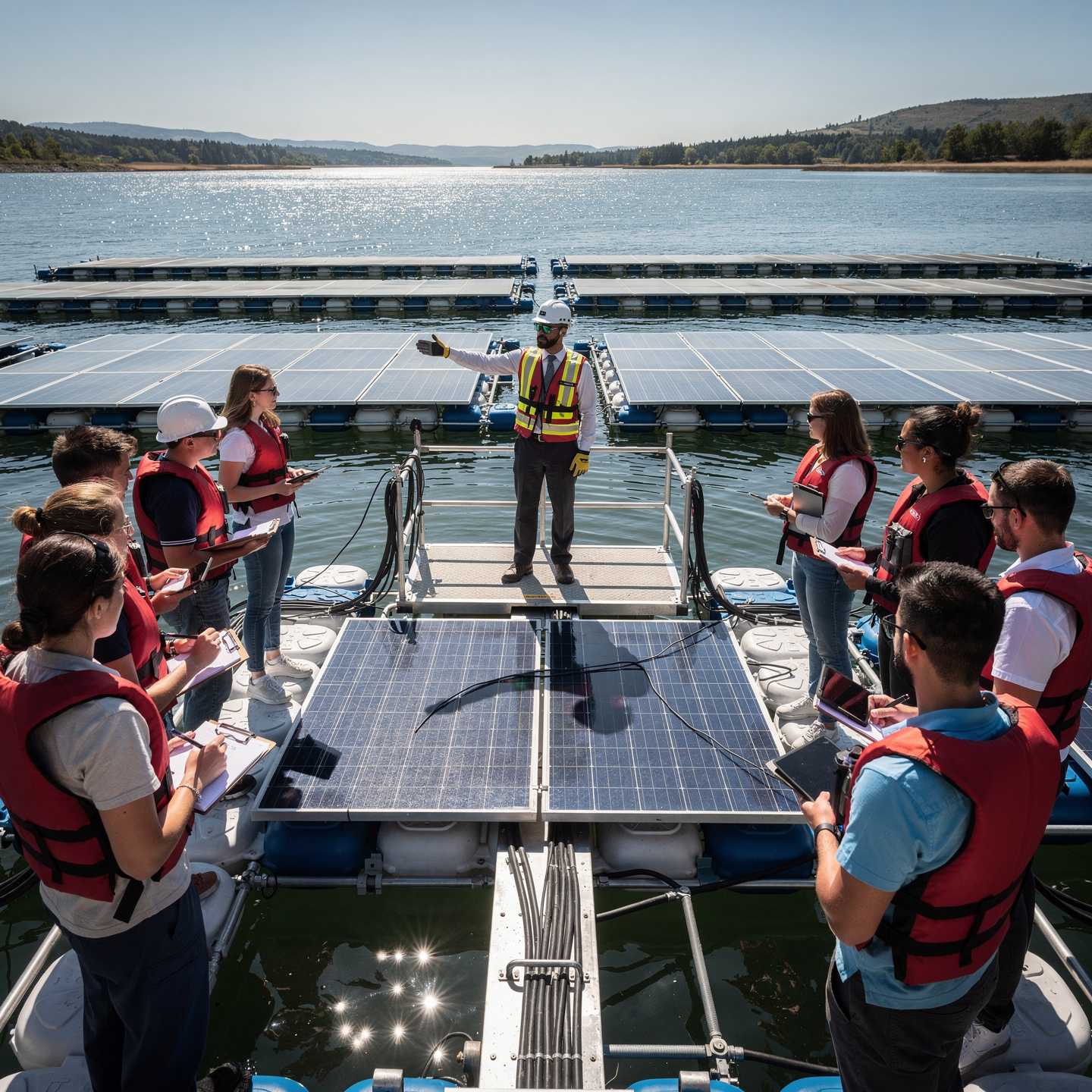
Diploma in Installation and Maintenance of Floating Panels
Why this certificate program?
The Diploma in Floating Solar Panel Installation and Maintenance
This program provides you with the essential skills to master this booming technology. Learn everything from the fundamentals of floating solar energy to advanced installation, operation, and maintenance techniques. Prepare yourself for a sector with high demand for qualified professionals.
Key Benefits
- Technical Mastery: Gain in-depth knowledge of the design, assembly, and connection of floating photovoltaic systems.
- Specialized Maintenance: Learn to diagnose and troubleshoot problems, optimizing panel performance.
- Safety and Regulations: Understand safety protocols and current regulations for floating installations.
- Feasibility Analysis: Evaluate the profitability and environmental impact of floating solar energy projects.
- Applied Practices: Develop practical skills through case studies and simulations.
- Modality: Online
- Level: Diplomado
- Hours: 800 H
- Start date: 01-10-2026
Availability: 1 in stock
Who is it aimed at?
- Architects and interior designers looking to specialize in innovative and sustainable construction systems.
- Installers and maintenance technicians who want to expand their skills in the installation and repair of floating panels.
- Construction professionals interested in incorporating efficient technologies for waterproofing and thermal insulation.
- Construction companies and real estate developers looking to optimize costs and timelines in building and renovation projects.
- Students in technical and engineering fields seeking practical and specialized knowledge in roofing and facade systems.
Academic flexibility
Ā Aimed at active professionals: classes online with flexible hours, access to learning materials 24/7 and personalized follow-up by experts in the sector.
Objectives and competencies

Diagnosing and repairing common faults:
“Use diagnostic tools (multimeter, oscilloscope) to identify defective components and apply standard repair techniques (soldering, component replacement) following technical manuals.”

Apply safety regulations in facilities:
“Identify electrical, mechanical and environmental risks, implementing preventive and corrective measures according to current regulations and emergency procedures.”

Evaluate the technical feasibility of projects:
“Analyze risks, costs and benefits, considering alternatives and simulations.”

Manage installation projects efficiently:
Develop realistic timelines, allocating optimal resources and proactively mitigating risks.

Optimizing the performance of photovoltaic systems:
“Implement advanced monitoring and predictive analytics strategies to maximize energy production and minimize downtime.”

Select and size components appropriately:
Taking into account technical specifications, installation requirements, and safety regulations.
Curriculum - Modules
- Comprehensive Maritime Incident Management: protocols, roles, and chain of command for coordinated response
- Operational Planning and Execution: briefing, routes, weather windows, and go/no-go criteria
- Rapid Risk Assessment: criticality matrix, scene control, and decision-making under pressure
- Operational Communication: VHF/GMDSS, standardized reports, and inter-agency liaison
- Tactical Mobility and Safe Boarding: RHIB maneuvers, approach, mooring, and recovery
- Equipment and Technologies: PPE, signaling, satellite tracking, and field data logging
- Immediate Care of the Affected: primary assessment, hypothermia, trauma, and stabilization for evacuation
- Adverse Environmental Conditions: swell, Visibility, flows, and operational mitigation
Simulation and training: critical scenarios, use of VR/AR, and exercises with performance metrics
Documentation and continuous improvement: lessons learned, indicators (MTTA/MTTR), and SOP updates
- Introduction to anchoring systems: Types, materials, and applications
- Load calculation and dimensioning of anchors: Regulations and safety
- Leveling techniques: Instrumentation, precision, and tolerances
- Thermal insulation: Materials, properties, and installation methods
- Energy optimization in buildings: Passive and active strategies
- Renewable energy systems: Solar photovoltaic, thermal, and wind power
- Energy efficiency in lighting: LED technologies and control
- Energy management systems: Monitoring, control, and analysis
- Maintenance and inspection of systems: Protocols and safety
- Energy regulations and certification: Compliance and sustainability
‘
- Introduction to Solar Floating Systems: Basic concepts, benefits, and challenges.
- Regulations and permits: Legal, environmental, and safety aspects.
- Feasibility studies: Technical, economic, and social analysis of the project.
- Floating system design: Types of floats, materials, and configurations.
- Solar plant engineering: Electrical design, panel selection, and optimization.
- Anchoring and mooring: Fixing methods, stability, and resistance to environmental conditions.
- Assembly and construction: Installation process, quality control, and workplace safety.
- Connection to the electrical grid: Substations, transmission lines, and synchronization.
- Operation and maintenance: Monitoring, cleaning, inspection, and repair.
- Sustainability and life cycle: Environmental impact, recycling, and the circular economy.
‘
- Introduction to anchoring systems: Types and applications.
- Load calculation and dimensioning: Safety factors and regulations.
- Mechanical anchors: Types, installation, and load testing.
- Chemical anchors: Types, applications, and material compatibility.
- Leveling systems: Techniques and tools for precision.
- Laser leveling: Types, operation, and applications on site.
- Humidity control: Diagnosis and types of humidity.
- Waterproofing: Materials, techniques, and applications.
- Ventilation and drainage: Systems for humidity control.
- Maintenance and repair of anchoring, leveling, and humidity control systems.
dampness.
‘
- Introduction to anchoring techniques: types of anchors and their application.
- Principles of leveling: geometric and trigonometric methods.
- Fundamentals of vibrations: types, causes, and effects on structures.
- Selection of materials and tools for anchoring and leveling.
- Anchoring techniques in different types of soil and structures: concrete, steel, wood.
- Leveling procedures with optical and laser equipment.
- Static and dynamic balancing of rotating machinery: methods and tools.
- Vibration isolation: materials and damping systems.
- Vibration measurement and analysis: equipment and software.
- Safety regulations and best practices in anchoring and leveling work and vibration control.
‘
- System Architecture and Components: Structural design, materials, and subsystems (mechanical, electrical, electronic, and fluid) with selection and assembly criteria for marine environments
- Fundamentals and Principles of Operation: Physical and engineering foundations (thermodynamics, fluid mechanics, electricity, control, and materials) that explain performance and operating limits
- Safety and Environmental (SHE): Risk analysis, PPE, LOTO, hazardous atmospheres, spill and waste management, and emergency response plans
- Applicable Regulations and Standards: IMO/ISO/IEC requirements and local regulations;
- Conformance criteria, certification, and best practices for operation and maintenance
- Inspection, testing, and diagnostics: Visual/dimensional inspection, functional testing, data analysis, and predictive techniques (vibration, thermography, fluid analysis) to identify root causes
- Preventive and predictive maintenance: Hourly/cycle/seasonal plans, lubrication, adjustments, calibrations, consumable replacement, post-service verification, and operational reliability
- Instrumentation, tools, and metrology: Measuring and testing equipment, diagnostic software, calibration and traceability; selection criteria, safe use, and storage
- Onboard integration and interfaces: Mechanical, electrical, fluid, and data compatibility; Sealing and watertightness, EMC/EMI, corrosion protection, and interoperability testing.
Quality, acceptance testing, and commissioning: process and materials control, FAT/SAT, bench and sea trials, go/no-go criteria, and evidence documentation.
Technical documentation and integrated practice: logs, checklists, reports, and a complete case study (safety ā diagnosis ā intervention ā verification ā report) applicable to any system.
- Introduction to anchoring systems: types, components, and regulations
- Calculation of wind and snow loads: regulations, coefficients, and simulations
- Leveling systems: topographic methods, laser methods, and structural adjustment
- Energy optimization in buildings: thermal insulation, ventilation, and efficiency
- Photovoltaic solar panels: types, installation, performance, and maintenance
- Anchoring systems for renewable energies: wind, geothermal, and tidal
- Energy monitoring systems: sensors, software, and data analysis
- Energy efficiency in lighting: LED technologies, control, and design
- Energy storage: Batteries, hybrid systems, and demand management
Case studies and examples of energy optimization in different building types
‘
Career opportunities
- Floating Panel Installer: Installation of systems in homes, commercial buildings, and industrial facilities.
- Maintenance Technician: Inspection, diagnosis, and repair of floating panels, ensuring their optimal performance.
- Energy Consultant: Advising on the feasibility and benefits of installing floating panels.
- Photovoltaic Systems Sales Representative: Sales and promotion of floating panels to residential and business clients.
- Photovoltaic Project Manager: Coordination of floating panel installation projects, from planning to commissioning.
- Renewable Energy Technician: Development and application of technologies related to floating solar energy.
- Solar Energy Company Employee: Performance of technical and management functions in energy companies. Solar.
- Entrepreneur: Creation of a company for the installation and maintenance of floating solar panels.
“`
Admission requirements

Academic/professional profile:
Degree/Bachelor's degree in Nautical Science/Maritime Transport, Naval/Marine Engineering, or a related field; or proven professional experience in bridge/operations.

Language proficiency:
Recommended functional maritime English (SMCP) for simulations and technical materials.

Documentation:
Updated resume, copy of degree or seaman's book, ID card/passport, letter of motivation.

Technical requirements (for online):
Equipment with camera/microphone, stable connection, ā„ 24ā monitor recommended for ECDIS/Radar-ARPA.
Admission process and dates

1. Online
application
(form + documents).

2. Academic review and interview
(profile/objectives/schedule compatibility).

3. Admission decision
(+ scholarship proposal if applicable).

4. Reservation of place
(deposit) and registration.

5. Induction
(access to campus, calendars, simulator guides).
Scholarships and grants
- Master Installation: Learn the techniques and regulations for the correct installation of floating panels.
- Expert Maintenance: Acquire skills to diagnose and solve common problems, extending the lifespan of the panels.
- Guaranteed Profitability: Maximize your job opportunities with specialized knowledge in a booming sector.
- Professional Certification: Obtain a recognized diploma that validates your skills and sets you apart in the market.
- Real-World Practice: Apply what you’ve learned in simulations and practical projects for a comprehensive experience.
Testimonials
“Thanks to the Diploma in Installation and Maintenance of Floating Panels, I successfully led the installation of a 1MW system on a reservoir. I not only met the deadlines and stayed within budget, but I also implemented improvements to the anchoring system that increased the stability and lifespan of the project. This achievement allowed me to get a promotion and establish myself as an expert in the sector.”
The Diploma in Marine Renewable Energies exceeded my expectations. I gained a solid technical understanding of the various technologies, from wave energy to offshore wind, including resource analysis, project design, and environmental considerations. This program provided me with the necessary tools to lead projects in this emerging sector and connected me with a valuable network of professionals. Thanks to the training I received, I secured a position at a company specializing in the development of offshore wind farms, where I am directly applying the knowledge I acquired.
Thanks to the Diploma in Installation and Maintenance of Floating Solar Panels, I successfully led the installation of a 1MWp system on a reservoir. The project was completed on time and within budget, exceeding the client’s expectations in terms of energy generation. Furthermore, the knowledge I gained enabled me to implement a predictive maintenance plan that minimizes downtime and maximizes the system’s lifespan.
After completing the Diploma in Installation and Maintenance of Floating Solar Panels, I secured a position as an installation supervisor at a leading solar energy company. My knowledge of anchoring, floating systems, and electrical connections, acquired during the diploma program, enabled me to successfully lead the installation of a 2MW floating solar park, meeting all required deadlines and quality standards.

Frequently asked questions
The floating panels.
Yes. The itinerary includes ECDIS/Radar-ARPA/BRM with harbor, ocean, fog, storm, and SAR scenarios.
Online with live sessions; hybrid option for simulator/practical placements through agreements.
Recommended functional SMCP. We offer support materials for standard phraseology.
Yes, with a relevant degree or experience in maritime/port operations. The admissions interview will confirm suitability.
Optional (3ā6 months) through Companies & Collaborations and the Alumni Network.
Simulator practice (rubrics), defeat plans, SOPs, checklists, micro-tests and applied TFM.
A degree from Navalis Magna University + operational portfolio (tracks, SOPs, reports and KPIs) useful for audits and employment.
- Introduction to Solar Floating Systems: Concept, Benefits, and Challenges
- Types of Floating Photovoltaic Systems: Differences and Applications
- Main Components: Solar Panels, Floats, Anchors, Inverters
- Structural Design of Floating Platforms: Materials, Stability, and Durability
- Hydraulic Engineering: Wave, Wind, and Dynamic Load Analysis
- Anchoring and Mooring: Systems, Design, Installation, and Maintenance
- Electrical Connection: Submarine Cables, Protections, and Grounding
- Environmental Impact: Assessment, Mitigation, and Regulations
- Assembly and Installation: Procedures, Safety, and Best Practices
- Monitoring and Performance: Production Tracking, Maintenance, and optimization.
‘
Request information
Complete the Application Form.
Attach your CV/degree certificate (if you have it to hand).
Indicate your preferred cohort (January/May/September) and whether you would like the hybrid option with simulator sessions.
An academic advisor will contact you within 24ā48 hours to guide you through the admission process, scholarships, and compatibility with your professional schedule.
Faculty
Eng. TomƔs Riera
Full Professor
Eng. TomƔs Riera
Full Professor
Eng. SofĆa Marquina
Full Professor
Eng. SofĆa Marquina
Full Professor
Eng. Javier BaƱuls
Full Professor
Eng. Javier BaƱuls
Full Professor
Dr. Nuria Llobregat
Full Professor
Dr. Nuria Llobregat
Full Professor
Dr. Pau Ferrer
Full Professor
Dr. Pau Ferrer
Full Professor
Cap. Javier Abaroa (MCA)
Full Professor
Cap. Javier Abaroa (MCA)
Full Professor

