Diploma in Tidal and Wave Energy

Why this certificate program?

The Diploma in Tidal and Wave Energy

Immerse yourself in the future of renewable energy, exploring the immense potential of the oceans. Learn about the key technologies for converting tidal and wave energy into electricity, from the theoretical foundations to practical applications and implementation challenges. Acquire the skills needed to participate in the development of marine energy projects, contributing to a sustainable energy future.

Differential Advantages

  • In-depth Analysis: Tidal energy conversion technologies (barriers, turbines) and wave energy technologies (point absorbers, attenuators).
  • Modeling and Simulation: Software tools for resource assessment and design optimization.
  • Environmental Aspects: Environmental impact assessment and mitigation strategies.
  • Regulation and Financing: Regulatory frameworks, incentive policies, and investment models in marine energy.
  • Case Studies: Analysis of successful projects and lessons learned globally.
mareomotriz

Diploma in Tidal and Wave Energy

Availability: 1 in stock

Who is it aimed at?

  • Engineers and technicians seeking to specialize in marine renewable energy, design, and operation of conversion systems.
  • Consultants and project developers interested in resource assessment, feasibility studies, and financing of tidal and wave energy plants.
  • Energy and environmental policymakers who need to understand the potential and challenges of these technologies for the energy transition.
  • Researchers and academics wishing to delve into the latest innovations in materials, hydrodynamics, and ocean energy system modeling.
  • Students of engineering, environmental science, and related fields seeking a distinctive professional profile in the energy sector renewables.

Study flexibility:
Learn at your own pace with asynchronous content accessible 24/7, discussion forums, and personalized online tutoring.

mareomotriz

Objectives and competencies

Assessing the energy potential of coastal sites:

Analyze available wind, wave, and ocean current data, considering the technical and economic feasibility of different utilization technologies.

Design and optimize wave energy conversion systems:

“Modeling wave behavior, fluid-structure interaction, and energy performance using advanced simulation software.”

Managing marine energy projects from conception to commissioning:

“Define scope, budget and timeline, managing risks and ensuring regulatory and environmental compliance.”

Analyze the economic and environmental viability of tidal and wave energy projects:

Evaluate the energy potential, investment costs, operation and maintenance, ecological impact, and regulatory framework to determine the technical and financial feasibility of marine energy technologies.
Implement maintenance and operation strategies for tidal and wave power plants:

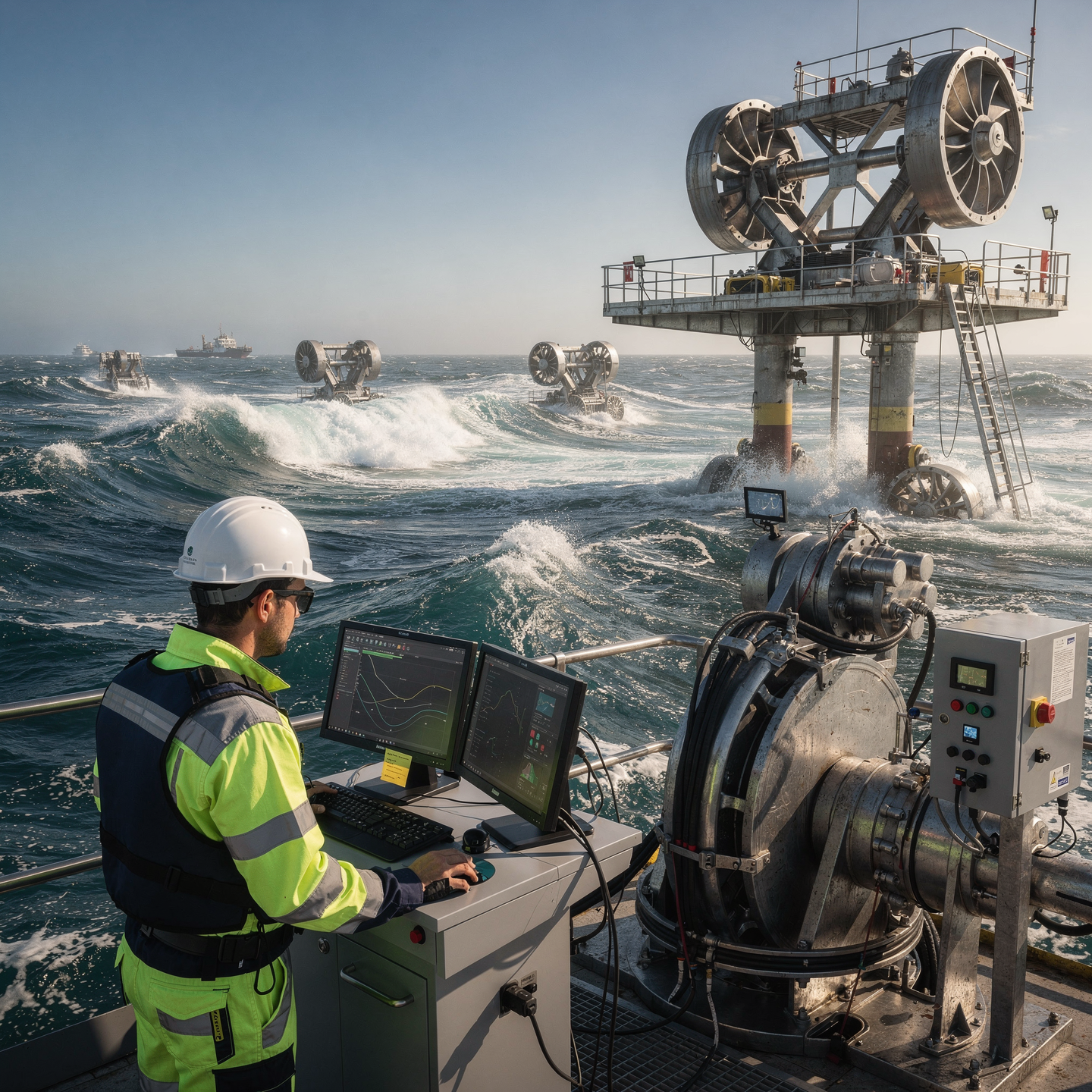
“Optimize energy efficiency through continuous monitoring, data analysis, and proactive adjustments of key operating parameters (turbines, generators, control systems) to maximize production and minimize downtime.”

Develop predictive models for tidal and wave energy generation:

“Using Machine Learning algorithms (neural networks, regression, decision trees) with historical and real-time data (tides, waves, weather) to optimize efficiency and predict energy production.”

Curriculum - Modules

  1. Comprehensive Maritime Incident Management: protocols, roles, and chain of command for coordinated response
  2. Operational Planning and Execution: briefing, routes, weather windows, and go/no-go criteria
  3. Rapid Risk Assessment: criticality matrix, scene control, and decision-making under pressure
  4. Operational Communication: VHF/GMDSS, standardized reports, and inter-agency liaison
  5. Tactical Mobility and Safe Boarding: RHIB maneuvers, approach, mooring, and recovery
  6. Equipment and Technologies: PPE, signaling, satellite tracking, and field data logging
  7. Immediate Care of the Affected: primary assessment, hypothermia, trauma, and stabilization for evacuation
  8. Adverse Environmental Conditions: swell, Visibility, flows, and operational mitigation

    Simulation and training: critical scenarios, use of VR/AR, and exercises with performance metrics

    Documentation and continuous improvement: lessons learned, indicators (MTTA/MTTR), and SOP updates

  1. Introduction to marine energies: waves, tides, currents, thermal and salinity gradients.
  2. Waves: Wave theory, wave spectrum, prediction, and resource characterization.
  3. Tidal energy: Operating principles, barrier technologies, and tidal current turbines.
  4. Ocean current energy: Resource assessment, turbine design, and performance optimization.
  5. Wave energy: Floating and submerged devices, energy conversion and storage systems.
  6. Ocean thermal gradient energy (OTEC): Rankine cycles, efficiency, and limitations.
  7. Salinity gradient energy: Reverse osmosis and electrodialysis processes, feasibility, and Applications.
  8. Materials and design for marine environments: Corrosion, biofouling, and resistance to extreme conditions.
  9. Integration of capture and conversion systems: Grid connection, energy storage, and demand management.
  10. Environmental impact and sustainability of marine energy capture and conversion technologies.

  1. Introduction to Technological Development in the Energy Sector
  2. Fundamentals of Energy Modeling: Material and Energy Balances
  3. Energy Simulation Tools: Software and Platforms
  4. Modeling of Renewable Energy Systems: Solar, Wind, Hydropower
  5. Modeling of Conventional Generation Systems: Thermal, Combined Cycle
  6. Energy Optimization of Buildings and Industrial Facilities
  7. Life Cycle Assessment (LCA) and Carbon Footprint of Technologies
  8. Integration of Technologies: Smart Grids, Energy Storage
  9. Economic Evaluation of Energy Technology Development Projects
  10. Trends and Future of Technological Development and Modeling energetic

  1. Introduction to marine energies: types, potential, and challenges
  2. Waves: characterization, modeling, and prediction of the resource
  3. Ocean currents: types, global and local patterns, and variability
  4. Tidal energy: cycles, amplitudes, resonance, and optimal location
  5. Salt gradients: principles, technologies, and potential applications
  6. Ocean thermal energy conversion (OTEC): thermodynamic cycles, efficiency, and feasibility
  7. Materials and corrosion in marine environments: selection and protection
  8. Design and sizing of marine structures for energy harvesting
  9. Life cycle assessment (LCA) of energy technologies marine
  10. Legal and regulatory framework for the development of marine energy projects

  1. Introduction to Ocean Energy: Types, Potential, and Global Distribution
  2. Waves: Formation, Characteristics, Modeling, and Prediction
  3. Tidal Energy: Fundamentals, Cycles, and Optimal Site Locations
  4. Ocean Current Energy: Principles and Geomorphological Intensification
  5. Salt and Thermal Gradient Energy: Principles and Extraction Technologies
  6. Ocean Resource Assessment: Measurement and Modeling Methodologies
  7. Environmental Impact of Ocean Energy Harvesting: Case Studies and Mitigation
  8. Ocean Energy Conversion Technologies: Types, Efficiency, and State of the Art
  9. Design and Optimization of Harvesting Devices: Hydrodynamics and Structural Aspects
  10. Grid Connection Electrical: Infrastructure, challenges and opportunities

  1. System Architecture and Components: Structural design, materials, and subsystems (mechanical, electrical, electronic, and fluid) with selection and assembly criteria for marine environments
  2. Fundamentals and Principles of Operation: Physical and engineering foundations (thermodynamics, fluid mechanics, electricity, control, and materials) that explain performance and operating limits
  3. Safety and Environmental (SHE): Risk analysis, PPE, LOTO, hazardous atmospheres, spill and waste management, and emergency response plans
  4. Applicable Regulations and Standards: IMO/ISO/IEC requirements and local regulations;
  5. Conformance criteria, certification, and best practices for operation and maintenance
  6. Inspection, testing, and diagnostics: Visual/dimensional inspection, functional testing, data analysis, and predictive techniques (vibration, thermography, fluid analysis) to identify root causes
  7. Preventive and predictive maintenance: Hourly/cycle/seasonal plans, lubrication, adjustments, calibrations, consumable replacement, post-service verification, and operational reliability
  8. Instrumentation, tools, and metrology: Measuring and testing equipment, diagnostic software, calibration and traceability; selection criteria, safe use, and storage
  9. Onboard integration and interfaces: Mechanical, electrical, fluid, and data compatibility; Sealing and watertightness, EMC/EMI, corrosion protection, and interoperability testing.

    Quality, acceptance testing, and commissioning: process and materials control, FAT/SAT, bench and sea trials, go/no-go criteria, and evidence documentation.

    Technical documentation and integrated practice: logs, checklists, reports, and a complete case study (safety → diagnosis → intervention → verification → report) applicable to any system.

  1. Introduction to Tidal Energy: Global Potential and Perspectives
  2. Fundamentals of Tides: Causes, Types, Harmonic Components, and Prediction
  3. Potential Sites: Resource Assessment, Feasibility Studies, and Selection
  4. Tidal Energy Conversion Technologies: Tidal Barrages, Tidal Stream Turbines, and Hybrid Systems
  5. Tidal Barrage Design: Hydrological, Geotechnical, and Structural Aspects
  6. Tidal Stream Turbine Design: Aerodynamics/Hydrodynamics, Materials, and Control Systems
  7. Environmental Impact of Tidal Power Plants: Flora, Fauna, Sedimentation, and Water Quality
  8. Operation of Tidal Power Plants: Scheduling, Control, and Energy generation and management

    Preventive and corrective maintenance: inspection, repair, and replacement of components
    Regulations and safety in tidal power plants: standards, protocols, and risk management

Career opportunities

  • Design and Development Engineer: Creation of new devices and optimization of existing technologies for tidal and wave energy conversion.
  • Maintenance and Installation Technician: Supervision and execution of the installation, repair, and maintenance of infrastructure and equipment in marine energy plants.
  • Energy Consultant: Advising companies and governments on the feasibility, implementation, and management of tidal and wave energy projects.
  • Energy Project Manager: Planning, coordination, and supervision of marine energy plant construction and operation projects.
  • Researcher and Technology Developer: Participation in research projects to improve the efficiency, sustainability, and profitability of tidal and wave energy technologies.
  • Energy Resource Analyst: Evaluation of the energy potential of tides and waves in different Geographic locations.
  • Environmental Impact Specialist: Assessment and mitigation of the environmental impacts of marine energy plants.
  • Renewable Energy Marketer: Sale and promotion of energy generated from tidal and wave sources.

“`

Admission requirements

Academic/professional profile:

Degree/Bachelor's degree in Nautical Science/Maritime Transport, Naval/Marine Engineering, or a related field; or proven professional experience in bridge/operations.

Language proficiency:

Recommended functional maritime English (SMCP) for simulations and technical materials.

Documentation:

Updated resume, copy of degree or seaman's book, ID card/passport, letter of motivation.

Technical requirements (for online):

Equipment with camera/microphone, stable connection, ≥ 24” monitor recommended for ECDIS/Radar-ARPA.

Admission process and dates

1. Online
application

(form + documents).

2. Academic review and interview

(profile/objectives/schedule compatibility).

3. Admission decision

(+ scholarship proposal if applicable).

4. Reservation of place

(deposit) and registration.

5. Induction

(access to campus, calendars, simulator guides).

Scholarships and grants

  • Marine Energy Mastery: Learn to design, implement, and manage tidal and wave energy projects, contributing to a sustainable energy future.
  • Advanced Technologies: Explore in depth the latest ocean energy conversion technologies, from wave energy converters to tidal turbines.
  • Simulation and Modeling: Acquire practical skills in simulation and modeling of marine energy systems, optimizing performance and reducing costs.
  • Environmental Impact and Regulations: Understand the environmental impact of marine energy projects and the applicable national and regulations.
  • Project Development: Train to lead the development of tidal and wave energy projects, from the conceptual phase to commissioning. Boost your career in the renewable energy sector with this specialized diploma.

Testimonials

Frequently asked questions

Yes. The itinerary includes ECDIS/Radar-ARPA/BRM with harbor, ocean, fog, storm, and SAR scenarios.

Online with live sessions; hybrid option for simulator/practical placements through agreements.

Recommended functional SMCP. We offer support materials for standard phraseology.

Yes, with a relevant degree or experience in maritime/port operations. The admissions interview will confirm suitability.

Optional (3–6 months) through Companies & Collaborations and the Alumni Network.

Simulator practice (rubrics), defeat plans, SOPs, checklists, micro-tests and applied TFM.

A degree from Navalis Magna University + operational portfolio (tracks, SOPs, reports and KPIs) useful for audits and employment.

  1. Introduction to Marine Energy: Types, Potential, and Global Distribution
  2. Waves: Theory, Modeling, Characterization, and Prediction
  3. Wave Energy: Conversion Principles, Technologies, and Classification
  4. Wave Energy Converters: Attenuators, Point Absorbers, Oscillating Water Columns
  5. Tides: Generation, Modeling, and Prediction of Tides
  6. Tidal Energy: Tidal Barrages, Tidal Stream Turbines
  7. Tidal Stream Turbines: Design, Operation, Performance, and Optimization
  8. Ocean Thermal Energy Conversion (OTEC): Open, Closed, and Hybrid Cycles
  9. Salt Gradient Energy: Forward and Pressure-retarded reverse osmosis (PRO)

    Environmental impact of marine energy technologies and mitigation strategies

Request information

  1. Complete the Application Form.

  2. Attach your CV/degree certificate (if you have it to hand).

  3. Indicate your preferred cohort (January/May/September) and whether you would like the hybrid option with simulator sessions.

    An academic advisor will contact you within 24–48 hours to guide you through the admission process, scholarships, and compatibility with your professional schedule.

Please enable JavaScript in your browser to complete this form.
Click or drag a file to this area to upload.

Faculty

0
    0
    Tu carrito
    Tu carrito esta vacíoRegresar a la tienda
    Scroll to Top