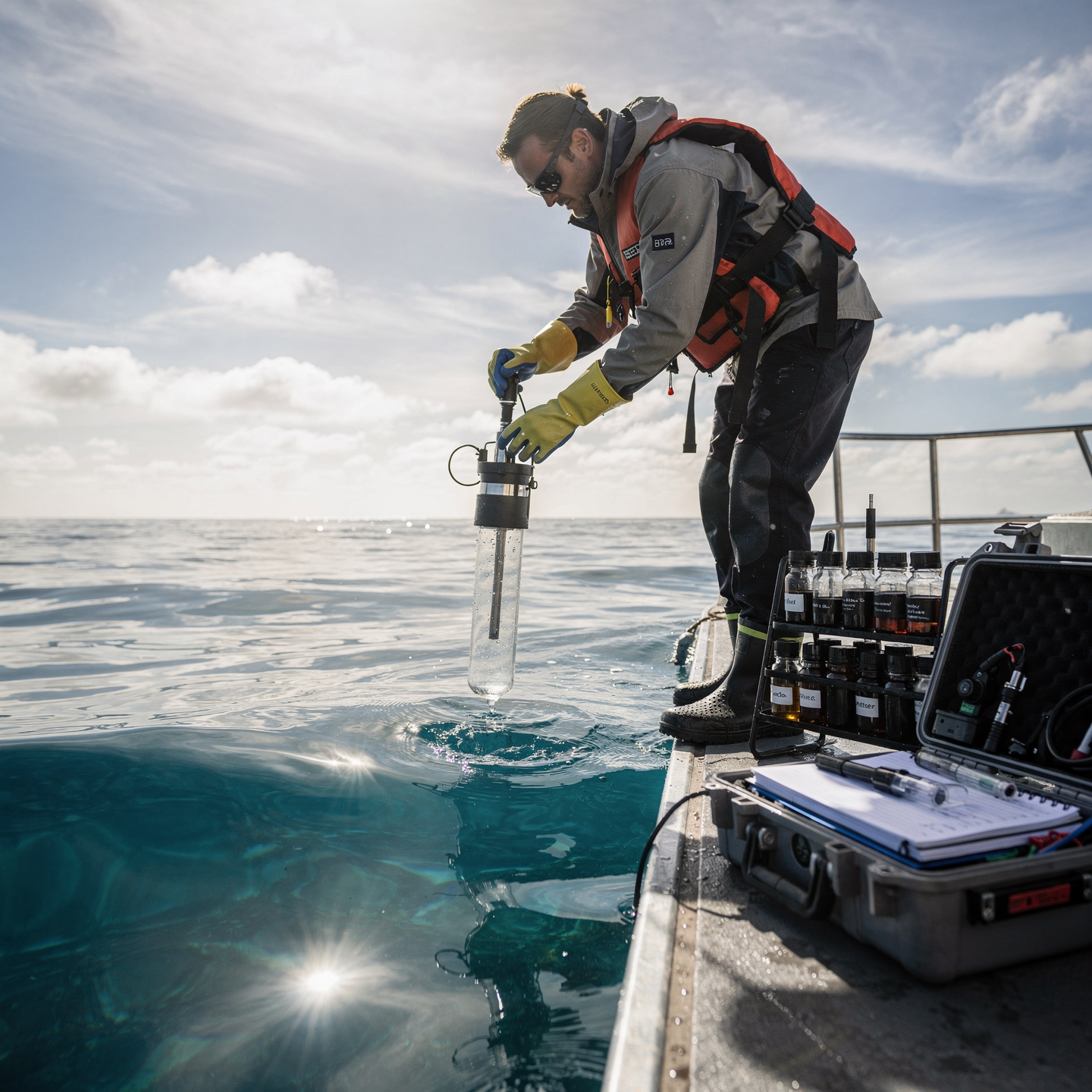
Water Sampling Techniques Course

Why this course?

The Water Sampling Techniques course

This course provides you with the essential tools to obtain representative and reliable samples. Master the most commonly used sampling methods, from surface water collection to groundwater extraction. You will learn to minimize contamination, select the appropriate materials, and apply preservation and transport protocols to ensure the integrity of your samples. Ideal for environmental professionals, laboratory technicians, and students seeking a solid foundation in water quality analysis.

Differential Advantages

  • Practical Approach: simulation exercises and real-world case study examples.
  • Standardized Protocols: application of national and international standards (ISO, EPA).
  • Specialized Equipment: knowledge of sampling instruments and devices.
  • Risk Management: identification and control of error sources during the process.
  • Certification: obtain a certificate of completion that validates your knowledge and skills.
Técnicas

Water Sampling Techniques Course

Availability: 1 in stock

Who is it aimed at?

  • Laboratory technicians seeking to master sampling techniques and ensure water quality.
  • Environmental consultants needing to obtain representative samples for accurate analysis and regulatory compliance.
  • Engineers and managers of water treatment plants requiring to optimize quality control and process efficiency.
  • Students and recent graduates in environmental science, chemistry, or biology seeking to specialize in water sampling and analysis.
  • Professionals in the agricultural and agro-industrial sectors interested in evaluating water quality for irrigation and animal consumption.

Flexibility
Online course with materials downloadable, discussion forums and unlimited access to learn at your own pace and from anywhere.

Técnicas

Objectives and competencies

Apply representative sampling methods:

“Selecting techniques (random, stratified, systematic) and calculating the appropriate sample size.”

Ensure the traceability of the collected samples:

Implement a rigorous digital labeling and registration system with data redundancy and verification at each stage of the process.

Evaluate water quality through sample analysis:

Accurately, using portable analysis kits and standardized protocols (EPA/ISO) to determine key physicochemical and microbiological parameters.

Comply with current environmental regulations:

Implement waste and emissions management protocols, ensuring compliance with established limits and minimizing the environmental impact of operations.

Minimize variability in sample collection:

“Standardize sampling procedures, train staff, and use calibrated and validated equipment.”

Optimize the representativeness of the samples obtained:

“Implement standardized sampling protocols and perform periodic equipment calibrations.”

Curriculum - Modules

  1. Comprehensive Maritime Incident Management: protocols, roles, and chain of command for coordinated response
  2. Operational Planning and Execution: briefing, routes, weather windows, and go/no-go criteria
  3. Rapid Risk Assessment: criticality matrix, scene control, and decision-making under pressure
  4. Operational Communication: VHF/GMDSS, standardized reports, and inter-agency liaison
  5. Tactical Mobility and Safe Boarding: RHIB maneuvers, approach, mooring, and recovery
  6. Equipment and Technologies: PPE, signaling, satellite tracking, and field data logging
  7. Immediate Care of the Affected: primary assessment, hypothermia, trauma, and stabilization for evacuation
  8. Adverse Environmental Conditions: swell, Visibility, flows, and operational mitigation

    Simulation and training: critical scenarios, use of VR/AR, and exercises with performance metrics

    Documentation and continuous improvement: lessons learned, indicators (MTTA/MTTR), and SOP updates

  1. Introduction to Water Sampling: Objectives, Sampling Types, and Applications.
  2. Regulations and Legislation: Water Quality Standards (national and international).
  3. Sampling Planning: Strategy design, site selection, frequency, and parameters.
  4. Sampling Equipment: Types of bottles, multiparameter probes, and in-situ measurement equipment.
  5. Sampling Techniques: Surface water, groundwater, drinking water, and wastewater.
  6. Sample Preservation and Transport: Refrigeration, fixation, and chain of custody.
  7. Quality Control in Sampling: Field blanks, duplicates, and reference materials.
  8. Safety in the Sampling: Environmental risks, PPE and safety protocols.
  9. Documentation and Record Keeping: Field sheets, reports, and sample traceability.

  10. Interpretation of Results: Basic statistical analysis and water quality assessment.

  1. Introduction to Water Sampling: Objectives, sample types, and applications.
  2. Legal and Regulatory Framework: National and international standards, environmental legislation.
  3. Sampling Planning: Sampling network design, site selection, and frequency.
  4. Equipment and Materials: Types of samplers, containers, preservatives, and their correct use.
  5. Sampling Techniques: Sampling of surface water, groundwater, wastewater, and seawater.
  6. Sampling Protocols: Standardized procedures, documentation, and chain of custody.
  7. In-situ Measurements: Physicochemical parameters (temperature, pH, conductivity, dissolved oxygen).
  8. Preservation and Transport
  9. Sample handling: Preservation methods, packaging, and transport requirements.
  10. Quality control in sampling: Field blanks, duplicates, reference materials, and traceability assurance.
  11. Safety in sampling: Hazard identification, personal protective equipment, and emergency procedures.

  1. Introduction to water sampling: Objectives, sample types, and representativeness.
  2. Regulations and legislation: Water framework directives, quality standards, and national and international guidelines.
  3. Sampling equipment: Niskin bottles, peristaltic pumps, bottom samplers, and in-situ devices.
  4. Surface and depth sampling techniques: Stratification, sampling points, and sample volume.
  5. Wastewater sampling: Control points, proportional sampling, and effluent management.
  6. Sample preservation: Refrigeration, addition of preservatives, and maximum storage times.
  7. Transport and chain of custody: Documentation, appropriate packaging, and sample tracking.
  8. Control of Sampling quality: Field blanks, duplicates, and variability assessment.

    In situ analysis: Measurement of pH, conductivity, dissolved oxygen, and temperature.

    Sample safety: Personal protective equipment (PPE), handling of hazardous substances, and emergency protocols.

  1. Introduction to water sampling: objectives, types, and applications
  2. Regulations and legislation: national and international standards
  3. Sampling planning: design, site selection, frequency
  4. Sampling equipment: bottles, pumps, probes, and materials
  5. Sampling techniques: surface, depth, sediment, biological
  6. Sample preservation and transport: refrigeration, additives, chain of custody
  7. Quality control in sampling: blanks, duplicates, calibration
  8. In situ measurements: pH, conductivity, dissolved oxygen, temperature
  9. Safety in sampling: risks, PPE, emergency protocols
  10. Documentation and record-keeping: field sheets, reports, traceability

  1. System Architecture and Components: Structural design, materials, and subsystems (mechanical, electrical, electronic, and fluid) with selection and assembly criteria for marine environments
  2. Fundamentals and Principles of Operation: Physical and engineering foundations (thermodynamics, fluid mechanics, electricity, control, and materials) that explain performance and operating limits
  3. Safety and Environmental (SHE): Risk analysis, PPE, LOTO, hazardous atmospheres, spill and waste management, and emergency response plans
  4. Applicable Regulations and Standards: IMO/ISO/IEC requirements and local regulations;
  5. Conformance criteria, certification, and best practices for operation and maintenance
  6. Inspection, testing, and diagnostics: Visual/dimensional inspection, functional testing, data analysis, and predictive techniques (vibration, thermography, fluid analysis) to identify root causes
  7. Preventive and predictive maintenance: Hourly/cycle/seasonal plans, lubrication, adjustments, calibrations, consumable replacement, post-service verification, and operational reliability
  8. Instrumentation, tools, and metrology: Measuring and testing equipment, diagnostic software, calibration and traceability; selection criteria, safe use, and storage
  9. Onboard integration and interfaces: Mechanical, electrical, fluid, and data compatibility; Sealing and watertightness, EMC/EMI, corrosion protection, and interoperability testing.

    Quality, acceptance testing, and commissioning: process and materials control, FAT/SAT, bench and sea trials, go/no-go criteria, and evidence documentation.

    Technical documentation and integrated practice: logs, checklists, reports, and a complete case study (safety → diagnosis → intervention → verification → report) applicable to any system.

Plan de estudio - Módulos

  1. Comprehensive Maritime Incident Management: protocols, roles, and chain of command for coordinated response
  2. Operational Planning and Execution: briefing, routes, weather windows, and go/no-go criteria
  3. Rapid Risk Assessment: criticality matrix, scene control, and decision-making under pressure
  4. Operational Communication: VHF/GMDSS, standardized reports, and inter-agency liaison
  5. Tactical Mobility and Safe Boarding: RHIB maneuvers, approach, mooring, and recovery
  6. Equipment and Technologies: PPE, signaling, satellite tracking, and field data logging
  7. Immediate Care of the Affected: primary assessment, hypothermia, trauma, and stabilization for evacuation
  8. Adverse Environmental Conditions: swell, Visibility, flows, and operational mitigation

    Simulation and training: critical scenarios, use of VR/AR, and exercises with performance metrics

    Documentation and continuous improvement: lessons learned, indicators (MTTA/MTTR), and SOP updates

  1. Introduction to Water Sampling: Objectives, Sampling Types, and Applications.
  2. Regulations and Legislation: Water Quality Standards (national and international).
  3. Sampling Planning: Strategy design, site selection, frequency, and parameters.
  4. Sampling Equipment: Types of bottles, multiparameter probes, and in-situ measurement equipment.
  5. Sampling Techniques: Surface water, groundwater, drinking water, and wastewater.
  6. Sample Preservation and Transport: Refrigeration, fixation, and chain of custody.
  7. Quality Control in Sampling: Field blanks, duplicates, and reference materials.
  8. Safety in the Sampling: Environmental risks, PPE and safety protocols.
  9. Documentation and Record Keeping: Field sheets, reports, and sample traceability.

  10. Interpretation of Results: Basic statistical analysis and water quality assessment.

  1. Introduction to Water Sampling: Objectives, sample types, and applications.
  2. Legal and Regulatory Framework: National and international standards, environmental legislation.
  3. Sampling Planning: Sampling network design, site selection, and frequency.
  4. Equipment and Materials: Types of samplers, containers, preservatives, and their correct use.
  5. Sampling Techniques: Sampling of surface water, groundwater, wastewater, and seawater.
  6. Sampling Protocols: Standardized procedures, documentation, and chain of custody.
  7. In-situ Measurements: Physicochemical parameters (temperature, pH, conductivity, dissolved oxygen).
  8. Preservation and Transport
  9. Sample handling: Preservation methods, packaging, and transport requirements.
  10. Quality control in sampling: Field blanks, duplicates, reference materials, and traceability assurance.
  11. Safety in sampling: Hazard identification, personal protective equipment, and emergency procedures.

  1. Introduction to water sampling: Objectives, sample types, and representativeness.
  2. Regulations and legislation: Water framework directives, quality standards, and national and international guidelines.
  3. Sampling equipment: Niskin bottles, peristaltic pumps, bottom samplers, and in-situ devices.
  4. Surface and depth sampling techniques: Stratification, sampling points, and sample volume.
  5. Wastewater sampling: Control points, proportional sampling, and effluent management.
  6. Sample preservation: Refrigeration, addition of preservatives, and maximum storage times.
  7. Transport and chain of custody: Documentation, appropriate packaging, and sample tracking.
  8. Control of Sampling quality: Field blanks, duplicates, and variability assessment.

    In situ analysis: Measurement of pH, conductivity, dissolved oxygen, and temperature.

    Sample safety: Personal protective equipment (PPE), handling of hazardous substances, and emergency protocols.

  1. Introduction to water sampling: objectives, types, and applications
  2. Regulations and legislation: national and international standards
  3. Sampling planning: design, site selection, frequency
  4. Sampling equipment: bottles, pumps, probes, and materials
  5. Sampling techniques: surface, depth, sediment, biological
  6. Sample preservation and transport: refrigeration, additives, chain of custody
  7. Quality control in sampling: blanks, duplicates, calibration
  8. In situ measurements: pH, conductivity, dissolved oxygen, temperature
  9. Safety in sampling: risks, PPE, emergency protocols
  10. Documentation and record-keeping: field sheets, reports, traceability

  1. System Architecture and Components: Structural design, materials, and subsystems (mechanical, electrical, electronic, and fluid) with selection and assembly criteria for marine environments
  2. Fundamentals and Principles of Operation: Physical and engineering foundations (thermodynamics, fluid mechanics, electricity, control, and materials) that explain performance and operating limits
  3. Safety and Environmental (SHE): Risk analysis, PPE, LOTO, hazardous atmospheres, spill and waste management, and emergency response plans
  4. Applicable Regulations and Standards: IMO/ISO/IEC requirements and local regulations;
  5. Conformance criteria, certification, and best practices for operation and maintenance
  6. Inspection, testing, and diagnostics: Visual/dimensional inspection, functional testing, data analysis, and predictive techniques (vibration, thermography, fluid analysis) to identify root causes
  7. Preventive and predictive maintenance: Hourly/cycle/seasonal plans, lubrication, adjustments, calibrations, consumable replacement, post-service verification, and operational reliability
  8. Instrumentation, tools, and metrology: Measuring and testing equipment, diagnostic software, calibration and traceability; selection criteria, safe use, and storage
  9. Onboard integration and interfaces: Mechanical, electrical, fluid, and data compatibility; Sealing and watertightness, EMC/EMI, corrosion protection, and interoperability testing.

    Quality, acceptance testing, and commissioning: process and materials control, FAT/SAT, bench and sea trials, go/no-go criteria, and evidence documentation.

    Technical documentation and integrated practice: logs, checklists, reports, and a complete case study (safety → diagnosis → intervention → verification → report) applicable to any system.

  1. Introduction to Water Quality and Traceability: Importance and Legal Framework
  2. Fundamentals of Sampling: Objectives, Types of Sampling (Random, Stratified, Systematic)
  3. Sampling Planning: Design, Selection of Points, Frequency, Volume
  4. Sampling Equipment and Materials: Types, Preparation, Calibration, and Maintenance
  5. Sampling Techniques: Surface Water, Groundwater, Wastewater, Drinking Water
  6. Sample Preservation and Transport: Methods, Maximum Times, Chain of Custody
  7. Quality Control in Sampling: Field Blanks, Duplicates, Reference Materials
  8. Documentation and Record Keeping: Formats, Traceability, Chain of Custody
  9. Applicable Regulations: National and International (ISO) 5667, etc.)
  10. Sampling Safety: Risks, Personal Protective Equipment (PPE), Emergency Protocols

  1. Introduction to Aquatic Sampling: Objectives, types of sampling, applications
  2. Regulations and Standards: EPA, ISO, local and international regulations
  3. Sampling Planning: Design, site selection, frequency, and parameters
  4. Sampling Equipment: Niskin bottles, peristaltic pumps, sediment samplers
  5. Sampling Techniques for Surface Water: Direct, with a container, safety considerations
  6. Sampling Techniques for Deep Water: Wiring, ROVs, precautions, and challenges
  7. Sediment Sampling: Corers, dredges, preservation and transport techniques
  8. In Situ Measurements: pH, Conductivity, dissolved oxygen, temperature, turbidity

    Sample Preservation and Transport: Methods, refrigeration, additives, chain of custody

    Quality Assurance and Control (QA/QC): Blanks, duplicates, equipment calibration, data validation

  1. Introduction to Water Sampling: Objectives, Sampling Types, and Applications
  2. Sampling Planning: Program Design, Site Selection, Frequency, and Volume
  3. Equipment and Materials: Types of Samplers, Containers, Preservatives, and Their Handling
  4. Sampling Techniques: Spot, Integrated, Composite, Continuous, and Stratified Sampling
  5. Surface Water Sampling: Rivers, Lakes, Reservoirs, and Estuaries: Specific Techniques
  6. Groundwater Sampling: Wells, Springs, and Aquifers: Purging and Sampling Protocols
  7. Wastewater Sampling: Industrial and Urban: Special Considerations and Regulations
  8. Preservation and Transport of
  9. Samples: Refrigeration methods, preservative addition, and chain of custody
  10. Quality Assurance (QA/QC): Field blanks, duplicates, equipment calibration, and contamination control
  11. Applicable legislation and regulations: National and international standards for water sampling

  1. Introduction to Water Sampling: Objectives, Types, and Applications
  2. Regulations and Legislation: Water Quality, Parameters, and Limits
  3. Sampling Planning: Design, Site Selection, and Frequency
  4. Basic Equipment: Bottles, Probes, GPS, and Safety Equipment
  5. Sampling Techniques: Surface, Depth, Sediment, and Biota
  6. Sample Preservation: Refrigeration, Additives, and Maximum Storage Times
  7. In-Situ Measurements: pH, Conductivity, Dissolved Oxygen, and Temperature
  8. Quality Control: Blanks, Duplicates, and Standards
  9. Transport and Chain of Custody: Documentation and Traceability
  10. Safety in Sampling: Risks, PPE, and Procedures emergency

Career opportunities

  • Environmental Laboratory Technician: Water quality analysis and control in specialized laboratories.
  • Environmental Inspector: Sampling and monitoring compliance with water resource regulations.
  • Environmental Consultant: Preparation of reports and management plans for companies and institutions.
  • Water Resources Manager: Water quality control and management in public and private organizations.
  • Water Treatment Technician: Optimization of treatment processes in drinking water and wastewater treatment plants.
  • Environmental Researcher: Participation in research projects on water quality and its impact on the environment.
  • Environmental Educator: Dissemination of knowledge and awareness about the importance of water quality.
  • Worker in drinking water supply companies: Quality control and management of the distribution network.

“`

Admission requirements

Academic/professional profile:

Degree/Bachelor's degree in Nautical Science/Maritime Transport, Naval/Marine Engineering, or a related field; or proven professional experience in bridge/operations.

Language proficiency:

Recommended functional maritime English (SMCP) for simulations and technical materials.

5. Induction

Updated resume, copy of degree or seaman's book, ID card/passport, letter of motivation.

Technical requirements (for online):

Equipment with camera/microphone, stable connection, ≥ 24” monitor recommended for ECDIS/Radar-ARPA.

Admission process and dates

1. Online
application

(form + documents).

2. Academic review and interview

(profile/objectives/schedule compatibility).

3. Admission decision

(+ scholarship proposal if applicable).

4. Reservation of place

(deposit) and registration.

5. Induction

(access to campus, calendars, simulator guides).

Scholarships and grants

  • Mastery of Techniques: Learn the most accurate and effective sampling methods for different types of water sources.
  • Regulatory Compliance: Ensure the validity of your results by understanding current regulations and standards for sampling.
  • Resource Optimization: Reduce costs and time by selecting the most appropriate sampling technique for each situation.
  • Analysis of Practical Cases: Apply the knowledge acquired through real-world examples and relevant case studies.
  • Interpretation of Results: Gain a deep understanding of the data obtained and its significance for water quality.
Apply these techniques to ensure water quality and safety in your professional environment.

Testimonials

Frequently asked questions

In simple random sampling, every member of the population has an equal chance of being selected. In stratified random sampling, the population is divided into subgroups (strata) based on shared characteristics, and then a simple random sample is taken from each stratum.

Yes. The itinerary includes ECDIS/Radar-ARPA/BRM with harbor, ocean, fog, storm, and SAR scenarios.

Online with live sessions; hybrid option for simulator/practical placements through agreements.

Composite sampling combines several individual samples taken at different times or places to create a single representative sample, while discrete sampling collects individual samples at a specific time and place, providing information about point conditions.

Recommended functional SMCP. We offer support materials for standard phraseology.

Yes, with a relevant degree or experience in maritime/port operations. The admissions interview will confirm suitability.

Optional (3–6 months) through Companies & Collaborations and the Alumni Network.

Simulator practice (rubrics), defeat plans, SOPs, checklists, micro-tests and applied TFM.

A degree from Navalis Magna University + operational portfolio (tracks, SOPs, reports and KPIs) useful for audits and employment.

  1. Introduction to Water Sampling: Objectives, Types, and Applications
  2. Regulations and Legislation: Water Quality, Parameters, and Limits
  3. Sampling Planning: Design, Site Selection, and Frequency
  4. Basic Equipment: Bottles, Probes, GPS, and Safety Equipment
  5. Sampling Techniques: Surface, Depth, Sediment, and Biota
  6. Sample Preservation: Refrigeration, Additives, and Maximum Storage Times
  7. In-Situ Measurements: pH, Conductivity, Dissolved Oxygen, and Temperature
  8. Quality Control: Blanks, Duplicates, and Standards
  9. Transport and Chain of Custody: Documentation and Traceability
  10. Safety in Sampling: Risks, PPE, and Procedures emergency

Request information

  1. Complete the Application Form
  2. Attach your CV/Qualifications (if you have them to hand).
  3. Indicate your preferred cohort (January/May/September) and whether you want the hybrid option with simulator sessions.
An academic advisor will contact you within 24–48 hours to guide you through the admission process, scholarships, and compatibility with your professional schedule. Translated with DeepL.com (free version)
Please enable JavaScript in your browser to complete this form.
Click or drag a file to this area to upload.

Teachers

0
    0
    Tu carrito
    Tu carrito esta vacíoRegresar a la tienda
    Scroll to Top


