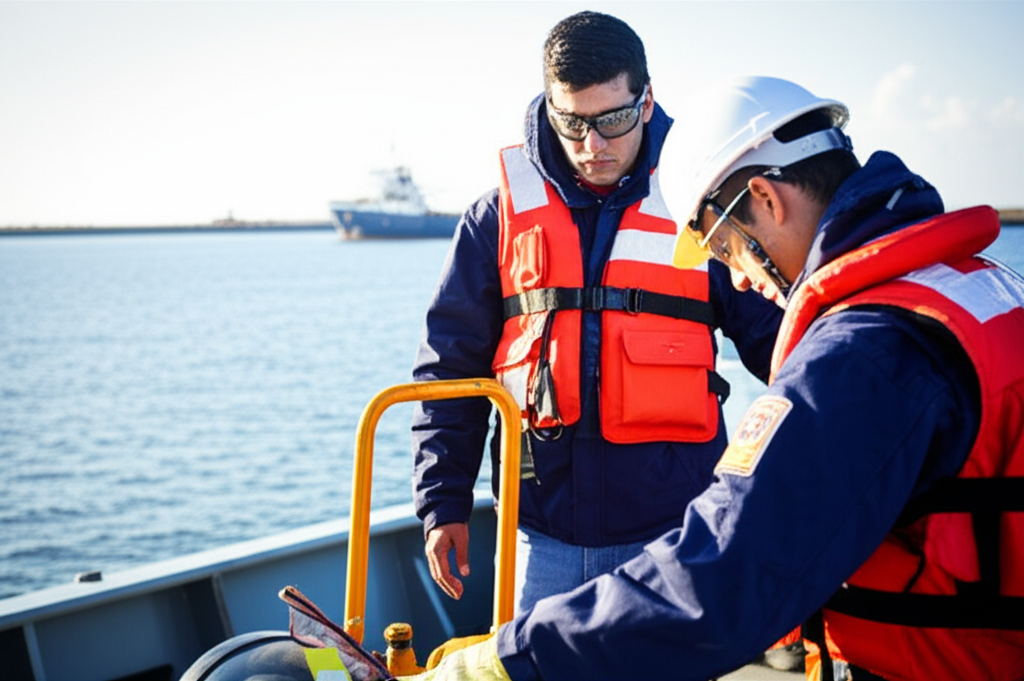
Diploma in Underwater Research Techniques

Why this certificate program?

The Diploma in Underwater Research Techniques

Immerse yourself in the fascinating world of underwater exploration and research. Acquire the skills and knowledge necessary to plan, execute, and analyze underwater scientific projects, from archaeology to marine biology. This program prepares you to become a highly skilled professional in a constantly evolving field.

Key Benefits

  • Mastery of Scientific Diving Techniques: Learn safe and effective protocols for data and sample collection.
  • Handling of Specialized Tools and Equipment: Use side-scan sonar, ROVs, and underwater positioning systems.
  • Analysis and Interpretation of Underwater Data: Transform raw data into actionable knowledge for research.
  • Planning and Management of Underwater Projects: Develop skills to lead and coordinate research expeditions.
  • Knowledge of Regulations and Best Practices: Ensure compliance with ethical and legal standards in underwater research.
Técnicas

Diploma in Underwater Research Techniques

Availability: 1 in stock

Who is it aimed at?

  • Archaeologists, oceanographers, and marine biologists seeking to master the latest techniques in underwater exploration and documentation.
  • Advanced professional and recreational divers interested in expanding their skills toward scientific research and the conservation of underwater heritage.
  • Students in related fields wishing to acquire hands-on experience and specialized knowledge in the field of underwater research.
  • Cultural and natural heritage managers requiring tools for the protection and study of vulnerable marine sites and ecosystems.
  • Offshore and marine renewable energy professionals needing training in the inspection and analysis of underwater structures.

Flexibility of Learning

Designed to adapt to your pace: asynchronous modules available 24/7, interactive discussion forums, and personalized tutoring to answer your questions.

Técnicas

Objectives and competencies

Document and analyze precise underwater findings:

“Use 3D modeling software and photogrammetry techniques to create detailed representations of the site and facilitate interpretation.”

Operate underwater research equipment and technologies safely and efficiently:

“Plan dives considering environmental factors and risks, execute pre-dive safety protocols, and effectively manage underwater emergencies.”

Applying innovative research methodologies in complex underwater contexts:

Integrate acoustic 3D mapping techniques with artificial intelligence analysis to optimize the identification of anomalies and risks in underwater infrastructures.

Interpreting oceanographic and geophysical data for underwater exploration:

“Analyze and integrate bathymetry, seismic, and magnetometry data to identify geological structures and potential underwater resources.”

Develop advanced skills in the identification and preservation of underwater cultural heritage:

“To meticulously document findings using photogrammetry, 3D modeling, and underwater archaeological recording.”

Assess and mitigate the risks associated with underwater research operations:

“Identify potential hazards (currents, wildlife, ROVs, deployed equipment), implement safety barriers (communication protocols, exclusion zones, equipment redundancy) and continuously monitor for a rapid response to emergencies.”

Curriculum - Modules

  1. Comprehensive Maritime Incident Management: protocols, roles, and chain of command for coordinated response
  2. Operational Planning and Execution: briefing, routes, weather windows, and go/no-go criteria
  3. Rapid Risk Assessment: criticality matrix, scene control, and decision-making under pressure
  4. Operational Communication: VHF/GMDSS, standardized reports, and inter-agency liaison
  5. Tactical Mobility and Safe Boarding: RHIB maneuvers, approach, mooring, and recovery
  6. Equipment and Technologies: PPE, signaling, satellite tracking, and field data logging
  7. Immediate Care of the Affected: primary assessment, hypothermia, trauma, and stabilization for evacuation
  8. Adverse Environmental Conditions: swell, Visibility, flows, and operational mitigation

    Simulation and training: critical scenarios, use of VR/AR, and exercises with performance metrics

    Documentation and continuous improvement: lessons learned, indicators (MTTA/MTTR), and SOP updates

  1. Introduction to Scientific Diving: History, Ethics, and Standards
  2. Basic and Advanced Equipment for Scientific Diving: Selection, Maintenance, and Configuration
  3. Physics and Physiology of Diving: Effects of Pressure, Gases, and Safety
  4. Planning Scientific Dives: Objectives, Risks, and Emergency Procedures
  5. Underwater Navigation Techniques: Compass, Underwater GPS, and Cartography
  6. Underwater Sampling Protocols: Collection, Preservation, and Transport of Samples
  7. Introduction to Underwater Photography: Equipment, Basic Techniques, and Composition
  8. Lighting in Underwater Photography: Natural Light, Flashes, and Strobes
  9. Advanced photographic documentation techniques: macro, wide-angle, panoramas.
  10. Underwater image processing and editing: workflow, software, and optimization.

  1. Introduction to Underwater Archaeology: history, ethics, and legislation.
  2. Diving Equipment and Techniques for Archaeology: safety, communications, and basic documentation.
  3. Underwater Photogrammetry: principles, equipment, calibration, and image planning.
  4. Photogrammetric Image Processing: alignment, 3D model generation, and texturing.
  5. 3D Documentation with Photogrammetry: creation of orthomosaics, digital elevation models (DEMs), and textured 3D models.
  6. Introduction to 3D Modeling Software: editing, cleaning, and optimizing models.
  7. Documentation of Underwater Archaeological Sites: recording findings, contextualization, and report writing.
  8. Case Studies: examples of Underwater archaeology projects and the application of photogrammetry.

    In Situ Conservation Techniques: protection of underwater sites and artifacts.

    Presentation and Dissemination of Results: creation of interactive 3D visualizations and public outreach.

  1. Introduction to Underwater Archaeology: History, Ethics, and Legislation.
  2. Basic Equipment for Underwater Archaeology: Scuba gear, ROVs, probes.
  3. Underwater Excavation Techniques: Pumping Systems, Grids, Documentation.
  4. Underwater 3D Photogrammetry: Principles, Calibration, Processing Software.
  5. Planning an Underwater Archaeology Project: Permits, Logistics, Safety.
  6. Documentation and Recording: Technical Drawing, Photography, Video.
  7. In-situ Conservation vs.
  8. Recovery: criteria, risks, and benefits.
  9. Processing and analysis of photogrammetric data: generation of 3D models and orthomosaics.
  10. Applications of 3D photogrammetry: documentation, dissemination, and research.
  11. Case studies: shipwrecks, ancient ports, and submerged prehistoric sites.

  1. Introduction to Underwater Archaeology: History, Objectives, and Challenges
  2. Legislation and Ethics in Underwater Archaeology: Protection of Submerged Heritage
  3. Diving Equipment for Underwater Archaeology: Selection, Maintenance, and Safety
  4. Underwater Survey Techniques: Visual Reconnaissance, Side-Scan Sonar, Magnetometry
  5. Underwater Excavation: Methodology, Documentation, and In-Situ Conservation
  6. 3D Photogrammetry: Basic Principles, Equipment, and Software
  7. Underwater Image Acquisition for Photogrammetry: Planning, Diving Techniques, and Camera Parameters
  8. Photogrammetric Data Processing: Alignment, Model Generation 3D and texturing.
  9. Analysis and documentation of 3D models: measurement, interpretation, and report creation.
  10. Applications of 3D photogrammetry in underwater archaeology: site documentation, artifact analysis, and outreach.

  1. System Architecture and Components: Structural design, materials, and subsystems (mechanical, electrical, electronic, and fluid) with selection and assembly criteria for marine environments
  2. Fundamentals and Principles of Operation: Physical and engineering foundations (thermodynamics, fluid mechanics, electricity, control, and materials) that explain performance and operating limits
  3. Safety and Environmental (SHE): Risk analysis, PPE, LOTO, hazardous atmospheres, spill and waste management, and emergency response plans
  4. Applicable Regulations and Standards: IMO/ISO/IEC requirements and local regulations;
  5. Conformance criteria, certification, and best practices for operation and maintenance
  6. Inspection, testing, and diagnostics: Visual/dimensional inspection, functional testing, data analysis, and predictive techniques (vibration, thermography, fluid analysis) to identify root causes
  7. Preventive and predictive maintenance: Hourly/cycle/seasonal plans, lubrication, adjustments, calibrations, consumable replacement, post-service verification, and operational reliability
  8. Instrumentation, tools, and metrology: Measuring and testing equipment, diagnostic software, calibration and traceability; selection criteria, safe use, and storage
  9. Onboard integration and interfaces: Mechanical, electrical, fluid, and data compatibility; Sealing and watertightness, EMC/EMI, corrosion protection, and interoperability testing.

    Quality, acceptance testing, and commissioning: process and materials control, FAT/SAT, bench and sea trials, go/no-go criteria, and evidence documentation.

    Technical documentation and integrated practice: logs, checklists, reports, and a complete case study (safety → diagnosis → intervention → verification → report) applicable to any system.

  1. Introduction to Underwater Archaeology: History, Ethics, and Legislation
  2. Archaeological Diving Techniques: Safety, Communication, and Excavation
  3. Underwater Archaeological Equipment: Tools, Recording Systems, and In-Situ Conservation
  4. 3D Photogrammetry Applied to Underwater Archaeology: Principles, Equipment, and Software
  5. Planning Underwater Archaeology Projects: Design, Permits, and Logistics
  6. Underwater Image Acquisition for Photogrammetry: Techniques, Lighting, and Calibration
  7. Photogrammetric Data Processing: Alignment, Texturing, and 3D Model Generation
  8. Analysis and Documentation of 3D Models: Interpretation, Measurement, and Representation
  9. Applications of 3D Photogrammetry in Archaeology Underwater archaeology: recording, preservation, and dissemination

    Case studies: examples of underwater archaeology projects using 3D photogrammetry

Career opportunities

  • Underwater Archaeologist: Research and documentation of submerged archaeological sites.
  • Marine Biologist: Study of underwater ecosystems and their conservation.
  • Oceanographer: Analysis of oceanographic processes and their impact on the environment.
  • Underwater Infrastructure Inspector: Evaluation of the integrity of pipelines, cables, and platforms.
  • Environmental Consultant: Evaluation of the environmental impact of underwater activities.
  • Maritime Salvage Technician: Recovery of submerged objects and vessels.
  • Professional Diver: Underwater work in various industries.
  • Specialized Diving Guide: Leading dives at sites of historical or biological interest.
  • Documentary Filmmaker Underwater: Production of audiovisual content about the underwater world.

    Researcher at universities and research centers: Development of new techniques and technologies for underwater exploration.

    “`

Admission requirements

Academic/professional profile:

Degree/Bachelor's degree in Nautical Science/Maritime Transport, Naval/Marine Engineering, or a related field; or proven professional experience in bridge/operations.

Language proficiency:

Recommended functional maritime English (SMCP) for simulations and technical materials.

Documentation:

Updated resume, copy of degree or seaman's book, ID card/passport, letter of motivation.

Technical requirements (for online):

Equipment with camera/microphone, stable connection, ≥ 24” monitor recommended for ECDIS/Radar-ARPA.

Admission process and dates

1. Online
application

(form + documents).

2. Academic review and interview

(profile/objectives/schedule compatibility).

3. Admission decision

(+ scholarship proposal if applicable).

4. Reservation of place

(deposit) and registration.

5. Induction

(access to campus, calendars, simulator guides).

Scholarships and grants

  • Explore the Depths: Master underwater research techniques, from planning to data analysis.
  • Cutting-Edge Technology: Learn to use ROVs, sonar, and scientific diving equipment for precise data collection.
  • Analysis and Conservation: Apply your knowledge to marine ecosystem conservation and sustainable resource management.
  • Hands-on Experience: Participate in real-world simulations and case studies to apply the techniques you’ve learned.
  • Professional Certification: Earn a recognized diploma that will boost your career in marine research and underwater exploration.
Get ready for lead research projects and discover the secrets the ocean holds.

Testimonials

Frequently asked questions

The marine environment, including oceans, seas, lakes, rivers and other bodies of water.

Yes. The itinerary includes ECDIS/Radar-ARPA/BRM with harbor, ocean, fog, storm, and SAR scenarios.

Online with live sessions; hybrid option for simulator/practical placements through agreements.

It focuses on techniques, which implies an important practical component, although it also includes the theory necessary to understand and apply these techniques.

Recommended functional SMCP. We offer support materials for standard phraseology.

Yes, with a relevant degree or experience in maritime/port operations. The admissions interview will confirm suitability.

Optional (3–6 months) through Companies & Collaborations and the Alumni Network.

Simulator practice (rubrics), defeat plans, SOPs, checklists, micro-tests and applied TFM.

A degree from Navalis Magna University + operational portfolio (tracks, SOPs, reports and KPIs) useful for audits and employment.

  1. Introduction to Underwater Archaeology: History, Ethics, and Legislation
  2. Archaeological Diving Techniques: Safety, Communication, and Excavation
  3. Underwater Photogrammetry: Principles, Equipment, and Data Acquisition
  4. Basic 3D Modeling: Software, Workflow, and Optimization
  5. Traditional Manual Documentation: Underwater Drawing, Photography, and Video
  6. Sensors and Positioning: GPS, USBL, DVL
  7. Photogrammetric Data Processing: Alignment, Texturing, and Scaling
  8. Data Integration: Combining 3D Information with Traditional Documentation
  9. Analysis and Interpretation of 3D Models: Identification, Dating, and Reconstruction
  10. Presentation and Dissemination: Reports, Publications, and Reality
  11. virtual

Request information

  1. Complete the Application Form.

  2. Attach your CV/degree certificate (if you have it to hand).

  3. Indicate your preferred cohort (January/May/September) and whether you would like the hybrid option with simulator sessions.

    An academic advisor will contact you within 24–48 hours to guide you through the admission process, scholarships, and compatibility with your professional schedule.

Please enable JavaScript in your browser to complete this form.
Click or drag a file to this area to upload.

Faculty

0
    0
    Tu carrito
    Tu carrito esta vacíoRegresar a la tienda
    Scroll to Top


