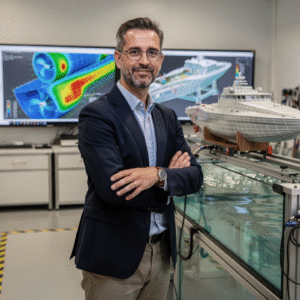
Diploma in Nautical Environmental Impact Assessment

Why this certificate program?

The Diploma in Nautical Environmental Impact Assessment

This program provides you with the tools and knowledge necessary to lead sustainable projects in the maritime sector. Learn to identify, predict, and mitigate the environmental impacts of nautical activities, ensuring regulatory compliance and the protection of marine ecosystems. This program covers everything from environmental legislation to modeling techniques and risk analysis, with a practical focus on real-world case studies.

Differential Advantages

  • Advanced Methodologies: Use of specialized software for impact assessment.
  • Up-to-date Legislation: In-depth knowledge of national and international regulations.
  • Real-World Case Studies: Analysis of nautical projects and their environmental implications.
  • Professional Certification: Validates your experience in nautical environmental management.
  • Specialized Networking: Contact with experts and professionals in the maritime sector.
Evaluación

Diploma in Nautical Environmental Impact Assessment

Availability: 1 in stock

Who is it aimed at?

  • Environmental consultants and sustainability specialists seeking to deepen their knowledge of legislation, methodologies, and tools for environmental impact assessment in nautical environments.
  • Maritime professionals (engineers, biologists, technicians) who wish to lead environmental impact studies and manage mitigation projects in ports, coastal areas, and marine environments.
  • Public officials and environmental authorities responsible for evaluating and approving nautical projects, ensuring regulatory compliance and environmental protection.
  • Academics and researchers interested in expanding their knowledge of the effects of nautical activities on marine and coastal ecosystems.
  • Graduate students in environmental and marine sciences seeking a specialization in High level in nautical environmental impact assessment to boost your professional career.

    Study flexibility

    Designed for professionals and students: 24/7 accessible virtual platform, interactive discussion forums, and personalized support from subject matter experts.

Evaluación

Objectives and competencies

Analyze and mitigate the environmental effects of maritime activities:

Implement waste and wastewater management plans, complying with MARPOL regulations and adapting to specific port regulations.

Applying environmental assessment methodologies to nautical projects:

Identify and assess environmental impacts (emissions, discharges, noise) in the design, construction and operation phases of nautical infrastructure and vessels, proposing preventive and corrective measures based on regulations and best practices.

Interpreting maritime environmental legislation to ensure regulatory compliance:

Identify and apply international conventions (MARPOL, SOLAS) and national regulations in port and onboard operations, managing mandatory environmental documentation and records.

Prepare rigorous and compliant nautical environmental impact reports:

Thoroughly assess potential impacts, propose effective mitigation measures, and communicate findings clearly and accurately to the relevant authorities.

Managing nautical projects while minimizing environmental impact:

Implement waste and spill management practices on board, ensuring compliance with MARPOL regulations and minimizing marine pollution.

Designing environmental management strategies for ports and marinas:

“Develop contingency plans for spills and leaks, considering response capacity and coordination with maritime authorities and local stakeholders.”

Curriculum - Modules

  1. Comprehensive Maritime Incident Management: protocols, roles, and chain of command for coordinated response
  2. Operational Planning and Execution: briefing, routes, weather windows, and go/no-go criteria
  3. Rapid Risk Assessment: criticality matrix, scene control, and decision-making under pressure
  4. Operational Communication: VHF/GMDSS, standardized reports, and inter-agency liaison
  5. Tactical Mobility and Safe Boarding: RHIB maneuvers, approach, mooring, and recovery
  6. Equipment and Technologies: PPE, signaling, satellite tracking, and field data logging
  7. Immediate Care of the Affected: primary assessment, hypothermia, trauma, and stabilization for evacuation
  8. Adverse Environmental Conditions: swell, Visibility, flows, and operational mitigation

    Simulation and training: critical scenarios, use of VR/AR, and exercises with performance metrics

    Documentation and continuous improvement: lessons learned, indicators (MTTA/MTTR), and SOP updates

  1. Introduction to International and National Maritime Law
  2. International Conventions: SOLAS, MARPOL, STCW, COLREG
  3. Maritime Law: Jurisdiction, Ownership, Claims, Salvage
  4. Administrative Regime of Ships and Ports: Flagging, Registration
  5. Civil Liability: Collisions, Pollution, Personal Injury
  6. Marine Insurance: P&I, Hull and Machinery, Liability
  7. Risks in Navigation: Operational, Environmental, Safety
  8. Risk Analysis and Assessment: Methodologies and Tools
  9. Risk Management: Mitigation, Transfer, Acceptance
  10. Maritime Audits: ISM, ISPS, Internal Audits and external

  1. Introduction to marine environmental risk analysis: concepts and definitions.
  2. Regulatory frameworks: international conventions, national legislation, and environmental guidelines.
  3. Hazard identification: sources of pollution, risky activities, and ecosystem vulnerability.
  4. Exposure assessment: contaminant transport pathways, dispersion modeling, and sensitive receptors.
  5. Toxicity assessment: effects of contaminants on marine biota and human health.
  6. Risk characterization: probability and consequences of pollution events.
  7. Dispersion models: mathematical tools for predicting the distribution of contaminants in water and sediments.
  8. Uncertainty analysis: identification and quantification of error sources in models.
  9. Measures of Mitigation: Strategies for preventing, controlling, and remediating pollution.

    Risk communication: Dissemination of results to stakeholders and informed decision-making.

  1. Introduction to Environmental Law: principles, sources, and historical evolution.
  2. International Environmental Legislation: conventions, treaties, and global agreements.
  3. National Environmental Legislation: Constitution, framework laws, regulations, and technical standards.
  4. Environmental Policy Instruments: Environmental Impact Assessment (EIA), licenses, permits, and authorizations.
  5. Terrestrial Ecosystems: biodiversity, ecological functions, threats, and conservation.
  6. Aquatic Ecosystems: marine, estuarine, and freshwater ecosystems, and their ecological importance.
  7. Urban and Rural Ecosystems: interactions, environmental problems, and sustainable management.
  8. Environmental Assessment Methodologies: indicators, evaluation criteria, and modeling tools.
  9. Environmental Risk Assessment: Risk identification, analysis, and management.

    Environmental Audits: types, methodologies, reports, and follow-up.

  1. Introduction to Water Quality Modeling: Objectives and Applications
  2. Fundamentals of Hydrology: Hydrological Cycle, Water Balances, Flow Rates
  3. Water Chemistry: Physicochemical Parameters, Reactions, Speciation
  4. Transport Processes: Advection, Diffusion, Dispersion
  5. Point Source Pollution Models: Industrial Discharges, Urban Wastewater
  6. Diffuse Pollution Models: Agricultural Runoff, Atmospheric Deposition
  7. Model Calibration and Validation: Field Data, Sensitivity Analysis, Uncertainty
  8. Application of Models to Water Quality Management: Control and Mitigation Strategies
  9. Modeling Software: Tools and Platforms (e.g., QUAL2K, WASP, CE-QUAL-W2)
  10. Case studies: modeling of rivers, lakes, estuaries, and groundwater

  1. System Architecture and Components: Structural design, materials, and subsystems (mechanical, electrical, electronic, and fluid) with selection and assembly criteria for marine environments
  2. Fundamentals and Principles of Operation: Physical and engineering foundations (thermodynamics, fluid mechanics, electricity, control, and materials) that explain performance and operating limits
  3. Safety and Environmental (SHE): Risk analysis, PPE, LOTO, hazardous atmospheres, spill and waste management, and emergency response plans
  4. Applicable Regulations and Standards: IMO/ISO/IEC requirements and local regulations;
  5. Conformance criteria, certification, and best practices for operation and maintenance
  6. Inspection, testing, and diagnostics: Visual/dimensional inspection, functional testing, data analysis, and predictive techniques (vibration, thermography, fluid analysis) to identify root causes
  7. Preventive and predictive maintenance: Hourly/cycle/seasonal plans, lubrication, adjustments, calibrations, consumable replacement, post-service verification, and operational reliability
  8. Instrumentation, tools, and metrology: Measuring and testing equipment, diagnostic software, calibration and traceability; selection criteria, safe use, and storage
  9. Onboard integration and interfaces: Mechanical, electrical, fluid, and data compatibility; Sealing and watertightness, EMC/EMI, corrosion protection, and interoperability testing.

    Quality, acceptance testing, and commissioning: process and materials control, FAT/SAT, bench and sea trials, go/no-go criteria, and evidence documentation.

    Technical documentation and integrated practice: logs, checklists, reports, and a complete case study (safety → diagnosis → intervention → verification → report) applicable to any system.

  1. Introduction to Risk Analysis: Key Concepts and General Framework.
  2. Hazard Identification in the Maritime Environment: Sources and Types.
  3. Risk Assessment: Quantitative and Qualitative Methodologies.
  4. International Maritime Environmental Legal Framework: Relevant Conventions and Treaties.
  5. National Maritime Environmental Legislation: Current Regulations and Competent Authorities.
  6. MARPOL: Annexes, Regulations, and Practical Application.
  7. Onboard Waste Management: Procedures and Regulatory Compliance.
  8. Oil Pollution Prevention: Contingency and Response Plans.
  9. Environmental Liability and Insurance: Legal aspects and coverage.
  10. Environmental audits and management systems: Continuous improvement and best practices.

Career opportunities

  • Nautical Environmental Impact Consultant: Preparation of Environmental Impact Assessments (EIAs), Environmental Impact Statements (EISs), and Strategic Environmental Assessments (SEAs) for nautical projects.
  • Environmental Management Technician in Ports and Marinas: Implementation of environmental management systems, spill control, waste management, and contingency plans in port and marina facilities.
  • Environmental Inspector in Public Administration: Supervision of compliance with environmental legislation in nautical activities, project evaluation, and monitoring of corrective measures.
  • Researcher in Marine Research Centers: Development of research projects on the effects of nautical activities on the marine environment, biodiversity assessment, and impact modeling.
  • Environmental Educator: Design and implementation of environmental awareness and education programs aimed at users of vessels, tour operators, and the general public.
  • Sustainability Manager in Nautical Companies: Implementation of sustainable practices in shipbuilding, maritime transport, nautical tourism, and recreational activities at sea.
  • Environmental Auditor: Conducting environmental audits to verify regulatory compliance and evaluate the environmental performance of nautical organizations.
  • Environmental Consultant in Marine Renewable Energy Projects: Environmental impact assessment of offshore wind farms, wave energy plants, and other renewable energy infrastructure at sea.

“`

Admission requirements

Academic/professional profile:

Degree/Bachelor's degree in Nautical Science/Maritime Transport, Naval/Marine Engineering, or a related field; or proven professional experience in bridge/operations.

Language proficiency:

Recommended functional maritime English (SMCP) for simulations and technical materials.

Documentation:

Updated resume, copy of degree or seaman's book, ID card/passport, letter of motivation.

Technical requirements (for online):

Equipment with camera/microphone, stable connection, ≄ 24ā€ monitor recommended for ECDIS/Radar-ARPA.

Admission process and dates

1. Online
application

(form + documents).

2. Academic review and interview

(profile/objectives/schedule compatibility).

3. Admission decision

(+ scholarship proposal if applicable).

4. Reservation of place

(deposit) and registration.

5. Induction

(access to campus, calendars, simulator guides).

Scholarships and grants

  • Regulatory Framework: Understand nautical environmental legislation and its application in projects.
  • EIA Methodologies: Apply advanced techniques for environmental impact assessment in the nautical sector.
  • Sustainable Management: Develop strategies to minimize environmental impact and promote sustainability.
  • Case Studies: Analyze real-world case studies and participate in impact assessment simulations.
  • Professional Certification: Obtain a recognized diploma that validates your expertise in nautical environmental impact assessment.
Boost your career with specialized knowledge in the protection of the marine and coastal environment.

Testimonials

Frequently asked questions

The assessment of the environmental impacts of projects, plans or programs that are developed in or affect the nautical environment.

Yes. The itinerary includes ECDIS/Radar-ARPA/BRM with harbor, ocean, fog, storm, and SAR scenarios.

Online with live sessions; hybrid option for simulator/practical placements through agreements.

Nautical projects or those involving activities in bodies of water, such as ports, marinas, maritime transport, dredging, aquaculture, offshore oil platforms, marine renewable energies and submarine outfalls.

Recommended functional SMCP. We offer support materials for standard phraseology.

Yes, with a relevant degree or experience in maritime/port operations. The admissions interview will confirm suitability.

Optional (3–6 months) through Companies & Collaborations and the Alumni Network.

Simulator practice (rubrics), defeat plans, SOPs, checklists, micro-tests and applied TFM.

A degree from Navalis Magna University + operational portfolio (tracks, SOPs, reports and KPIs) useful for audits and employment.

  1. Introduction to Maritime Law: Sources, Jurisdiction, and International Conventions
  2. National and International Legislation on Maritime Safety (SOLAS, MARPOL, etc.)
  3. London Convention and Discharges: Prohibitions, Exceptions, and Sanctions
  4. Environmental Impact Assessment (EIA) of Nautical Projects
  5. Legislation on the Protection of Marine Species and Sensitive Habitats
  6. Marine Protected Areas: Delimitation, Management, and Restrictions
  7. Discharge Modeling: Dispersion, Biodegradation, and Risks
  8. Hydrodynamic Models: Simulation of Currents, Tides, and Waves
  9. Techniques for the Restoration of Damaged Marine Ecosystems
  10. Measures Compensatory measures: creation of artificial reefs, transplantation of seagrasses.

Request information

  1. Complete the Application Form.

  2. Attach your CV/degree certificate (if you have it to hand).

  3. Indicate your preferred cohort (January/May/September) and whether you would like the hybrid option with simulator sessions.

    An academic advisor will contact you within 24–48 hours to guide you through the admission process, scholarships, and compatibility with your professional schedule.

Please enable JavaScript in your browser to complete this form.
Click or drag a file to this area to upload.

Faculty

0
    0
    Tu carrito
    Tu carrito esta vacĆ­oRegresar a la tienda
    Scroll to Top