
Master in Underwater Robotics (ROVs and AUVs)
This program prepares you to lead the next generation of ocean explorers. Master the design, operation, and maintenance of remotely operated underwater vehicles (ROVs) and autonomous underwater vehicles (AUVs), key tools for…
Prior Knowledge Assessment
These are the skills this programme builds. Tick the ones you already have and we will tell you which part of the syllabus is really for you.
What is the Master in Underwater Robotics (ROVs and AUVs)?
The Master in Underwater Robotics (ROVs and AUVs)
This program prepares you to lead the next generation of ocean explorers. Master the design, operation, and maintenance of remotely operated underwater vehicles (ROVs) and autonomous underwater vehicles (AUVs), key tools for scientific research, the offshore industry, and the inspection of submerged infrastructure. This intensive program provides you with a solid foundation in engineering, robotics, and oceanography, combined with hands-on experience in advanced simulators and with real equipment. You will learn to program, navigate, and troubleshoot in complex underwater environments, acquiring the skills necessary to drive innovation in this constantly growing field.
Differential Advantages
- Development of Real Projects: Design, construction, and operation of ROVs/AUVs in simulated and real missions.
- Cutting-Edge Software and Hardware: Training in the latest tools and technologies on the market.
- Expert Faculty: Instructors with extensive experience in the marine industry and research.
- Professional Networking: Connections with leading companies in the underwater robotics sector.
- Professional Certification: Obtain a recognized certification that will open doors to the job market.
Programme highlights
- Design and Operation: Master the construction, piloting, and maintenance of ROVs and AUVs, essential tools in underwater exploration.
- Advanced Technologies: Delve into autonomous navigation, underwater image processing, and artificial intelligence applied to marine robotics.
- Practical Applications: Learn to apply underwater robotics in infrastructure inspections, scientific research, maritime rescue, and the offshore industry.
- Simulations and Practice: Participate in realistic simulations and field exercises that will prepare you to face real-world challenges.
- Expert Professionals: Learn from underwater robotics experts with experience in industry and research, and build your professional network.
- Boost your career at the forefront of underwater technology with our Master's in Underwater Robotics.
Programme Structure
The programme is structured in 11 modules, listed below in order of study.
Basics of Physical Oceanography, Marine Environment and Underwater Hydrodynamics
- The marine environment: temperature, salinity, density and hydrostatic pressure at different depths
- Sea wave propagation: light, visibility, electromagnetic attenuation and marine acoustic
- Ocean currents, depth waves, tides and their impact on the dynamics of submarine vehicles
- Hydrodynamics of submerged bodies: drag coefficient, drag coefficient ($C_D$) and lift
- Kinematic and dynamic modelling of submarine vehicles in 6 degrees of freedom (6 DOF)
- Added mass forces, hydrodynamic damping and buoyancy restorative forces
- Centre of gravity design ($CG$) and buoyancy centre ($CB$) for static and dynamic stability
- Marine geology and seabed topography: implications for vehicle mobility design
- Marine corrosion, biological fouling (biofouling) and selection of seawater tolerant materials
- Tests in hydrographic experience channels and test tanks for ROVs and AUVs prototypes
Mechanical design, structural architecture and hyperbaric engineering
- General architecture of underwater vehicles: differences between ROVs of observation, work (work-class) and AUVs
- Open-frame and stream-lined chassis and rack design: load distribution and operational flexibility
- Pressure Vessels: Pressure Vessels: Calculation of thicknesses in titanium, aluminium and composite materials
- Simulation and analysis by finite element (FEA) of structures subjected to hyperbaric pressure collapse
- Syntactic materials (Syntactic Foams) and high-depth buoyancy systems
- Mechanical sealing, o-rings (O-rings), marine penetrators and subsea wet and dry connectors
- Pressure Compensation in Oil-Filled Pressure-Compensated Electronics and Hydraulic Boxes
- Impact tolerance, structural fatigue analysis and on-board hitch protection
- Modular design and quick coupling systems for payloads and scientific instruments
- Hyperbaric pressure chamber tests for structural integrity certification
Propulsion, submarine energy and umbilical systems
- Electric thrusters (DC Brushless): Characterization, thrust curves, performance and speed control
- Configuration and geometry of propulsors: vector propulsion, azimuth thrust and manoeuvreability in static flight (Hovering)
- Hydraulic propulsion systems for ROVs of work class: Pumps, manifolds and solenoid valves
- AUV batteries: lithium-ion chemical, lithium polymer and solid state for high-pressure submerged environments
- Battery management (BMS) in AUVs: monitoring of charge, cell balance, security and autonomy estimation
- Surface feeding systems and high voltage transmission through umbilicals in ROVs
- Design, manufacture and management of electromechanical and fibre optic umbilical cables (TETHER)
- Umbilical management systems (Tether Management Systems - TMS): Garage configuration and launch cage
- Fuel cells and energy hybridization for long-range AUVs (Long-range AUVs)
- Thermal management and heat dissipation generated by power electronics in cold and warm water
Electronics, communications and underwater signal processing
- On-board control electronic system architecture: microcontrollers, FPGAs and embedded computers
- Industrial communication buses and interfaces: CAN BUS, RS-485, Ethernet SUBSEA and serial protocols
- Fibre Optic Communications: Uncompressed Video Transmitters, Multiplexers, and Through Optical Connectors
- Underwater acoustic communications: acoustic modems, modulation, transfer rate and latency
- Short-range optical communications for fast data downloading and video streaming in AUVs
- Marine physical parameter sensors: CTD probe (conductivity, temperature, depth), altimetres and pressure sensors
- Orientation sensors: Inertial measurement units (IMU), fibre optic gyroscopes (FOG) and magnetic compasses
- Acquisition of high-precision analog data and electrical noise filtering in powered environments
- Management of internal power distribution and protection against surges and short circuits in salted water
- Emergency communication systems: Satellite beacon, acoustic beacon (pinger) and recovery systems
Navigation, Positioning and Submarine Mapping (SLAM) systems
- The challenge of GPS-free navigation in the submarine medium: drift problems and accumulated uncertainty
- Surface acoustic positioning: Ultra-short baseline (USBL), short baseline (SBL) and long baseline (LBL) systems
- Doppler correction navigation: Acoustic Doppler speedometres (DVL) and velocity estimation on the bottom
- Submarine Inertial Navigation Systems (INS) and INS/DVL coupled integration/Pressure via Extended Kalman Filter (EKF)
- Side-sweep (SSS) and multi-haze echo sounders (MBES) for high-resolution bathymetric mapping
- Simultaneous acoustic mapping and localization (Acoustic Slam): Use of natural marks and bathymetry for position correction
- Visual Slam Submarine: Seafloor Image Processing for 3D Reconstruction and Navigation
- Navigation based on geophysical magnetic fields and pre-existing topographic maps
- Sea Calibration of Navigation Systems: Inertial Alignment Tests and Offset Compensation
- Planning paths of tracking and search patterns for hydrographic surveys with AUVs
Computational vision, marine acoustics and image processing
- Underwater optics and backscattering: Lighting in the dark marine and colour correction
- HD/4K submarine cameras, low-light cameras (SIT) and high-power LED lighting systems
- Underwater Image Restoration Algorithms: Turbidity Removal, Water Attenuation and Contrast Enhancement
- Computer vision for pipe tracking, subfluvial cables and marine structures
- Underwater photogrammetry and three-dimensional reconstruction of offshore wrecks and infrastructures
- High resolution image sonar (FLS - Forward Looking Sonar) and acoustic cameras (Didson/Aris)
- Sonar data processing for submerged object detection and target classification
- Artificial vision algorithms for automatic identification and classification of fauna or structural damage
- Augmented reality systems in the ROV pilot console for navigation in murky waters
- Integration of submarine LiDAR sensors for volumetric measurements and ultra-precision laser scanning
Control systems, autonomy and artificial intelligence in AUVs
- Automatic position and attitude control in ROVS/AUVS: PID controllers, slider control (SMC) and adaptive control
- Robotic control software architectures: ROS (Robot Operating System), ROS 2 and MOOS-IVP for marine robotics
- Decisional autonomy in AUVs: reactive, deliberative and hybrid behavioural architectures
- Real-time obstacle avoidance algorithms using front view sonar data (FLS)
- Autonomous mission planning: optimisation of energy consumption, area coverage and contingency management
- Reinforcement learning applied to autonomous manoeuvreing in complex currents
- Convolutional neural networks for the autonomous recognition of characteristics in inspection of hulls and pipes
- Underwater collabourative robotics: AUVS swarm coordination for massive oceanographic sampling
- Autonomous Fault Management (FDIR): On-board breakdown diagnosis, control reconfiguration and mission safe abortion
- Simulation of underwater vehicles in virtual environments (Gazebo, UwSim, Holoocean) prior to sea trials
Underwater intervention, robotic manipulation and tools
- Kinematics and dynamics of submarine manipulative arms: degrees of freedom, workspace and singularities
- Work-class hydraulic handlers (5 and 7 functions) and precision electrical handlers
- Master’s-Slave control systems for remote manipulation with force feedback (haptic)
- ROV powered cutting and intervention tools: guillotines, diamond discs and high pressure water jet
- Sampling systems: sediment takers, suction and bio-medical containers
- Flow line interconnection and connection operations (TIE-IN), connector coupling and valves Subsea (Hot Stabs)
- Autonomous handling by means of intervention AUVs (I-AUVs): Floating grip and coupling to fixed structures
- Contact, force and torque sensors for delicate manipulation in archeology and marine science
- Soil-vehicle interaction during seafloor support and trench excavation (trenching)
- Workshop integration testing and integration with the ROV hydraulic/electric interface
Offshore operations, deployment, regulations and security
- Logistics Planning of Marine Robotics Campaigns: Selection of the Support Vessel (ROV Support Vessel)
- Launch and Recovery Systems (LARS): A-Frame gantries, Surge-compensated cranes (AHC) and Moonpools
- ROV/AUV system integration in the deck of the ship: control rooms, workshop containers and generators
- Guidelines from the International Association of Maritime Contractors (IMCA) for ROV operations (IMCA R 004)
- ROV Personnel and Roles: Pilot/Technician, Supervisor, Superintendent and Deck Support Staff
- Operational Risk Management (Hazid/Hazop) and Hazard Identification in Deck and Underwater
- Emergency Procedures: Power Loss, Umbilical Tangle, TMS Failure and AUV Rescue Adrift
- Preventive, corrective maintenance and periodic inspections of lifting equipment and pressure vessels
- Environmental regulations: Prevention of hydraulic discharges, anthropogenic acoustics and protection of sensitive habitats
- Maritime insurance, civil liability and robotics service contracts in the offshore industry
Capstone Project: Design, simulation and operational mission of an underwater vehicle
- Selection and technical specification of the problem or underwater operation (e.g., wind farm inspection, abyssal sampling)
- Conceptual design and calculation of dimensions, buoyancy, balance of weights and pressure vessels of the vehicle
- Selection and dimension of the propulsion system, electric/hydraulic power and umbilical cable or battery architecture
- Control architecture design, electronic component selection, navigation sensors and payloads
- Implementation of the mathematical model of the vehicle in a 3D simulation environment (ROS/Gazebo)
- Programming of the navigation algorithms (EKF/DVL), position control and mission autonomy routine
- Simulation of the operational mission: evaluation of performance under current conditions, low visibility and failures
- Field Operations Plan: Launch Procedure Design, Recovery (LARS) and IMCA Risk Analysis
- Economic evaluation of the project: manufacturing budget, operational costs (OPEX) and return on investment
- Preparation of the technical report of the underwater robotics project and oral defence before the Court of Maritime Engineers and Specialists
Master’s Final Project in Master in Underwater Robotics (ROVs and AUVs)
- Choice of topic and definition of the research problem
- Formulation of objectives, hypotheses and scope of work
- Review of the state of the art and specialised bibliography
- Analysis of the applicable regulatory and technical framework
- Design of the methodology and the work plan
- Data collection, processing and validation
- Technical development and analysis of results
- Discussion, conclusions and future lines of work
- Drafting of the memory in accordance with academic standards
- Presentation and public defence before the Court
Study Time and Workload
1600 hours of study, online and at your own pace. Move the slider to the hours a week you can really put in.
Engineers, technicians, and scientists who wish to specialize in the design, operation, and maintenance of ROVs and AUVs.Offshore professionals (oil, gas, renewable energy) seeking to optimize underwater inspections, repairs, and operations.Marine biologists, oceanographers, and underwater archaeologists who need advanced tools for exploration, research, and documentation in the marine environ
Academic direction and faculty
The teaching team at Navalis: working professionals who deliver and oversee the institute's programmes.


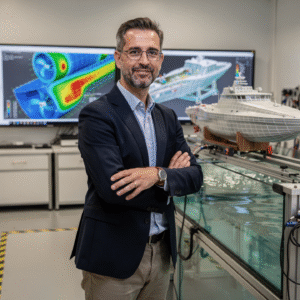


Student Reviews
Reviews collected and verified by Opynio, not written by us.
Learning Outcomes
- 01Mastering the operation and maintenance of ROVs and AUVs
- 02Develop and implement innovative robotic solutions for underwater inspection and repair
- 03Managing underwater robotics projects, from conception to delivery
- 04Interpret data and generate detailed technical reports
- 05Design control and navigation systems for ROVs and AUVs
- 06Adapting and applying underwater robotics technologies to diverse environments and needs
Career Opportunities
Entry Requirements
Admissions Process
No waiting for a phone call. If your documents are complete, you can pay in the same session.
```htmlAcademic/Professional Profile:Bachelor's/Undergraduate Degree in Engineering (Electronics, Mechanical, Computer Science, Naval), Science (Physics, Mathematics) or related field; Demonstrable professional experience in robotics, automation, or the underwater industry.Language proficiency:Advanced level of English (B2 or higher) for understanding technical documentation, participating in international projects, and using specialized software.Documentation: Updated CV, copy of academic degree(s), academic transcript, ID/Passport, cover letter detailing interest in underwater ro
Frequently Asked Questions
Leave your details and admissions will write back. If you already know this is the one, go straight to the application and pay in the same session.
