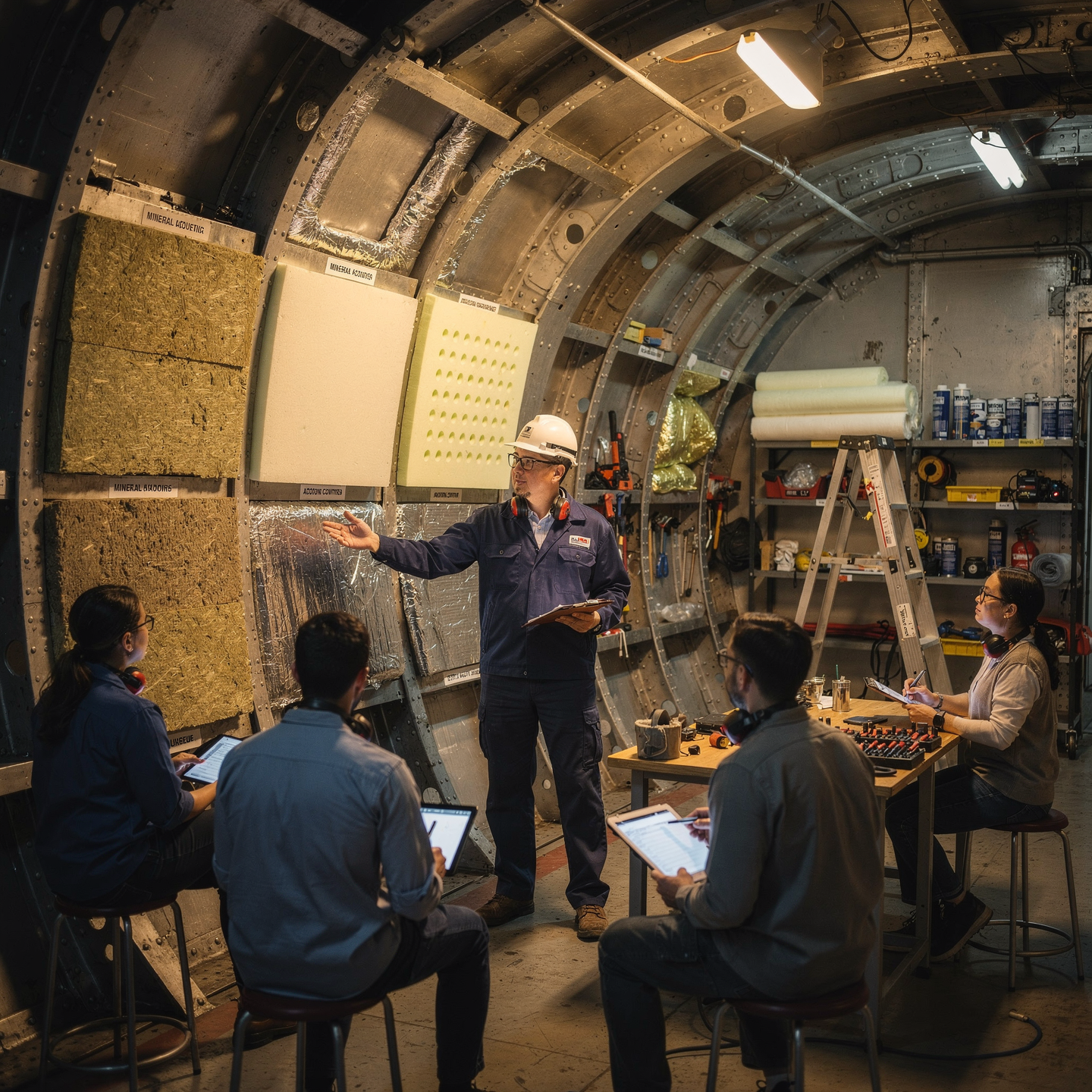
Course on thermal and acoustic insulation in ships
Why this course?
The Thermal and Acoustic Insulation in Boats
This course will provide you with the knowledge and practical skills to optimize comfort and efficiency on all types of vessels. You will learn about innovative materials, effective installation techniques, and current regulations, ensuring a comfortable interior environment and significantly reducing noise. This program is designed for both professionals in the marine sector and boat owners who wish to improve the quality of life on board and energy performance.
Acoustic Insulation in Boats
Differential Advantages
- Material Selection: Learn to choose the most suitable insulation materials for each application, considering factors such as weight, fire resistance, and acoustic performance.
- Installation Techniques: Master professional installation techniques to achieve optimal insulation, avoiding thermal and acoustic bridges.
- Regulatory Compliance: Familiarize yourself with the regulations and standards of the marine industry regarding thermal and acoustic insulation.
- Customized Solutions: Learn to design customized insulation solutions for different areas of the vessel, adapting to the specific needs of each space.
- Energy Efficiency: Discover how good insulation can reduce energy consumption for heating and cooling, lowering operating costs. boat.
- Modality: Online
- Level: Cursos
- Hours: 150 H
- Start date: 26-07-2026
Availability: 1 in stock
Who is it aimed at?
- Naval architects and ship interior designers looking to optimize onboard comfort and comply with insulation regulations.
- Naval engineers and shipbuilders interested in improving energy efficiency and reducing noise on vessels.
- Boat owners and refit companies wanting to increase the value of their vessels by improving insulation.
- Suppliers of insulation materials and soundproofing systems looking to expand their technical knowledge and offer innovative solutions.
- Students of naval architecture and marine engineering wanting to specialize in designing efficient and comfortable ships.
Flexibility of Learning
Access content at your own pace: downloadable materials, asynchronous discussion forums, and personalized online tutoring.
Objectives and competencies

Select and install appropriate insulating materials:
Considering the thermal, acoustic and safety properties, according to current regulations and project specifications.

Evaluate and improve thermal and acoustic comfort on board:
“Analyze insulation, ventilation and air conditioning systems, proposing solutions to optimize energy efficiency and reduce noise pollution, guaranteeing a comfortable environment for crew and passengers.”

Comply with maritime safety and environmental regulations:
Manage waste and prevent pollution, reporting incidents and implementing contingency plans.

Diagnose and solve existing insulation problems:
Employ thermography, visual inspection and continuity testing techniques to identify leaks, thermal bridges and areas with insulation deficiencies, proposing improvement and repair solutions based on industry standards and best practices.

Manage insulation projects from conception to completion:
“Define scope, budget and schedule, coordinating multidisciplinary teams and ensuring compliance with safety and quality regulations.”

Apply measurement and analysis techniques to optimize insulation:
“Implement thermography, airtightness testing, and energy analysis to identify weak points and improve the efficiency of thermal/acoustic insulation.”
Curriculum - Modules
- Comprehensive Maritime Incident Management: protocols, roles, and chain of command for coordinated response
- Operational Planning and Execution: briefing, routes, weather windows, and go/no-go criteria
- Rapid Risk Assessment: criticality matrix, scene control, and decision-making under pressure
- Operational Communication: VHF/GMDSS, standardized reports, and inter-agency liaison
- Tactical Mobility and Safe Boarding: RHIB maneuvers, approach, mooring, and recovery
- Equipment and Technologies: PPE, signaling, satellite tracking, and field data logging
- Immediate Care of the Affected: primary assessment, hypothermia, trauma, and stabilization for evacuation
- Adverse Environmental Conditions: swell, Visibility, flows, and operational mitigation
Simulation and training: critical scenarios, use of VR/AR, and exercises with performance metrics
Documentation and continuous improvement: lessons learned, indicators (MTTA/MTTR), and SOP updates
- Introduction to Energy Efficiency in Naval Design: Basic Concepts and Regulations.
- Hydrodynamics and Resistance: Optimizing Hull Shape.
- Efficient Propulsion Systems: Propellers, Engines, and Alternative Fuels.
- Thermal Insulation and Onboard Energy Management: Reducing Losses.
- HVAC and Ventilation Systems: Designing for Comfort and Efficiency.
- Efficient Lighting: LEDs and Daylighting Control.
- Sustainable Materials and Eco-Design in Shipbuilding.
- Simulation and Modeling: Tools for Energy Optimization.
- Life Cycle Assessment and Impact Assessment environmental.
Case studies: Energy-efficient ships and implemented strategies.
‘
- Introduction to Energy Efficiency in Ships: Regulatory Context and Benefits
- Basic Thermodynamics: Key Concepts, Heat, Work, and Energy
- Thermal Insulation: Materials, Properties, and Applications in Ships
- Heating and Ventilation (HVAC) Systems: Design, Operation, and Maintenance
- Efficient Lighting: LED Technologies, Control, and Optimization
- Electrical Energy Management: Optimizing Consumption, Monitoring Systems
- Efficient Propulsion Systems: Optimizing Performance, New Technologies
- Renewable Energy on Board: Solar, Wind, Potential, and Challenges
- Water Management: Efficient Consumption, Treatment, and reuse
- Life cycle analysis and environmental impact assessment
‘
- Introduction to Energy Efficiency in Vessels: Basic Concepts and Regulations.
- Thermal Insulation: Types of Materials, Applications in Hull and Superstructure, Calculation of Heat Losses and Gains.
- Windows and Skylights: Design, Materials, Solar Control, and Energy Efficiency.
- Natural and Forced Ventilation Systems: Flow Rate Calculations, Optimization of Air Distribution.
- Efficient Climate Control: Types of Systems (Heat Pumps, Chillers), Sizing, and Control.
- LED Lighting: Selection of Luminaires, Efficient Lighting Design, and Control.
- Renewable Energy on Board: Solar Panels, Wind Turbines, Integration, and Energy Storage.
- Electrical Energy Management: Fuel consumption optimization, monitoring, and control.
Propulsion efficiency: Hull design optimization, efficient propellers, and energy recovery systems.
Energy audits and efficiency certification for vessels.
‘
- Introduction to Energy Efficiency: Key Concepts and Regulations
- Thermal Insulation: Materials, Application Techniques, and Calculation of Heat Losses/Gains
- Air Conditioning Systems: Types, Efficiency, Maintenance, and Control
- Efficient Lighting: LED Technologies, Lighting Control, and Use of Natural Light
- Electrical Energy Management: Monitoring, Consumption Optimization, and Storage
- Renewable Energies on Board: Solar, Wind, Potential, and Limitations
- Optimizing Water Consumption: Saving, Reuse, and Treatment Systems
- Impact of Design on Energy Efficiency and Comfort on Board
- Automation and Intelligent Control: BMS systems, sensors, and remote management.
- Energy audits: methodology, data analysis, and improvement proposals.
‘
- System Architecture and Components: Structural design, materials, and subsystems (mechanical, electrical, electronic, and fluid) with selection and assembly criteria for marine environments
- Fundamentals and Principles of Operation: Physical and engineering foundations (thermodynamics, fluid mechanics, electricity, control, and materials) that explain performance and operating limits
- Safety and Environmental (SHE): Risk analysis, PPE, LOTO, hazardous atmospheres, spill and waste management, and emergency response plans
- Applicable Regulations and Standards: IMO/ISO/IEC requirements and local regulations;
- Conformance criteria, certification, and best practices for operation and maintenance
- Inspection, testing, and diagnostics: Visual/dimensional inspection, functional testing, data analysis, and predictive techniques (vibration, thermography, fluid analysis) to identify root causes
- Preventive and predictive maintenance: Hourly/cycle/seasonal plans, lubrication, adjustments, calibrations, consumable replacement, post-service verification, and operational reliability
- Instrumentation, tools, and metrology: Measuring and testing equipment, diagnostic software, calibration and traceability; selection criteria, safe use, and storage
- Onboard integration and interfaces: Mechanical, electrical, fluid, and data compatibility; Sealing and watertightness, EMC/EMI, corrosion protection, and interoperability testing.
Quality, acceptance testing, and commissioning: process and materials control, FAT/SAT, bench and sea trials, go/no-go criteria, and evidence documentation.
Technical documentation and integrated practice: logs, checklists, reports, and a complete case study (safety → diagnosis → intervention → verification → report) applicable to any system.
Plan de estudio - Módulos
- Comprehensive Maritime Incident Management: protocols, roles, and chain of command for coordinated response
- Operational Planning and Execution: briefing, routes, weather windows, and go/no-go criteria
- Rapid Risk Assessment: criticality matrix, scene control, and decision-making under pressure
- Operational Communication: VHF/GMDSS, standardized reports, and inter-agency liaison
- Tactical Mobility and Safe Boarding: RHIB maneuvers, approach, mooring, and recovery
- Equipment and Technologies: PPE, signaling, satellite tracking, and field data logging
- Immediate Care of the Affected: primary assessment, hypothermia, trauma, and stabilization for evacuation
- Adverse Environmental Conditions: swell, Visibility, flows, and operational mitigation
Simulation and training: critical scenarios, use of VR/AR, and exercises with performance metrics
Documentation and continuous improvement: lessons learned, indicators (MTTA/MTTR), and SOP updates
- Introduction to Energy Efficiency in Naval Design: Basic Concepts and Regulations.
- Hydrodynamics and Resistance: Optimizing Hull Shape.
- Efficient Propulsion Systems: Propellers, Engines, and Alternative Fuels.
- Thermal Insulation and Onboard Energy Management: Reducing Losses.
- HVAC and Ventilation Systems: Designing for Comfort and Efficiency.
- Efficient Lighting: LEDs and Daylighting Control.
- Sustainable Materials and Eco-Design in Shipbuilding.
- Simulation and Modeling: Tools for Energy Optimization.
- Life Cycle Assessment and Impact Assessment environmental.
Case studies: Energy-efficient ships and implemented strategies.
‘
- Introduction to Energy Efficiency in Ships: Regulatory Context and Benefits
- Basic Thermodynamics: Key Concepts, Heat, Work, and Energy
- Thermal Insulation: Materials, Properties, and Applications in Ships
- Heating and Ventilation (HVAC) Systems: Design, Operation, and Maintenance
- Efficient Lighting: LED Technologies, Control, and Optimization
- Electrical Energy Management: Optimizing Consumption, Monitoring Systems
- Efficient Propulsion Systems: Optimizing Performance, New Technologies
- Renewable Energy on Board: Solar, Wind, Potential, and Challenges
- Water Management: Efficient Consumption, Treatment, and reuse
- Life cycle analysis and environmental impact assessment
‘
- Introduction to Energy Efficiency in Vessels: Basic Concepts and Regulations.
- Thermal Insulation: Types of Materials, Applications in Hull and Superstructure, Calculation of Heat Losses and Gains.
- Windows and Skylights: Design, Materials, Solar Control, and Energy Efficiency.
- Natural and Forced Ventilation Systems: Flow Rate Calculations, Optimization of Air Distribution.
- Efficient Climate Control: Types of Systems (Heat Pumps, Chillers), Sizing, and Control.
- LED Lighting: Selection of Luminaires, Efficient Lighting Design, and Control.
- Renewable Energy on Board: Solar Panels, Wind Turbines, Integration, and Energy Storage.
- Electrical Energy Management: Fuel consumption optimization, monitoring, and control.
Propulsion efficiency: Hull design optimization, efficient propellers, and energy recovery systems.
Energy audits and efficiency certification for vessels.
‘
- Introduction to Energy Efficiency: Key Concepts and Regulations
- Thermal Insulation: Materials, Application Techniques, and Calculation of Heat Losses/Gains
- Air Conditioning Systems: Types, Efficiency, Maintenance, and Control
- Efficient Lighting: LED Technologies, Lighting Control, and Use of Natural Light
- Electrical Energy Management: Monitoring, Consumption Optimization, and Storage
- Renewable Energies on Board: Solar, Wind, Potential, and Limitations
- Optimizing Water Consumption: Saving, Reuse, and Treatment Systems
- Impact of Design on Energy Efficiency and Comfort on Board
- Automation and Intelligent Control: BMS systems, sensors, and remote management.
- Energy audits: methodology, data analysis, and improvement proposals.
‘
- System Architecture and Components: Structural design, materials, and subsystems (mechanical, electrical, electronic, and fluid) with selection and assembly criteria for marine environments
- Fundamentals and Principles of Operation: Physical and engineering foundations (thermodynamics, fluid mechanics, electricity, control, and materials) that explain performance and operating limits
- Safety and Environmental (SHE): Risk analysis, PPE, LOTO, hazardous atmospheres, spill and waste management, and emergency response plans
- Applicable Regulations and Standards: IMO/ISO/IEC requirements and local regulations;
- Conformance criteria, certification, and best practices for operation and maintenance
- Inspection, testing, and diagnostics: Visual/dimensional inspection, functional testing, data analysis, and predictive techniques (vibration, thermography, fluid analysis) to identify root causes
- Preventive and predictive maintenance: Hourly/cycle/seasonal plans, lubrication, adjustments, calibrations, consumable replacement, post-service verification, and operational reliability
- Instrumentation, tools, and metrology: Measuring and testing equipment, diagnostic software, calibration and traceability; selection criteria, safe use, and storage
- Onboard integration and interfaces: Mechanical, electrical, fluid, and data compatibility; Sealing and watertightness, EMC/EMI, corrosion protection, and interoperability testing.
Quality, acceptance testing, and commissioning: process and materials control, FAT/SAT, bench and sea trials, go/no-go criteria, and evidence documentation.
Technical documentation and integrated practice: logs, checklists, reports, and a complete case study (safety → diagnosis → intervention → verification → report) applicable to any system.
- Introduction to Energy Efficiency: Basic Concepts and Regulations
- Thermal Insulation: Materials, Application Techniques, and Calculating Needs
- HVAC Systems: Types, Efficiency, Control, and Maintenance
- Efficient Lighting: LED Technologies, Lighting Control, and Lighting Design
- Renewable Energies: Solar Photovoltaics, Wind Power, Hydropower
- Water Management: Efficient Drinking Water and Wastewater Systems
- Hull and Propeller Optimization: Reducing Hydrodynamic Resistance
- Monitoring and Control Systems: Measuring Consumption and Optimization
- Efficiency in the Use of Electrical and Electronic Appliances: Refrigerators, Pumps, etc.
- Preventive and corrective maintenance for energy efficiency
‘
- Introduction to Energy Efficiency in Shipbuilding: Concepts and Benefits
- Thermal Insulation: Materials, Application Techniques, and Transmittance Calculations
- Hydrocarbon Management Systems: HVAC, Heat Pumps, Efficient Cooling, and Ventilation
- Efficient Lighting: LEDs, Lighting Control, and Daylighting
- Onboard Energy Management: Monitoring, Optimization, and Control Systems
- Passive Design: Orientation, Solar Protection, and Natural Ventilation
- Renewable Energy: Photovoltaic Solar Power, Wind Power, and Other Onboard Sources
- Acoustic Comfort: Insulation, Absorption, and Noise Control
- Indoor Air Quality: Ventilation, Filtration, and Control pollutants.
- Regulations and certification in naval energy efficiency.
‘
- Introduction to Energy Efficiency in Shipbuilding: Key Concepts and Regulations
- Thermal Insulation: Materials, Properties, Thickness Calculations, and Applications in Naval Structures
- Windows and Enclosures: Bioclimatic Design, Solar Control, Thermal Transmittance, and Solar Factor
- Ventilation Systems: Natural and Mechanical, Heat Recovery, Indoor Air Quality, and Hygrothermal Comfort
- Efficient Lighting: LEDs, Lighting Control, Natural Light Utilization, and Visual Comfort
- Efficient Climate Control: Heat Pumps, Absorption Cooling, Free Cooling, and Control Systems
- Renewable Energies: Photovoltaic Solar Power, Solar Thermal Solar Power, Wind Power, and Their Integration into Ships
- Energy Management: Monitoring, Energy control, optimization, and audits in ships
Energy simulation: Software tools for analyzing the energy performance of ships
Acoustic comfort: Sound insulation, sound absorption, vibration control, and applicable regulations‘
- Introduction to Energy Efficiency: Basic Concepts and Regulations
- Thermal Insulation: Types of Materials, Application in Vessels, and Calculation of Needs
- Air Conditioning Systems: Types, Efficiency, Installation, and Maintenance
- Efficient Lighting: LED Technologies, Lighting Design, and Control
- Renewable Energy on Board: Solar Panels, Wind Turbines, and Other Sources
- Energy Management on Board: Consumption, Storage, and Optimization
- Natural Ventilation and Bioclimatic Design: Strategies for Thermal Comfort
- Indoor Air Quality: Ventilation, Filtration, and Humidity Control
- Acoustic Comfort: Sound Insulation, Noise Reduction, and design
- Evaluation and improvement of energy efficiency in existing vessels
‘
Career opportunities
- Insulation Installer in Shipyards and Naval Repair Companies: Application of thermal and acoustic insulation materials in new ship construction and refits.
- Insulation System Maintenance Technician: Inspection, repair, and maintenance of insulation systems on board ships.
- Technical Consultant in Naval Energy Efficiency and Acoustics: Advising shipowners and shipyards on the selection and installation of optimized insulation materials and systems.
- Quality Inspector in Naval Insulation Projects: Verification of compliance with regulations and technical specifications in insulation installations.
- Technical Sales Representative for Insulation Products in the Naval Sector: Sales and technical advice on insulation materials to shipyards and shipping companies.
- Ship Insulation System Designer: Development of customized insulation solutions for vessels, considering factors such as the type of vessel, the climate, and the client’s specific needs.
- Naval expert specializing in insulation: Assessment of damage and problems related to insulation on ships, preparation of expert reports for insurance companies and shipowners.
- Self-employment: Creation of a company specializing in the installation, maintenance, or consulting of thermal and acoustic insulation on ships.
“`
Admission requirements

Academic/professional profile:
Degree/Bachelor's degree in Nautical Science/Maritime Transport, Naval/Marine Engineering, or a related field; or proven professional experience in bridge/operations.

Language proficiency:
Recommended functional maritime English (SMCP) for simulations and technical materials.

5. Induction
Updated resume, copy of degree or seaman's book, ID card/passport, letter of motivation.

Technical requirements (for online):
Equipment with camera/microphone, stable connection, ≥ 24” monitor recommended for ECDIS/Radar-ARPA.
Admission process and dates

1. Online
application
(form + documents).

2. Academic review and interview
(profile/objectives/schedule compatibility).

3. Admission decision
(+ scholarship proposal if applicable).

4. Reservation of place
(deposit) and registration.

5. Induction
(access to campus, calendars, simulator guides).
Scholarships and grants
- Energy Optimization: Master techniques to reduce fuel consumption and pollutant emissions through efficient insulation.
- Onboard Comfort: Learn to create pleasant interior environments, minimizing noise and temperature fluctuations for passengers and crew.
- Regulatory Compliance: Ensure your vessel complies with international safety and environmental regulations regarding insulation.
- Innovative Materials: Discover the latest technologies and cutting-edge materials for superior and long-lasting insulation.
- Case Studies: Analyze real-world examples of insulation projects on different types of boats and learn from expert experience.
Testimonials
I managed to reduce engine noise by 30% and cabin temperature fluctuations by 25% on the yacht “Oceanus” through the strategic application of thermoacoustic insulation materials, exceeding customer expectations and significantly improving onboard comfort.
I applied the painting and design techniques I learned in the course to renovate my kitchen. I achieved a professional finish, optimizing the space and lighting, with a result that exceeded my and my family’s expectations. I saved significantly by doing it myself, and the final result is comparable to a professional’s work.
We managed to reduce engine noise in the engine room of the yacht “Seabreeze” by 12dB and the ambient temperature by 5°C during sea trials, exceeding customer expectations and significantly improving onboard comfort.
I achieved exceptional thermal and acoustic insulation on a 40-foot yacht. We reduced engine noise by 70%, and the interior temperature remained stable despite high outside temperatures, exceeding the client’s expectations and significantly improving onboard comfort.

Frequently asked questions
Improve comfort and safety on board by reducing heat transfer and noise.
Yes. The itinerary includes ECDIS/Radar-ARPA/BRM with harbor, ocean, fog, storm, and SAR scenarios.
Online with live sessions; hybrid option for simulator/practical placements through agreements.
Greater comfort and energy efficiency on board by minimizing heat transfer and noise.
Recommended functional SMCP. We offer support materials for standard phraseology.
Yes, with a relevant degree or experience in maritime/port operations. The admissions interview will confirm suitability.
Optional (3–6 months) through Companies & Collaborations and the Alumni Network.
Simulator practice (rubrics), defeat plans, SOPs, checklists, micro-tests and applied TFM.
A degree from Navalis Magna University + operational portfolio (tracks, SOPs, reports and KPIs) useful for audits and employment.
- Introduction to Energy Efficiency: Basic Concepts and Regulations
- Thermal Insulation: Types of Materials, Application in Vessels, and Calculation of Needs
- Air Conditioning Systems: Types, Efficiency, Installation, and Maintenance
- Efficient Lighting: LED Technologies, Lighting Design, and Control
- Renewable Energy on Board: Solar Panels, Wind Turbines, and Other Sources
- Energy Management on Board: Consumption, Storage, and Optimization
- Natural Ventilation and Bioclimatic Design: Strategies for Thermal Comfort
- Indoor Air Quality: Ventilation, Filtration, and Humidity Control
- Acoustic Comfort: Sound Insulation, Noise Reduction, and design
- Evaluation and improvement of energy efficiency in existing vessels
‘
Request information
- Complete the Application Form
- Attach your CV/Qualifications (if you have them to hand).
- Indicate your preferred cohort (January/May/September) and whether you want the hybrid option with simulator sessions.
Teachers
Eng. Tomás Riera
Full Professor
Eng. Tomás Riera
Full Professor
Eng. Sofía Marquina
Full Professor
Eng. Sofía Marquina
Full Professor
Eng. Javier Bañuls
Full Professor
Eng. Javier Bañuls
Full Professor
Dr. Nuria Llobregat
Full Professor
Dr. Nuria Llobregat
Full Professor
Dr. Pau Ferrer
Full Professor
Dr. Pau Ferrer
Full Professor
Cap. Javier Abaroa (MCA)
Full Professor
Cap. Javier Abaroa (MCA)
Full Professor

