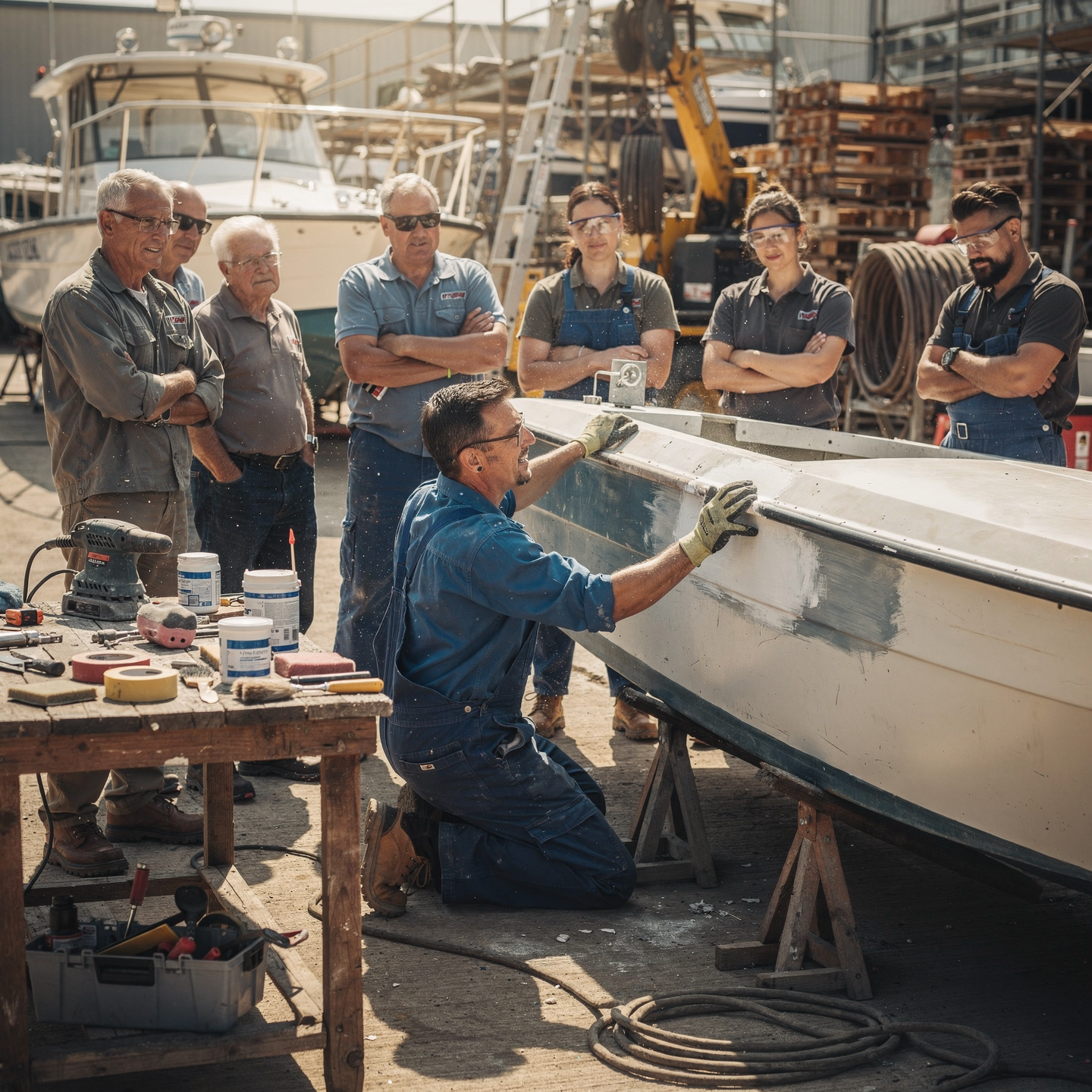
Basic Helmet Repair Techniques Course

Why this course?

The Basic Hull Repair Techniques course

This course will provide you with the fundamental skills to maintain and restore the structural integrity of vessels. You will learn everything from identifying common damage, such as osmosis, cracks, and dents, to applying repair techniques using fiberglass, epoxy resins, and marine sealants. You will also learn essential safety procedures and the correct use of specialized tools to achieve long-lasting, professional repairs.

Key Benefits

  • Accurate Diagnosis: Identifies and assesses different types of damage to fiberglass hulls.
  • Effective Repairs: Applies sanding, laminating, filling, and painting techniques to restore hull integrity.
  • Appropriate Materials: Correctly selects and uses resins, catalysts, fiberglass, and other repair materials.
  • Workplace Safety: Adopts safe practices for handling chemicals and using tools.
  • Professional Finish: Achieves long-lasting repairs with a flawless aesthetic appearance.
Técnicas

Basic Helmet Repair Techniques Course

Availability: 1 in stock

Who is it aimed at?

  • Recreational boat owners who want to acquire basic skills for hull maintenance and repair, enabling them to solve minor problems and save on repair costs.
  • Boat enthusiasts and marine DIYers looking for an introductory, hands-on course to learn how to work with fiberglass, resins, and other hull repair materials.
  • Students of nautical or marine mechanics courses who require a solid foundation in hull repair techniques to complement their theoretical training.
  • Shipyard or naval workshop staff who need basic training to begin hull repair tasks and support more experienced technicians.
  • Anyone interested in the world of shipbuilding and repair who wants to explore new skills and career opportunities in this field.

Flexibility of Learning
 Course with a practical approach: online classes and demonstrations, access to discussion forums and downloadable material to review at your own pace.

Técnicas

Objectives and competencies

Identify and repair common damage to boat hulls.

“Detect cracks, osmosis, delamination and impacts, applying sanding techniques, fiberglass patches, epoxy resins and marine putties.”

Apply temporary sealing and patching techniques to prevent leaks.

“Quickly and safely, using the appropriate materials according to the type of filtration and weather conditions.”

Use appropriate tools and materials for basic helmet repairs:

“Select resins, catalysts, fiberglass and tools (sandpaper, spatulas, brushes) according to the type of damage and hull material, following the manufacturer’s instructions.”

Conduct detailed visual inspections to detect potential structural problems:

“Use checklists, measuring tools (calipers, level) and photographic records to document anomalies and assess their severity according to industry standards.”

Evaluate the structural integrity of the hull after repair:

“Through NDT (Non-Destructive Testing), thorough visual inspection and leak tests, verifying compliance with standards and certifications.”

Prepare damaged surfaces for the application of repair materials:

“Remove rust, dirt and deteriorated coatings using manual or mechanical techniques, ensuring a clean and adherent surface for repair.”

Curriculum - Modules

  1. Comprehensive Maritime Incident Management: protocols, roles, and chain of command for coordinated response
  2. Operational Planning and Execution: briefing, routes, weather windows, and go/no-go criteria
  3. Rapid Risk Assessment: criticality matrix, scene control, and decision-making under pressure
  4. Operational Communication: VHF/GMDSS, standardized reports, and inter-agency liaison
  5. Tactical Mobility and Safe Boarding: RHIB maneuvers, approach, mooring, and recovery
  6. Equipment and Technologies: PPE, signaling, satellite tracking, and field data logging
  7. Immediate Care of the Affected: primary assessment, hypothermia, trauma, and stabilization for evacuation
  8. Adverse Environmental Conditions: swell, Visibility, flows, and operational mitigation

    Simulation and training: critical scenarios, use of VR/AR, and exercises with performance metrics

    Documentation and continuous improvement: lessons learned, indicators (MTTA/MTTR), and SOP updates

  1. Introduction to Shipbuilding Materials: Types, Properties, and Applications.
  2. Damage Inspection and Assessment: Visual and Non-Destructive Testing Techniques and Acceptance Criteria.
  3. Workshop Safety: Personal Protective Equipment, Chemical Handling, and Occupational Hazards.
  4. Surface Preparation: Cleaning, Degreasing, Sanding, and Contaminant Removal.
  5. Epoxy Resin Repair: Lamination, Impregnation, Curing, and Post-Curing Processes.
  6. Gelcoat Repair: Color Matching, Application, Sanding, and Polishing.
  7. Core Repair: Replacement of Balsa, Foam, and Other Materials.
  8. Structural Reinforcements: Application of Fiberglass, Carbon Fiber, and Aramid.
  9. Quality control: Adhesion, hardness, and resistance tests.

    Regulations and standards applicable to hull repair.

  1. Introduction to Materials: Types of resins (epoxy, polyester, vinyl ester), fibers (glass, carbon, aramid), cores (balsa, foam), additives, and catalysts.
  2. Common Hull Damage: Evaluation of impacts, delamination, osmosis, cracks, abrasion, and other deterioration.
  3. Tools and Equipment: Sanders, polishers, applicators, moisture meters, and personal protective equipment (PPE).
  4. Gelcoat Repair: Surface preparation, color matching, application, sanding, and polishing.
  5. Laminate Repair: Hand lay-up, infusion, and vacuum lay-up techniques.
  6. Repair of delaminations and cracks.

  7. Osmosis treatment: Diagnosis, stripping, drying, preventive and curative treatment.
  8. Structural reinforcement: Application of reinforcements with different types of fibers and resins. Calculation of thicknesses and overlaps.
  9. Finishing and painting: Primers, antifouling paints, finishing paints. Application and polishing techniques.
  10. Repairs to wooden hulls: Identification of wood types, treatment of rot, crack repair, and replacement of sections.
  11. Regulations and safety: Safety standards in the handling of chemical products, waste management, and environmental protection.

  1. Introduction to Hull Materials: Types of fiber (glass, carbon, aramid), resins (polyester, epoxy, vinyl ester), and cores (balsa, foam).
  2. Basic Repair Tools: Sanders, polishers, spatulas, rollers, brushes, paint guns, and personal protective equipment (PPE).
  3. Surface Preparation: Cleaning, degreasing, sanding, and masking the area to be repaired.
  4. Repairing Small Cracks and Fissures: Laminating techniques with fiberglass and resin.
  5. Repairing Dents and Bumps: Filling with putty, sanding, and smoothing the surface.
  6. Gelcoat Application: Preparation, Gelcoat mixing, application, and polishing.
  7. Osmosis Repair: Identification, treatment, and prevention of osmosis.
  8. Sanding and Polishing Techniques: Different types of sandpaper, polishes, and techniques for achieving a professional finish.
  9. Hull Painting: Preparation, priming, paint and varnish application.
  10. Safety in Repairs: Ventilation, chemical handling, PPE, and waste disposal.

  1. Introduction to Hull Structure: Types of vessels, construction materials (steel, aluminum, fiberglass, wood), nomenclature, and hull parts.
  2. Inspection and Damage Diagnosis: Identification of corrosion, osmosis, cracks, dents, delamination, and other common defects in different materials.
  3. Surface Preparation: Cleaning techniques (sandblasting, sanding, scraping), degreasing, priming, and filling.
  4. Steel Repair: Welding (types, techniques), patching, replacement of damaged sections, and corrosion protection.
  5. Aluminum Repair: Welding (types, special techniques), riveting, and the use of specific fillers and compounds.
  6. Fiberglass Repair
  7. Glass: Laminating techniques, application of resins and fiberglass, gelcoat repair, osmosis treatment.
  8. Wood Repair: Caulking, plank replacement, wood treatment against rot and insects.
  9. Preventive Hull Maintenance: Application of antifouling, periodic inspections, lubrication of seacocks, and treatment of areas prone to corrosion.
  10. Workplace Safety: Use of personal protective equipment (PPE), safe handling of chemicals, fire prevention, and first aid.
  11. Standards and Regulations: Compliance with maritime safety and environmental regulations related to hull repair and maintenance.

  1. System Architecture and Components: Structural design, materials, and subsystems (mechanical, electrical, electronic, and fluid) with selection and assembly criteria for marine environments
  2. Fundamentals and Principles of Operation: Physical and engineering foundations (thermodynamics, fluid mechanics, electricity, control, and materials) that explain performance and operating limits
  3. Safety and Environmental (SHE): Risk analysis, PPE, LOTO, hazardous atmospheres, spill and waste management, and emergency response plans
  4. Applicable Regulations and Standards: IMO/ISO/IEC requirements and local regulations;
  5. Conformance criteria, certification, and best practices for operation and maintenance
  6. Inspection, testing, and diagnostics: Visual/dimensional inspection, functional testing, data analysis, and predictive techniques (vibration, thermography, fluid analysis) to identify root causes
  7. Preventive and predictive maintenance: Hourly/cycle/seasonal plans, lubrication, adjustments, calibrations, consumable replacement, post-service verification, and operational reliability
  8. Instrumentation, tools, and metrology: Measuring and testing equipment, diagnostic software, calibration and traceability; selection criteria, safe use, and storage
  9. Onboard integration and interfaces: Mechanical, electrical, fluid, and data compatibility; Sealing and watertightness, EMC/EMI, corrosion protection, and interoperability testing.

    Quality, acceptance testing, and commissioning: process and materials control, FAT/SAT, bench and sea trials, go/no-go criteria, and evidence documentation.

    Technical documentation and integrated practice: logs, checklists, reports, and a complete case study (safety → diagnosis → intervention → verification → report) applicable to any system.

Plan de estudio - Módulos

  1. Comprehensive Maritime Incident Management: protocols, roles, and chain of command for coordinated response
  2. Operational Planning and Execution: briefing, routes, weather windows, and go/no-go criteria
  3. Rapid Risk Assessment: criticality matrix, scene control, and decision-making under pressure
  4. Operational Communication: VHF/GMDSS, standardized reports, and inter-agency liaison
  5. Tactical Mobility and Safe Boarding: RHIB maneuvers, approach, mooring, and recovery
  6. Equipment and Technologies: PPE, signaling, satellite tracking, and field data logging
  7. Immediate Care of the Affected: primary assessment, hypothermia, trauma, and stabilization for evacuation
  8. Adverse Environmental Conditions: swell, Visibility, flows, and operational mitigation

    Simulation and training: critical scenarios, use of VR/AR, and exercises with performance metrics

    Documentation and continuous improvement: lessons learned, indicators (MTTA/MTTR), and SOP updates

  1. Introduction to Shipbuilding Materials: Types, Properties, and Applications.
  2. Damage Inspection and Assessment: Visual and Non-Destructive Testing Techniques and Acceptance Criteria.
  3. Workshop Safety: Personal Protective Equipment, Chemical Handling, and Occupational Hazards.
  4. Surface Preparation: Cleaning, Degreasing, Sanding, and Contaminant Removal.
  5. Epoxy Resin Repair: Lamination, Impregnation, Curing, and Post-Curing Processes.
  6. Gelcoat Repair: Color Matching, Application, Sanding, and Polishing.
  7. Core Repair: Replacement of Balsa, Foam, and Other Materials.
  8. Structural Reinforcements: Application of Fiberglass, Carbon Fiber, and Aramid.
  9. Quality control: Adhesion, hardness, and resistance tests.

    Regulations and standards applicable to hull repair.

  1. Introduction to Materials: Types of resins (epoxy, polyester, vinyl ester), fibers (glass, carbon, aramid), cores (balsa, foam), additives, and catalysts.
  2. Common Hull Damage: Evaluation of impacts, delamination, osmosis, cracks, abrasion, and other deterioration.
  3. Tools and Equipment: Sanders, polishers, applicators, moisture meters, and personal protective equipment (PPE).
  4. Gelcoat Repair: Surface preparation, color matching, application, sanding, and polishing.
  5. Laminate Repair: Hand lay-up, infusion, and vacuum lay-up techniques.
  6. Repair of delaminations and cracks.

  7. Osmosis treatment: Diagnosis, stripping, drying, preventive and curative treatment.
  8. Structural reinforcement: Application of reinforcements with different types of fibers and resins. Calculation of thicknesses and overlaps.
  9. Finishing and painting: Primers, antifouling paints, finishing paints. Application and polishing techniques.
  10. Repairs to wooden hulls: Identification of wood types, treatment of rot, crack repair, and replacement of sections.
  11. Regulations and safety: Safety standards in the handling of chemical products, waste management, and environmental protection.

  1. Introduction to Hull Materials: Types of fiber (glass, carbon, aramid), resins (polyester, epoxy, vinyl ester), and cores (balsa, foam).
  2. Basic Repair Tools: Sanders, polishers, spatulas, rollers, brushes, paint guns, and personal protective equipment (PPE).
  3. Surface Preparation: Cleaning, degreasing, sanding, and masking the area to be repaired.
  4. Repairing Small Cracks and Fissures: Laminating techniques with fiberglass and resin.
  5. Repairing Dents and Bumps: Filling with putty, sanding, and smoothing the surface.
  6. Gelcoat Application: Preparation, Gelcoat mixing, application, and polishing.
  7. Osmosis Repair: Identification, treatment, and prevention of osmosis.
  8. Sanding and Polishing Techniques: Different types of sandpaper, polishes, and techniques for achieving a professional finish.
  9. Hull Painting: Preparation, priming, paint and varnish application.
  10. Safety in Repairs: Ventilation, chemical handling, PPE, and waste disposal.

  1. Introduction to Hull Structure: Types of vessels, construction materials (steel, aluminum, fiberglass, wood), nomenclature, and hull parts.
  2. Inspection and Damage Diagnosis: Identification of corrosion, osmosis, cracks, dents, delamination, and other common defects in different materials.
  3. Surface Preparation: Cleaning techniques (sandblasting, sanding, scraping), degreasing, priming, and filling.
  4. Steel Repair: Welding (types, techniques), patching, replacement of damaged sections, and corrosion protection.
  5. Aluminum Repair: Welding (types, special techniques), riveting, and the use of specific fillers and compounds.
  6. Fiberglass Repair
  7. Glass: Laminating techniques, application of resins and fiberglass, gelcoat repair, osmosis treatment.
  8. Wood Repair: Caulking, plank replacement, wood treatment against rot and insects.
  9. Preventive Hull Maintenance: Application of antifouling, periodic inspections, lubrication of seacocks, and treatment of areas prone to corrosion.
  10. Workplace Safety: Use of personal protective equipment (PPE), safe handling of chemicals, fire prevention, and first aid.
  11. Standards and Regulations: Compliance with maritime safety and environmental regulations related to hull repair and maintenance.

  1. System Architecture and Components: Structural design, materials, and subsystems (mechanical, electrical, electronic, and fluid) with selection and assembly criteria for marine environments
  2. Fundamentals and Principles of Operation: Physical and engineering foundations (thermodynamics, fluid mechanics, electricity, control, and materials) that explain performance and operating limits
  3. Safety and Environmental (SHE): Risk analysis, PPE, LOTO, hazardous atmospheres, spill and waste management, and emergency response plans
  4. Applicable Regulations and Standards: IMO/ISO/IEC requirements and local regulations;
  5. Conformance criteria, certification, and best practices for operation and maintenance
  6. Inspection, testing, and diagnostics: Visual/dimensional inspection, functional testing, data analysis, and predictive techniques (vibration, thermography, fluid analysis) to identify root causes
  7. Preventive and predictive maintenance: Hourly/cycle/seasonal plans, lubrication, adjustments, calibrations, consumable replacement, post-service verification, and operational reliability
  8. Instrumentation, tools, and metrology: Measuring and testing equipment, diagnostic software, calibration and traceability; selection criteria, safe use, and storage
  9. Onboard integration and interfaces: Mechanical, electrical, fluid, and data compatibility; Sealing and watertightness, EMC/EMI, corrosion protection, and interoperability testing.

    Quality, acceptance testing, and commissioning: process and materials control, FAT/SAT, bench and sea trials, go/no-go criteria, and evidence documentation.

    Technical documentation and integrated practice: logs, checklists, reports, and a complete case study (safety → diagnosis → intervention → verification → report) applicable to any system.

  1. Introduction to hull construction materials: wood, fiberglass, composites, metals.
  2. Basic tools: types, uses, maintenance, and safety.
  3. Workshop safety: ventilation, personal protective equipment, handling of chemicals.
  4. Damage assessment: identification of cracks, osmosis, corrosion, and delamination.
  5. Fiberglass repair: sanding, resin and fiber application, finishing.
  6. Surface preparation: cleaning, degreasing, and priming.
  7. Gelcoat repair: color matching, application, and polishing.
  8. Puttys and fillers: types, application, and sanding.
  9. Basic techniques of Sanding: by hand and with power tools.

    Finishing and polishing: buffing, waxing, and protection.

  1. Introduction to shipbuilding materials: wood, fiberglass, resins, composites.
  2. Basic tools for repair: sanders, polishers, spatulas, brushes, paint sprayers.
  3. Workshop safety: personal protective equipment (PPE), ventilation, handling of chemicals.
  4. Surface preparation: cleaning, degreasing, sanding, rust removal.
  5. Repairing small cracks and fissures: use of fillers, epoxy resins, and fiberglass.
  6. Repairing dents and dings: molding techniques, application of reinforcements.
  7. Repairing delamination: identification, treatment, and reconstruction.
  8. Application of gelcoat and Painting: preparation, mixing, application, and finishing.

    Repair of hardware and fittings: riveting, bolting, and cold welding.

    Preventive maintenance: inspection, cleaning, and weather protection.

  1. Introduction to Naval Hull Building: History, Evolution, and Purposes
  2. Materials: Traditional woods, marine plywood, composites, and metals
  3. Basic Tools: Brushes, chisels, rasps, sandpaper, and measuring tools
  4. Workshop Safety: Personal protective equipment (PPE), ventilation, and chemical handling
  5. Surface Preparation Techniques: Cleaning, sanding, and wood treatment
  6. Caulking: Materials, tools, and procedures for sealing joints
  7. Priming and Painting: Types of primers, marine paints, and application techniques
  8. Repairing Minor Damage: Cracks, chips, dents, and Other defects.
  9. Preventive maintenance: inspections, cleaning, and protection against corrosion and deterioration.
  10. Introduction to technical documentation: drawings, specifications, and repair manuals.

  1. Introduction to Helmets: Types, Materials, and Their Properties
  2. Workshop Safety: Personal Protective Equipment, Ventilation, and Chemical Handling
  3. Basic Tools: Sanders, Spatulas, Brushes, Heat Guns
  4. Surface Preparation: Cleaning, Sanding, Degreasing, and Masking
  5. Repairing Cracks and Fissures: Resin and Filler Application Techniques
  6. Repairing Dents and Bumps: Using Fillers, Sanding, and Leveling
  7. Applying Primer Coats: Types of Primers and Application Techniques
  8. Painting and Finishing: Selecting Paints, Application Techniques, and Polishing
  9. Minor Repairs: Sealing joints, repairing fittings and hardware
  10. Final Inspection and Quality Control

Career opportunities

  • Recreational and Sports Boat Repairer: Maintenance and repair of hulls made of fiberglass, polyester, and other materials.
  • Shipyard Technician: Repair and maintenance work on hulls of various types of vessels.
  • Composite Specialist: Repair and reinforcement of composite structures in various sectors, including nautical and aeronautical.
  • Naval Surveyor: Assessment of damage to vessel hulls and preparation of technical reports.
  • Naval Maintenance Worker: Performing hull repair and maintenance tasks under supervision.
  • Self-Employed Worker: Offering hull repair services to individuals and companies.
  • Employee at Yacht Clubs and Marinas: Maintenance and repair of boats. Partners.
  • Boatbuilding: Collaboration in the construction and repair of new hulls.

“`

Admission requirements

Academic/professional profile:

Degree/Bachelor's degree in Nautical Science/Maritime Transport, Naval/Marine Engineering, or a related field; or proven professional experience in bridge/operations.

Language proficiency:

Recommended functional maritime English (SMCP) for simulations and technical materials.

5. Induction

Updated resume, copy of degree or seaman's book, ID card/passport, letter of motivation.

Technical requirements (for online):

Equipment with camera/microphone, stable connection, ≥ 24” monitor recommended for ECDIS/Radar-ARPA.

Admission process and dates

1. Online
application

(form + documents).

2. Academic review and interview

(profile/objectives/schedule compatibility).

3. Admission decision

(+ scholarship proposal if applicable).

4. Reservation of place

(deposit) and registration.

5. Induction

(access to campus, calendars, simulator guides).

Scholarships and grants

  • Repair Fundamentals: Learn to identify and assess common damage to boat hulls.
  • Materials and Tools: Master the use of resins, fiberglass, putties, and essential repair tools.
  • Lamination Techniques: Practice lamination techniques to restore the hull’s structural integrity.
  • Professional Finishes: Achieve high-quality finishes through sanding, polishing, and gel coat application.
  • Safety and Prevention: Understand safety measures and best practices for a safe working environment.
Learn to repair hulls like a professional and extend the life of your boat with this hands-on course.

Testimonials

Frequently asked questions

A patch covers the damage from the outside, while a plug is inserted into the hole from the inside.

Yes. The itinerary includes ECDIS/Radar-ARPA/BRM with harbor, ocean, fog, storm, and SAR scenarios.

Online with live sessions; hybrid option for simulator/practical placements through agreements.

A patch covers a hole from the outside, while a plug is inserted into the hole from the inside.

Recommended functional SMCP. We offer support materials for standard phraseology.

Yes, with a relevant degree or experience in maritime/port operations. The admissions interview will confirm suitability.

Optional (3–6 months) through Companies & Collaborations and the Alumni Network.

Simulator practice (rubrics), defeat plans, SOPs, checklists, micro-tests and applied TFM.

A degree from Navalis Magna University + operational portfolio (tracks, SOPs, reports and KPIs) useful for audits and employment.

  1. Introduction to Helmets: Types, Materials, and Their Properties
  2. Workshop Safety: Personal Protective Equipment, Ventilation, and Chemical Handling
  3. Basic Tools: Sanders, Spatulas, Brushes, Heat Guns
  4. Surface Preparation: Cleaning, Sanding, Degreasing, and Masking
  5. Repairing Cracks and Fissures: Resin and Filler Application Techniques
  6. Repairing Dents and Bumps: Using Fillers, Sanding, and Leveling
  7. Applying Primer Coats: Types of Primers and Application Techniques
  8. Painting and Finishing: Selecting Paints, Application Techniques, and Polishing
  9. Minor Repairs: Sealing joints, repairing fittings and hardware
  10. Final Inspection and Quality Control

Request information

  1. Complete the Application Form
  2. Attach your CV/Qualifications (if you have them to hand).
  3. Indicate your preferred cohort (January/May/September) and whether you want the hybrid option with simulator sessions.
An academic advisor will contact you within 24–48 hours to guide you through the admission process, scholarships, and compatibility with your professional schedule. Translated with DeepL.com (free version)
Please enable JavaScript in your browser to complete this form.
Click or drag a file to this area to upload.

Teachers

0
    0
    Tu carrito
    Tu carrito esta vacíoRegresar a la tienda
    Scroll to Top


