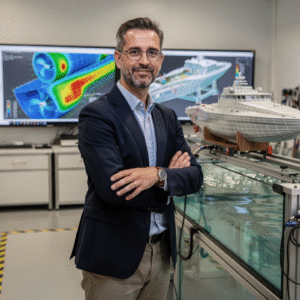
Diploma in Mooring and Anchoring Techniques

Why this certificate program?

The Diploma in Mooring and Anchoring Techniques

This program is designed to provide a comprehensive and practical understanding of mooring and anchoring operations, crucial for maritime safety and efficiency. Learn to execute these maneuvers with precision and safety, minimizing risks and optimizing time in port. This program covers everything from theoretical fundamentals to the most advanced techniques, using the latest industry standards and best practices.

Differential Advantages

  • In-Depth Knowledge: Master the design principles of mooring and anchoring systems, including chains, cables, and anchors.
  • Practical Skills: Apply advanced mooring and anchoring techniques in diverse environmental conditions and vessel types.
  • Maritime Safety: Identify and mitigate risks associated with operations, complying with international regulations.
  • Resource Optimization: Learn to select and maintain mooring and anchoring equipment, maximizing its lifespan and reducing costs.
  • Simulations and Real-World Case Studies: Participate in case studies and practical simulations to address common industry challenges.
Técnicas

Diploma in Mooring and Anchoring Techniques

Availability: 1 in stock

Who is it aimed at?

  • Deck officers and merchant mariners who wish to deepen their knowledge of best practices and safety regulations for mooring and anchoring.
  • Port terminal supervisors and stevedores who seek to optimize the efficiency and safety of mooring operations at their facilities.
  • Maritime safety inspectors and auditors who need to strengthen their knowledge to properly assess mooring and anchoring procedures on board.
  • Fleet managers and operations personnel responsible for reducing risks and improving the reliability of shipping operations related to mooring and anchoring.
  • Maritime students and recent graduates who seek to acquire practical expertise in mooring and anchoring techniques for a competitive advantage competitive.

Study Flexibility:
Designed for professionals and students with tight schedules: 24/7 accessible content, asynchronous discussion forums, and downloadable materials for offline learning.

Técnicas

Objectives and competencies

Master mooring and anchoring techniques in various conditions:

“Execute safe maneuvers by assessing wind, current, bottom type, and available equipment.”

Select the appropriate mooring and anchoring equipment according to the vessel and the environment:

Considering the displacement, length, draft of the vessel, type of seabed, expected weather conditions and the availability of space in the anchorage/mooring area.

Assess risks and respond effectively to emergencies during mooring and anchoring maneuvers:

“Identify specific hazards, implement contingency plans, and communicate efficiently with the crew and port authorities.”

Optimize safety and efficiency in mooring and anchoring operations:

“Select equipment and procedures appropriate to the vessel, environmental conditions and maneuver requirements, minimizing risks and optimizing time.”

Correctly interpret meteorological and bathymetric information for the selection of safe anchorages:

Analyze nautical charts and forecasts, considering currents, tides, and seabed conditions to identify hazard-free areas suitable for anchoring.

Apply current regulations on maritime safety and environmental protection during mooring and anchoring operations:

“Interpret and apply SOLAS, MARPOL regulations and national conventions, ensuring compliance with emergency procedures and mitigation of environmental risks.”

Curriculum - Modules

  1. Comprehensive Maritime Incident Management: protocols, roles, and chain of command for coordinated response
  2. Operational Planning and Execution: briefing, routes, weather windows, and go/no-go criteria
  3. Rapid Risk Assessment: criticality matrix, scene control, and decision-making under pressure
  4. Operational Communication: VHF/GMDSS, standardized reports, and inter-agency liaison
  5. Tactical Mobility and Safe Boarding: RHIB maneuvers, approach, mooring, and recovery
  6. Equipment and Technologies: PPE, signaling, satellite tracking, and field data logging
  7. Immediate Care of the Affected: primary assessment, hypothermia, trauma, and stabilization for evacuation
  8. Adverse Environmental Conditions: swell, Visibility, flows, and operational mitigation

    Simulation and training: critical scenarios, use of VR/AR, and exercises with performance metrics

    Documentation and continuous improvement: lessons learned, indicators (MTTA/MTTR), and SOP updates

  1. Introduction to Safe Maneuvering: Definition and Fundamental Principles
  2. Physics of Maneuvering: Forces, Inertia, Moments, and Their Effects on the Vessel
  3. Steering and Propulsion: Rudder, Propellers, Thrusters, and Their Interactions
  4. Environmental Effects: Wind, Current, Waves, and Shallow Waters
  5. Maneuvers in Open Spaces: Courses, Turns, Acceleration, and Braking
  6. Bedding and Unberthing Maneuvers: Planning, Execution, and Safety
  7. Tugboats: Types, Capacities, Communications, and Strategies
  8. Maneuvers in Channels and Rivers: Currents, Drafts, and Buoys
  9. Maneuvers of Emergency: Man overboard, loss of control, and collisions

    Case studies and simulations: Practical application of the concepts

  1. Introduction to Safe Maneuvering: Definition, Scope, and Objectives
  2. Ship Dynamics: Acting Forces, Inertia, and Propeller and Rudder Effects
  3. Environmental Conditions: Wind, Current, Waves, and Their Influence on Maneuvering
  4. Aids to Navigation: Buoys, Beacons, Lighthouses, Fog Signals, and Their Interpretation
  5. Communications: VHF, Standard Procedures, and Maritime Phraseology
  6. Maneuver Planning: Information Gathering, Risk Assessment, and Plan Development
  7. Speed ​​and Distances: Calculating Stops, Turns, and Approaches
  8. Maneuvering in Confined Spaces: Channels, Basins, Locks, and Specific procedures
  9. Bedding and unberthing: Preliminary considerations, use of tugboats and mooring lines
  10. Emergency maneuvers: Man overboard, engine failure, loss of steering and response to critical situations

  1. Basic Principles of Berthing: Forces involved, effects of wind and current.
  2. Bertling Planning: Necessary information, risk assessment, factors to consider.
  3. Approach and Contact Maneuvers: Use of propellers, rudder, and tugs.
  4. Mooring and Securing the Vessel: Types of lines, proper arrangement and tension.
  5. Unberthing: Sequence of maneuvers, precautions, and special considerations.
  6. Anchoring: Site selection, chain length calculation, anchoring and weighing techniques.
  7. Onboard Emergencies: Fires, floods, machinery failures, abandoning ship.
  8. Procedures for Emergency: Alarm activation, communication, damage control.

    Salvage and towing: Basic techniques, equipment, and safety considerations.

    Applicable legislation and regulations: International conventions, port regulations.

  1. Fundamentals of Anchoring: Types of seabeds, chains, mooring lines, and anchors
  2. Calculating the anchoring length: Factors, formulas, and safety
  3. Anchoring techniques with one and two anchors: Advantages, disadvantages, and risks
  4. Anchor recovery maneuvers: Methods and solutions to problems
  5. Swinging: Factors that influence it, forecasting, and risk management
  6. Safety at anchor: Surveillance, alarms, and monitoring systems
  7. Optimizing anchoring: Reducing swinging, environmental protection
  8. Anchoring in adverse conditions: Strong currents, winds, and waves
  9. Maintenance of anchoring equipment: inspection, cleaning, and repair
  10. Regulations and legislation on restricted and protected anchoring areas

  1. System Architecture and Components: Structural design, materials, and subsystems (mechanical, electrical, electronic, and fluid) with selection and assembly criteria for marine environments
  2. Fundamentals and Principles of Operation: Physical and engineering foundations (thermodynamics, fluid mechanics, electricity, control, and materials) that explain performance and operating limits
  3. Safety and Environmental (SHE): Risk analysis, PPE, LOTO, hazardous atmospheres, spill and waste management, and emergency response plans
  4. Applicable Regulations and Standards: IMO/ISO/IEC requirements and local regulations;
  5. Conformance criteria, certification, and best practices for operation and maintenance
  6. Inspection, testing, and diagnostics: Visual/dimensional inspection, functional testing, data analysis, and predictive techniques (vibration, thermography, fluid analysis) to identify root causes
  7. Preventive and predictive maintenance: Hourly/cycle/seasonal plans, lubrication, adjustments, calibrations, consumable replacement, post-service verification, and operational reliability
  8. Instrumentation, tools, and metrology: Measuring and testing equipment, diagnostic software, calibration and traceability; selection criteria, safe use, and storage
  9. Onboard integration and interfaces: Mechanical, electrical, fluid, and data compatibility; Sealing and watertightness, EMC/EMI, corrosion protection, and interoperability testing.

    Quality, acceptance testing, and commissioning: process and materials control, FAT/SAT, bench and sea trials, go/no-go criteria, and evidence documentation.

    Technical documentation and integrated practice: logs, checklists, reports, and a complete case study (safety → diagnosis → intervention → verification → report) applicable to any system.

  1. Maneuvering Principles: Acting forces (wind, current, draft, inertia)
  2. Bertling: Types of berthing, planning, use of tugboats, springs, fenders
  3. Anchoring: Selection of anchorage, calculation of chain length, anchoring and weighing anchor techniques
  4. Single-Engine Maneuvering: Propeller effects, emergency maneuvers
  5. Steering and Rudder: Effects, types of rudders, failures
  6. Maneuvering Aids: Transverse thrusters, bow/stern jets, dynamic positioning systems (DP)
  7. Onboard Emergencies: Fires, floods, engine failures, man overboard water
  8. Emergency Communication: Procedures, equipment, communications with shore
  9. Simulation Exercises: Docking, anchoring, emergencies, navigation in adverse conditions
  10. Post-Maneuver Analysis: Lessons learned, continuous improvement, reports

Career opportunities

  • Specialized Deckhand: Expert execution of moorings and anchoring, equipment maintenance.
  • Port Master: Supervision and coordination of mooring and anchoring operations in marinas and fishing ports.
  • Professional Mooringman: Provision of specialized mooring and unmooring services in commercial ports.
  • Support Vessel Operator: Assistance in anchoring and mooring maneuvers for larger vessels.
  • Mooring and Anchoring Facility Inspector: Evaluation and certification of the safety and reliability of equipment and systems.
  • Mooring and Anchoring Techniques Instructor: Training of maritime personnel in safe and efficient procedures.
  • Port Operations Consultant: Advising on optimization of mooring and anchoring operations.
  • Anchorage Base Manager: Administration and maintenance of anchorage infrastructure for vessels.

“`

Admission requirements

Academic/professional profile:

Degree/Bachelor's degree in Nautical Science/Maritime Transport, Naval/Marine Engineering, or a related field; or proven professional experience in bridge/operations.

Language proficiency:

Recommended functional maritime English (SMCP) for simulations and technical materials.

Documentation:

Updated resume, copy of degree or seaman's book, ID card/passport, letter of motivation.

Technical requirements (for online):

Equipment with camera/microphone, stable connection, ≥ 24” monitor recommended for ECDIS/Radar-ARPA.

Admission process and dates

1. Online
application

(form + documents).

2. Academic review and interview

(profile/objectives/schedule compatibility).

3. Admission decision

(+ scholarship proposal if applicable).

4. Reservation of place

(deposit) and registration.

5. Induction

(access to campus, calendars, simulator guides).

Scholarships and grants

  • Expert Mastery: Learn the essential techniques for safe and efficient mooring and anchoring.
  • Case Studies: Analyze real-life situations and make informed decisions in diverse maritime environments.
  • Current Regulations: Understand current legislation and safety standards applicable to mooring and anchoring operations.
  • Resource Optimization: Maximize the lifespan of your equipment and reduce costs through preventive maintenance practices.
  • Professional Certification: Obtain a diploma that validates your skills and sets you apart in the industry. Maritime industry.
Prepare to face any challenge in mooring and anchoring with solid and applicable knowledge.

Testimonials

Frequently asked questions

To keep a vessel safe and fixed in a specific location, whether at a dock, buoy, or anchor.

Yes. The itinerary includes ECDIS/Radar-ARPA/BRM with harbor, ocean, fog, storm, and SAR scenarios.

Online with live sessions; hybrid option for simulator/practical placements through agreements.

Recommended functional SMCP. We offer support materials for standard phraseology.

Yes, with a relevant degree or experience in maritime/port operations. The admissions interview will confirm suitability.

Optional (3–6 months) through Companies & Collaborations and the Alumni Network.

Simulator practice (rubrics), defeat plans, SOPs, checklists, micro-tests and applied TFM.

A degree from Navalis Magna University + operational portfolio (tracks, SOPs, reports and KPIs) useful for audits and employment.

  1. Introduction to Maneuver Planning: Phases, Objectives, and Resources
  2. Vector Calculus Applied to Maneuvering: Forces, Moments, and Trajectories
  3. Ship Dynamics: Inertia, Stability, and the Effects of Wind and Current
  4. Propulsion and Steering: Propellers, Rudders, Transverse Thrusters, and Their Effects
  5. Basic Maneuvers: Starting, Stopping, Turning, Buoyancy, and Simple Berthing
  6. Maneuvers with Tugs: Types, Configuration, and Usage Strategies
  7. Bertling and Unberthing: Environmental Analysis, Lines, Fenders, and Communication
  8. Maneuvers in Adverse Conditions: Strong Winds, Currents, and Reduced Visibility
  9. Emergency Maneuvers: Man Overboard, Breakdowns, and Loss of Steering
  10. Maneuver Simulation: Application of Calculations and Risk Assessment

Request information

  1. Complete the Application Form.

  2. Attach your CV/degree certificate (if you have it to hand).

  3. Indicate your preferred cohort (January/May/September) and whether you would like the hybrid option with simulator sessions.

    An academic advisor will contact you within 24–48 hours to guide you through the admission process, scholarships, and compatibility with your professional schedule.

Please enable JavaScript in your browser to complete this form.
Click or drag a file to this area to upload.

Faculty

0
    0
    Tu carrito
    Tu carrito esta vacíoRegresar a la tienda
    Scroll to Top