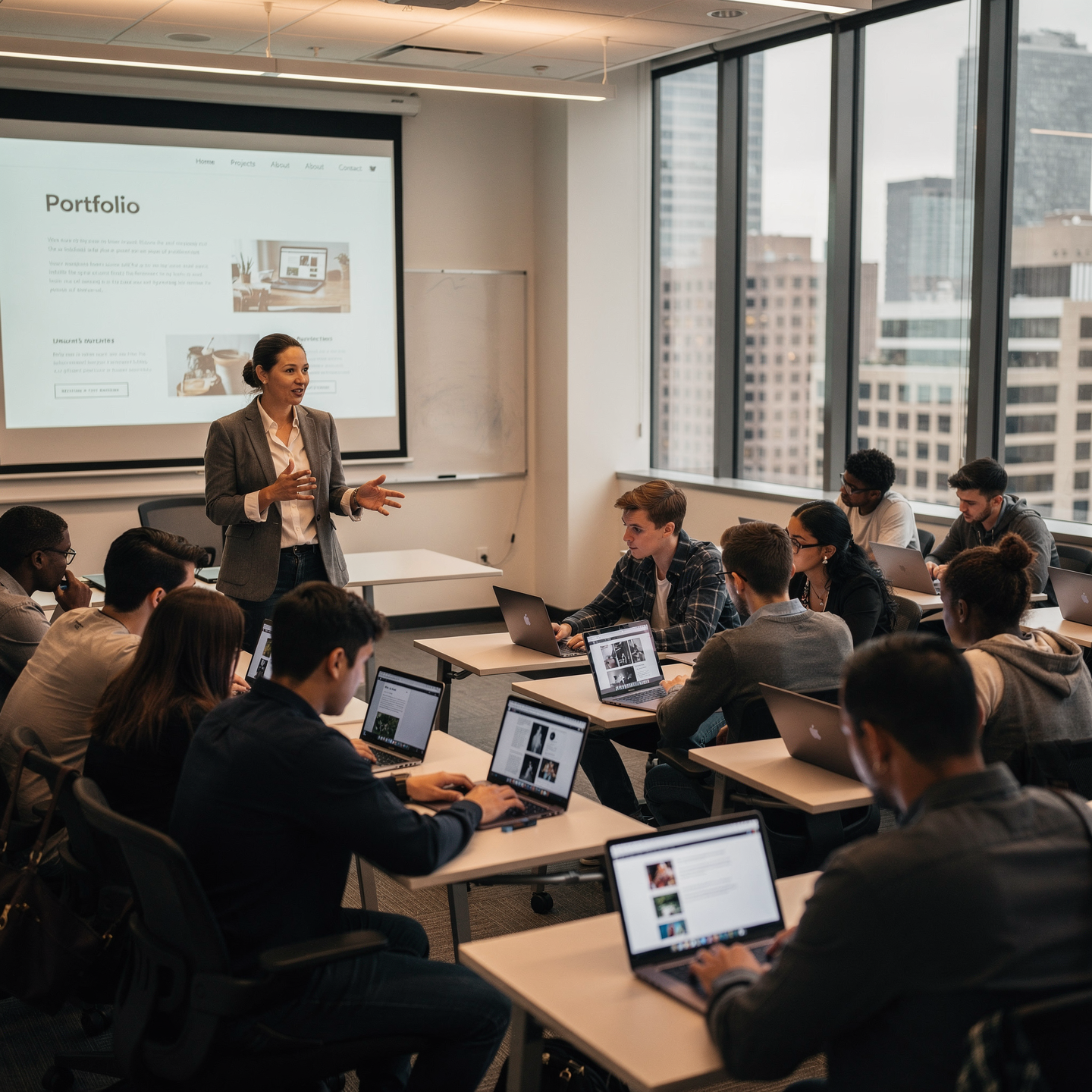
Digital Publishing and Portfolios Course

Why this course?

The Digital Publishing and Portfolios

course

Provides you with the essential tools to stand out in the digital world. Learn to create engaging and professional content for your personal brand or business. Master key platforms, from social media to websites, optimizing your online presence and building an impactful portfolio. This program guides you step-by-step through the design, strategy, and promotion of your content, ensuring that you reach your target audience and achieve your goals.

Key Benefits

  • Tool Mastery: Learn to use design and content management software and platforms.
  • Content Strategy: Develop an effective plan to create and distribute relevant content.
  • Engaging Design: Create visually striking presentations and portfolios that showcase your work.
  • SEO Optimization: Improve the visibility of your content on search engines and social media.
  • Digital Networking: Connect with other professionals and expand your online reach.
Publicación

Digital Publishing and Portfolios Course

Availability: 1 in stock

Who is it aimed at?

  • Creatives, designers, and communicators who want to maximize their online presence and showcase their work in an impactful way.
  • Entrepreneurs and freelancers looking to build a strong personal brand and attract clients through engaging content.
  • Students and recent graduates who need a professional digital portfolio to stand out in the job market.
  • Marketing and advertising professionals interested in mastering the tools and strategies for creating effective digital content.
  • Anyone with a story to tell who wants to learn how to create captivating digital posts and share them with the world.

Flexibility and Personalized Learning Adapted to your pace: materials Downloadable resources, practical exercises, and individualized advice to boost your project.

Publicación

Objectives and competencies

Create impactful digital portfolios:

Design visually appealing and narratively coherent portfolios, optimized for project presentation and demonstration of professional skills.

Mastering digital design tools:

“Create vector graphics, retouch images, and design publication layouts, optimizing for different platforms and formats.”

Optimize your professional online presence:

“Implement SEO, content marketing, and web analytics to increase visibility and engagement.”

Managing effective content strategies:

Develop original, relevant content adaptable to various platforms, optimizing its distribution and measurement to achieve audience and business objectives.

Develop compelling visual storytelling skills:

“Create coherent visual stories, using composition, lighting, and rhythm to evoke emotions and impact the viewer.”

Building a strong digital personal brand:

“Create valuable content, interact authentically, and optimize profiles to project expertise and build an influential professional network.”

Curriculum - Modules

  1. Comprehensive Maritime Incident Management: protocols, roles, and chain of command for coordinated response
  2. Operational Planning and Execution: briefing, routes, weather windows, and go/no-go criteria
  3. Rapid Risk Assessment: criticality matrix, scene control, and decision-making under pressure
  4. Operational Communication: VHF/GMDSS, standardized reports, and inter-agency liaison
  5. Tactical Mobility and Safe Boarding: RHIB maneuvers, approach, mooring, and recovery
  6. Equipment and Technologies: PPE, signaling, satellite tracking, and field data logging
  7. Immediate Care of the Affected: primary assessment, hypothermia, trauma, and stabilization for evacuation
  8. Adverse Environmental Conditions: swell, Visibility, flows, and operational mitigation

    Simulation and training: critical scenarios, use of VR/AR, and exercises with performance metrics

    Documentation and continuous improvement: lessons learned, indicators (MTTA/MTTR), and SOP updates

  1. Introduction to Digital Editing: Basic Concepts, Formats, and Trends
  2. Editing Software: Comparison of Tools (Adobe Creative Suite, Affinity Suite, Free Alternatives)
  3. Image Optimization: Resolution, Size, Formats, Compression, and Metadata
  4. Video Editing: Capture, Editing, Color Correction, Audio, and Exporting
  5. Graphic Design for Social Media: Creating Attractive Visual Content Adapted to Each Platform
  6. Digital Marketing Fundamentals: SEO, SEM, Email Marketing, and Social Media
  7. Content Strategies: Content Creation, Curation, Adaptation, and Scheduling
  8. Web and Social Media Analytics: Key Metrics, Analysis Tools, and Reporting
  9. Community Management: Managing Online Communities, Interaction, and Moderation
  10. **Content Monetization:** Monetization strategies, online advertising, and affiliate marketing.

  1. Fundamentals of Digital Storytelling: Key concepts, formats, and platforms.
  2. Storytelling for the Web: Adapting narratives to digital environments.
  3. The Multimedia Script: Structure, characters, and development in digital projects.
  4. Visual Elements in Digital Storytelling: Images, video, animation, and graphic design.
  5. User Experience (UX) Design in Storytelling: Interactivity and navigation.
  6. Typography and Legibility in Digital Environments: Selection and hierarchy.
  7. Color Theory Applied to Digital Design: Color psychology and effective combinations.
  8. Introduction to Portfolio Design: Objectives, audience, and work selection.
  9. Portfolio Structure and Organization Digital: Usability and accessibility.

    Portfolio presentation: Copywriting, visual design, and SEO optimization.

  1. Introduction to Digital Editing: Basic Concepts, Software, and Hardware
  2. Graphic Design Fundamentals: Typography, Color, Composition, and Visual Hierarchy
  3. Image Editing Software: Adobe Photoshop (or alternative), Interface, Essential Tools
  4. Vector Design Software: Adobe Illustrator (or alternative), Logo and Illustration Creation
  5. Social Media Design: Formats, Sizes, Trends, and Optimization
  6. Multimedia Content Creation: Images, Videos, and GIFs
  7. Digital Marketing Fundamentals: SEO, SEM, Social Media, and Email Marketing
  8. Basic Website Creation: HTML, CSS, and CMS Platforms (WordPress)
  9. Online Distribution Strategies: Segmentation, Advertising, and Results Analysis
  10. Ethics and Copyright in digital publishing and online distribution

  1. Introduction to Visual Storytelling: Key concepts and their importance in self-promotion.
  2. Fundamentals of Visual Composition: Rule of thirds, guidelines, negative space, balance.
  3. Color and Typography: Color psychology, palettes, typographic hierarchy, legibility.
  4. Photography for Social Media: Capture techniques with smartphones and cameras, basic lighting.
  5. Photo and Video Editing: Software and apps, color correction, retouching, basic editing.
  6. Visual Storytelling: Creating compelling stories, characters, conflict, resolution.
  7. Personal Branding: Defining visual identity, logo, color palette, voice.
  8. Creating Content for Different Platforms: Adapting the narrative to Instagram, TikTok, YouTube, etc.
  9. Digital self-promotion strategies: Image SEO, hashtags, engagement, metrics analysis.
  10. Legal and ethical aspects: Copyright, licenses, use of images and music.

  1. System Architecture and Components: Structural design, materials, and subsystems (mechanical, electrical, electronic, and fluid) with selection and assembly criteria for marine environments
  2. Fundamentals and Principles of Operation: Physical and engineering foundations (thermodynamics, fluid mechanics, electricity, control, and materials) that explain performance and operating limits
  3. Safety and Environmental (SHE): Risk analysis, PPE, LOTO, hazardous atmospheres, spill and waste management, and emergency response plans
  4. Applicable Regulations and Standards: IMO/ISO/IEC requirements and local regulations;
  5. Conformance criteria, certification, and best practices for operation and maintenance
  6. Inspection, testing, and diagnostics: Visual/dimensional inspection, functional testing, data analysis, and predictive techniques (vibration, thermography, fluid analysis) to identify root causes
  7. Preventive and predictive maintenance: Hourly/cycle/seasonal plans, lubrication, adjustments, calibrations, consumable replacement, post-service verification, and operational reliability
  8. Instrumentation, tools, and metrology: Measuring and testing equipment, diagnostic software, calibration and traceability; selection criteria, safe use, and storage
  9. Onboard integration and interfaces: Mechanical, electrical, fluid, and data compatibility; Sealing and watertightness, EMC/EMI, corrosion protection, and interoperability testing.

    Quality, acceptance testing, and commissioning: process and materials control, FAT/SAT, bench and sea trials, go/no-go criteria, and evidence documentation.

    Technical documentation and integrated practice: logs, checklists, reports, and a complete case study (safety → diagnosis → intervention → verification → report) applicable to any system.

Plan de estudio - Módulos

  1. Comprehensive Maritime Incident Management: protocols, roles, and chain of command for coordinated response
  2. Operational Planning and Execution: briefing, routes, weather windows, and go/no-go criteria
  3. Rapid Risk Assessment: criticality matrix, scene control, and decision-making under pressure
  4. Operational Communication: VHF/GMDSS, standardized reports, and inter-agency liaison
  5. Tactical Mobility and Safe Boarding: RHIB maneuvers, approach, mooring, and recovery
  6. Equipment and Technologies: PPE, signaling, satellite tracking, and field data logging
  7. Immediate Care of the Affected: primary assessment, hypothermia, trauma, and stabilization for evacuation
  8. Adverse Environmental Conditions: swell, Visibility, flows, and operational mitigation

    Simulation and training: critical scenarios, use of VR/AR, and exercises with performance metrics

    Documentation and continuous improvement: lessons learned, indicators (MTTA/MTTR), and SOP updates

  1. Introduction to Digital Editing: Basic Concepts, Formats, and Trends
  2. Editing Software: Comparison of Tools (Adobe Creative Suite, Affinity Suite, Free Alternatives)
  3. Image Optimization: Resolution, Size, Formats, Compression, and Metadata
  4. Video Editing: Capture, Editing, Color Correction, Audio, and Exporting
  5. Graphic Design for Social Media: Creating Attractive Visual Content Adapted to Each Platform
  6. Digital Marketing Fundamentals: SEO, SEM, Email Marketing, and Social Media
  7. Content Strategies: Content Creation, Curation, Adaptation, and Scheduling
  8. Web and Social Media Analytics: Key Metrics, Analysis Tools, and Reporting
  9. Community Management: Managing Online Communities, Interaction, and Moderation
  10. **Content Monetization:** Monetization strategies, online advertising, and affiliate marketing.

  1. Fundamentals of Digital Storytelling: Key concepts, formats, and platforms.
  2. Storytelling for the Web: Adapting narratives to digital environments.
  3. The Multimedia Script: Structure, characters, and development in digital projects.
  4. Visual Elements in Digital Storytelling: Images, video, animation, and graphic design.
  5. User Experience (UX) Design in Storytelling: Interactivity and navigation.
  6. Typography and Legibility in Digital Environments: Selection and hierarchy.
  7. Color Theory Applied to Digital Design: Color psychology and effective combinations.
  8. Introduction to Portfolio Design: Objectives, audience, and work selection.
  9. Portfolio Structure and Organization Digital: Usability and accessibility.

    Portfolio presentation: Copywriting, visual design, and SEO optimization.

  1. Introduction to Digital Editing: Basic Concepts, Software, and Hardware
  2. Graphic Design Fundamentals: Typography, Color, Composition, and Visual Hierarchy
  3. Image Editing Software: Adobe Photoshop (or alternative), Interface, Essential Tools
  4. Vector Design Software: Adobe Illustrator (or alternative), Logo and Illustration Creation
  5. Social Media Design: Formats, Sizes, Trends, and Optimization
  6. Multimedia Content Creation: Images, Videos, and GIFs
  7. Digital Marketing Fundamentals: SEO, SEM, Social Media, and Email Marketing
  8. Basic Website Creation: HTML, CSS, and CMS Platforms (WordPress)
  9. Online Distribution Strategies: Segmentation, Advertising, and Results Analysis
  10. Ethics and Copyright in digital publishing and online distribution

  1. Introduction to Visual Storytelling: Key concepts and their importance in self-promotion.
  2. Fundamentals of Visual Composition: Rule of thirds, guidelines, negative space, balance.
  3. Color and Typography: Color psychology, palettes, typographic hierarchy, legibility.
  4. Photography for Social Media: Capture techniques with smartphones and cameras, basic lighting.
  5. Photo and Video Editing: Software and apps, color correction, retouching, basic editing.
  6. Visual Storytelling: Creating compelling stories, characters, conflict, resolution.
  7. Personal Branding: Defining visual identity, logo, color palette, voice.
  8. Creating Content for Different Platforms: Adapting the narrative to Instagram, TikTok, YouTube, etc.
  9. Digital self-promotion strategies: Image SEO, hashtags, engagement, metrics analysis.
  10. Legal and ethical aspects: Copyright, licenses, use of images and music.

  1. System Architecture and Components: Structural design, materials, and subsystems (mechanical, electrical, electronic, and fluid) with selection and assembly criteria for marine environments
  2. Fundamentals and Principles of Operation: Physical and engineering foundations (thermodynamics, fluid mechanics, electricity, control, and materials) that explain performance and operating limits
  3. Safety and Environmental (SHE): Risk analysis, PPE, LOTO, hazardous atmospheres, spill and waste management, and emergency response plans
  4. Applicable Regulations and Standards: IMO/ISO/IEC requirements and local regulations;
  5. Conformance criteria, certification, and best practices for operation and maintenance
  6. Inspection, testing, and diagnostics: Visual/dimensional inspection, functional testing, data analysis, and predictive techniques (vibration, thermography, fluid analysis) to identify root causes
  7. Preventive and predictive maintenance: Hourly/cycle/seasonal plans, lubrication, adjustments, calibrations, consumable replacement, post-service verification, and operational reliability
  8. Instrumentation, tools, and metrology: Measuring and testing equipment, diagnostic software, calibration and traceability; selection criteria, safe use, and storage
  9. Onboard integration and interfaces: Mechanical, electrical, fluid, and data compatibility; Sealing and watertightness, EMC/EMI, corrosion protection, and interoperability testing.

    Quality, acceptance testing, and commissioning: process and materials control, FAT/SAT, bench and sea trials, go/no-go criteria, and evidence documentation.

    Technical documentation and integrated practice: logs, checklists, reports, and a complete case study (safety → diagnosis → intervention → verification → report) applicable to any system.

  1. Fundamentals of Digital Editing: Software, file formats, and image resolution.
  2. Branding: Visual identity, brand guidelines, and logo creation.
  3. Graphic Design for Social Media: Dimensions, formats, and design tools.
  4. Photography and Digital Retouching: Composition, lighting, and editing with Adobe Photoshop.
  5. Video Marketing: Creating and editing videos for online platforms.
  6. SEO Basics: Optimizing content for search engines.
  7. Content Marketing: Creating relevant and engaging content for your audience.
  8. Social Media Management: Strategies, scheduling tools, and metrics analysis.
  9. Online Advertising: Facebook Ads, Google Ads, and other advertising platforms Digital.
  10. Web analytics: monitoring and analyzing results to optimize strategies.

  1. Defining Your Personal Brand: Identity, values, mission, and unique value proposition.
  2. Target Audience Analysis: Identification, segmentation, and understanding of needs.
  3. Creating an Attractive Professional Profile: Optimizing profiles on social networks and platforms.
  4. Social Media Content Strategies: Editorial calendar, formats, engagement, and analytics.
  5. SEO for Online Visibility: Keywords, on-page and off-page optimization.
  6. Effective Digital Networking: Building relationships, participating in communities, and collaborations.
  7. Email Marketing for Self-Promotion: Creating lists, newsletters, and segmented campaigns.
  8. Content Marketing: Blogs, Articles, ebooks, webinars, and case studies.
  9. Measuring and Analyzing Results: KPIs, analytics tools, and strategy adjustments.
  10. Online Reputation Management: Monitoring, responding to comments, and crisis management.

  1. Introduction to Digital Editing: basic concepts, file formats, essential software.
  2. Optimizing Images for the Web: size, resolution, compression, formats (JPEG, PNG, WebP).
  3. Graphic Design Tools: Canva, Adobe Spark, GIMP; Creation of engaging visual content.
  4. Basic video editing: cutting, editing, transitions, subtitles, background music.

    Creation of SEO-optimized written content: keywords, structure, readability, meta descriptions.

    Creation of an impactful digital resume: design, content, keywords, formats (PDF, HTML).

    Building a professional online portfolio: platforms, design, work selection, presentation.

    LinkedIn profile optimization: photo, headline, summary, experience, skills, recommendations.

    Online networking strategies: group participation, comments, personalized messages, virtual events.

    Online reputation management: monitoring, responding to comments, content creation positive.

  1. Introduction to Digital Narratives: Key Concepts and Evolution
  2. Scriptwriting for Digital Narratives: Structure, Characters, and Plot in Interactive Environments
  3. Content Creation Tools: Video, Audio, and Image Editing Software
  4. Visual Design and UX for Narratives: Design Principles, Usability, and Accessibility
  5. Digital Video Production: Recording, Lighting, Sound, and Editing
  6. Podcast and Narrative Audio Creation: Scriptwriting, Recording, Editing, and Distribution
  7. Digital Animation and Motion Graphics: Fundamentals, Techniques, and Software
  8. Interactive Narratives: Video Games, Virtual Reality, Augmented Reality, and Immersive Experiences
  9. Digital Marketing and Dissemination Strategies: Social Media, SEO, Online Advertising, and Web Analytics.
  10. Legal and Ethical Aspects of Creating and Disseminating Digital Narratives.

Career opportunities

  • Web Designer: Creation and management of websites, optimization of user experience, and design of interactive portfolios.
  • Digital Graphic Designer: Development of visual materials for online platforms, including banners, infographics, and social media content.
  • Digital Marketing Specialist: Creation of online advertising campaigns, content management, and analysis of web metrics.
  • Digital Content Creator: Production of engaging and relevant content for blogs, social media, and other online platforms.
  • Digital Portfolio Editor: Design and curation of online portfolios for creative professionals, showcasing their best work.
  • Visual Communication Specialist: Development of communication strategies through digital media, including the creation of visual content and management of online presence.
  • Digital Image Consultant: Advising companies and professionals on creating and managing their online image through portfolios and digital content.
  • Social Media Manager: Creating and managing social media profiles, developing content strategies, and analyzing metrics.

“`

Admission requirements

Academic/professional profile:

Degree/Bachelor's degree in Nautical Science/Maritime Transport, Naval/Marine Engineering, or a related field; or proven professional experience in bridge/operations.

Language proficiency:

Recommended functional maritime English (SMCP) for simulations and technical materials.

5. Induction

Updated resume, copy of degree or seaman's book, ID card/passport, letter of motivation.

Technical requirements (for online):

Equipment with camera/microphone, stable connection, ≄ 24ā€ monitor recommended for ECDIS/Radar-ARPA.

Admission process and dates

1. Online
application

(form + documents).

2. Academic review and interview

(profile/objectives/schedule compatibility).

3. Admission decision

(+ scholarship proposal if applicable).

4. Reservation of place

(deposit) and registration.

5. Induction

(access to campus, calendars, simulator guides).

Scholarships and grants

  • Master Digital Content Creation: Learn to design engaging posts and professional portfolios that showcase your work.
  • Key Tools and Platforms: Discover and master the essential tools for creating and managing impactful digital content.
  • Online Visibility Strategies: Optimize your portfolio and posts to increase your online presence and reach your target audience.
  • Design and Visual Storytelling: Learn to tell captivating visual stories that effectively communicate your message.
  • Analytics and Results Measurement: Measure the impact of your posts and portfolios to optimize your digital strategy.
Boost your career with a strong and engaging online presence.

Testimonials

Frequently asked questions

A digital portfolio displays a collection of works, while a digital publication is a standalone document.

Yes. The itinerary includes ECDIS/Radar-ARPA/BRM with harbor, ocean, fog, storm, and SAR scenarios.

Online with live sessions; hybrid option for simulator/practical placements through agreements.

A digital publication focuses on disseminating information to an audience, while a digital portfolio showcases an individual’s skills and achievements.

Recommended functional SMCP. We offer support materials for standard phraseology.

Yes, with a relevant degree or experience in maritime/port operations. The admissions interview will confirm suitability.

Optional (3–6 months) through Companies & Collaborations and the Alumni Network.

Simulator practice (rubrics), defeat plans, SOPs, checklists, micro-tests and applied TFM.

A degree from Navalis Magna University + operational portfolio (tracks, SOPs, reports and KPIs) useful for audits and employment.

  1. Introduction to Digital Narratives: Key Concepts and Evolution
  2. Scriptwriting for Digital Narratives: Structure, Characters, and Plot in Interactive Environments
  3. Content Creation Tools: Video, Audio, and Image Editing Software
  4. Visual Design and UX for Narratives: Design Principles, Usability, and Accessibility
  5. Digital Video Production: Recording, Lighting, Sound, and Editing
  6. Podcast and Narrative Audio Creation: Scriptwriting, Recording, Editing, and Distribution
  7. Digital Animation and Motion Graphics: Fundamentals, Techniques, and Software
  8. Interactive Narratives: Video Games, Virtual Reality, Augmented Reality, and Immersive Experiences
  9. Digital Marketing and Dissemination Strategies: Social Media, SEO, Online Advertising, and Web Analytics.
  10. Legal and Ethical Aspects of Creating and Disseminating Digital Narratives.

Request information

  1. Complete the Application Form
  2. Attach your CV/Qualifications (if you have them to hand).
  3. Indicate your preferred cohort (January/May/September) and whether you want the hybrid option with simulator sessions.
An academic advisor will contact you within 24–48 hours to guide you through the admission process, scholarships, and compatibility with your professional schedule. Translated with DeepL.com (free version)
Please enable JavaScript in your browser to complete this form.
Click or drag a file to this area to upload.

Teachers

0
    0
    Tu carrito
    Tu carrito esta vacĆ­oRegresar a la tienda
    Scroll to Top


