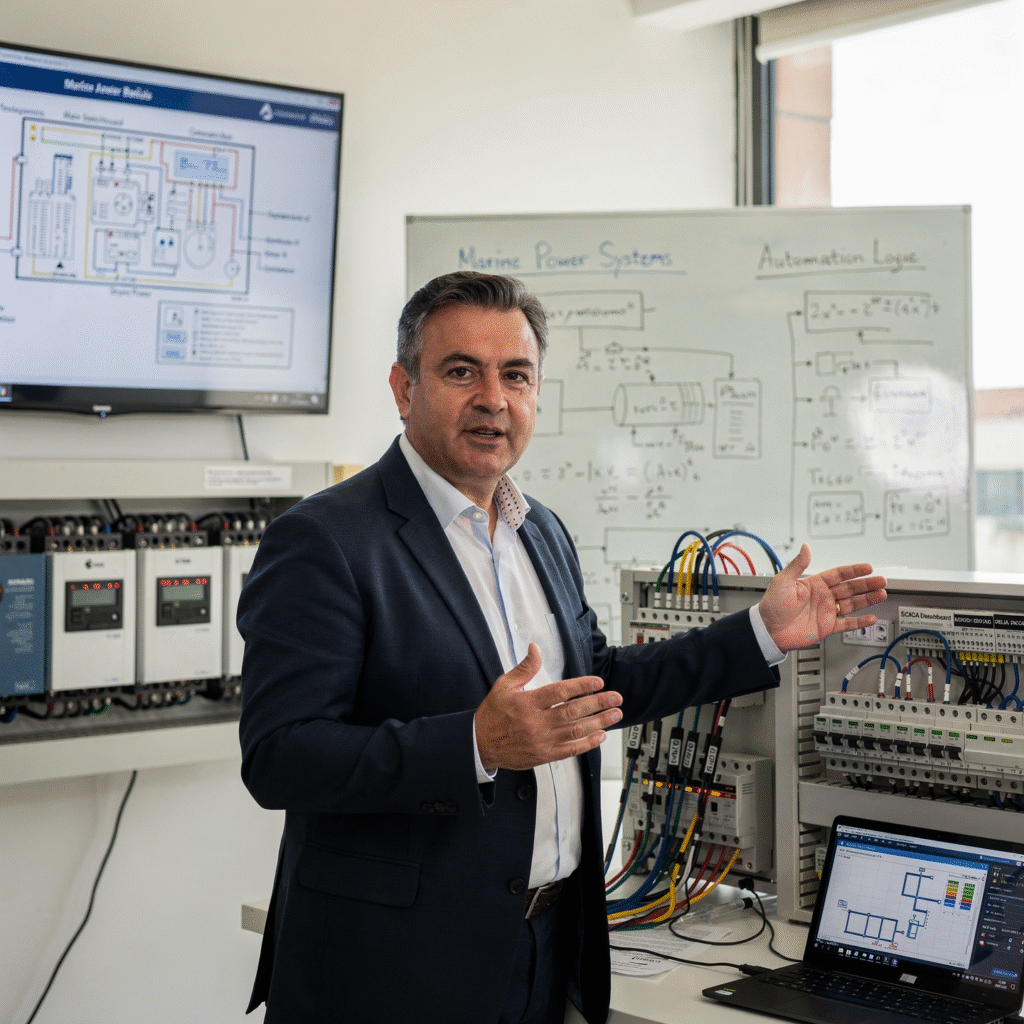
Introduction to 3D Printing for Boats Course

Why this course?

The Introduction to 3D Printing for Boats

course

This course will provide you with the tools and knowledge necessary to revolutionize the way you approach the design, repair, and customization of vessels. You will learn everything from the fundamentals of 3D printing technology to its practical application in the nautical sector, exploring materials, modeling software, and optimization techniques. This course is designed for boat owners, shipbuilders, engineers, and enthusiasts looking to innovate and optimize their marine projects.

Key Benefits

  • Master 3D Printing: From basic theory to advanced practice focused on marine applications.
  • Reduce Costs and Time: Learn to create custom parts and prototypes quickly and efficiently.
  • Customization and Repair: Discover how to manufacture unique components or hard-to-find spare parts.
  • Marine Materials: Learn about the properties and applications of filaments and resins ideal for marine environments.
  • 3D Design and Modeling: Acquire basic skills to create and adapt models to your specific needs.
Introducción

Introduction to 3D Printing for Boats Course

Availability: 1 in stock

Who is it aimed at?

  • Recreational boat owners and marine professionals who want to customize and optimize components, from interiors to plumbing systems.
  • Naval engineering and industrial design students looking to master rapid prototyping and additive manufacturing techniques for marine applications.
  • Marine repair and maintenance companies looking to reduce costs and lead times by creating custom spare parts and specialized tools.
  • Designers and manufacturers of marine accessories who want to innovate in products and processes using the design freedom and flexibility of 3D printing.
  • Ship modeling and scale shipbuilding enthusiasts looking for a superior level of detail and customization in their projects.

Learning Flexibility
 Adapted for professionals and enthusiasts: online modules at your own pace, applicable practical projects and an active support community.

Introducción

Objectives and competencies

Evaluate the feasibility of implementing 3D printing in the maintenance and repair of vessels:

Identify parts suitable for 3D printing, analyze costs vs. alternatives, and evaluate the strength and durability of printed materials in a marine environment.

Understanding the fundamentals of 3D printing technology and its applications in the naval context:

“To identify the operating principles of different 3D printing technologies, their advantages and specific limitations for the manufacture of components and prototypes in the naval environment, from material selection to post-processing.”

Select suitable materials for 3D printing naval components considering their resistance to salt water and durability:

Evaluate the galvanic corrosion resistance, moisture absorption, and UV degradation of polymers, metals, and composites, choosing those with the best performance according to the specific application of the naval component.

Design and manufacture basic prototypes of parts for ships using 3D modeling software and 3D printers:

“Modeling with precision, optimizing for 3D printing and considering nautical materials and tolerances.”
Optimizing the design and production process of naval components through experimentation with 3D printing:

“Reduce cycle times and costs through rapid iteration of functional 3D printed prototypes, validating their structural performance and optimizing material selection.”

Identify the advantages and disadvantages of 3D printing compared to traditional manufacturing methods for the shipbuilding industry:

“Evaluate the economic (costs, materials, times) and technical (scalability, properties, certifications) feasibility in shipbuilding/repair, considering the complete product life cycle.”

Curriculum - Modules

  1. Comprehensive Maritime Incident Management: protocols, roles, and chain of command for coordinated response
  2. Operational Planning and Execution: briefing, routes, weather windows, and go/no-go criteria
  3. Rapid Risk Assessment: criticality matrix, scene control, and decision-making under pressure
  4. Operational Communication: VHF/GMDSS, standardized reports, and inter-agency liaison
  5. Tactical Mobility and Safe Boarding: RHIB maneuvers, approach, mooring, and recovery
  6. Equipment and Technologies: PPE, signaling, satellite tracking, and field data logging
  7. Immediate Care of the Affected: primary assessment, hypothermia, trauma, and stabilization for evacuation
  8. Adverse Environmental Conditions: swell, Visibility, flows, and operational mitigation

    Simulation and training: critical scenarios, use of VR/AR, and exercises with performance metrics

    Documentation and continuous improvement: lessons learned, indicators (MTTA/MTTR), and SOP updates

  1. Introduction to 3D Printing: History, Technologies, and Materials
  2. 3D Modeling for Nautical Applications: CAD/CAM Software, Parametric Design
  3. Materials for 3D Printing in Marine Environments: ABS, PLA, PETG, Nylon, Resins
  4. 3D Printing Parameters: Temperature, Speed, Infill, Supports, and Adhesion
  5. Optimizing Designs for Strength and Durability in Saltwater: Corrosion and Fatigue Considerations
  6. 3D Printing Applications in Boat Construction and Repair
  7. Prototyping Nautical Parts: Propellers, Rudders, Deck Fittings
  8. Manufacturing Custom Tools and Equipment for Maintenance and Repair
  9. 3D Printing Onboard Spare Parts: Identification, design, and on-demand printing

    Maintenance and calibration of 3D printers in marine environments

  1. Introduction to 3D Design: Basic Concepts and CAD/CAM Software
  2. 3D Modeling for Marine Applications: Specific Tools and Techniques
  3. Materials for 3D Printing: Properties, Selection, and Marine Applications
  4. Preparing Files for 3D Printing: Slicing, Parameters, and Optimization
  5. FDM 3D Printing: Operation, Calibration, and Maintenance
  6. SLA/DLP 3D Printing: Resins, Post-processing, and Specialized Applications
  7. Design and Printing of Marine Components: Fittings, Supports, and Adapters
  8. Rapid Prototyping in Marine Applications: Design Validation and Functional Testing
  9. Applications of 3D Printing in Naval Repair and Maintenance
  10. Case Studies: Success Stories and Best Practices in the Nautical Sector

  1. Introduction to 3D Printing: History, evolution, and main technologies.
  2. Materials for 3D Printing in Shipbuilding: Polymers, metals, composites, and their properties.
  3. CAD/CAM Design Software for 3D Printing: Modeling, simulation, and file preparation.
  4. 3D Printing Process: Preparation, configuration, execution, and post-processing.
  5. Applications of 3D Printing in Shipbuilding: Prototyping, tooling, and parts production.
  6. Applications of 3D Printing in Shipbuilding: Manufacturing spare parts on demand, adaptations, and upgrades.
  7. Design Considerations for 3D Printing in Shipbuilding: Structural optimization, weight reduction, and Functionality.
  8. Regulations and certification in naval 3D printing: Quality, safety, and homologation standards.
  9. Examples of success stories in the naval industry: Innovations, challenges, and benefits of 3D printing.
  10. Future trends in naval 3D printing: Advanced materials, automation, and sustainability.

  1. Introduction to Additive Manufacturing: History, advantages, and disadvantages in the naval context.
  2. Materials for Naval Additive Manufacturing: Polymers, metals, ceramics, and composites used in the naval industry. Properties and applications.
  3. Additive Manufacturing Processes: FDM, SLA, SLS, DMLS, and other technologies relevant to the naval sector. Operating principles and selection according to application.
  4. Design for Additive Manufacturing (DfAM): Design considerations to optimize the manufacturing and performance of printed naval components.

    3D Modeling and CAM Software: Software tools for designing and preparing 3D models for printing in the naval sector.

    Post-Processing: Cleaning, curing, machining, and surface treatment techniques to improve the properties and appearance of printed parts.

    Applications of Additive Manufacturing in the Naval Industry: Ship repair and maintenance, rapid prototyping, manufacturing of custom parts, and optimization of existing designs.

    Regulations and Certification: Standards and regulations relevant to additive manufacturing in the naval sector. Certification and quality assurance processes.

    Case Studies: Analysis of successful additive manufacturing projects in the naval sector. Lessons learned and best practices.

    Future Trends: Research and development in naval additive manufacturing. Emerging materials, new technologies, and innovation opportunities.

  1. System Architecture and Components: Structural design, materials, and subsystems (mechanical, electrical, electronic, and fluid) with selection and assembly criteria for marine environments
  2. Fundamentals and Principles of Operation: Physical and engineering foundations (thermodynamics, fluid mechanics, electricity, control, and materials) that explain performance and operating limits
  3. Safety and Environmental (SHE): Risk analysis, PPE, LOTO, hazardous atmospheres, spill and waste management, and emergency response plans
  4. Applicable Regulations and Standards: IMO/ISO/IEC requirements and local regulations;
  5. Conformance criteria, certification, and best practices for operation and maintenance
  6. Inspection, testing, and diagnostics: Visual/dimensional inspection, functional testing, data analysis, and predictive techniques (vibration, thermography, fluid analysis) to identify root causes
  7. Preventive and predictive maintenance: Hourly/cycle/seasonal plans, lubrication, adjustments, calibrations, consumable replacement, post-service verification, and operational reliability
  8. Instrumentation, tools, and metrology: Measuring and testing equipment, diagnostic software, calibration and traceability; selection criteria, safe use, and storage
  9. Onboard integration and interfaces: Mechanical, electrical, fluid, and data compatibility; Sealing and watertightness, EMC/EMI, corrosion protection, and interoperability testing.

    Quality, acceptance testing, and commissioning: process and materials control, FAT/SAT, bench and sea trials, go/no-go criteria, and evidence documentation.

    Technical documentation and integrated practice: logs, checklists, reports, and a complete case study (safety → diagnosis → intervention → verification → report) applicable to any system.

Plan de estudio - Módulos

  1. Comprehensive Maritime Incident Management: protocols, roles, and chain of command for coordinated response
  2. Operational Planning and Execution: briefing, routes, weather windows, and go/no-go criteria
  3. Rapid Risk Assessment: criticality matrix, scene control, and decision-making under pressure
  4. Operational Communication: VHF/GMDSS, standardized reports, and inter-agency liaison
  5. Tactical Mobility and Safe Boarding: RHIB maneuvers, approach, mooring, and recovery
  6. Equipment and Technologies: PPE, signaling, satellite tracking, and field data logging
  7. Immediate Care of the Affected: primary assessment, hypothermia, trauma, and stabilization for evacuation
  8. Adverse Environmental Conditions: swell, Visibility, flows, and operational mitigation

    Simulation and training: critical scenarios, use of VR/AR, and exercises with performance metrics

    Documentation and continuous improvement: lessons learned, indicators (MTTA/MTTR), and SOP updates

  1. Introduction to 3D Printing: History, Technologies, and Materials
  2. 3D Modeling for Nautical Applications: CAD/CAM Software, Parametric Design
  3. Materials for 3D Printing in Marine Environments: ABS, PLA, PETG, Nylon, Resins
  4. 3D Printing Parameters: Temperature, Speed, Infill, Supports, and Adhesion
  5. Optimizing Designs for Strength and Durability in Saltwater: Corrosion and Fatigue Considerations
  6. 3D Printing Applications in Boat Construction and Repair
  7. Prototyping Nautical Parts: Propellers, Rudders, Deck Fittings
  8. Manufacturing Custom Tools and Equipment for Maintenance and Repair
  9. 3D Printing Onboard Spare Parts: Identification, design, and on-demand printing

    Maintenance and calibration of 3D printers in marine environments

  1. Introduction to 3D Design: Basic Concepts and CAD/CAM Software
  2. 3D Modeling for Marine Applications: Specific Tools and Techniques
  3. Materials for 3D Printing: Properties, Selection, and Marine Applications
  4. Preparing Files for 3D Printing: Slicing, Parameters, and Optimization
  5. FDM 3D Printing: Operation, Calibration, and Maintenance
  6. SLA/DLP 3D Printing: Resins, Post-processing, and Specialized Applications
  7. Design and Printing of Marine Components: Fittings, Supports, and Adapters
  8. Rapid Prototyping in Marine Applications: Design Validation and Functional Testing
  9. Applications of 3D Printing in Naval Repair and Maintenance
  10. Case Studies: Success Stories and Best Practices in the Nautical Sector

  1. Introduction to 3D Printing: History, evolution, and main technologies.
  2. Materials for 3D Printing in Shipbuilding: Polymers, metals, composites, and their properties.
  3. CAD/CAM Design Software for 3D Printing: Modeling, simulation, and file preparation.
  4. 3D Printing Process: Preparation, configuration, execution, and post-processing.
  5. Applications of 3D Printing in Shipbuilding: Prototyping, tooling, and parts production.
  6. Applications of 3D Printing in Shipbuilding: Manufacturing spare parts on demand, adaptations, and upgrades.
  7. Design Considerations for 3D Printing in Shipbuilding: Structural optimization, weight reduction, and Functionality.
  8. Regulations and certification in naval 3D printing: Quality, safety, and homologation standards.
  9. Examples of success stories in the naval industry: Innovations, challenges, and benefits of 3D printing.
  10. Future trends in naval 3D printing: Advanced materials, automation, and sustainability.

  1. Introduction to Additive Manufacturing: History, advantages, and disadvantages in the naval context.
  2. Materials for Naval Additive Manufacturing: Polymers, metals, ceramics, and composites used in the naval industry. Properties and applications.
  3. Additive Manufacturing Processes: FDM, SLA, SLS, DMLS, and other technologies relevant to the naval sector. Operating principles and selection according to application.
  4. Design for Additive Manufacturing (DfAM): Design considerations to optimize the manufacturing and performance of printed naval components.

    3D Modeling and CAM Software: Software tools for designing and preparing 3D models for printing in the naval sector.

    Post-Processing: Cleaning, curing, machining, and surface treatment techniques to improve the properties and appearance of printed parts.

    Applications of Additive Manufacturing in the Naval Industry: Ship repair and maintenance, rapid prototyping, manufacturing of custom parts, and optimization of existing designs.

    Regulations and Certification: Standards and regulations relevant to additive manufacturing in the naval sector. Certification and quality assurance processes.

    Case Studies: Analysis of successful additive manufacturing projects in the naval sector. Lessons learned and best practices.

    Future Trends: Research and development in naval additive manufacturing. Emerging materials, new technologies, and innovation opportunities.

  1. System Architecture and Components: Structural design, materials, and subsystems (mechanical, electrical, electronic, and fluid) with selection and assembly criteria for marine environments
  2. Fundamentals and Principles of Operation: Physical and engineering foundations (thermodynamics, fluid mechanics, electricity, control, and materials) that explain performance and operating limits
  3. Safety and Environmental (SHE): Risk analysis, PPE, LOTO, hazardous atmospheres, spill and waste management, and emergency response plans
  4. Applicable Regulations and Standards: IMO/ISO/IEC requirements and local regulations;
  5. Conformance criteria, certification, and best practices for operation and maintenance
  6. Inspection, testing, and diagnostics: Visual/dimensional inspection, functional testing, data analysis, and predictive techniques (vibration, thermography, fluid analysis) to identify root causes
  7. Preventive and predictive maintenance: Hourly/cycle/seasonal plans, lubrication, adjustments, calibrations, consumable replacement, post-service verification, and operational reliability
  8. Instrumentation, tools, and metrology: Measuring and testing equipment, diagnostic software, calibration and traceability; selection criteria, safe use, and storage
  9. Onboard integration and interfaces: Mechanical, electrical, fluid, and data compatibility; Sealing and watertightness, EMC/EMI, corrosion protection, and interoperability testing.

    Quality, acceptance testing, and commissioning: process and materials control, FAT/SAT, bench and sea trials, go/no-go criteria, and evidence documentation.

    Technical documentation and integrated practice: logs, checklists, reports, and a complete case study (safety → diagnosis → intervention → verification → report) applicable to any system.

  1. Introduction to Additive Manufacturing: History, Evolution, and Current Landscape
  2. 3D Printing Processes: FDM, SLA, SLS, MJF, DMLS, and Their Particularities
  3. Materials for the Shipbuilding Industry: Polymers, Metals, Composites, and Ceramics
  4. Design for Additive Manufacturing (DfAM): Considerations and Topological Optimization
  5. 3D Modeling Software: CAD/CAM for Shipbuilding Additive Manufacturing
  6. Preparing Files for Printing: Slicing, Printing Parameters, and Supports
  7. Post-Processing: Cleaning, Curing, Machining, and Surface Finishing
  8. Quality Control and Non-Destructive Testing of Additively Manufactured Parts
  9. Applications in the Shipbuilding Industry: Prototyping, tooling, finished parts, and repair

    Regulations, standards, and certifications in marine additive manufacturing

  1. Introduction to 3D Design: History, Evolution, and Applications in the Naval Industry
  2. 3D Modeling Software: Interface, Basic Tools, and Workflow
  3. Computer-Aided Design (CAD): Fundamental Principles and Methodologies
  4. Modeling Naval Components: Propellers, Hulls, Decks, and Internal Structures
  5. Design Optimization: Strength, Hydrodynamics, and Energy Efficiency
  6. Materials for 3D Printing: Polymers, Metals, and Composites in Marine Environments
  7. 3D Printing: FDM, SLA, and SLS Technologies and Their Naval Applications
  8. Preparing Files for Printing: Requirements, Formats, and Settings
  9. Technical Aspects

  10. Post-Processing: Finishing, Painting, Assembly, and Quality Control
  11. Case Studies: Successful Naval 3D Design and Printing Projects and Their Lessons

  1. Introduction to 3D Printing: History, Technologies, and Key Terminology
  2. Materials for 3D Printing in Naval Applications: Polymers, Metals, Composites, and Their Properties
  3. 3D Modeling Software: CAD Design, Slicing, and Optimization for Printing
  4. Preparing Files for 3D Printing: Formats, Resolution, and Supports
  5. FDM 3D Printing Processes: Parameters, Calibration, and Printer Maintenance
  6. SLA/DLP 3D Printing Processes: Resins, Curing, and Post-Processing
  7. SLS/SLM 3D Printing Processes: Powders, Sintering, and Safety
  8. Optimizing Designs for 3D Printing in Naval Applications: Strength, Weight, and Functionality
  9. Considerations Safety in 3D printing: ventilation, materials, and handling

    3D printing applications in the shipbuilding industry: prototyping, repair, and customization

  1. Introduction to 3D Modeling: Basic Concepts, Software, and Tools
  2. Naval CAD Software: Interface, Navigation, and Initial Setup
  3. Creating Basic Shapes: Cubes, Cylinders, Spheres, and Boolean Operations
  4. Modeling Naval Components: Hulls, Decks, and Superstructures
  5. Advanced Modeling Techniques: Surfaces, NURBS, and Surface Subdivision
  6. Optimizing 3D Models for Printing: Simplification and Polygon Reduction
  7. Introduction to 3D Printing: Technologies, Materials, and File Preparation
  8. 3D Printer Setup: Printing Parameters, Supports, and Adhesion
  9. 3D Printing Process: Monitoring and Resolution of common problems and post-processing.
  10. Finishing and assembly of printed models: sanding, painting, and joining parts.

Career opportunities

  • Nautical Parts Designer: Creation and optimization of ship components using 3D printing.
  • Naval Maintenance Technician: Repair and manufacture of spare parts on board using 3D printing.
  • Naval Innovation Consultant: Advising shipyards and shipowners on the implementation of 3D printing.
  • Boat Builder: Integration of 3D printing into the production of custom-built and bespoke boats.
  • 3D Printing Service Provider for the Naval Sector: Offering 3D printing solutions to companies in the sector.
  • Researcher and Developer: Exploration of new materials and 3D printing techniques for naval applications.
  • Educator and Trainer: Delivery of courses and workshops on 3D printing in The maritime sector.
  • Entrepreneur: creating your own business related to 3D printing for ships.

“`

Admission requirements

Academic/professional profile:

Degree/Bachelor's degree in Nautical Science/Maritime Transport, Naval/Marine Engineering, or a related field; or proven professional experience in bridge/operations.

Language proficiency:

Recommended functional maritime English (SMCP) for simulations and technical materials.

5. Induction

Updated resume, copy of degree or seaman's book, ID card/passport, letter of motivation.

Technical requirements (for online):

Equipment with camera/microphone, stable connection, ≥ 24” monitor recommended for ECDIS/Radar-ARPA.

Admission process and dates

1. Online
application

(form + documents).

2. Academic review and interview

(profile/objectives/schedule compatibility).

3. Admission decision

(+ scholarship proposal if applicable).

4. Reservation of place

(deposit) and registration.

5. Induction

(access to campus, calendars, simulator guides).

Scholarships and grants

  • 3D Printing Fundamentals: Discover the key technologies, materials, and processes applied to the naval sector.
  • Design and Modeling for 3D Printing: Learn to create 3D models optimized for manufacturing nautical components.
  • Applications in the Naval Industry: Explore success stories and opportunities for 3D printing in shipbuilding, repair, and customization.
  • Complete Workflow: From the initial idea to the final part, master every stage of the 3D printing process.
  • Optimization and Post-Processing: Improve the quality and functionality of your printed parts with advanced techniques.
Acquire the skills needed to innovate in the naval industry with 3D printing.

Testimonials

Frequently asked questions

The main advantage is the ability to create complex, lightweight, custom parts on demand, reducing production costs and delivery times.

Yes. The itinerary includes ECDIS/Radar-ARPA/BRM with harbor, ocean, fog, storm, and SAR scenarios.

Online with live sessions; hybrid option for simulator/practical placements through agreements.

Common materials include fiber-reinforced plastics (such as nylon and ABS), epoxy resins, metals (such as stainless steel and aluminum), and composite materials.

Recommended functional SMCP. We offer support materials for standard phraseology.

Yes, with a relevant degree or experience in maritime/port operations. The admissions interview will confirm suitability.

Optional (3–6 months) through Companies & Collaborations and the Alumni Network.

Simulator practice (rubrics), defeat plans, SOPs, checklists, micro-tests and applied TFM.

A degree from Navalis Magna University + operational portfolio (tracks, SOPs, reports and KPIs) useful for audits and employment.

  1. Introduction to 3D Modeling: Basic Concepts, Software, and Tools
  2. Naval CAD Software: Interface, Navigation, and Initial Setup
  3. Creating Basic Shapes: Cubes, Cylinders, Spheres, and Boolean Operations
  4. Modeling Naval Components: Hulls, Decks, and Superstructures
  5. Advanced Modeling Techniques: Surfaces, NURBS, and Surface Subdivision
  6. Optimizing 3D Models for Printing: Simplification and Polygon Reduction
  7. Introduction to 3D Printing: Technologies, Materials, and File Preparation
  8. 3D Printer Setup: Printing Parameters, Supports, and Adhesion
  9. 3D Printing Process: Monitoring and Resolution of common problems and post-processing.
  10. Finishing and assembly of printed models: sanding, painting, and joining parts.

Request information

  1. Complete the Application Form
  2. Attach your CV/Qualifications (if you have them to hand).
  3. Indicate your preferred cohort (January/May/September) and whether you want the hybrid option with simulator sessions.
An academic advisor will contact you within 24–48 hours to guide you through the admission process, scholarships, and compatibility with your professional schedule. Translated with DeepL.com (free version)
Please enable JavaScript in your browser to complete this form.
Click or drag a file to this area to upload.

Teachers

0
    0
    Tu carrito
    Tu carrito esta vacíoRegresar a la tienda
    Scroll to Top