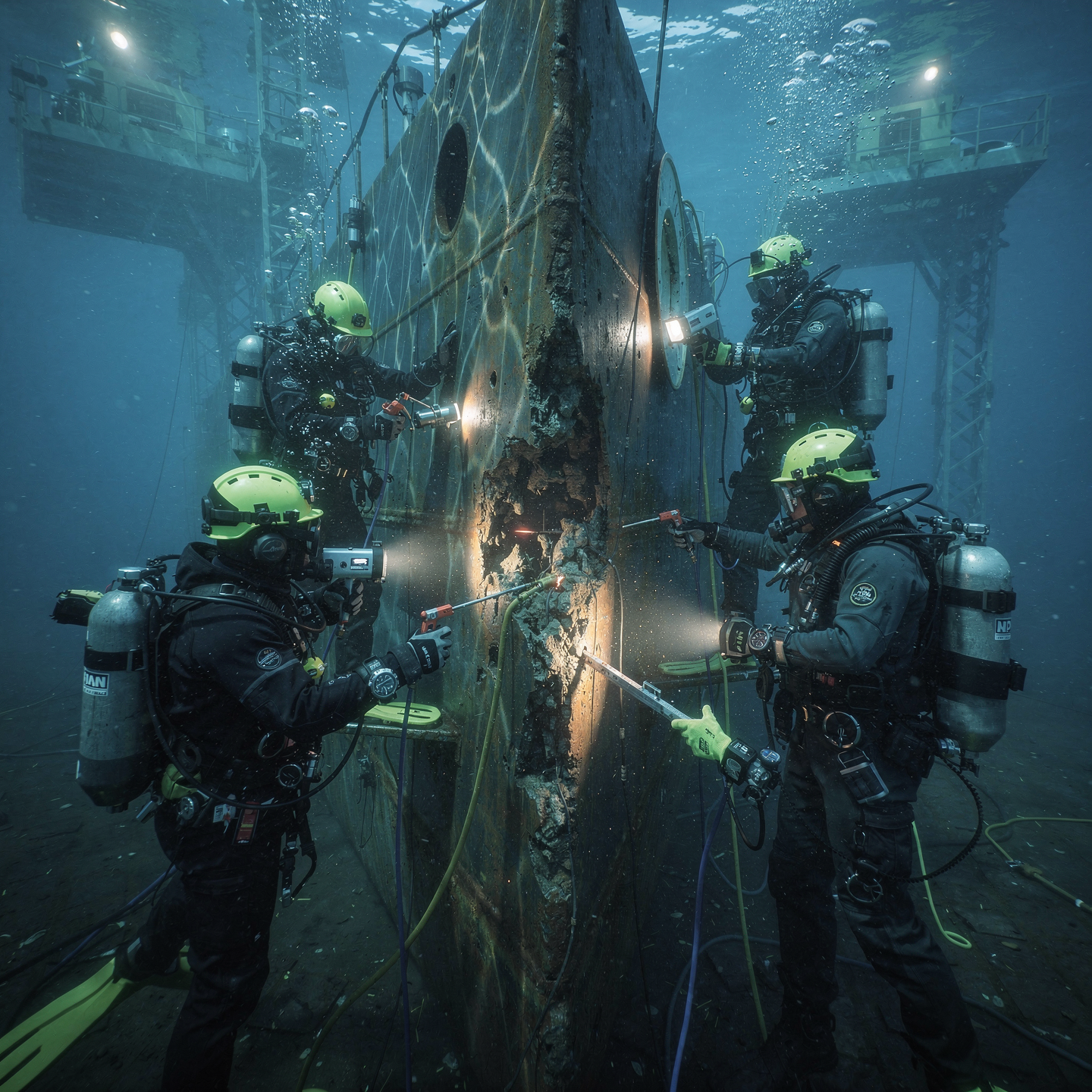
Diploma in Underwater Inspection and Repair

Why this certificate program?

The Diploma in Underwater Inspection and Repair

This program will provide you with the skills and knowledge necessary to succeed in the demanding world of underwater work. You will learn to perform visual and non-destructive inspections of submerged structures, identify damage and anomalies, and apply the most advanced repair techniques. This program will prepare you to work in various sectors, including oil and gas, shipbuilding, and renewable energy.

Differential Advantages

  • Hands-on Training: simulation exercises and real-world case studies.
  • Expert Instructors: professionals with extensive experience in underwater inspection and repair.
  • Cutting-Edge Technology: use of state-of-the-art equipment and tools.
  • Professional Certification: recognition of your skills in the underwater field.
  • Networking: opportunities to connect with other professionals in the sector.
Inspección

Diploma in Underwater Inspection and Repair

Availability: 1 in stock

Who is it aimed at?

  • Civil and structural engineers seeking to specialize in the evaluation and maintenance of submerged infrastructure such as bridges, piers, and dams.
  • Professional divers and underwater inspection technicians wishing to obtain formal certification in non-destructive inspection and underwater repair techniques.
  • Marine construction and maintenance companies needing to train their staff in safety procedures and best practices for underwater work.
  • Port works inspectors and supervisors interested in expanding their knowledge of pathologies, diagnosis, and repair solutions in marine environments.
  • Marine and naval engineering students seeking a differentiated profile with practical skills in the field of inspection and repair underwater.

Study flexibility:
Adapted to professionals with demanding schedules: live and recorded online classes, 24/7 access to learning materials, and personalized tutoring.

Inspección

Objectives and competencies

Evaluate the structural integrity of submerged elements:

“Visually inspect and use NDT (Non-Destructive Testing) to detect corrosion, cracks and deformations, interpreting the results according to regulations and technical procedures.”

Apply underwater welding and cutting techniques safely and effectively:

“Following standardized procedures, adapting to environmental conditions, and using the appropriate equipment.”

Perform visual and non-destructive inspections in underwater environments:

“Identify and document anomalies (corrosion, structural damage, leaks) using high-resolution underwater photography and video techniques.”

Document and report inspection findings accurately and professionally:

“Prepare clear, concise, and objective reports, using appropriate technical terminology and supporting conclusions with photographic/documentary evidence.”

Operate and maintain underwater inspection and repair equipment:

“Conduct thorough pre- and post-immersion tests, documenting findings and adjusting protocols as needed.”

Manage underwater repair projects in compliance with regulations and quality standards:

“Develop detailed repair plans, managing risks, resources and schedules, ensuring document traceability and compliance with applicable technical and legal specifications.”

Curriculum - Modules

  1. Comprehensive Maritime Incident Management: protocols, roles, and chain of command for coordinated response
  2. Operational Planning and Execution: briefing, routes, weather windows, and go/no-go criteria
  3. Rapid Risk Assessment: criticality matrix, scene control, and decision-making under pressure
  4. Operational Communication: VHF/GMDSS, standardized reports, and inter-agency liaison
  5. Tactical Mobility and Safe Boarding: RHIB maneuvers, approach, mooring, and recovery
  6. Equipment and Technologies: PPE, signaling, satellite tracking, and field data logging
  7. Immediate Care of the Affected: primary assessment, hypothermia, trauma, and stabilization for evacuation
  8. Adverse Environmental Conditions: swell, Visibility, flows, and operational mitigation

    Simulation and training: critical scenarios, use of VR/AR, and exercises with performance metrics

    Documentation and continuous improvement: lessons learned, indicators (MTTA/MTTR), and SOP updates

  1. Introduction to Underwater Welding: History, Applications, and Challenges
  2. Physics and Physiology of Diving: Pressure, Gases, Effects on the Human Body
  3. Diving Equipment for Welding: Suits, Regulators, Umbilicals, Communication
  4. Underwater Welding and Cutting Equipment: Power Sources, Electrodes, Thermal Lances
  5. Wet Welding Techniques: Modified SMAW (Shielded Metal Arc Welding)
  6. Dry Welding Techniques: Hyperbaric Chambers, Habitats
  7. Underwater Cutting Techniques: Oxyfuel Cutting, Hollow Electrode Cutting, Plasma Jetting
  8. Safety in Underwater Welding and Cutting: Electrical Hazards, Explosives, Biologicals
  9. Emergency Procedures: Rescue, First Aid, Evacuation

    Inspection and Quality Control of Underwater Welds

  1. Introduction to Underwater Welding: History, Applications, and Safety
  2. Physics and Physiology of Diving: Pressure, Gases, and Effects on the Human Body
  3. Diving Equipment for Welding: Types, Maintenance, and Safety
  4. Dry and Wet Welding Techniques: Differences, Advantages, and Disadvantages
  5. Underwater Shielded Metal Arc Welding (SMAW): Selection, Preparation, and Techniques
  6. Underwater Gas Tungsten Inert Gas Welding (GTAW/TIG): Applications and Precautions
  7. Underwater Visual Inspection (VT): Techniques, Tools, and Documentation
  8. Underwater Magnetic Particle Testing (MT): Principles, Procedure, and Evaluation
  9. Underwater Ultrasonic Testing (UT): Principles, Calibration, and Flaw Detection
  10. Safety and Regulations in Underwater Welding and Inspection

  1. Introduction to Underwater Welding: History, Applications, and Challenges
  2. Physics and Physiology of Diving: Pressure, Gases, Effects on the Human Body
  3. Diving Equipment for Welding: Types, Maintenance, and Safety
  4. Wet Welding Techniques: Shielded Metal Arc Welding (SMAW), Polarity, Parameters
  5. Dry Welding Techniques: Hyperbaric Chamber, Procedures, and Advantages
  6. Materials for Underwater Welding: Steels, Alloys, Compatibility
  7. Joint Preparation: Cleaning, Beveling, and Underwater Alignment
  8. Underwater Visual Inspection: Techniques and Tools
  9. Introduction to Non-Destructive Testing (NDT) Underwater welding: Principles and applications
  10. Safety in underwater welding: Electrical hazards, explosions, emergency procedures

  1. Introduction to Non-Destructive Testing (NDT): Principles and applications.
  2. Visual Inspection (VT): Techniques, equipment, and acceptance criteria.
  3. Penetrant Testing (PT): Procedures, materials, and evaluation of indications.
  4. Magnetic Particle Testing (MT): Magnetization, detection, and demagnetization methods.
  5. Ultrasound (UT): Principles, inspection techniques (A-scan, B-scan, C-scan), calibration, and evaluation.
  6. Radiography (RT): Fundamentals, exposure techniques, radiograph interpretation, and radiation safety.
  7. Eddy Current Testing (ECT): Principles, applications in crack detection and measurement of thicknesses.
  8. Infrared Thermography (IRT): Principles, equipment, and applications in the detection of thermal anomalies.
  9. Introduction to ROVs (Remotely Operated Vehicles): Types, components, and applications in underwater inspection.
  10. Integration of NDT and ROVs: Techniques and challenges in the remote inspection of underwater structures.

  1. System Architecture and Components: Structural design, materials, and subsystems (mechanical, electrical, electronic, and fluid) with selection and assembly criteria for marine environments
  2. Fundamentals and Principles of Operation: Physical and engineering foundations (thermodynamics, fluid mechanics, electricity, control, and materials) that explain performance and operating limits
  3. Safety and Environmental (SHE): Risk analysis, PPE, LOTO, hazardous atmospheres, spill and waste management, and emergency response plans
  4. Applicable Regulations and Standards: IMO/ISO/IEC requirements and local regulations;
  5. Conformance criteria, certification, and best practices for operation and maintenance
  6. Inspection, testing, and diagnostics: Visual/dimensional inspection, functional testing, data analysis, and predictive techniques (vibration, thermography, fluid analysis) to identify root causes
  7. Preventive and predictive maintenance: Hourly/cycle/seasonal plans, lubrication, adjustments, calibrations, consumable replacement, post-service verification, and operational reliability
  8. Instrumentation, tools, and metrology: Measuring and testing equipment, diagnostic software, calibration and traceability; selection criteria, safe use, and storage
  9. Onboard integration and interfaces: Mechanical, electrical, fluid, and data compatibility; Sealing and watertightness, EMC/EMI, corrosion protection, and interoperability testing.

    Quality, acceptance testing, and commissioning: process and materials control, FAT/SAT, bench and sea trials, go/no-go criteria, and evidence documentation.

    Technical documentation and integrated practice: logs, checklists, reports, and a complete case study (safety → diagnosis → intervention → verification → report) applicable to any system.

  1. Introduction to Underwater Visual Inspection: Scope, Objectives, and Limitations
  2. Water Physics: Visibility, Turbidity, Lighting, and Their Impact on Inspection
  3. Visual Inspection Equipment: Underwater Cameras (Video and Photography), Lights, ROVs, and AUVs
  4. Underwater Photography and Videography Techniques: Focus, Lighting, and Composition
  5. Common Defects in Underwater Structures: Corrosion, Fatigue, Mechanical Damage, and Fouling
  6. Principles of Underwater Non-Destructive Testing (NDT): Selection and Application
  7. Remote Visual Inspection (ROV/AUV): Planning, Operation, and Data Analysis
  8. Ultrasound Submarines: Basic principles, equipment, and inspection techniques

    Submarine Magnetic Particles: Basic principles, equipment, and inspection techniques

    Preparing Inspection Reports: Documentation, analysis, and recommendations

Career opportunities

  • Underwater Inspector: Visual and non-destructive inspection of underwater structures (oil platforms, pipelines, bridges, etc.).
  • Underwater Repair Technician: Execution of repairs and maintenance of submerged infrastructure.
  • Underwater Project Supervisor: Planning, management, and supervision of inspection and repair projects.
  • Professional Diver: Performance of underwater work in various industries (oil, offshore wind, shipbuilding, etc.).
  • Underwater Inspection Consultant: Technical advice on inspection and repair projects, preparation of reports and recommendations.
  • Underwater Services Companies: Work in companies specializing in the inspection, repair, and maintenance of underwater infrastructure.
  • Oil and Gas Industry: Inspection and maintenance of offshore platforms, subsea pipelines, and other infrastructure.
  • Offshore Wind Energy: Inspection and repair of foundations and structures of offshore wind turbines.
  • Shipbuilding and Port Construction: Inspection and repair of ship hulls, docks, piers, and other port structures.
  • Research and Development: Participation in research and development projects for new technologies and techniques for underwater inspection and repair.

“`

Admission requirements

Academic/professional profile:

Degree/Bachelor's degree in Nautical Science/Maritime Transport, Naval/Marine Engineering, or a related field; or proven professional experience in bridge/operations.

Language proficiency:

Recommended functional maritime English (SMCP) for simulations and technical materials.

Documentation:

Updated resume, copy of degree or seaman's book, ID card/passport, letter of motivation.

Technical requirements (for online):

Equipment with camera/microphone, stable connection, ≥ 24” monitor recommended for ECDIS/Radar-ARPA.

Admission process and dates

1. Online
application

(form + documents).

2. Academic review and interview

(profile/objectives/schedule compatibility).

3. Admission decision

(+ scholarship proposal if applicable).

4. Reservation of place

(deposit) and registration.

5. Induction

(access to campus, calendars, simulator guides).

Scholarships and grants

  • Master Inspection Techniques: Learn to identify and assess damage to underwater structures using advanced methodologies and state-of-the-art equipment.
  • Effective Underwater Repair: Acquire the skills necessary to plan and execute safe and durable repairs, including welding, coatings, and other specialized techniques.
  • Professional Certification: Earn a recognized diploma that will boost your career in the underwater industry, opening doors to new job opportunities.
  • Industry Experts: Learn from instructors with extensive experience in underwater inspection and repair, who will share practical case studies and up-to-date knowledge.
  • Simulated Practices: Participate in hands-on exercises that simulate real-world inspection and repair scenarios, solidifying your skills and preparing you for work in the industry. field.
Ensure the integrity of submerged infrastructure and become a highly sought-after specialist in the sector.

Testimonials

Frequently asked questions

Offshore structures such as oil platforms, gas pipelines, submarine cables, ships, and other port infrastructure.

Yes. The itinerary includes ECDIS/Radar-ARPA/BRM with harbor, ocean, fog, storm, and SAR scenarios.

Online with live sessions; hybrid option for simulator/practical placements through agreements.

Offshore structures such as oil platforms, gas pipelines, oil pipelines, submarine cables, docks, ships and offshore wind turbine components.

Recommended functional SMCP. We offer support materials for standard phraseology.

Yes, with a relevant degree or experience in maritime/port operations. The admissions interview will confirm suitability.

Optional (3–6 months) through Companies & Collaborations and the Alumni Network.

Simulator practice (rubrics), defeat plans, SOPs, checklists, micro-tests and applied TFM.

A degree from Navalis Magna University + operational portfolio (tracks, SOPs, reports and KPIs) useful for audits and employment.

  1. Introduction to Underwater Welding: History, Applications, and Challenges
  2. Physics of Diving: Pressure, Gases, Physiological Effects, and Decompression
  3. Underwater Welding Equipment: Electrodes, Power Sources, Umbilicals, and Control Systems
  4. Wet Welding Techniques: Procedures, Variables, and Environmental Considerations
  5. Underwater Non-Destructive Testing (NDT): Visual Methods, Magnetic Particle Testing, Ultrasonic Testing, and Radiography
  6. Hyperbaric Safety: Decompression Chambers, Emergency Procedures, and Risk Prevention
  7. Materials and Metallurgy in Marine Environments: Corrosion, Fatigue, and Alloy Selection
  8. Underwater Emergency Procedures: Rescue, First Aid, and Evacuation
  9. Underwater welding standards and regulations: AWS D3.6, ISO 15618, and safety regulations
  10. Professional ethics and environmental responsibility in underwater operations

Request information

  1. Complete the Application Form.

  2. Attach your CV/degree certificate (if you have it to hand).

  3. Indicate your preferred cohort (January/May/September) and whether you would like the hybrid option with simulator sessions.

    An academic advisor will contact you within 24–48 hours to guide you through the admission process, scholarships, and compatibility with your professional schedule.

Please enable JavaScript in your browser to complete this form.
Click or drag a file to this area to upload.

Faculty

0
    0
    Tu carrito
    Tu carrito esta vacíoRegresar a la tienda
    Scroll to Top


