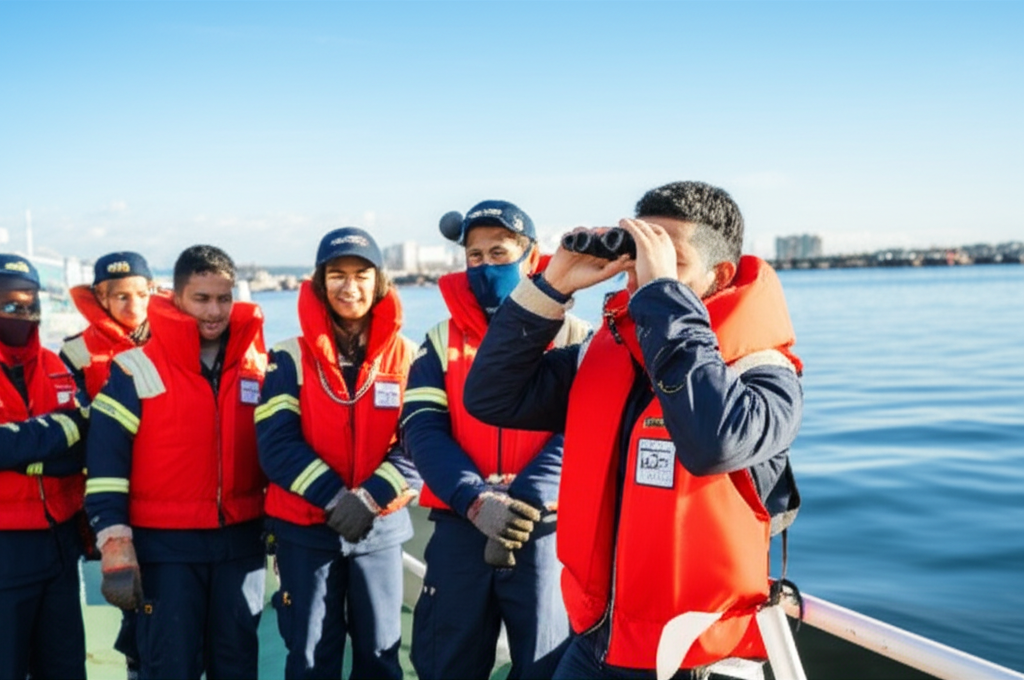
Diploma in Tourist Navigation Experiences
Why this certificate program?
The Diploma in Tourist Sailing Experiences
This program prepares you to design and manage memorable nautical itineraries, combining safety, comfort, and added value. Learn to select vessels, create innovative routes, manage onboard safety, and offer high-quality tourism services that exceed your clients’ expectations. This program will give you the tools to excel in the competitive world of nautical tourism.
This program prepares you to design and manage memorable nautical itineraries, combining safety, comfort, and added value.
Differential Advantages
- Nautical Tourism Product Design: Create unique and personalized experiences.
- Safety and Risk Management: Guarantee the safety of your passengers and crew.
- Marketing and Sales: Attract and retain customers in the nautical tourism sector.
- Legislation and Regulations: Operate within the current legal framework, avoiding penalties and legal problems.
- Sustainability and Best Practices: Minimize environmental impact and contribute to responsible tourism.
- Modality: Online
- Level: Diplomado
- Hours: 800 H
- Start date: 01-10-2026
Availability: 1 in stock
Who is it aimed at?
- Tourism professionals looking to design and market unique and memorable nautical experiences.
- Entrepreneurs wanting to start or expand businesses in the maritime tourism sector.
- Tour guides and tour operators wanting to enrich their offerings with innovative sailing activities.
- Marketing and sales managers in tourism companies interested in capturing new market segments with nautical experiences.
- Students and recent graduates in tourism and related fields looking to specialize in a booming sector with great growth potential.
Flexibility for your development
Adapted to your pace: 24/7 accessible online content, discussion forums, personalized advice and practical cases to apply what you have learned.
Objectives and competencies

Managing maritime risks and emergencies:
Implement emergency response procedures (fires, floods, abandonment) and coordinate with maritime rescue services, prioritizing crew safety and the protection of the marine environment.

Mastering maritime and port legislation:
“Interpret and apply national and international regulations on maritime safety, marine environmental protection and port operations, including the SOLAS Convention, MARPOL and ISPS, to ensure regulatory compliance in all activities.”

Design and market innovative nautical tourism products:
“Identify nautical market niches and create unique tourism experiences based on sustainability and technology.”

Monitor and optimize the quality of tourist services on board:
“Implement customer satisfaction surveys, analyze results and propose continuous improvements to the services offered, guaranteeing memorable experiences and exceeding passenger expectations.”

Leading multidisciplinary teams in nautical tourism environments:
“Promote effective communication and conflict resolution among team members, considering the diversity of roles and specialties.”

Applying sustainability principles to the management of nautical tourism activities:
Minimize environmental impact (spills, waste, noise) by optimizing routes, vessels and onboard practices.
Curriculum - Modules
- Comprehensive Maritime Incident Management: protocols, roles, and chain of command for coordinated response
- Operational Planning and Execution: briefing, routes, weather windows, and go/no-go criteria
- Rapid Risk Assessment: criticality matrix, scene control, and decision-making under pressure
- Operational Communication: VHF/GMDSS, standardized reports, and inter-agency liaison
- Tactical Mobility and Safe Boarding: RHIB maneuvers, approach, mooring, and recovery
- Equipment and Technologies: PPE, signaling, satellite tracking, and field data logging
- Immediate Care of the Affected: primary assessment, hypothermia, trauma, and stabilization for evacuation
- Adverse Environmental Conditions: swell, Visibility, flows, and operational mitigation
Simulation and training: critical scenarios, use of VR/AR, and exercises with performance metrics
Documentation and continuous improvement: lessons learned, indicators (MTTA/MTTR), and SOP updates
- Introduction to nautical marketing: characteristics and trends of the sector.
- Nautical market segmentation: customer profiles, needs, and motivations.
- Nautical customer analysis: Customer journey, buyer persona, and empathy map.
- Customer acquisition strategies: digital marketing, nautical events, public relations.
- Consultative selling techniques: identifying needs, offering personalized solutions, closing sales.
- Loyalty programs: rewards, exclusive benefits, personalized communication.
- CRM for the nautical sector: data management, segmentation, marketing automation.
- Content marketing: blogs, social media, Videos, guides, and ebooks to attract and retain customers.
- Nautical Customer Experience: service design, customer service, and complaint and claim management.
- Measuring and analyzing results: KPIs, ROI, and tracking dashboards.
‘
- Introduction to Nautical Tourism: Definition, Types, and Trends
- Regulations and Legislation Applicable to Nautical Tourism: Licenses, Permits, and Insurance
- Vessels Used in Nautical Tourism: Characteristics, Types, and Basic Maintenance
- Maritime Safety: Safety Equipment, Emergency Procedures, and First Aid
- Marine Meteorology: Forecast Interpretation, Climatic Factors, and Precautions
- Nautical Routes and Destinations: Selection, Evaluation, and Itinerary Design
- Digital and Analog Nautical Charting: Use of Charts, GPS, and Navigation Systems
- Navigation Techniques: Voyage Planning, Position Determination, and Instrument Use
- Onboard Tourist Services: Accommodation, Catering, Activities, and Entertainment
- Human Resources Management: Selection, Training, and Coordination of Onboard Personnel
‘
- Introduction to Nautical Tourism: Market Trends and Opportunities
- Designing Nautical Experiences: Segmentation, Customer Needs, and Expectations
- Types of Nautical Experiences: Charters, Excursions, Water Sports, Fishing, Diving, etc.
- Vessel Selection and Preparation: Technical Criteria, Safety, and Comfort
- Nautical Routes and Destinations: Analysis, Selection, and Design of Attractive Itineraries
- Applicable Regulations and Legislation: Licenses, Insurance, Maritime Safety, and Environmental Protection
- Digital Marketing for Nautical Tourism: SEO, SEM, Social Media, Email Marketing
- Marketing Nautical Experiences: Distribution Channels, Pricing, and Promotions
- Quality Management and Customer Satisfaction: Surveys, Online Reviews, and Complaint Management
- Sustainability in Nautical Tourism: Best Practices, Environmental Impact, and Social Responsibility
‘
- Introduction to Security: Concepts, Importance, and Legal Framework.
- Risk Management: Identification, Assessment, and Control of Risks in Transportation.
- Facility Security: Fire Protection, Access Control, and Emergency Plans.
- Security Procedures: Emergency Response Protocols, Evacuation, and First Aid.
- Passenger Security: Access Control, Baggage Handling, and Assistance to Passengers with Reduced Mobility.
- Security Regulations: Compliance with National and International Regulations (IMO, ICAO, etc.).
- Passenger Communication: Security Information, Announcements, and Complaint Management.
- Customer Service: Effective Communication Techniques, Problem Solving, and Conflict Management.
- Quality in the Service: Quality standards, satisfaction surveys, and continuous improvement.
Professional ethics: Confidentiality, respect, and responsibility in customer service.
‘
- System Architecture and Components: Structural design, materials, and subsystems (mechanical, electrical, electronic, and fluid) with selection and assembly criteria for marine environments
- Fundamentals and Principles of Operation: Physical and engineering foundations (thermodynamics, fluid mechanics, electricity, control, and materials) that explain performance and operating limits
- Safety and Environmental (SHE): Risk analysis, PPE, LOTO, hazardous atmospheres, spill and waste management, and emergency response plans
- Applicable Regulations and Standards: IMO/ISO/IEC requirements and local regulations;
- Conformance criteria, certification, and best practices for operation and maintenance
- Inspection, testing, and diagnostics: Visual/dimensional inspection, functional testing, data analysis, and predictive techniques (vibration, thermography, fluid analysis) to identify root causes
- Preventive and predictive maintenance: Hourly/cycle/seasonal plans, lubrication, adjustments, calibrations, consumable replacement, post-service verification, and operational reliability
- Instrumentation, tools, and metrology: Measuring and testing equipment, diagnostic software, calibration and traceability; selection criteria, safe use, and storage
- Onboard integration and interfaces: Mechanical, electrical, fluid, and data compatibility; Sealing and watertightness, EMC/EMI, corrosion protection, and interoperability testing.
Quality, acceptance testing, and commissioning: process and materials control, FAT/SAT, bench and sea trials, go/no-go criteria, and evidence documentation.
Technical documentation and integrated practice: logs, checklists, reports, and a complete case study (safety → diagnosis → intervention → verification → report) applicable to any system.
- Introduction to Route Planning: Key Factors and Considerations
- Marine Meteorology: Interpreting Bulletins, Charts, and Forecasts
- Maritime Safety: Regulations, Risks, and Preventive Measures
- Safety Equipment: Life Jackets, Life Rafts, EPIRBs, SARTs
- Route Planning: Selecting Charts, Sailing Directions, and Publications
- Determining Position: Traditional and Modern Methods (GNSS)
- Maritime Communications: VHF, MF/HF, GMDSS
- Vessel Maneuvering: Steering, Docking, and Undocking
- Basic First Aid on Board and Emergency Management
- Survival in the sea: techniques and procedures
‘
Career opportunities
- Onboard Tourism Experience Designer: Creation of themed itineraries, activities, and events for cruise ships and tourist vessels.
- Nautical Tourism Product Manager: Development and marketing of tour packages that include sailing, water sports, and port visits.
- Cruise Ship or Pleasure Craft Entertainment Leader: Organization and facilitation of entertainment and leisure activities for passengers.
- Specialized Maritime Route Tour Guide: Leading tourist groups on nautical excursions, interpreting maritime and natural heritage.
- Nautical and Cruise Tourism Consultant: Advising tourism companies on the creation of innovative products and improving the customer experience.
- Marketing and Communications Manager in Nautical Tourism Companies: Promotion of Destinations and tourist services related to sailing.
- Marina and Port Management Technician: Customer service, reservation management, and event organization at nautical facilities.
- Digital Content Creator specializing in sailing tourism: Production of articles, videos, and photographs for blogs, social media, and online platforms.
“`
Admission requirements

Academic/professional profile:
Degree/Bachelor's degree in Nautical Science/Maritime Transport, Naval/Marine Engineering, or a related field; or proven professional experience in bridge/operations.

Language proficiency:
Recommended functional maritime English (SMCP) for simulations and technical materials.

Documentation:
Updated resume, copy of degree or seaman's book, ID card/passport, letter of motivation.

Technical requirements (for online):
Equipment with camera/microphone, stable connection, ≥ 24” monitor recommended for ECDIS/Radar-ARPA.
Admission process and dates

1. Online
application
(form + documents).

2. Academic review and interview
(profile/objectives/schedule compatibility).

3. Admission decision
(+ scholarship proposal if applicable).

4. Reservation of place
(deposit) and registration.

5. Induction
(access to campus, calendars, simulator guides).
Scholarships and grants
- Design Unique Experiences: Master the techniques for creating memorable tourist journeys.
- Know the Regulations: Delve into maritime and safety legislation to ensure successful operations.
- Manage Resources Efficiently: Learn to optimize the logistics, personnel, and budgets of your trips.
- Attract and Retain Customers: Discover the digital marketing strategies and customer service that make the difference.
- Boost Your Business: Develop a solid business plan to enter or expand your presence in nautical tourism.
Testimonials
This diploma program exceeded my expectations. I gained in-depth knowledge about creating and managing memorable tourism experiences, from planning innovative itineraries to providing personalized customer service. The tools and strategies I learned allowed me to design a new river tourism route in my region, which has been a resounding success, increasing customer satisfaction and bookings by 30%. Thanks to this training, I feel much more competent and confident to continue innovating in the sector.
The Diploma in Tourism & Nautical Recreation exceeded my expectations. I gained a solid foundation in nautical business management, maritime regulations and safety, as well as practical skills in navigation and water sports. This comprehensive training enabled me to secure a position as activities coordinator at a leading yacht club, where I apply my newly acquired knowledge daily and contribute to the growth of the sector.
This diploma program exceeded my expectations. I gained practical and theoretical knowledge that enabled me to design and manage innovative and memorable tourism experiences, with a customer-centric approach. I am already applying the tools and methodologies I learned in my work, achieving increased customer satisfaction and a 15% increase in bookings for our services.
This diploma program exceeded my expectations. I gained practical and theoretical knowledge, from route planning and safety management to heritage interpretation and customer service, enabling me to design innovative and memorable tourism experiences. The skills I developed have opened doors to new job opportunities in the sector.

Frequently asked questions
To provide participants with the knowledge and skills necessary to design, manage and evaluate memorable, innovative and high-quality tourism experiences focused on navigation.
Yes. The itinerary includes ECDIS/Radar-ARPA/BRM with harbor, ocean, fog, storm, and SAR scenarios.
Online with live sessions; hybrid option for simulator/practical placements through agreements.
It focuses on the design of tourist experiences for passengers that involve navigation.
Recommended functional SMCP. We offer support materials for standard phraseology.
Yes, with a relevant degree or experience in maritime/port operations. The admissions interview will confirm suitability.
Optional (3–6 months) through Companies & Collaborations and the Alumni Network.
Simulator practice (rubrics), defeat plans, SOPs, checklists, micro-tests and applied TFM.
A degree from Navalis Magna University + operational portfolio (tracks, SOPs, reports and KPIs) useful for audits and employment.
- Introduction to comprehensive security: key concepts and evolution.
- Legal and regulatory framework of private and public security.
- Risk analysis: identification, assessment, and mitigation.
- Security plans: design, implementation, and monitoring.
- Security technologies: CCTV, access control, alarms.
- Customer service: effective communication, conflict management.
- Customer psychology and loyalty techniques.
- First aid and emergency response.
- Crisis management and contingency plans.
- Professional ethics and social responsibility in security and customer service.
‘
Request information
Complete the Application Form.
Attach your CV/degree certificate (if you have it to hand).
Indicate your preferred cohort (January/May/September) and whether you would like the hybrid option with simulator sessions.
An academic advisor will contact you within 24–48 hours to guide you through the admission process, scholarships, and compatibility with your professional schedule.
Faculty
Eng. Tomás Riera
Full Professor
Eng. Tomás Riera
Full Professor
Eng. Sofía Marquina
Full Professor
Eng. Sofía Marquina
Full Professor
Eng. Javier Bañuls
Full Professor
Eng. Javier Bañuls
Full Professor
Dr. Nuria Llobregat
Full Professor
Dr. Nuria Llobregat
Full Professor
Dr. Pau Ferrer
Full Professor
Dr. Pau Ferrer
Full Professor
Cap. Javier Abaroa (MCA)
Full Professor
Cap. Javier Abaroa (MCA)
Full Professor

