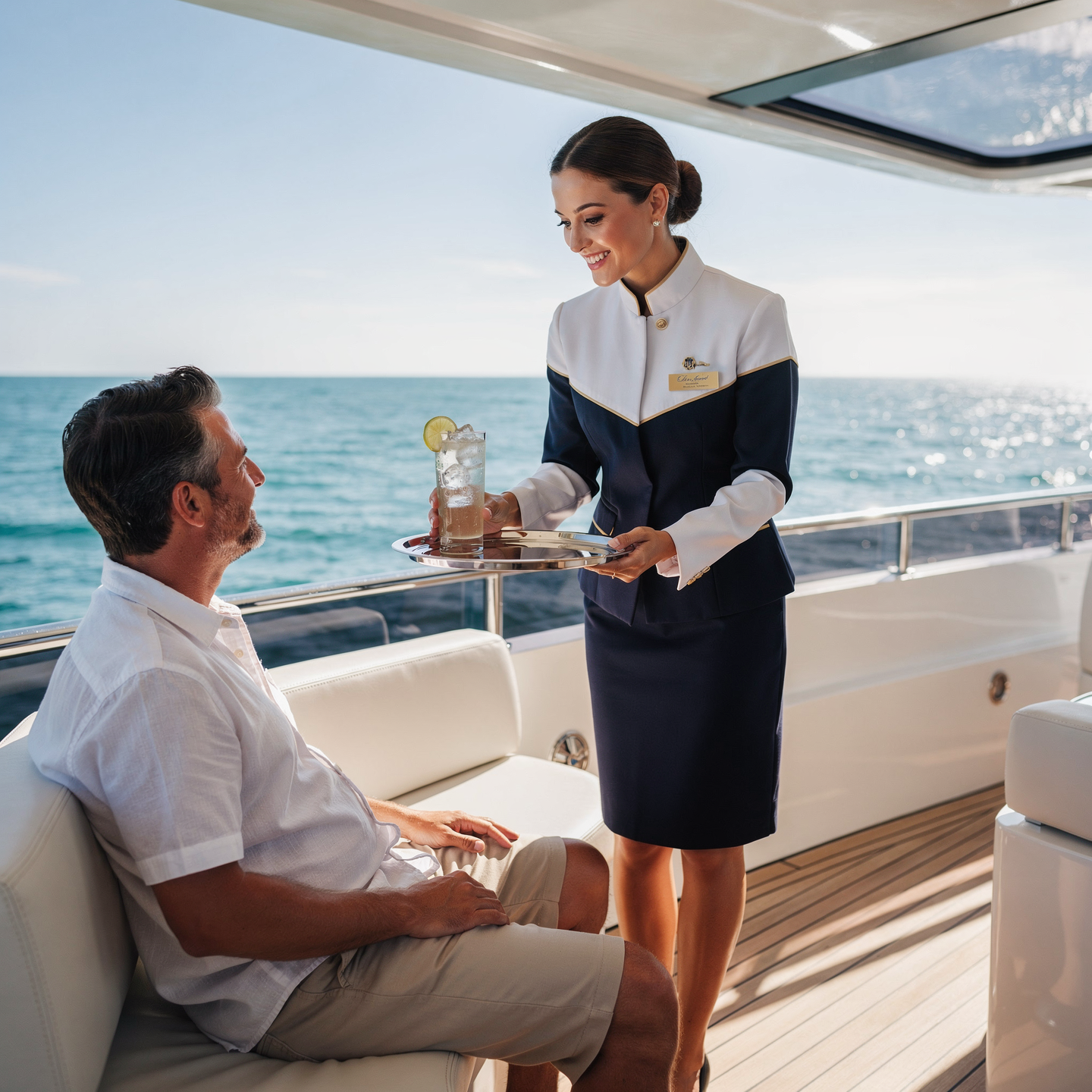
Customer service course on boats
Why this course?
The Customer Service on Vessels
This course provides you with the essential skills to offer exceptional service on board. Learn to manage customer expectations, resolve problems effectively, and create memorable experiences at sea. This program covers everything from effective communication and handling complaints to passenger safety and knowledge of nautical services.
Differentiating Advantages
- Interpersonal Communication Techniques: Establish strong and lasting relationships with clients.
- Conflict Resolution: Manage difficult situations with professionalism and empathy.
- Knowledge of the Nautical Sector: Familiarize yourself with onboard services, regulations, and best practices.
- Personalized Customer Service: Adapt your service to the needs and preferences of each client.
- Practical Simulations: Apply your knowledge in real-world scenarios to hone your skills.
- Modality: Online
- Level: Cursos
- Hours: 150 H
- Start date: 25-04-2026
Availability: 1 in stock
Who is it aimed at?
- Cabin crew and onboard service personnel who wish to refine their communication, hospitality, and problem-solving skills in challenging environments.
- Cruise and cruise line ground staff seeking to understand the dynamics of customer service onboard to optimize the overall passenger experience.
- Tourism and hospitality students aspiring to a career in the maritime sector and wishing to acquire a solid foundation in customer service.
- Fleet and human resources managers interested in raising service standards and customer loyalty on their vessels.
- Nautical sector entrepreneurs seeking to differentiate themselves in the market by offering exceptional customer service on their recreational or commercial vessels rental.
Flexibility and practical approach
Ā Adapted for professionals with busy schedules: 24/7 accessible online content, real-world case studies, and downloadable tools for immediate application.
Objectives and competencies

To effectively resolve the queries and needs of customers on board:
Communicate relevant information clearly (safety, schedules, services) and handle complaints or incidents with empathy and proactive solutions.

To ensure a positive and memorable experience for customers during their stay on board:
Promote proactive, attentive, and personalized communication, anticipating needs and solving problems efficiently and empathetically.

Handle customer complaints and suggestions professionally to continuously improve service:
“With empathy and proactivity, documenting each interaction and proposing corrective actions based on data analysis.”

Provide accurate and timely information about the services and facilities available on board the vessel:
Clearly, adapting communication to the specific needs of each user (passengers, crew, suppliers, etc.) and using various channels (advertisements, brochures, signage, etc.).

Implement effective communication protocols to anticipate and exceed customer expectations:
Establish clear and proactive communication channels (email, phone, surveys), documenting interactions and personalizing the response according to the customer profile.

To foster a welcoming and personalized environment that exceeds the individual needs of each client:
“Actively anticipate customer preferences and exceed their expectations through proactive communication and agile incident resolution.”
Curriculum - Modules
- Comprehensive Maritime Incident Management: protocols, roles, and chain of command for coordinated response
- Operational Planning and Execution: briefing, routes, weather windows, and go/no-go criteria
- Rapid Risk Assessment: criticality matrix, scene control, and decision-making under pressure
- Operational Communication: VHF/GMDSS, standardized reports, and inter-agency liaison
- Tactical Mobility and Safe Boarding: RHIB maneuvers, approach, mooring, and recovery
- Equipment and Technologies: PPE, signaling, satellite tracking, and field data logging
- Immediate Care of the Affected: primary assessment, hypothermia, trauma, and stabilization for evacuation
- Adverse Environmental Conditions: swell, Visibility, flows, and operational mitigation
Simulation and training: critical scenarios, use of VR/AR, and exercises with performance metrics
Documentation and continuous improvement: lessons learned, indicators (MTTA/MTTR), and SOP updates
- Introduction to the onboard service protocol: importance and objectives
- Effective communication with passengers: listening, empathy, and conflict resolution skills
- Standards of personal and professional presentation: uniformity, hygiene, and a positive attitude
- Handling complaints and difficult situations: response and escalation strategies
- Basic first aid and handling of medical emergencies onboard
- Passenger welcome and farewell protocol: procedures and courtesy
- Maritime safety: SOLAS regulations, crew roles and responsibilities
- Evacuation procedures and use of lifesaving equipment: life jackets, lifeboats, and life rafts
- Fire prevention and fighting onboard: equipment and extinguishing techniques
- Situational awareness and risk prevention: identification and reporting of dangers
‘
- Introduction to Protocol: Definition, types, and its importance in the aviation sector.
- Personal and Professional Image: Attire, hygiene, posture, and nonverbal communication.
- Effective Communication: Active listening, empathy, and assertiveness skills.
- Customer Service: Customer service techniques, handling complaints, and conflict resolution.
- Onboard Protocol: Greeting and bidding farewell to passengers, handling special situations.
- Onboard Safety: Emergency procedures, evacuation, and basic first aid.
- Culture and Diversity: Cultural sensitivity, adapting to different types of passengers.
- Assistance to Passengers with Special Needs: Passengers with Reduced Mobility, unaccompanied minors, etc.
- Stress and Fatigue Management: Relaxation techniques and mindfulness.
- Applicable legislation and regulations: Passenger rights, air safety, and data protection.
‘
- Introduction to Luxury Customer Service: Expectations and Trends
- Effective Communication: Verbal and Nonverbal Skills and Active Listening
- Greeting and Welcome Protocol: Reception, Introduction, and Luggage Handling
- Reservation Management and Personalized Check-in/Check-out
- Attention to Special Needs: Children, the Elderly, and People with Disabilities
- Food and Beverage Service: Etiquette, Pairing, and Menu Knowledge
- Resolving Complaints and Conflict Situations: Empathy, Solutions, and Follow-up
- Destination Knowledge and Personalized Recommendations: Excursions, Restaurants, and Activities
- Personal Image Management and Appearance Care: Hygiene, Attire, and Attitude professional
- Customer loyalty: loyalty programs, personalized details, and post-trip follow-up
‘
- Introduction to Maritime Passenger Transport: Types of vessels, routes, and regulations.
- Legal and Regulatory Framework: SOLAS, STCW, applicable international conventions.
- Passenger Documentation: Ticket, passport, visas, and travel requirements.
- Check-in and Boarding: Procedures, queue management, and security screening.
- Onboard Customer Service: Reception, information, handling complaints, and special needs.
- Baggage Management: Check-in, storage, delivery, and claims.
- Emergency Procedures: Evacuation, drills, safety, and rescue.
- First Aid and Medical Assistance: Basic protocols and emergency management Medical services.
- Passenger Communication: Announcements, relevant information, and multilingual support.
- Disembarkation and Arrivals Management: Procedures, customs, immigration, and post-trip assistance.
‘
- System Architecture and Components: Structural design, materials, and subsystems (mechanical, electrical, electronic, and fluid) with selection and assembly criteria for marine environments
- Fundamentals and Principles of Operation: Physical and engineering foundations (thermodynamics, fluid mechanics, electricity, control, and materials) that explain performance and operating limits
- Safety and Environmental (SHE): Risk analysis, PPE, LOTO, hazardous atmospheres, spill and waste management, and emergency response plans
- Applicable Regulations and Standards: IMO/ISO/IEC requirements and local regulations;
- Conformance criteria, certification, and best practices for operation and maintenance
- Inspection, testing, and diagnostics: Visual/dimensional inspection, functional testing, data analysis, and predictive techniques (vibration, thermography, fluid analysis) to identify root causes
- Preventive and predictive maintenance: Hourly/cycle/seasonal plans, lubrication, adjustments, calibrations, consumable replacement, post-service verification, and operational reliability
- Instrumentation, tools, and metrology: Measuring and testing equipment, diagnostic software, calibration and traceability; selection criteria, safe use, and storage
- Onboard integration and interfaces: Mechanical, electrical, fluid, and data compatibility; Sealing and watertightness, EMC/EMI, corrosion protection, and interoperability testing.
Quality, acceptance testing, and commissioning: process and materials control, FAT/SAT, bench and sea trials, go/no-go criteria, and evidence documentation.
Technical documentation and integrated practice: logs, checklists, reports, and a complete case study (safety ā diagnosis ā intervention ā verification ā report) applicable to any system.
Plan de estudio - Módulos
- Comprehensive Maritime Incident Management: protocols, roles, and chain of command for coordinated response
- Operational Planning and Execution: briefing, routes, weather windows, and go/no-go criteria
- Rapid Risk Assessment: criticality matrix, scene control, and decision-making under pressure
- Operational Communication: VHF/GMDSS, standardized reports, and inter-agency liaison
- Tactical Mobility and Safe Boarding: RHIB maneuvers, approach, mooring, and recovery
- Equipment and Technologies: PPE, signaling, satellite tracking, and field data logging
- Immediate Care of the Affected: primary assessment, hypothermia, trauma, and stabilization for evacuation
- Adverse Environmental Conditions: swell, Visibility, flows, and operational mitigation
Simulation and training: critical scenarios, use of VR/AR, and exercises with performance metrics
Documentation and continuous improvement: lessons learned, indicators (MTTA/MTTR), and SOP updates
- Introduction to the onboard service protocol: importance and objectives
- Effective communication with passengers: listening, empathy, and conflict resolution skills
- Standards of personal and professional presentation: uniformity, hygiene, and a positive attitude
- Handling complaints and difficult situations: response and escalation strategies
- Basic first aid and handling of medical emergencies onboard
- Passenger welcome and farewell protocol: procedures and courtesy
- Maritime safety: SOLAS regulations, crew roles and responsibilities
- Evacuation procedures and use of lifesaving equipment: life jackets, lifeboats, and life rafts
- Fire prevention and fighting onboard: equipment and extinguishing techniques
- Situational awareness and risk prevention: identification and reporting of dangers
‘
- Introduction to Protocol: Definition, types, and its importance in the aviation sector.
- Personal and Professional Image: Attire, hygiene, posture, and nonverbal communication.
- Effective Communication: Active listening, empathy, and assertiveness skills.
- Customer Service: Customer service techniques, handling complaints, and conflict resolution.
- Onboard Protocol: Greeting and bidding farewell to passengers, handling special situations.
- Onboard Safety: Emergency procedures, evacuation, and basic first aid.
- Culture and Diversity: Cultural sensitivity, adapting to different types of passengers.
- Assistance to Passengers with Special Needs: Passengers with Reduced Mobility, unaccompanied minors, etc.
- Stress and Fatigue Management: Relaxation techniques and mindfulness.
- Applicable legislation and regulations: Passenger rights, air safety, and data protection.
‘
- Introduction to Luxury Customer Service: Expectations and Trends
- Effective Communication: Verbal and Nonverbal Skills and Active Listening
- Greeting and Welcome Protocol: Reception, Introduction, and Luggage Handling
- Reservation Management and Personalized Check-in/Check-out
- Attention to Special Needs: Children, the Elderly, and People with Disabilities
- Food and Beverage Service: Etiquette, Pairing, and Menu Knowledge
- Resolving Complaints and Conflict Situations: Empathy, Solutions, and Follow-up
- Destination Knowledge and Personalized Recommendations: Excursions, Restaurants, and Activities
- Personal Image Management and Appearance Care: Hygiene, Attire, and Attitude professional
- Customer loyalty: loyalty programs, personalized details, and post-trip follow-up
‘
- Introduction to Maritime Passenger Transport: Types of vessels, routes, and regulations.
- Legal and Regulatory Framework: SOLAS, STCW, applicable international conventions.
- Passenger Documentation: Ticket, passport, visas, and travel requirements.
- Check-in and Boarding: Procedures, queue management, and security screening.
- Onboard Customer Service: Reception, information, handling complaints, and special needs.
- Baggage Management: Check-in, storage, delivery, and claims.
- Emergency Procedures: Evacuation, drills, safety, and rescue.
- First Aid and Medical Assistance: Basic protocols and emergency management Medical services.
- Passenger Communication: Announcements, relevant information, and multilingual support.
- Disembarkation and Arrivals Management: Procedures, customs, immigration, and post-trip assistance.
‘
- System Architecture and Components: Structural design, materials, and subsystems (mechanical, electrical, electronic, and fluid) with selection and assembly criteria for marine environments
- Fundamentals and Principles of Operation: Physical and engineering foundations (thermodynamics, fluid mechanics, electricity, control, and materials) that explain performance and operating limits
- Safety and Environmental (SHE): Risk analysis, PPE, LOTO, hazardous atmospheres, spill and waste management, and emergency response plans
- Applicable Regulations and Standards: IMO/ISO/IEC requirements and local regulations;
- Conformance criteria, certification, and best practices for operation and maintenance
- Inspection, testing, and diagnostics: Visual/dimensional inspection, functional testing, data analysis, and predictive techniques (vibration, thermography, fluid analysis) to identify root causes
- Preventive and predictive maintenance: Hourly/cycle/seasonal plans, lubrication, adjustments, calibrations, consumable replacement, post-service verification, and operational reliability
- Instrumentation, tools, and metrology: Measuring and testing equipment, diagnostic software, calibration and traceability; selection criteria, safe use, and storage
- Onboard integration and interfaces: Mechanical, electrical, fluid, and data compatibility; Sealing and watertightness, EMC/EMI, corrosion protection, and interoperability testing.
Quality, acceptance testing, and commissioning: process and materials control, FAT/SAT, bench and sea trials, go/no-go criteria, and evidence documentation.
Technical documentation and integrated practice: logs, checklists, reports, and a complete case study (safety ā diagnosis ā intervention ā verification ā report) applicable to any system.
- Introduction to Customer Service in the Nautical Industry: Expectations and Specifics.
- Effective Communication: Verbal and Non-verbal Skills, Active Listening, Empathy.
- Types of Clients in the Nautical Sector: Owners, Charterers, Passengers, Suppliers.
- Nautical Protocol and Etiquette: Attire, Greetings, Introductions, Hierarchy.
- Handling Complaints and Claims: Conflict Resolution Techniques, Managing Frustration.
- The Importance of First Impressions: Personal Image, Environment, Punctuality.
- Onboard Hospitality: Welcoming Guests, Personalized Attention, Anticipating Needs.
- Nautical Concierge Services: Reservations, Transportation, Activities, Tourist Information.
- Customer security and privacy: confidentiality, data protection, risk management.
- Service culture and continuous improvement: feedback, evaluation, training.
‘
- Introduction to Customer Service Protocol: Importance and Benefits
- Standards of Courtesy and Effective Communication: Verbal and Non-verbal
- Personal Presentation and Professional Image: Uniform, Hygiene, and Attitude
- Handling Difficult Situations and Complaint Resolution: Techniques and Empathy
- Onboard Safety: Emergency and Evacuation Procedures
- Basic First Aid: Responding to Common Incidents and Injuries
- Safety Equipment: Location, Use, and Basic Maintenance
- Fire Prevention and Control: Types of Fire and Extinguishing Methods
- Maritime Safety Legislation and Regulations: Knowledge and Compliance
- Safety Culture and Continuous Improvement: Participation and Reporting incidents.
‘
- Introduction to Customer Service in Transportation: Passenger Expectations and Needs
- Effective Communication: Verbal and Non-verbal Skills, Active Listening, and Empathy
- Handling Complaints and Claims: Protocols, Conflict Resolution, and Customer Satisfaction
- Assistance to Passengers with Special Needs: Reduced Mobility, Unaccompanied Minors, and Other Situations
- Boarding and Disembarking Procedures: Queue Management, Document Control, and Security
- Passenger Information: Announcements, Travel Updates, and Answers to Frequently Asked Questions
- Basic First Aid: Recognizing Medical Emergencies and Response Protocols
- Onboard Safety: Emergency Procedures, Evacuation, and Risk Prevention
- Customer service in crisis situations: delays, cancellations, and other unforeseen events.
- Service culture: professionalism, courtesy, and exceeding expectations.
‘
- Introduction to Emergency Protocols: Legal and Regulatory Framework
- Risk Assessment on Board: Identification, Analysis, and Mitigation
- Organization of the Emergency Response: Roles and Responsibilities
- Communication in Crisis Situations: Notice and Alert Protocols
- Fires on Board: Prevention, Detection, Extinguishing, and Evacuation
- Breakdowns and Technical Failures: Control and Repair Procedures
- Medical Emergencies: First Aid, Telemedicine, and Evacuation
- Abandon Ship: Preparation, Procedures, and Survival
- Passenger Management in Emergency Situations: Information, Control, and Assistance
- Drills and Training continuous improvement in response and coordination
‘
Career opportunities
- Customer Service Staff at Marinas and Ports: Reception and assistance to customers, reservation and service management.
- Nautical Travel Agent: Advising on and selling tour packages for boats, cruises, and boat rentals.
- Sales Representative at Boat Rental Companies: Promotion and rental of boats, contract management, and customer service.
- Support Staff at Nautical Charter Companies: Onboard assistance, troubleshooting, and passenger support.
- Customer Service Representative at Nautical Service Companies: Technical support, information, and incident management related to boats.
- Promoter of Nautical Events and Water Sports Activities: Organization, promotion, and customer service at events and activities related to the world of nautical activities. Nautical.
- Tourist Information Officer in Coastal Tourist Offices: Provide information on services, activities, and points of interest related to sailing and nautical tourism.
- Telemarketer in Nautical Sector Companies: Answer telephone inquiries, manage queries, and resolve issues for clients in the sector.
“`
Admission requirements

Academic/professional profile:
Degree/Bachelor's degree in Nautical Science/Maritime Transport, Naval/Marine Engineering, or a related field; or proven professional experience in bridge/operations.

Language proficiency:
Recommended functional maritime English (SMCP) for simulations and technical materials.

5. Induction
Updated resume, copy of degree or seaman's book, ID card/passport, letter of motivation.

Technical requirements (for online):
Equipment with camera/microphone, stable connection, ā„ 24ā monitor recommended for ECDIS/Radar-ARPA.
Admission process and dates

1. Online
application
(form + documents).

2. Academic review and interview
(profile/objectives/schedule compatibility).

3. Admission decision
(+ scholarship proposal if applicable).

4. Reservation of place
(deposit) and registration.

5. Induction
(access to campus, calendars, simulator guides).
Scholarships and grants
- Excellent Customer Service: Learn techniques to offer impeccable and personalized customer service on board.
- Handling Complex Situations: Acquire skills to resolve conflicts and handle complaints effectively.
- Effective Communication: Master the art of verbal and non-verbal communication to connect with passengers.
- Protocol and Etiquette: Understand the most demanding customer service standards in the maritime sector.
- Customer Loyalty: Discover strategies to build lasting relationships and foster loyalty.
Testimonials
During my customer service training on ships, I exceeded expectations by resolving a complex issue with a dissatisfied customer due to a mechanical failure during a cruise. I successfully calmed the customer, arranged for repairs at the next port, and offered appropriate compensation, turning a negative experience into a positive one that resulted in an excellent review and a recommendation to friends and family.
During the Tourism and Nautical Experiences course, I gained a solid understanding of nautical business management and the creation of innovative tourism experiences. I applied this knowledge to the design of a coastal kayaking tour, including logistical planning, risk management, and customer service. The project received top marks and attracted the interest of a local company, which subsequently offered me a professional internship.
I managed to increase customer satisfaction by 15% by implementing a new reservation management system and proactively resolving passenger queries before boarding, resulting in fewer delays and a more enjoyable onboard experience.
During my customer service training on ships, I exceeded expectations by resolving a complex issue with a dissatisfied customer due to a delay in their itinerary. I calmed the customer, offered viable alternatives, and ensured they continued their journey with a positive impression of the company, subsequently receiving a formal commendation for my excellent handling of the situation.

Frequently asked questions
To guarantee a positive, safe and comfortable experience for passengers, attending to their needs and resolving any problems that may arise during the trip.
Yes. The itinerary includes ECDIS/Radar-ARPA/BRM with harbor, ocean, fog, storm, and SAR scenarios.
Online with live sessions; hybrid option for simulator/practical placements through agreements.
Empathy, patience, clear communication, active listening, and the ability to calmly solve problems under pressure.
Recommended functional SMCP. We offer support materials for standard phraseology.
Yes, with a relevant degree or experience in maritime/port operations. The admissions interview will confirm suitability.
Optional (3ā6 months) through Companies & Collaborations and the Alumni Network.
Simulator practice (rubrics), defeat plans, SOPs, checklists, micro-tests and applied TFM.
A degree from Navalis Magna University + operational portfolio (tracks, SOPs, reports and KPIs) useful for audits and employment.
- Introduction to Emergency Protocols: Legal and Regulatory Framework
- Risk Assessment on Board: Identification, Analysis, and Mitigation
- Organization of the Emergency Response: Roles and Responsibilities
- Communication in Crisis Situations: Notice and Alert Protocols
- Fires on Board: Prevention, Detection, Extinguishing, and Evacuation
- Breakdowns and Technical Failures: Control and Repair Procedures
- Medical Emergencies: First Aid, Telemedicine, and Evacuation
- Abandon Ship: Preparation, Procedures, and Survival
- Passenger Management in Emergency Situations: Information, Control, and Assistance
- Drills and Training continuous improvement in response and coordination
‘
Request information
- Complete the Application Form
- Attach your CV/Qualifications (if you have them to hand).
- Indicate your preferred cohort (January/May/September) and whether you want the hybrid option with simulator sessions.
Teachers
Eng. TomƔs Riera
Full Professor
Eng. TomƔs Riera
Full Professor
Eng. SofĆa Marquina
Full Professor
Eng. SofĆa Marquina
Full Professor
Eng. Javier BaƱuls
Full Professor
Eng. Javier BaƱuls
Full Professor
Dr. Nuria Llobregat
Full Professor
Dr. Nuria Llobregat
Full Professor
Dr. Pau Ferrer
Full Professor
Dr. Pau Ferrer
Full Professor
Cap. Javier Abaroa (MCA)
Full Professor
Cap. Javier Abaroa (MCA)
Full Professor

