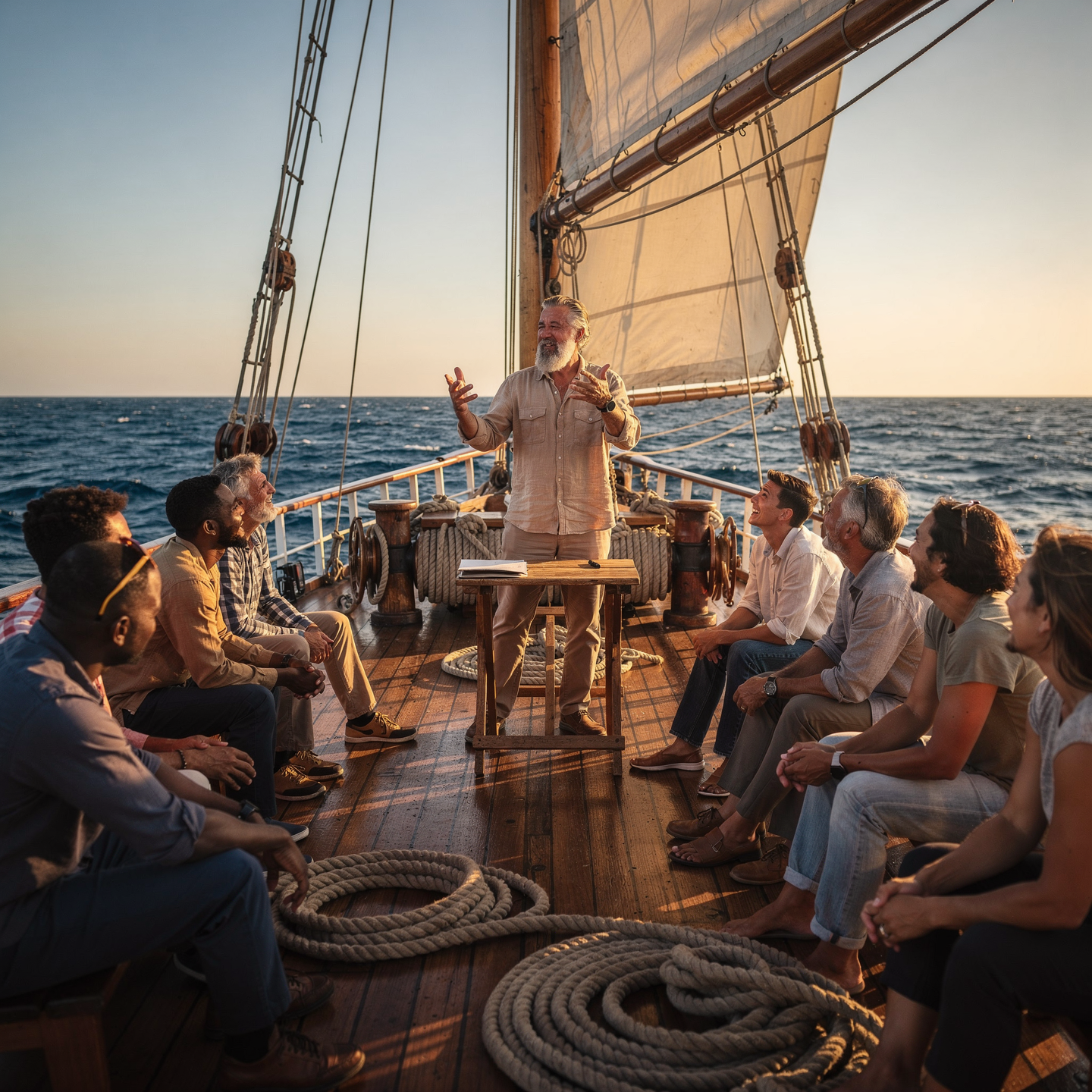
Storytelling course for boat trips

Why this course?

The Ship Travel Storytelling Course

Equips you with the tools to transform your maritime experiences into captivating narratives. Learn to connect with your audience through emotion, detail, and authenticity, mastering the art of vivid description and effective narrative structuring. This program guides you from story conception to final polish, including onboard photography and videography techniques to complement your stories with impactful visuals.

Differentiating Advantages

  • Practical Approach: Creative writing and editing exercises with personalized feedback.
  • Multimedia Tools: Integration of photos, videos, and audio to create immersive narratives.
  • Learning Community: Connect with others passionate about boating and storytelling.
  • Success Stories: Analysis of real-world examples to inspire you and help you understand best practices.
  • Immediate Applicability: Develop a portfolio of stories ready to publish on blogs, social media, or specialized magazines.
Storytelling

Storytelling course for boat trips

Availability: 1 in stock

Who is it aimed at?

  • Sailing enthusiasts who want to share their adventures in a captivating way and build an online community.
  • Bloggers and content creators looking to specialize in the nautical sector, monetize their passion, and stand out from the crowd.
  • Nautical tourism professionals (agencies, charters, marinas) who want to boost their brand with authentic narratives and reach new clients.
  • Writers and photographers who want to perfect their craft by telling inspiring and exciting stories of boating trips.
  • Crew members and frequent travelers who yearn to professionally document their experiences and create a legacy Memorable.

    Creative Flexibility

    Suitable for all levels: practical exercises, personalized feedback, and strategies for various formats (text, photo, video).

Storytelling

Objectives and competencies

Captivating audiences with authentic nautical stories:

“Mastering the art of narrating maritime experiences, conveying the passion, technical rigor, and camaraderie inherent in life at sea.”

Transforming maritime experiences into immersive narratives:

“Using technical and emotional knowledge to create stories that connect with the audience and convey the unique essence of life at sea.”

Mastering narrative techniques to evoke life at sea:

Use literary devices (metaphors, personification, similes) to describe marine fauna, flora, and phenomena, conveying the immensity and power of the ocean.

Creating emotional connections through sailing stories:

“Connecting personal narratives with the challenges of navigation, generating empathy and reinforcing the emotional memory of learning.”

Structuring maritime travelogues with a compelling narrative arc:

“Select significant milestones and intertwine them with challenges overcome and personal discoveries.”

Use sensory language to convey the unique atmosphere of sailing:

“To use metaphors of taste, texture, aroma, sound, and color to evoke the maritime experience.”

Curriculum - Modules

  1. Comprehensive Maritime Incident Management: protocols, roles, and chain of command for coordinated response
  2. Operational Planning and Execution: briefing, routes, weather windows, and go/no-go criteria
  3. Rapid Risk Assessment: criticality matrix, scene control, and decision-making under pressure
  4. Operational Communication: VHF/GMDSS, standardized reports, and inter-agency liaison
  5. Tactical Mobility and Safe Boarding: RHIB maneuvers, approach, mooring, and recovery
  6. Equipment and Technologies: PPE, signaling, satellite tracking, and field data logging
  7. Immediate Care of the Affected: primary assessment, hypothermia, trauma, and stabilization for evacuation
  8. Adverse Environmental Conditions: swell, Visibility, flows, and operational mitigation

    Simulation and training: critical scenarios, use of VR/AR, and exercises with performance metrics

    Documentation and continuous improvement: lessons learned, indicators (MTTA/MTTR), and SOP updates

  1. Introduction to Maritime Narratives: history and evolution of the genre.
  2. The Sea as Setting: description and personification of the marine environment.
  3. Archetypal Maritime Characters: sailors, captains, pirates, and sea creatures.
  4. Narrative Structures in Sea Voyages: voyages, shipwrecks, discoveries.
  5. The Language of the Sea: nautical jargon, metaphors, and marine symbolism.
  6. Creative Writing Techniques: sensory description, dialogue, and suspense.
  7. Research and Documentation: historical, scientific, and personal sources.
  8. Ethics in Travel Writing: respect for cultures, environment, and privacy.
  9. Adaptation to Different Media: books, blogs, podcasts, documentaries.
  10. Development of Personal Projects: planning, writing, and revision.

  1. Introduction to Maritime Narratives: History and Evolution of the Travel Story
  2. The Art of Observation: Capturing Sensory Details in the Maritime Environment
  3. Characters and Crews: Creating Memorable Protagonists and Antagonists
  4. Plot on the High Seas: Building Conflicts, Adventures, and Resolutions on Board
  5. The Language of the Sea: Nautical Vocabulary, Seaman’s Slang, and Idiomatic Expressions
  6. Maritime Narrative Genres: Adventure, Romance, Mystery, Horror, and Nonfiction
  7. Research and Documentation: Historical Sources, Ship’s Logs, and Testimonials
  8. Narrative Structure: Designing the Chronology, Flashbacks, and Points of View

    Editing and Revision: Perfecting the Manuscript for Publication

    Dissemination and Marketing: Strategies to Promote Your Maritime Story

  1. Introduction to Maritime Narratives: History, Genres, and Key Authors
  2. The Art of Observation: Techniques for Sensory Description of the Marine Environment
  3. Logbook: Structure, Tone, Recording Events and Emotions
  4. Maritime Photography and Videography: Composition, Lighting, and Basic Editing for Social Media
  5. Interviewing Crew Members: Preparation, Conversation Techniques, and Ethics
  6. From Experience to Story: Transforming Experiences into Engaging Stories
  7. Character Creation: Marine Archetypes, Conflicts, and Development
  8. Narrative Structure: Exposition, Rising Action, Climax, and Resolution in Travel Stories
  9. Social Media Outreach: Instagram, YouTube, blogs, and specialized platforms.

    Legal and ethical aspects: copyright, informed consent, and responsible representation.

  1. Introduction to Maritime Narratives: History and Evolution of the Ship’s Travel Narrative.
  2. The Ship’s Log as a Literary Genre: Structure, Style, and Narrative Resources.
  3. Research and Documentation: Primary and Secondary Sources for Constructing the Narrative.
  4. Character Development: Creating Authentic and Believable Voices.
  5. The Maritime Space as Protagonist: Description of Landscapes, Natural Phenomena, and Marine Environments.
  6. Creative Writing Techniques: Use of Metaphor, Analogy, and Personification.
  7. Photography and Video: Capturing and Editing Images to Enrich the Narrative.
  8. Dissemination Platforms: Blogs, Social Media, Specialized Magazines, and Books.
  9. Legal Considerations: Copyright, Licenses, and Ownership intellectual.
  10. Ethics of travel writing: responsibility and respect for cultures and the environment.

  1. System Architecture and Components: Structural design, materials, and subsystems (mechanical, electrical, electronic, and fluid) with selection and assembly criteria for marine environments
  2. Fundamentals and Principles of Operation: Physical and engineering foundations (thermodynamics, fluid mechanics, electricity, control, and materials) that explain performance and operating limits
  3. Safety and Environmental (SHE): Risk analysis, PPE, LOTO, hazardous atmospheres, spill and waste management, and emergency response plans
  4. Applicable Regulations and Standards: IMO/ISO/IEC requirements and local regulations;
  5. Conformance criteria, certification, and best practices for operation and maintenance
  6. Inspection, testing, and diagnostics: Visual/dimensional inspection, functional testing, data analysis, and predictive techniques (vibration, thermography, fluid analysis) to identify root causes
  7. Preventive and predictive maintenance: Hourly/cycle/seasonal plans, lubrication, adjustments, calibrations, consumable replacement, post-service verification, and operational reliability
  8. Instrumentation, tools, and metrology: Measuring and testing equipment, diagnostic software, calibration and traceability; selection criteria, safe use, and storage
  9. Onboard integration and interfaces: Mechanical, electrical, fluid, and data compatibility; Sealing and watertightness, EMC/EMI, corrosion protection, and interoperability testing.

    Quality, acceptance testing, and commissioning: process and materials control, FAT/SAT, bench and sea trials, go/no-go criteria, and evidence documentation.

    Technical documentation and integrated practice: logs, checklists, reports, and a complete case study (safety → diagnosis → intervention → verification → report) applicable to any system.

Plan de estudio - Módulos

  1. Comprehensive Maritime Incident Management: protocols, roles, and chain of command for coordinated response
  2. Operational Planning and Execution: briefing, routes, weather windows, and go/no-go criteria
  3. Rapid Risk Assessment: criticality matrix, scene control, and decision-making under pressure
  4. Operational Communication: VHF/GMDSS, standardized reports, and inter-agency liaison
  5. Tactical Mobility and Safe Boarding: RHIB maneuvers, approach, mooring, and recovery
  6. Equipment and Technologies: PPE, signaling, satellite tracking, and field data logging
  7. Immediate Care of the Affected: primary assessment, hypothermia, trauma, and stabilization for evacuation
  8. Adverse Environmental Conditions: swell, Visibility, flows, and operational mitigation

    Simulation and training: critical scenarios, use of VR/AR, and exercises with performance metrics

    Documentation and continuous improvement: lessons learned, indicators (MTTA/MTTR), and SOP updates

  1. Introduction to Maritime Narratives: history and evolution of the genre.
  2. The Sea as Setting: description and personification of the marine environment.
  3. Archetypal Maritime Characters: sailors, captains, pirates, and sea creatures.
  4. Narrative Structures in Sea Voyages: voyages, shipwrecks, discoveries.
  5. The Language of the Sea: nautical jargon, metaphors, and marine symbolism.
  6. Creative Writing Techniques: sensory description, dialogue, and suspense.
  7. Research and Documentation: historical, scientific, and personal sources.
  8. Ethics in Travel Writing: respect for cultures, environment, and privacy.
  9. Adaptation to Different Media: books, blogs, podcasts, documentaries.
  10. Development of Personal Projects: planning, writing, and revision.

  1. Introduction to Maritime Narratives: History and Evolution of the Travel Story
  2. The Art of Observation: Capturing Sensory Details in the Maritime Environment
  3. Characters and Crews: Creating Memorable Protagonists and Antagonists
  4. Plot on the High Seas: Building Conflicts, Adventures, and Resolutions on Board
  5. The Language of the Sea: Nautical Vocabulary, Seaman’s Slang, and Idiomatic Expressions
  6. Maritime Narrative Genres: Adventure, Romance, Mystery, Horror, and Nonfiction
  7. Research and Documentation: Historical Sources, Ship’s Logs, and Testimonials
  8. Narrative Structure: Designing the Chronology, Flashbacks, and Points of View

    Editing and Revision: Perfecting the Manuscript for Publication

    Dissemination and Marketing: Strategies to Promote Your Maritime Story

  1. Introduction to Maritime Narratives: History, Genres, and Key Authors
  2. The Art of Observation: Techniques for Sensory Description of the Marine Environment
  3. Logbook: Structure, Tone, Recording Events and Emotions
  4. Maritime Photography and Videography: Composition, Lighting, and Basic Editing for Social Media
  5. Interviewing Crew Members: Preparation, Conversation Techniques, and Ethics
  6. From Experience to Story: Transforming Experiences into Engaging Stories
  7. Character Creation: Marine Archetypes, Conflicts, and Development
  8. Narrative Structure: Exposition, Rising Action, Climax, and Resolution in Travel Stories
  9. Social Media Outreach: Instagram, YouTube, blogs, and specialized platforms.

    Legal and ethical aspects: copyright, informed consent, and responsible representation.

  1. Introduction to Maritime Narratives: History and Evolution of the Ship’s Travel Narrative.
  2. The Ship’s Log as a Literary Genre: Structure, Style, and Narrative Resources.
  3. Research and Documentation: Primary and Secondary Sources for Constructing the Narrative.
  4. Character Development: Creating Authentic and Believable Voices.
  5. The Maritime Space as Protagonist: Description of Landscapes, Natural Phenomena, and Marine Environments.
  6. Creative Writing Techniques: Use of Metaphor, Analogy, and Personification.
  7. Photography and Video: Capturing and Editing Images to Enrich the Narrative.
  8. Dissemination Platforms: Blogs, Social Media, Specialized Magazines, and Books.
  9. Legal Considerations: Copyright, Licenses, and Ownership intellectual.
  10. Ethics of travel writing: responsibility and respect for cultures and the environment.

  1. System Architecture and Components: Structural design, materials, and subsystems (mechanical, electrical, electronic, and fluid) with selection and assembly criteria for marine environments
  2. Fundamentals and Principles of Operation: Physical and engineering foundations (thermodynamics, fluid mechanics, electricity, control, and materials) that explain performance and operating limits
  3. Safety and Environmental (SHE): Risk analysis, PPE, LOTO, hazardous atmospheres, spill and waste management, and emergency response plans
  4. Applicable Regulations and Standards: IMO/ISO/IEC requirements and local regulations;
  5. Conformance criteria, certification, and best practices for operation and maintenance
  6. Inspection, testing, and diagnostics: Visual/dimensional inspection, functional testing, data analysis, and predictive techniques (vibration, thermography, fluid analysis) to identify root causes
  7. Preventive and predictive maintenance: Hourly/cycle/seasonal plans, lubrication, adjustments, calibrations, consumable replacement, post-service verification, and operational reliability
  8. Instrumentation, tools, and metrology: Measuring and testing equipment, diagnostic software, calibration and traceability; selection criteria, safe use, and storage
  9. Onboard integration and interfaces: Mechanical, electrical, fluid, and data compatibility; Sealing and watertightness, EMC/EMI, corrosion protection, and interoperability testing.

    Quality, acceptance testing, and commissioning: process and materials control, FAT/SAT, bench and sea trials, go/no-go criteria, and evidence documentation.

    Technical documentation and integrated practice: logs, checklists, reports, and a complete case study (safety → diagnosis → intervention → verification → report) applicable to any system.

  1. Introduction to Maritime Narratives: Origins and Importance Throughout History
  2. The Journey as Metaphor: Symbolism, archetypes, and personal transformation in maritime narratives
  3. Research and Documentation: Gathering data, historical sources, and firsthand accounts
  4. Characters and Voices: Creating memorable characters and the importance of the narrative voice
  5. Narrative Structures: Plot development, conflict, climax, and resolution in voyage narratives.
  6. Genres and Styles: Exploring fiction, nonfiction, travelogues, poetry, and screenplays.
  7. The Language of the Sea: Using nautical jargon, vivid descriptions, and Creating atmosphere.
  8. Copyright and Intellectual Property Rights: Protecting your work and ethically using third-party materials.
  9. Distribution Platforms: Blogs, social media, ebooks, podcasts, and maritime festivals.
  10. Marketing and Promotion Strategies: Building a personal brand and connecting with your audience.

  1. The Art of Observing: Sharpening the Senses for Travel Narrative
  2. Logbook vs. Travel Log: Differences and Purposes

    The Narrator’s Voice: First Person, Third Person, Style, and Tone

    Sensory Description: Evoking the Sea, the Wind, and the Landscape

    Characters Onboard and Ashore: Authentic Portraits and Dialogues

    Narrative Structure: Beginning, Rising Action, Climax, and Resolution in the Travel Log

    Photography and Video as Narrative Complements: Selection and Editing

    Nautical Language: Essential Vocabulary and Its Creative Use

    Traveler’s Ethics: Cultural Respect and Environmental Responsibility in Writing

    Publication and Dissemination: Sharing the Travel Log (Blog, Book, Social Media)

  1. Introduction to Maritime Narrative: History, Genres, and Key Authors.
  2. The Language of the Sea: Nautical Vocabulary, Expressions, and Idioms.
  3. The Logbook as a Tool: Structure, Purpose, and Essential Elements.
  4. Emotional Cartography: The Representation of Maritime Space in Writing.
  5. The Voyage as Metaphor: Physical Journey and Personal Transformation.
  6. Construction of Seafaring Characters: Archetypes and Unique Traits.
  7. Description of the Marine Environment: Atmosphere, Climate, and Fauna.
  8. Narrative Techniques: Point of View, Rhythm, Suspense, and Climax.
  9. Dialogues and Voices: Orality in Maritime Narrative.
  10. Ethics and Responsibility in the Representation of the sea and its people.

  1. Introduction to Maritime Narratives: History and Evolution of the Genre
  2. The Sea as a Character: Symbolism, Archetypes, and Nautical Metaphors
  3. Travel Logs: From Ship’s Log to Personal Narrative
  4. Creative Writing Techniques: Description, Dialogue, and Narrative Rhythm in Marine Settings
  5. Research and Documentation: Primary and Secondary Sources for Historical and Cultural Accuracy
  6. Onboard Photography and Videography: Composition, Editing, and Copyright in Confined Spaces
  7. Creating Podcasts and Audiobooks: Oral Storytelling, Sound Effects, and Distribution Platforms
  8. Social Media and Travel Blogs: Content Strategies, Engagement, and Monetization For sailors.
  9. Legal and ethical aspects: Privacy, defamation, and responsibility in storytelling.
  10. Practical workshop: Creating and presenting a maritime narrative project.

Career opportunities

  • Content Writer for Cruise Ships: Creating articles, guides, and blog posts for magazines, websites, and tourism companies.
  • Social Media Content Creator: Managing profiles and producing visual storytelling for cruise brands, shipping companies, and travel agencies.
  • Screenwriter for Maritime Travel Documentaries: Developing narratives for audiovisual productions about expeditions and experiences on board ships.
  • Copywriter specializing in nautical tourism: Writing persuasive copy for advertising campaigns and promotional materials for cruise ship travel.
  • Cruise Ship Blogger/Vlogger: Creating independent content, sharing personal experiences and travel tips.
  • Storytelling Consultant for Cruise Lines: Advising on the creation of compelling brand narratives. and differentiating factors.
  • Community manager of online communities for boat travelers: Moderation and facilitation of forums and discussion groups about maritime travel.
  • Organizer of boat travel storytelling events: Design and execution of workshops, talks, and festivals to share stories and experiences.

“`

Admission requirements

Academic/professional profile:

Degree/Bachelor's degree in Nautical Science/Maritime Transport, Naval/Marine Engineering, or a related field; or proven professional experience in bridge/operations.

Language proficiency:

Recommended functional maritime English (SMCP) for simulations and technical materials.

5. Induction

Updated resume, copy of degree or seaman's book, ID card/passport, letter of motivation.

Technical requirements (for online):

Equipment with camera/microphone, stable connection, ≥ 24” monitor recommended for ECDIS/Radar-ARPA.

Admission process and dates

1. Online
application

(form + documents).

2. Academic review and interview

(profile/objectives/schedule compatibility).

3. Admission decision

(+ scholarship proposal if applicable).

4. Reservation of place

(deposit) and registration.

5. Induction

(access to campus, calendars, simulator guides).

Scholarships and grants

  • Master the art of storytelling: Learn to create travel narratives that captivate and excite your audience.
  • Discover effective techniques: From planning to editing, master every stage of storytelling for sea voyages.
  • Inspire and connect: Transform your experiences into memorable stories that generate impact and engagement.
  • Learn from experts: Receive personalized feedback and practical advice from industry professionals.
  • Build your portfolio: Develop practical projects that demonstrate your skills and open doors for you in the world of travel storytelling.
Turn your maritime adventures into unforgettable stories and stand out in the world of tourism and communication!

Testimonials

Frequently asked questions

Stories that combine the beauty and adventure of the sea with the emotional depth of the characters and their experiences, whether real or fictional, including elements of mystery, romance, overcoming adversity, or humor.

Yes. The itinerary includes ECDIS/Radar-ARPA/BRM with harbor, ocean, fog, storm, and SAR scenarios.

Online with live sessions; hybrid option for simulator/practical placements through agreements.

Stories of adventure, shipwrecks, pirates, exploration, migration, trade, romance on board, marine life, or the mystery of the ocean.

Recommended functional SMCP. We offer support materials for standard phraseology.

Yes, with a relevant degree or experience in maritime/port operations. The admissions interview will confirm suitability.

Optional (3–6 months) through Companies & Collaborations and the Alumni Network.

Simulator practice (rubrics), defeat plans, SOPs, checklists, micro-tests and applied TFM.

A degree from Navalis Magna University + operational portfolio (tracks, SOPs, reports and KPIs) useful for audits and employment.

  1. Introduction to Maritime Narratives: History and Evolution of the Genre
  2. The Sea as a Character: Symbolism, Archetypes, and Nautical Metaphors
  3. Travel Logs: From Ship’s Log to Personal Narrative
  4. Creative Writing Techniques: Description, Dialogue, and Narrative Rhythm in Marine Settings
  5. Research and Documentation: Primary and Secondary Sources for Historical and Cultural Accuracy
  6. Onboard Photography and Videography: Composition, Editing, and Copyright in Confined Spaces
  7. Creating Podcasts and Audiobooks: Oral Storytelling, Sound Effects, and Distribution Platforms
  8. Social Media and Travel Blogs: Content Strategies, Engagement, and Monetization For sailors.
  9. Legal and ethical aspects: Privacy, defamation, and responsibility in storytelling.
  10. Practical workshop: Creating and presenting a maritime narrative project.

Request information

  1. Complete the Application Form
  2. Attach your CV/Qualifications (if you have them to hand).
  3. Indicate your preferred cohort (January/May/September) and whether you want the hybrid option with simulator sessions.
An academic advisor will contact you within 24–48 hours to guide you through the admission process, scholarships, and compatibility with your professional schedule. Translated with DeepL.com (free version)
Please enable JavaScript in your browser to complete this form.
Click or drag a file to this area to upload.

Teachers

0
    0
    Tu carrito
    Tu carrito esta vacíoRegresar a la tienda
    Scroll to Top


