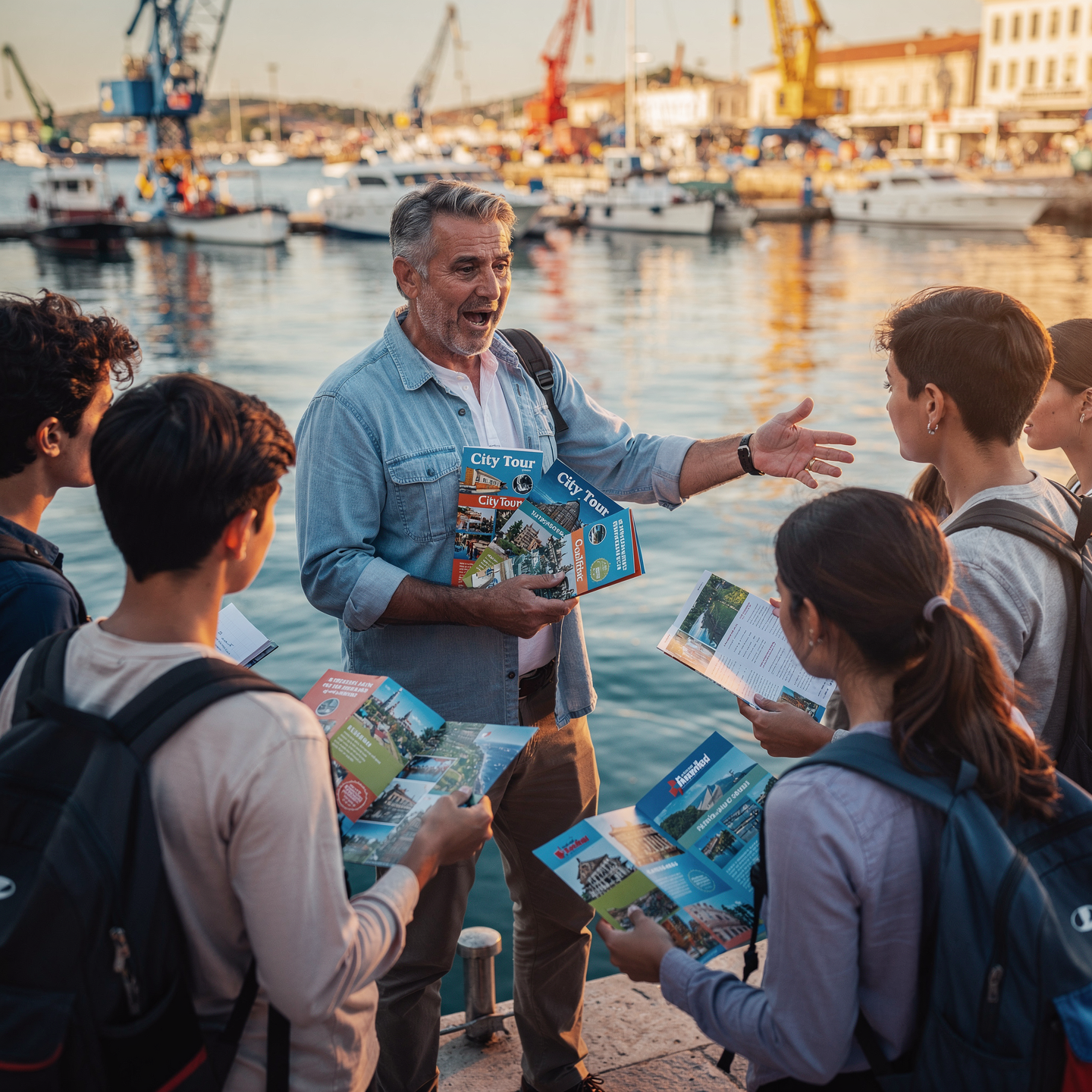
Port Tourist Guide Course
Why this course?
The Port Tourist Guide
This is your passport to discovering the best-kept secrets of the world’s most fascinating maritime destinations. Learn to plan unforgettable itineraries, identify authentic local attractions, and connect with the port culture of each location. This course provides you with the tools and expert knowledge to become an exceptional tour guide, capable of offering unique and enriching experiences to your travelers.
Key Benefits
- In-depth Knowledge: Master the history, geography, and unique characteristics of each port.
- Expert Planning: Learn to design optimized and personalized tour routes.
- Effective Communication: Hone your skills in connecting with tourists from diverse cultures.
- Valuable Resources: Access a comprehensive database of tourism providers, activities, and services.
- Career Opportunities: Boost your career in the tourism sector with a recognized certification.
- Modality: Online
- Level: Cursos
- Hours: 150 H
- Start date: 25-07-2026
Availability: 1 in stock
Who is it aimed at?
- Travel lovers who want to transform their vacations into unique experiences, discovering the essence of each port.
- Tourism students who want to acquire specialized knowledge to stand out in the sector and offer distinctive tours.
- Active tour guides who want to expand their offerings with innovative and attractive port itineraries.
- Maritime professionals interested in learning about the tourism potential of ports and creating synergies.
- Entrepreneurs who see business opportunities in port tourism and are looking for a guide to get started.
Flexibility and learning at your own pace
Access the content whenever and wherever you want, with downloadable materials and practical exercises to solidify your knowledge.
Objectives and competencies

Managing group logistics in port environments:
“Optimize flows (PTI, docks, terminals), coordinating resources (tugboats, mooring crews) and prioritizing safety.”

Effectively communicate relevant information about the port and its surroundings:
Adapt the message to the target audience (crew, authorities, port users) using the appropriate communication channels (radio, public address system, written reports).

Implement security and emergency protocols in port facilities:
“Following the ISPS Code, controlling access, preventing risks and responding to incidents (fires, spills, threats) effectively and with inter-institutional coordination.”

Design attractive and personalized port tourism experiences:
“Identify and segment port market niches to adapt the offer to their interests and motivations.”

Promote sustainability and respect for the cultural and natural heritage of the port environment:
“To minimize the environmental impact of port operations by managing waste, spills and emissions responsibly and complying with current regulations.”

Interpreting local history and culture to enrich the tourist experience:
“Design routes and activities that highlight intangible heritage, adapting to the visitor’s expectations.”
Curriculum - Modules
- Comprehensive Maritime Incident Management: protocols, roles, and chain of command for coordinated response
- Operational Planning and Execution: briefing, routes, weather windows, and go/no-go criteria
- Rapid Risk Assessment: criticality matrix, scene control, and decision-making under pressure
- Operational Communication: VHF/GMDSS, standardized reports, and inter-agency liaison
- Tactical Mobility and Safe Boarding: RHIB maneuvers, approach, mooring, and recovery
- Equipment and Technologies: PPE, signaling, satellite tracking, and field data logging
- Immediate Care of the Affected: primary assessment, hypothermia, trauma, and stabilization for evacuation
- Adverse Environmental Conditions: swell, Visibility, flows, and operational mitigation
Simulation and training: critical scenarios, use of VR/AR, and exercises with performance metrics
Documentation and continuous improvement: lessons learned, indicators (MTTA/MTTR), and SOP updates
- Introduction to Port Tourism: History, Evolution, and Current Trends
- Analysis of the Port Environment: Infrastructure, Services, and Resources
- Diagnosis of the Current Tourism Situation: Strengths, Weaknesses, Opportunities, and Threats (SWOT Analysis)
- Design of Port Tourism Products: Cruises, Excursions, and Nautical Activities
- Tourism Marketing Strategies: Segmentation, Positioning, and Promotion
- Public-Private Partnerships: Management and Financing Models
- Tourism Sustainability: Environmental, Social, and Economic Impact
- Visitor Experience Management: Quality, Satisfaction, and Loyalty
- Innovation and Technology in Port Tourism: Apps, virtual reality, smart ports.
- Evaluation and monitoring of tourism development strategies.
‘
- Introduction to Port Management: History, Evolution, and Trends
- Organizational Structure of a Port: Roles, Responsibilities, and Relationships
- National and International Port Legislation: Conventions, Regulations, and Standards
- Port Services: Pilotage, Towing, Mooring, Supply, etc.
- Port Infrastructure: Docks, Terminals, Warehouses, Access Points
- Port Security Management: ISPS, Emergency Plans, Access Control
- Cruise Ship Tourist Services: Welcome Protocols, Tourist Information, Excursion Management
- Port Tourism Marketing: Destination Promotion, Experience Creation, Customer Loyalty Programs
- Sustainability in port management: environment, social responsibility, energy efficiency.
- Innovation and technologies in port management: digitalization, automation, artificial intelligence.
‘
- Introduction to the Cruise Sector: History, Types of Cruises, and Main Markets.
- The Cruise Passenger Profile: Expectations, Needs, and Travel Motivations.
- Port Call Planning: Selection of Destinations, Itineraries, and Tourist Attractions.
- Coordination with Port Authorities: Procedures, Permits, and Local Regulations.
- Cruise Passenger Services in Port: Tourist Information, Transportation, Excursions, and Shopping.
- Managing Cruise Passenger Arrivals and Departures: Reception, Welcome, Farewell, and Satisfaction Surveys.
- Protocol and Etiquette in Cruise Passenger Service: Communication, Courtesy, and Problem-solving.
- Emergency and Crisis Management in Contingency plans, evacuation, and medical assistance.
Sustainability and responsible tourism on cruises: Environmental, social, and economic impact.
Current and future trends in cruise passenger services: Innovation, personalization, and technology.
‘
- Introduction to Port Tourism: History, Evolution, and Current Trends
- Maritime Heritage: Identification, Conservation, and Enhancement of Resources
- Coastal Marine Ecosystems: Biodiversity, Conservation, and Environmental Challenges
- Port Security: Regulations, Protocols, and Risk Management in the Port Environment
- Effective Communication: Public Speaking, Storytelling, and Group Dynamics Techniques
- Designing Tourist Itineraries: Planning, Logistics, and Memorable Experiences
- Heritage Interpretation: Methodologies, Tools, and Scriptwriting Techniques
- First Aid and Emergency Response
Emergencies: Protocols, Techniques, and Drills
Tourism Legislation: Local, National, and International Regulations Applicable to Port Tourism
Professional Ethics and Sustainable Tourism: Responsible Practices and Local Development
‘
- System Architecture and Components: Structural design, materials, and subsystems (mechanical, electrical, electronic, and fluid) with selection and assembly criteria for marine environments
- Fundamentals and Principles of Operation: Physical and engineering foundations (thermodynamics, fluid mechanics, electricity, control, and materials) that explain performance and operating limits
- Safety and Environmental (SHE): Risk analysis, PPE, LOTO, hazardous atmospheres, spill and waste management, and emergency response plans
- Applicable Regulations and Standards: IMO/ISO/IEC requirements and local regulations;
- Conformance criteria, certification, and best practices for operation and maintenance
- Inspection, testing, and diagnostics: Visual/dimensional inspection, functional testing, data analysis, and predictive techniques (vibration, thermography, fluid analysis) to identify root causes
- Preventive and predictive maintenance: Hourly/cycle/seasonal plans, lubrication, adjustments, calibrations, consumable replacement, post-service verification, and operational reliability
- Instrumentation, tools, and metrology: Measuring and testing equipment, diagnostic software, calibration and traceability; selection criteria, safe use, and storage
- Onboard integration and interfaces: Mechanical, electrical, fluid, and data compatibility; Sealing and watertightness, EMC/EMI, corrosion protection, and interoperability testing.
Quality, acceptance testing, and commissioning: process and materials control, FAT/SAT, bench and sea trials, go/no-go criteria, and evidence documentation.
Technical documentation and integrated practice: logs, checklists, reports, and a complete case study (safety → diagnosis → intervention → verification → report) applicable to any system.
Plan de estudio - Módulos
- Comprehensive Maritime Incident Management: protocols, roles, and chain of command for coordinated response
- Operational Planning and Execution: briefing, routes, weather windows, and go/no-go criteria
- Rapid Risk Assessment: criticality matrix, scene control, and decision-making under pressure
- Operational Communication: VHF/GMDSS, standardized reports, and inter-agency liaison
- Tactical Mobility and Safe Boarding: RHIB maneuvers, approach, mooring, and recovery
- Equipment and Technologies: PPE, signaling, satellite tracking, and field data logging
- Immediate Care of the Affected: primary assessment, hypothermia, trauma, and stabilization for evacuation
- Adverse Environmental Conditions: swell, Visibility, flows, and operational mitigation
Simulation and training: critical scenarios, use of VR/AR, and exercises with performance metrics
Documentation and continuous improvement: lessons learned, indicators (MTTA/MTTR), and SOP updates
- Introduction to Port Tourism: History, Evolution, and Current Trends
- Analysis of the Port Environment: Infrastructure, Services, and Resources
- Diagnosis of the Current Tourism Situation: Strengths, Weaknesses, Opportunities, and Threats (SWOT Analysis)
- Design of Port Tourism Products: Cruises, Excursions, and Nautical Activities
- Tourism Marketing Strategies: Segmentation, Positioning, and Promotion
- Public-Private Partnerships: Management and Financing Models
- Tourism Sustainability: Environmental, Social, and Economic Impact
- Visitor Experience Management: Quality, Satisfaction, and Loyalty
- Innovation and Technology in Port Tourism: Apps, virtual reality, smart ports.
- Evaluation and monitoring of tourism development strategies.
‘
- Introduction to Port Management: History, Evolution, and Trends
- Organizational Structure of a Port: Roles, Responsibilities, and Relationships
- National and International Port Legislation: Conventions, Regulations, and Standards
- Port Services: Pilotage, Towing, Mooring, Supply, etc.
- Port Infrastructure: Docks, Terminals, Warehouses, Access Points
- Port Security Management: ISPS, Emergency Plans, Access Control
- Cruise Ship Tourist Services: Welcome Protocols, Tourist Information, Excursion Management
- Port Tourism Marketing: Destination Promotion, Experience Creation, Customer Loyalty Programs
- Sustainability in port management: environment, social responsibility, energy efficiency.
- Innovation and technologies in port management: digitalization, automation, artificial intelligence.
‘
- Introduction to the Cruise Sector: History, Types of Cruises, and Main Markets.
- The Cruise Passenger Profile: Expectations, Needs, and Travel Motivations.
- Port Call Planning: Selection of Destinations, Itineraries, and Tourist Attractions.
- Coordination with Port Authorities: Procedures, Permits, and Local Regulations.
- Cruise Passenger Services in Port: Tourist Information, Transportation, Excursions, and Shopping.
- Managing Cruise Passenger Arrivals and Departures: Reception, Welcome, Farewell, and Satisfaction Surveys.
- Protocol and Etiquette in Cruise Passenger Service: Communication, Courtesy, and Problem-solving.
- Emergency and Crisis Management in Contingency plans, evacuation, and medical assistance.
Sustainability and responsible tourism on cruises: Environmental, social, and economic impact.
Current and future trends in cruise passenger services: Innovation, personalization, and technology.
‘
- Introduction to Port Tourism: History, Evolution, and Current Trends
- Maritime Heritage: Identification, Conservation, and Enhancement of Resources
- Coastal Marine Ecosystems: Biodiversity, Conservation, and Environmental Challenges
- Port Security: Regulations, Protocols, and Risk Management in the Port Environment
- Effective Communication: Public Speaking, Storytelling, and Group Dynamics Techniques
- Designing Tourist Itineraries: Planning, Logistics, and Memorable Experiences
- Heritage Interpretation: Methodologies, Tools, and Scriptwriting Techniques
- First Aid and Emergency Response
Emergencies: Protocols, Techniques, and Drills
Tourism Legislation: Local, National, and International Regulations Applicable to Port Tourism
Professional Ethics and Sustainable Tourism: Responsible Practices and Local Development
‘
- System Architecture and Components: Structural design, materials, and subsystems (mechanical, electrical, electronic, and fluid) with selection and assembly criteria for marine environments
- Fundamentals and Principles of Operation: Physical and engineering foundations (thermodynamics, fluid mechanics, electricity, control, and materials) that explain performance and operating limits
- Safety and Environmental (SHE): Risk analysis, PPE, LOTO, hazardous atmospheres, spill and waste management, and emergency response plans
- Applicable Regulations and Standards: IMO/ISO/IEC requirements and local regulations;
- Conformance criteria, certification, and best practices for operation and maintenance
- Inspection, testing, and diagnostics: Visual/dimensional inspection, functional testing, data analysis, and predictive techniques (vibration, thermography, fluid analysis) to identify root causes
- Preventive and predictive maintenance: Hourly/cycle/seasonal plans, lubrication, adjustments, calibrations, consumable replacement, post-service verification, and operational reliability
- Instrumentation, tools, and metrology: Measuring and testing equipment, diagnostic software, calibration and traceability; selection criteria, safe use, and storage
- Onboard integration and interfaces: Mechanical, electrical, fluid, and data compatibility; Sealing and watertightness, EMC/EMI, corrosion protection, and interoperability testing.
Quality, acceptance testing, and commissioning: process and materials control, FAT/SAT, bench and sea trials, go/no-go criteria, and evidence documentation.
Technical documentation and integrated practice: logs, checklists, reports, and a complete case study (safety → diagnosis → intervention → verification → report) applicable to any system.
- Introduction to the Cruise Industry: History, Evolution, and Current Trends
- Types of Cruises: Expedition, Themed, River, Luxury, etc.
- Cruise Market: Customer Segmentation, Profiles, and Expectations
- Design and Operation of Itineraries: Geographic, Seasonal, and Demand Factors
- Planning Excursions: Selection, Negotiation with Suppliers, and Quality Control
- Risk Management in Excursions: Safety, Insurance, and Emergency Protocols
- Legal and Regulatory Aspects: Licenses, Permits, and Local and International Regulations
- Marketing and Promotion of Cruises and Excursions: Online and Offline Strategies
- Sales and Reservations: Systems of Management, distribution channels, and customer service.
- Customer satisfaction assessment and complaint management.
‘
- Introduction to Cruise Tourism: History, Evolution, and Current Trends
- The Cruise Passenger Profile: Segmentation, Motivations, and Expectations
- The Port as a Destination: Infrastructure, Services, and Tourist Attractions
- Designing Excursions and Activities for Cruise Passengers: Selection Criteria and Planning
- Customer Service Techniques: Effective Communication, Conflict Resolution, and Complaint Management
- Promoting the Port Destination: Marketing Strategies, Distribution Channels, and Public Relations
- The Economic and Social Impact of Cruise Tourism: Benefits and Challenges for the Destination
- Sustainability in Cruise Tourism: Environmental Best Practices and Social Responsibility
- Regulations and Legislation Applicable to Cruise Tourism Cruises.
- Success stories and best practices in cruise passenger service and port destination promotion.
‘
- Introduction to the Cruise Industry: History, Evolution, and Current Landscape.
- Types of Cruises and Market Segments: Luxury Cruises, Family Cruises, Themed Cruises, etc.
- The Cruise Passenger: Profile, Expectations, and Needs.
- Customer Service in the Cruise Industry: Standards of Quality and Excellence.
- Effective Communication with Cruise Passengers: Interpersonal Skills and Conflict Resolution.
- Onboard Protocol and Etiquette: Rules of Courtesy and Professional Conduct.
- Complaint and Claim Management: Procedures and Resolution Techniques.
- Onboard Safety and Emergencies: Evacuation Procedures and First Aid.
- Port Operations: Functions, Responsibilities, and Coordination.
- Legislation and Regulations applicable to cruise ship port operations.
‘
- Introduction to the Cruise Industry: History, Types of Cruises, and Markets.
- The Cruise Passenger Profile: Expectations, Needs, and Segmentation.
- Effective Communication with Cruise Passengers: Interpersonal Skills and Conflict Resolution.
- Protocol and Etiquette in Cruise Passenger Service.
- Complaint and Claim Management: Procedures and Resolution Techniques.
- The Cruise Terminal: Facilities, Services, and Staff.
- Embarkation and Disembarkation Operations: Procedures and Safety.
- Baggage Logistics: Management, Transportation, and Claims.
- Tourist Information Services: Resources and Communication Strategies.
- Safety and Emergency Measures in the Cruise Terminal.
‘
Career opportunities
- Local Tour Guide: Offering walking, cycling, or bus tours of the city and its surroundings.
- Cruise Cruise Guide: Accompanying cruise ship passengers on shore excursions.
- Tourist Information Officer: Providing information and assistance to visitors at ports and resorts.
- Tourist Entertainer: Organizing activities and events for tourists in the port area.
- Tourism Promoter: Working to promote the tourist destination and attract more visitors.
- Tourism Content Creator: Developing content for blogs, social media, and websites about the port area and its attractions.
- Cruise Cruise Travel Agent: Advising and selling cruise packages to clients.
- Tourism Consultant: Advising companies and organizations on how to improve their tourism offerings in the port area.
“`
Admission requirements

Academic/professional profile:
Degree/Bachelor's degree in Nautical Science/Maritime Transport, Naval/Marine Engineering, or a related field; or proven professional experience in bridge/operations.

Language proficiency:
Recommended functional maritime English (SMCP) for simulations and technical materials.

5. Induction
Updated resume, copy of degree or seaman's book, ID card/passport, letter of motivation.

Technical requirements (for online):
Equipment with camera/microphone, stable connection, ≥ 24” monitor recommended for ECDIS/Radar-ARPA.
Admission process and dates

1. Online
application
(form + documents).

2. Academic review and interview
(profile/objectives/schedule compatibility).

3. Admission decision
(+ scholarship proposal if applicable).

4. Reservation of place
(deposit) and registration.

5. Induction
(access to campus, calendars, simulator guides).
Scholarships and grants
- Discover the secrets: Master the keys to creating unforgettable tourist experiences in port environments.
- Become an expert: Learn about the history, culture, and unique characteristics of each port, highlighting its unique attractions.
- Plan engaging routes: Design itineraries that capture the essence of each destination, optimizing time and resources.
- Exceptional customer service: Develop communication skills to connect with visitors and exceed their expectations.
- Career opportunities: Boost your career in a booming sector with a high demand for guides specializing in port tourism.
Testimonials
“As a port tour guide, I exceeded my expectations in terms of customer satisfaction. On one occasion, a group of cruise passengers, initially skeptical about the proposed excursion, were delighted by my knowledge of local history, my ability to adapt to their interests, and my infectious enthusiasm. At the end of the tour, they not only congratulated me profusely but also recommended me to other passengers, resulting in a significant increase in bookings for my subsequent tours.”
Mastering the communication strategies learned in the course allowed me to design and execute a tourism promotion campaign for a small town, achieving a 30% increase in the number of visitors in one quarter and revitalizing its local economy.
“As a port tour guide, I exceeded my expectations in terms of customer satisfaction. I developed a customized route for a group of cruise passengers with reduced mobility, including priority access to sites and adaptations to the itinerary. I received praise for my sensitivity, knowledge, and the way I anticipated their needs, making their visit a memorable and inclusive experience.”
“As a port tour guide, I captivated a discerning group of cruise passengers with my deep knowledge of local history and infectious enthusiasm. I not only exceeded their expectations by answering all their questions accurately, but also provided personalized recommendations that enriched their experience ashore. I received praise for my organization, my ability to adapt to unexpected situations, and my genuine interest in ensuring they made the most of their brief time in port. Thanks to my performance, the travel agency congratulated me and offered me the opportunity to lead future tours with even larger groups.”

Frequently asked questions
To provide information and assistance to visitors to a port, highlighting points of interest and local history to enrich their experience.
Yes. The itinerary includes ECDIS/Radar-ARPA/BRM with harbor, ocean, fog, storm, and SAR scenarios.
Online with live sessions; hybrid option for simulator/practical placements through agreements.
To provide information and assistance to visitors to a port, including details about attractions, transportation, restaurants and other local services.
Recommended functional SMCP. We offer support materials for standard phraseology.
Yes, with a relevant degree or experience in maritime/port operations. The admissions interview will confirm suitability.
Optional (3–6 months) through Companies & Collaborations and the Alumni Network.
Simulator practice (rubrics), defeat plans, SOPs, checklists, micro-tests and applied TFM.
A degree from Navalis Magna University + operational portfolio (tracks, SOPs, reports and KPIs) useful for audits and employment.
- Introduction to the Cruise Industry: History, Types of Cruises, and Markets.
- The Cruise Passenger Profile: Expectations, Needs, and Segmentation.
- Effective Communication with Cruise Passengers: Interpersonal Skills and Conflict Resolution.
- Protocol and Etiquette in Cruise Passenger Service.
- Complaint and Claim Management: Procedures and Resolution Techniques.
- The Cruise Terminal: Facilities, Services, and Staff.
- Embarkation and Disembarkation Operations: Procedures and Safety.
- Baggage Logistics: Management, Transportation, and Claims.
- Tourist Information Services: Resources and Communication Strategies.
- Safety and Emergency Measures in the Cruise Terminal.
‘
Request information
- Complete the Application Form
- Attach your CV/Qualifications (if you have them to hand).
- Indicate your preferred cohort (January/May/September) and whether you want the hybrid option with simulator sessions.
Teachers
Eng. Tomás Riera
Full Professor
Eng. Tomás Riera
Full Professor
Eng. Sofía Marquina
Full Professor
Eng. Sofía Marquina
Full Professor
Eng. Javier Bañuls
Full Professor
Eng. Javier Bañuls
Full Professor
Dr. Nuria Llobregat
Full Professor
Dr. Nuria Llobregat
Full Professor
Dr. Pau Ferrer
Full Professor
Dr. Pau Ferrer
Full Professor
Cap. Javier Abaroa (MCA)
Full Professor
Cap. Javier Abaroa (MCA)
Full Professor

