Photography and video course in nautical activities

Why this course?

Master the art of Photography and Videography in Nautical Activities

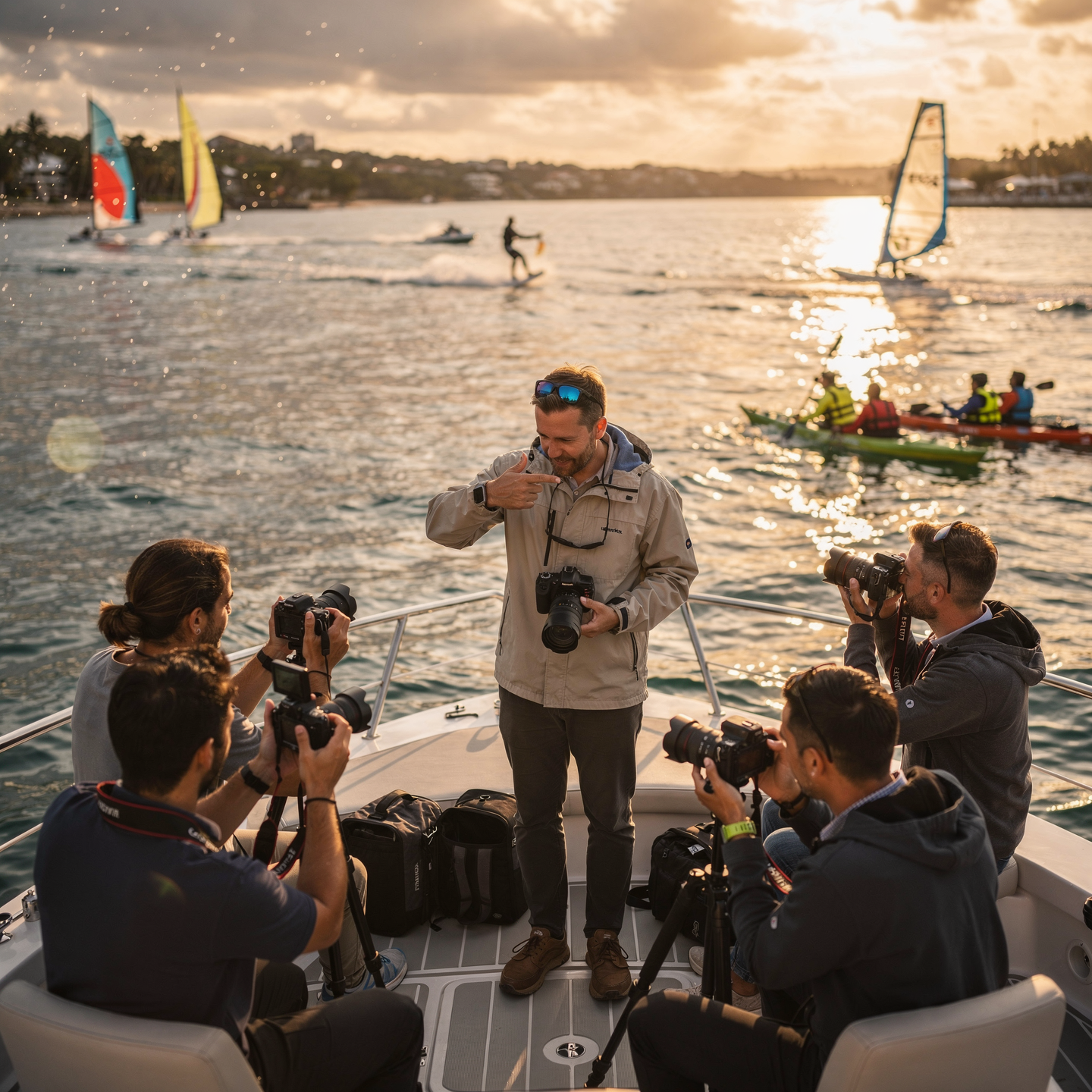
Transform your adventures at sea into unforgettable memories. This course provides you with the essential tools and techniques to capture stunning images and videos, overcoming the challenges of the marine environment. You will learn about composition, lighting, and camera settings, adapting to changing water and weather conditions.

What will you learn?

  • Technical Mastery: Camera settings, lenses, and accessories for underwater photography and video.
  • Creative Composition: Framing, perspective, and visual storytelling in nautical environments.
  • Overcoming Challenges: Stabilization, equipment protection, and filming in adverse conditions.
  • Professional Editing: Post-production of photos and videos for high-quality results.
  • Social Media Content: Creating engaging material to share your nautical experiences online.
FotografĂ­a

Photography and video course in nautical activities

Availability: 1 in stock

Who is it aimed at?

  • Sailing and water sports enthusiasts looking to capture the beauty of the sea and their adventures with high-quality photos and videos.
  • Nautical professionals (instructors, tour guides) who want to create engaging visual content to promote their services and experiences.
  • Photography and video enthusiasts who want to specialize in techniques and equipment adapted to the maritime environment.
  • Bloggers and digital content creators looking to stand out with stunning images and videos of their trips and nautical activities.
  • Nautical businesses (boat rentals, sailing schools) interested in improving their digital marketing with visual content professional.

Flexibility and Hands-on Learning
 Designed to adapt to your pace: online theory classes, practical training in real nautical environments, and personalized guidance for your final project.

FotografĂ­a

Objectives and competencies

Visually document nautical events and experiences:

“To compose attractive and technically correct images that capture the essence of sailing, considering light, framing, and visual storytelling.”

Mastering stabilization and focusing techniques in maritime environments:

“Anticipate vessel movements due to drift, wind, and current, adjusting focus and stabilization parameters of equipment and systems.”

Adapting photographic and video equipment to adverse weather conditions:

“Use specific protections (covers, UV filters, sunshades), control humidity with desiccants, and keep batteries at optimal temperature.”

Editing and post-producing high-quality nautical audiovisual material:

Master editing and post-production software (DaVinci Resolve, Adobe Premiere) to optimize color, sound, and visual storytelling.
Operating drones safely and effectively to capture nautical aerial images:

“Plan flights considering marine weather, currents and tides, ensuring drone stability and image quality.”

Apply maritime safety regulations to the recording of images and video:

“Respect restricted areas, ensure the confidentiality of sensitive information, and avoid interference with navigation equipment.”

Curriculum - Modules

  1. Comprehensive Maritime Incident Management: protocols, roles, and chain of command for coordinated response
  2. Operational Planning and Execution: briefing, routes, weather windows, and go/no-go criteria
  3. Rapid Risk Assessment: criticality matrix, scene control, and decision-making under pressure
  4. Operational Communication: VHF/GMDSS, standardized reports, and inter-agency liaison
  5. Tactical Mobility and Safe Boarding: RHIB maneuvers, approach, mooring, and recovery
  6. Equipment and Technologies: PPE, signaling, satellite tracking, and field data logging
  7. Immediate Care of the Affected: primary assessment, hypothermia, trauma, and stabilization for evacuation
  8. Adverse Environmental Conditions: swell, Visibility, flows, and operational mitigation

    Simulation and training: critical scenarios, use of VR/AR, and exercises with performance metrics

    Documentation and continuous improvement: lessons learned, indicators (MTTA/MTTR), and SOP updates

  1. Introduction to Nautical Audiovisual Capture: Objectives and Applications
  2. Filming and Photography Equipment: Cameras, Drones, Stabilizers, Audio
  3. Basic Maritime Safety: Life Jackets, Communications, Emergency Plan
  4. Legislation and Permits: Drone Regulations, Restricted Areas, Privacy
  5. Filming Techniques at Sea: Composition, Framing, Camera Movement
  6. Filming Planning: Risk Analysis, Meteorology, Tides
  7. Exposure and Color Control: Camera Settings, Filters, White Balance
  8. Basic Video and Photo Editing: Software, Workflow, Color Correction
  9. File Storage and Management: Backups, metadata, organization
  10. Ethics and responsibility in nautical audiovisual capture: Respect for the environment and wildlife

  1. Introduction to nautical photography: history, evolution, and key figures.
  2. Essential photography and video equipment: cameras, lenses, stabilizers, drones.
  3. Visual composition techniques in maritime environments: rule of thirds, lines, symmetry, perspective.
  4. Exposure and light control: ISO, aperture, shutter speed, filters.
  5. Photography and video with natural light at sea: sunrise, sunset, cloudy days, extreme conditions.
  6. Night photography and astrophotography on board: equipment, techniques, safety.
  7. Professional video recording in nautical environments: resolution, frame rate, codecs, audio.
  8. Editing and post-production of nautical photos and videos: Software, workflows, optimization.
  9. Legal and security aspects of nautical visual capture: permissions, privacy, risks.
  10. Creating a professional portfolio and marketing strategies for nautical photographers and videographers.

  1. Introduction to nautical photography: history, styles, and influences.
  2. Essential photographic equipment: cameras, lenses, filters, and accessories for the marine environment.
  3. Fundamentals of exposure: aperture, shutter speed, ISO, and their impact on the image.
  4. Composition and framing in marine photography: rules and techniques for creating striking images.
  5. Seascape photography: sunrises, sunsets, waves, and coastal formations.
  6. Vessel photography: sailboats, yachts, fishing boats, and cargo ships.
  7. Marine wildlife photography: birds, marine mammals, and underwater life (introduction).
  8. Introduction to nautical video: formats, resolutions, and frame rates.
  9. Image Stabilization: Techniques and equipment for recording video while moving.
  10. Basic Photo and Video Editing: Software, Workflow, and Optimization for Web.

  1. Introduction to nautical photography: history, evolution, and key figures.
  2. Essential photographic equipment: cameras, lenses, filters, and accessories for the sea.
  3. Exposure and composition: light control, rule of thirds, lines, and nautical perspectives.
  4. Seascape photography: sunrises, sunsets, waves, and coastal formations.
  5. Vessel photography: sailboats, yachts, fishing boats, and merchant ships.
  6. Marine life photography: marine mammals, shorebirds, and underwater ecosystems.
  7. Introduction to nautical video: formats, resolutions, and frame rates.
  8. Video recording in marine environments: stability, sound, and weather conditions.
  9. Basic Video Editing: Software, cuts, transitions, and color correction.
  10. Ethics in nautical photography and video: Respect for the environment and marine life.

  1. System Architecture and Components: Structural design, materials, and subsystems (mechanical, electrical, electronic, and fluid) with selection and assembly criteria for marine environments
  2. Fundamentals and Principles of Operation: Physical and engineering foundations (thermodynamics, fluid mechanics, electricity, control, and materials) that explain performance and operating limits
  3. Safety and Environmental (SHE): Risk analysis, PPE, LOTO, hazardous atmospheres, spill and waste management, and emergency response plans
  4. Applicable Regulations and Standards: IMO/ISO/IEC requirements and local regulations;
  5. Conformance criteria, certification, and best practices for operation and maintenance
  6. Inspection, testing, and diagnostics: Visual/dimensional inspection, functional testing, data analysis, and predictive techniques (vibration, thermography, fluid analysis) to identify root causes
  7. Preventive and predictive maintenance: Hourly/cycle/seasonal plans, lubrication, adjustments, calibrations, consumable replacement, post-service verification, and operational reliability
  8. Instrumentation, tools, and metrology: Measuring and testing equipment, diagnostic software, calibration and traceability; selection criteria, safe use, and storage
  9. Onboard integration and interfaces: Mechanical, electrical, fluid, and data compatibility; Sealing and watertightness, EMC/EMI, corrosion protection, and interoperability testing.

    Quality, acceptance testing, and commissioning: process and materials control, FAT/SAT, bench and sea trials, go/no-go criteria, and evidence documentation.

    Technical documentation and integrated practice: logs, checklists, reports, and a complete case study (safety → diagnosis → intervention → verification → report) applicable to any system.

Plan de estudio - MĂłdulos

  1. Comprehensive Maritime Incident Management: protocols, roles, and chain of command for coordinated response
  2. Operational Planning and Execution: briefing, routes, weather windows, and go/no-go criteria
  3. Rapid Risk Assessment: criticality matrix, scene control, and decision-making under pressure
  4. Operational Communication: VHF/GMDSS, standardized reports, and inter-agency liaison
  5. Tactical Mobility and Safe Boarding: RHIB maneuvers, approach, mooring, and recovery
  6. Equipment and Technologies: PPE, signaling, satellite tracking, and field data logging
  7. Immediate Care of the Affected: primary assessment, hypothermia, trauma, and stabilization for evacuation
  8. Adverse Environmental Conditions: swell, Visibility, flows, and operational mitigation

    Simulation and training: critical scenarios, use of VR/AR, and exercises with performance metrics

    Documentation and continuous improvement: lessons learned, indicators (MTTA/MTTR), and SOP updates

  1. Introduction to Nautical Audiovisual Capture: Objectives and Applications
  2. Filming and Photography Equipment: Cameras, Drones, Stabilizers, Audio
  3. Basic Maritime Safety: Life Jackets, Communications, Emergency Plan
  4. Legislation and Permits: Drone Regulations, Restricted Areas, Privacy
  5. Filming Techniques at Sea: Composition, Framing, Camera Movement
  6. Filming Planning: Risk Analysis, Meteorology, Tides
  7. Exposure and Color Control: Camera Settings, Filters, White Balance
  8. Basic Video and Photo Editing: Software, Workflow, Color Correction
  9. File Storage and Management: Backups, metadata, organization
  10. Ethics and responsibility in nautical audiovisual capture: Respect for the environment and wildlife

  1. Introduction to nautical photography: history, evolution, and key figures.
  2. Essential photography and video equipment: cameras, lenses, stabilizers, drones.
  3. Visual composition techniques in maritime environments: rule of thirds, lines, symmetry, perspective.
  4. Exposure and light control: ISO, aperture, shutter speed, filters.
  5. Photography and video with natural light at sea: sunrise, sunset, cloudy days, extreme conditions.
  6. Night photography and astrophotography on board: equipment, techniques, safety.
  7. Professional video recording in nautical environments: resolution, frame rate, codecs, audio.
  8. Editing and post-production of nautical photos and videos: Software, workflows, optimization.
  9. Legal and security aspects of nautical visual capture: permissions, privacy, risks.
  10. Creating a professional portfolio and marketing strategies for nautical photographers and videographers.

  1. Introduction to nautical photography: history, styles, and influences.
  2. Essential photographic equipment: cameras, lenses, filters, and accessories for the marine environment.
  3. Fundamentals of exposure: aperture, shutter speed, ISO, and their impact on the image.
  4. Composition and framing in marine photography: rules and techniques for creating striking images.
  5. Seascape photography: sunrises, sunsets, waves, and coastal formations.
  6. Vessel photography: sailboats, yachts, fishing boats, and cargo ships.
  7. Marine wildlife photography: birds, marine mammals, and underwater life (introduction).
  8. Introduction to nautical video: formats, resolutions, and frame rates.
  9. Image Stabilization: Techniques and equipment for recording video while moving.
  10. Basic Photo and Video Editing: Software, Workflow, and Optimization for Web.

  1. Introduction to nautical photography: history, evolution, and key figures.
  2. Essential photographic equipment: cameras, lenses, filters, and accessories for the sea.
  3. Exposure and composition: light control, rule of thirds, lines, and nautical perspectives.
  4. Seascape photography: sunrises, sunsets, waves, and coastal formations.
  5. Vessel photography: sailboats, yachts, fishing boats, and merchant ships.
  6. Marine life photography: marine mammals, shorebirds, and underwater ecosystems.
  7. Introduction to nautical video: formats, resolutions, and frame rates.
  8. Video recording in marine environments: stability, sound, and weather conditions.
  9. Basic Video Editing: Software, cuts, transitions, and color correction.
  10. Ethics in nautical photography and video: Respect for the environment and marine life.

  1. System Architecture and Components: Structural design, materials, and subsystems (mechanical, electrical, electronic, and fluid) with selection and assembly criteria for marine environments
  2. Fundamentals and Principles of Operation: Physical and engineering foundations (thermodynamics, fluid mechanics, electricity, control, and materials) that explain performance and operating limits
  3. Safety and Environmental (SHE): Risk analysis, PPE, LOTO, hazardous atmospheres, spill and waste management, and emergency response plans
  4. Applicable Regulations and Standards: IMO/ISO/IEC requirements and local regulations;
  5. Conformance criteria, certification, and best practices for operation and maintenance
  6. Inspection, testing, and diagnostics: Visual/dimensional inspection, functional testing, data analysis, and predictive techniques (vibration, thermography, fluid analysis) to identify root causes
  7. Preventive and predictive maintenance: Hourly/cycle/seasonal plans, lubrication, adjustments, calibrations, consumable replacement, post-service verification, and operational reliability
  8. Instrumentation, tools, and metrology: Measuring and testing equipment, diagnostic software, calibration and traceability; selection criteria, safe use, and storage
  9. Onboard integration and interfaces: Mechanical, electrical, fluid, and data compatibility; Sealing and watertightness, EMC/EMI, corrosion protection, and interoperability testing.

    Quality, acceptance testing, and commissioning: process and materials control, FAT/SAT, bench and sea trials, go/no-go criteria, and evidence documentation.

    Technical documentation and integrated practice: logs, checklists, reports, and a complete case study (safety → diagnosis → intervention → verification → report) applicable to any system.

  1. Introduction to Audiovisual Capture in the Nautical Environment: Specificities and Challenges.
  2. Filming and Photography Equipment: Cameras, lenses, stabilizers, and accessories recommended for maritime use.
  3. Safety at Sea: Basic safety rules for the operator and equipment. Risks of the aquatic environment and their mitigation.
  4. Filming and Photography Techniques: Composition, framing, exposure, and focus adapted to the movement and light at sea.
  5. Audio in Noisy Environments: Microphones, recorders, and techniques for obtaining clear and crisp sound in adverse conditions.
  6. Basic Post-Production: Video and photo editing with specialized software.
  7. Color and sound correction.

  8. Legislation and permits: Regulations concerning the use of drones and filming equipment in protected marine areas.
  9. Equipment maintenance and care: Cleaning, storage, and inspection of equipment to extend its lifespan in saline environments.
  10. Basic first aid: Essential knowledge for responding to emergencies at sea.
  11. Professional ethics: Respect for the marine environment and local wildlife. Responsible practices in audiovisual capture.

  1. Introduction to Underwater Photography and Videography: History and Evolution.
  2. Physics of Light and Sound in Water: Absorption, Refraction, Scattering, and Attenuation.
  3. Image Capture Equipment: Cameras, Housings, Lenses, Artificial Lighting (Flashes, Spotlights).
  4. Sound Capture Equipment: Hydrophones, Underwater Microphones, Recorders.
  5. Principles of Underwater Lighting: Lighting Techniques, White Balance, Color Temperature.
  6. Composition and Visual Narrative: Framing, Shots, Angles, Underwater Storytelling.
  7. Diving Techniques for Photographers and Videographers: Buoyancy Control, Safety, Environmental Conservation.
  8. Image Post-Production and Sound: editing, color correction, noise removal, mastering.

    Legal and ethical aspects: permissions, intellectual property, respect for the marine environment.

    Workflow: from planning to final distribution of the material.

  1. Introduction to Underwater Photography: History, Evolution, and Applications
  2. Underwater Photography Equipment: Cameras, Housings, Flashes, and Accessories
  3. Basic Principles of Photography: Aperture, Shutter Speed, ISO, and White Balance
  4. Light Underwater: Absorption, Dispersion, Refraction, and Color
  5. Underwater Lighting Techniques: Using External Flashes and Natural Light
  6. Underwater Photographic Composition: Rule of Thirds, Guidelines, and Perspective
  7. Focus and Sharpness: Techniques for Obtaining Sharp Images Underwater
  8. Digital Editing of Underwater Images: Adjusting Color, Contrast, and Sharpness
  9. Editing Workflow: Software and Post-Processing Techniques
  10. Ethics and Conservation: Environmental Impact of Underwater Photography and Best Practices

  1. Fundamentals of nautical visual storytelling: telling stories at sea.
  2. Basic equipment for audiovisual capture: cameras, drones, and accessories.
  3. Principles of photographic composition: rule of thirds, guidelines, symmetry.
  4. Natural lighting techniques in marine environments: utilization and control.
  5. Video recording: formats, resolutions, fps, and codecs.
  6. Sound in nautical audiovisual capture: microphones, recording, and editing.
  7. Image stabilization: techniques and equipment for smooth footage.
  8. Use of drones in nautical audiovisual capture: legislation, safety, and flight techniques.
  9. Basic photography and video editing: software and workflow.
  10. Ethics and responsibility in nautical audiovisual capture: respect for the environment and the maritime community.

Career opportunities

  • Freelance Nautical Photographer/Videographer: Covering events, regattas, and marine and aquatic photo shoots.
  • Audiovisual Content Producer for Nautical Companies: Creating promotional videos, tutorials, and social media content for brands in the sector.
  • Photographer/Videographer for Magazines and Specialized Nautical Publications: Collaborating with media outlets on reports, articles, and visual documentation.
  • Documentarian of Nautical Expeditions and Projects: Recording research projects, marine conservation, and adventures at sea.
  • Audiovisual Technician at Nautical Events and Competitions: Camera operation, live editing, and content production for giant screens and broadcasts.
  • Content Creator for Online Platforms and Social Media: Developing thematic channels about Nautical activities, boat trips, and water sports.

    Underwater Image Specialist: Underwater photography and videography for scientific projects, documentaries, and scuba diving tourism.

    I work in marketing agencies specializing in the nautical sector: Creation and management of advertising campaigns with a visual focus on the maritime world.

    “`

Admission requirements

Academic/professional profile:

Degree/Bachelor's degree in Nautical Science/Maritime Transport, Naval/Marine Engineering, or a related field; or proven professional experience in bridge/operations.

Language proficiency:

Recommended functional maritime English (SMCP) for simulations and technical materials.

5. Induction

Updated resume, copy of degree or seaman's book, ID card/passport, letter of motivation.

Technical requirements (for online):

Equipment with camera/microphone, stable connection, ≥ 24” monitor recommended for ECDIS/Radar-ARPA.

Admission process and dates

1. Online
application

(form + documents).

2. Academic review and interview

(profile/objectives/schedule compatibility).

3. Admission decision

(+ scholarship proposal if applicable).

4. Reservation of place

(deposit) and registration.

5. Induction

(access to campus, calendars, simulator guides).

Scholarships and grants

  • Master Nautical Imagery: Learn to capture the beauty and action of marine environments, from underwater photography to onboard videos.
  • Specialized Equipment and Techniques: Discover the ideal equipment for photography and video at sea, and master filming and editing techniques adapted to extreme conditions.
  • Safety and Planning: Prioritize safety on the water while maximizing your creative opportunities. Learn to plan your sessions and anticipate environmental challenges.
  • Professional Editing: Transform your shots into impactful visual narratives with professional editing software and advanced post-production techniques.
  • Marketing and Promotion: Boost your work and reach your target audience with digital marketing and promotion strategies for nautical photographers and videographers.
Develop your passion and turn your skills at sea into an exciting professional career.

Testimonials

Frequently asked questions

Maintain adequate and consistent lighting.

Yes. The itinerary includes ECDIS/Radar-ARPA/BRM with harbor, ocean, fog, storm, and SAR scenarios.

Online with live sessions; hybrid option for simulator/practical placements through agreements.

Recommended functional SMCP. We offer support materials for standard phraseology.

Yes, with a relevant degree or experience in maritime/port operations. The admissions interview will confirm suitability.

Optional (3–6 months) through Companies & Collaborations and the Alumni Network.

Simulator practice (rubrics), defeat plans, SOPs, checklists, micro-tests and applied TFM.

A degree from Navalis Magna University + operational portfolio (tracks, SOPs, reports and KPIs) useful for audits and employment.

  1. Fundamentals of nautical visual storytelling: telling stories at sea.
  2. Basic equipment for audiovisual capture: cameras, drones, and accessories.
  3. Principles of photographic composition: rule of thirds, guidelines, symmetry.
  4. Natural lighting techniques in marine environments: utilization and control.
  5. Video recording: formats, resolutions, fps, and codecs.
  6. Sound in nautical audiovisual capture: microphones, recording, and editing.
  7. Image stabilization: techniques and equipment for smooth footage.
  8. Use of drones in nautical audiovisual capture: legislation, safety, and flight techniques.
  9. Basic photography and video editing: software and workflow.
  10. Ethics and responsibility in nautical audiovisual capture: respect for the environment and the maritime community.

Request information

  1. Complete the Application Form
  2. Attach your CV/Qualifications (if you have them to hand).
  3. Indicate your preferred cohort (January/May/September) and whether you want the hybrid option with simulator sessions.
An academic advisor will contact you within 24–48 hours to guide you through the admission process, scholarships, and compatibility with your professional schedule. Translated with DeepL.com (free version)
Please enable JavaScript in your browser to complete this form.
Click or drag a file to this area to upload.

Teachers

0
    0
    Tu carrito
    Tu carrito esta vacĂ­oRegresar a la tienda
    Scroll to Top