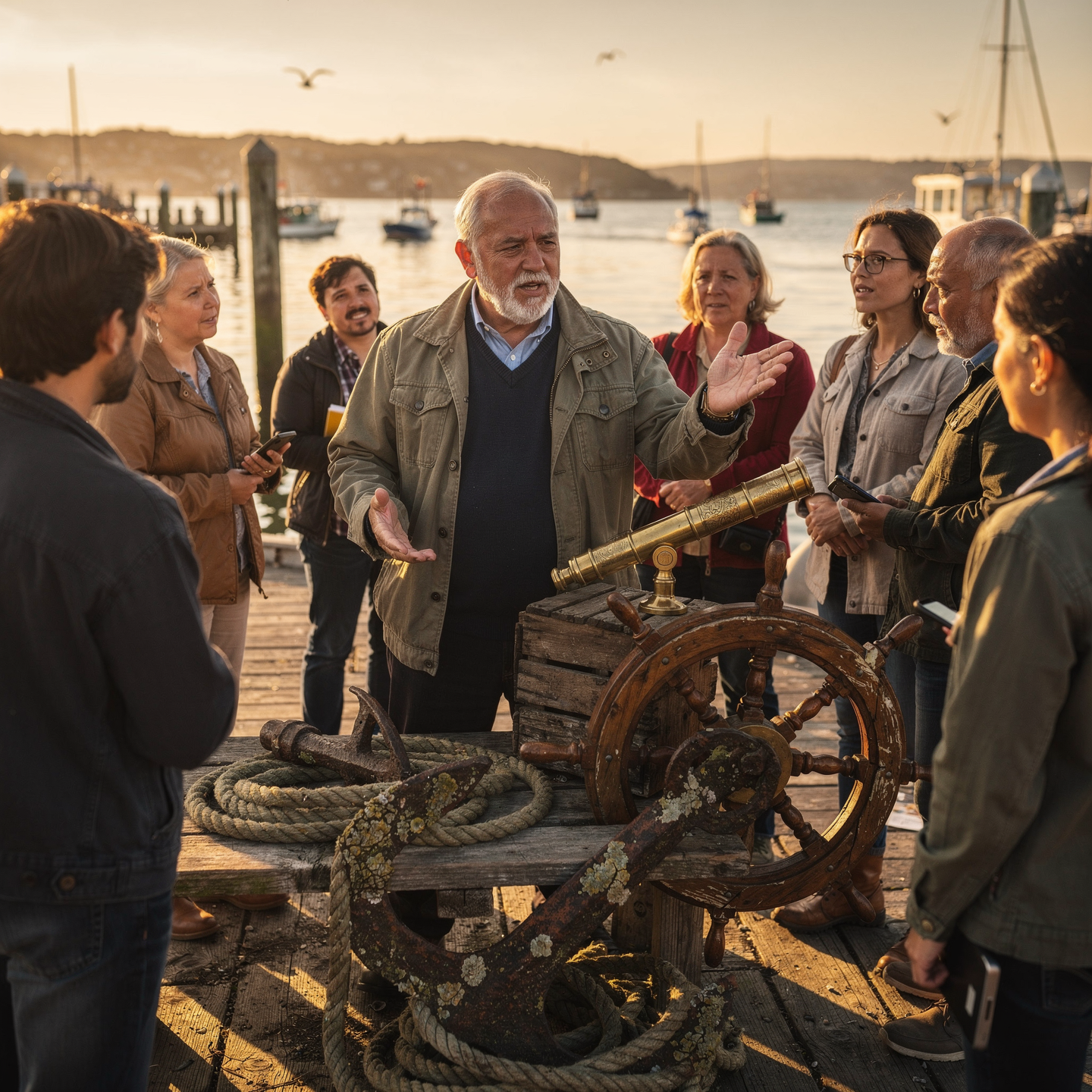
Local Maritime History Course

Why this course?

Discover the secrets of the sea that washes our shores with the Local Maritime History course.

Immerse yourself in a fascinating journey through the centuries, exploring the key events, iconic figures, and naval traditions that have shaped our identity. Learn about the legendary ships, naval battles, and trade routes that have marked the development of our community. This course will provide you with a deep and enriching insight into our maritime heritage, connecting you with our roots and awakening your passion for history.

Distinctive Advantages

  • Local Archive Research: Access to historical documents and firsthand accounts.
  • Guided Tours of Historical Sites: On-site exploration of key locations in our maritime history.
  • Meetings with Experts: Talks and discussions with historians and naval specialists.
  • Development of Research Skills: Learn to analyze primary sources and construct historical narratives.
  • Community of Enthusiasts: Share your interest with other local maritime history enthusiasts.
Historia

Local Maritime History Course

Availability: 1 in stock

Who is it aimed at?

  • Local history enthusiasts who wish to delve deeper into the maritime heritage of their region.
  • History students and professors seeking primary sources and new perspectives on the influence of the sea.
  • Tour guides and cultural promoters interested in enriching their narratives with historical facts and maritime anecdotes.
  • Members of cultural and neighborhood associations who wish to preserve and disseminate the maritime memory of their community.
  • People with an interest in genealogy who seek to connect with their ancestors linked to local maritime life.

Accessibility and Flexibility
 Adapted for participants of diverse levels: engaging and rigorous content, multimedia resources, and hands-on activities for an enriching experience.

Historia

Objectives and competencies

Understanding coastal socio-economic evolution:

Analyze the impact of globalization and tourism on coastal communities, considering sustainability and the preservation of cultural heritage.

Identify and preserve tangible and intangible maritime heritage:

To document and disseminate traditional naval techniques, adapting them to modern contexts for their survival.

Promote sustainable maritime cultural tourism:

Promote the participation of local communities in the creation and management of tourist experiences, ensuring the preservation of heritage and the equitable distribution of benefits.

Promoting maritime civic identity and pride:

Actively promote participation in community events and activities related to the sea, fostering knowledge of local maritime history and the conservation of maritime heritage.

Develop critical analysis skills using historical maritime sources:

Evaluate the authenticity, bias, and context of nautical documents, logbooks, and old maps to accurately reconstruct maritime events.

Interpreting the influence of the sea on local culture:

“Identify cultural manifestations (gastronomy, festivities, art) influenced by maritime activity and its socio-economic impact on the region.”

Curriculum - Modules

  1. Comprehensive Maritime Incident Management: protocols, roles, and chain of command for coordinated response
  2. Operational Planning and Execution: briefing, routes, weather windows, and go/no-go criteria
  3. Rapid Risk Assessment: criticality matrix, scene control, and decision-making under pressure
  4. Operational Communication: VHF/GMDSS, standardized reports, and inter-agency liaison
  5. Tactical Mobility and Safe Boarding: RHIB maneuvers, approach, mooring, and recovery
  6. Equipment and Technologies: PPE, signaling, satellite tracking, and field data logging
  7. Immediate Care of the Affected: primary assessment, hypothermia, trauma, and stabilization for evacuation
  8. Adverse Environmental Conditions: swell, Visibility, flows, and operational mitigation

    Simulation and training: critical scenarios, use of VR/AR, and exercises with performance metrics

    Documentation and continuous improvement: lessons learned, indicators (MTTA/MTTR), and SOP updates

  1. Legal Framework for Local Maritime Governance: applicable laws, regulations, and international conventions.
  2. Local Maritime Strategic Planning: development of integrated coastal zone management plans.
  3. Maritime Resources: identification, assessment, and sustainable management of fisheries, tourism, and energy resources.
  4. Maritime Cultural Heritage: protection and enhancement of historical sites, shipwrecks, and local maritime traditions.
  5. Maritime Infrastructure: ports, marinas, and other coastal facilities: design, operation, and maintenance.
  6. Sustainable Maritime Tourism: development of tourism activities that respect the environment and local culture.
  7. Climate Change and Coastal Adaptation: impacts of climate change on the Coastal zones and adaptation strategies.
  8. Maritime Risk and Disaster Management: prevention, preparedness, and response to natural events and maritime accidents.

    Citizen Participation and Collaborative Governance: involvement of the local community in decision-making.

    Financing and the Local Blue Economy: financing models for sustainable maritime projects and local economic development.

  1. Introduction to Underwater Archaeology: History, Development, and Ethics
  2. International Legislation and Conventions: Protection of Underwater Heritage
  3. Underwater Research Methodology: Survey, Excavation, and Documentation
  4. Archaeological Diving Techniques: Safety, Communication, and Handling of Artifacts
  5. Photogrammetry and 3D Modeling: Recording and Virtual Conservation of Sites
  6. Conservation of Underwater Artifacts: Organic and Inorganic Materials
  7. Naval Heritage: Ship Typologies, Evolution, and Cultural Significance
  8. Shipwrecks: Causes, Formation Processes, and Archaeological Study
  9. Experimental Naval Archaeology: Reconstruction and Sea Trials
  10. Dissemination and management of underwater heritage: Sustainable tourism and education

  1. Introduction to Coastal History: Definitions, Sources, and Methods of Study.
  2. Early Maritime Explorations: Phoenicians, Greeks, and Roman Expansion in the Mediterranean.
  3. The Viking Age: Navigation, Trade, and Settlements on the European Coasts.
  4. Iberian Explorations: Discovery of America and Circumnavigation of the Globe.
  5. The Spice Route: The Impact of Maritime Trade on World History.
  6. Pirates and Privateers: Legends, Historical Reality, and Their Influence on Culture.
  7. Shipbuilding Throughout History: From Rowing Boats to Tall Sailing Ships.
  8. The Industrial Revolution and Steam Navigation: Transformation of Maritime Transport.
  9. Naval Wars: Trafalgar, the First and Second World Wars at Sea.
  10. The Future of Coastal History: Conservation of Maritime Heritage and Sustainable Tourism.

  1. Introduction to Coastal Navigation: Definition, importance, and particularities.
  2. Local Maritime History: Evolution of navigation in the region, prominent figures.
  3. Maritime Culture: Traditions, customs, slang, and maritime folklore.
  4. Traditional Vessels: Types, uses, and conservation of naval heritage.
  5. Basic Maritime Legislation: National and international regulations relevant to coastal navigation.
  6. Maritime Signaling: Buoys, beacons, lighthouses, and other navigation aids.
  7. Coastal Geography: Characteristics of the coastline, geographical features, and their influence on navigation.
  8. Marine Environment Conservation: Impact of navigation on the ecosystem Coastal navigation and best practices.

    Safety at sea: Accident prevention, safety equipment, and emergency procedures.

    The sea as a source of inspiration: Art, literature, and music related to coastal navigation.

  1. System Architecture and Components: Structural design, materials, and subsystems (mechanical, electrical, electronic, and fluid) with selection and assembly criteria for marine environments
  2. Fundamentals and Principles of Operation: Physical and engineering foundations (thermodynamics, fluid mechanics, electricity, control, and materials) that explain performance and operating limits
  3. Safety and Environmental (SHE): Risk analysis, PPE, LOTO, hazardous atmospheres, spill and waste management, and emergency response plans
  4. Applicable Regulations and Standards: IMO/ISO/IEC requirements and local regulations;
  5. Conformance criteria, certification, and best practices for operation and maintenance
  6. Inspection, testing, and diagnostics: Visual/dimensional inspection, functional testing, data analysis, and predictive techniques (vibration, thermography, fluid analysis) to identify root causes
  7. Preventive and predictive maintenance: Hourly/cycle/seasonal plans, lubrication, adjustments, calibrations, consumable replacement, post-service verification, and operational reliability
  8. Instrumentation, tools, and metrology: Measuring and testing equipment, diagnostic software, calibration and traceability; selection criteria, safe use, and storage
  9. Onboard integration and interfaces: Mechanical, electrical, fluid, and data compatibility; Sealing and watertightness, EMC/EMI, corrosion protection, and interoperability testing.

    Quality, acceptance testing, and commissioning: process and materials control, FAT/SAT, bench and sea trials, go/no-go criteria, and evidence documentation.

    Technical documentation and integrated practice: logs, checklists, reports, and a complete case study (safety → diagnosis → intervention → verification → report) applicable to any system.

Plan de estudio - Módulos

  1. Comprehensive Maritime Incident Management: protocols, roles, and chain of command for coordinated response
  2. Operational Planning and Execution: briefing, routes, weather windows, and go/no-go criteria
  3. Rapid Risk Assessment: criticality matrix, scene control, and decision-making under pressure
  4. Operational Communication: VHF/GMDSS, standardized reports, and inter-agency liaison
  5. Tactical Mobility and Safe Boarding: RHIB maneuvers, approach, mooring, and recovery
  6. Equipment and Technologies: PPE, signaling, satellite tracking, and field data logging
  7. Immediate Care of the Affected: primary assessment, hypothermia, trauma, and stabilization for evacuation
  8. Adverse Environmental Conditions: swell, Visibility, flows, and operational mitigation

    Simulation and training: critical scenarios, use of VR/AR, and exercises with performance metrics

    Documentation and continuous improvement: lessons learned, indicators (MTTA/MTTR), and SOP updates

  1. Legal Framework for Local Maritime Governance: applicable laws, regulations, and international conventions.
  2. Local Maritime Strategic Planning: development of integrated coastal zone management plans.
  3. Maritime Resources: identification, assessment, and sustainable management of fisheries, tourism, and energy resources.
  4. Maritime Cultural Heritage: protection and enhancement of historical sites, shipwrecks, and local maritime traditions.
  5. Maritime Infrastructure: ports, marinas, and other coastal facilities: design, operation, and maintenance.
  6. Sustainable Maritime Tourism: development of tourism activities that respect the environment and local culture.
  7. Climate Change and Coastal Adaptation: impacts of climate change on the Coastal zones and adaptation strategies.
  8. Maritime Risk and Disaster Management: prevention, preparedness, and response to natural events and maritime accidents.

    Citizen Participation and Collaborative Governance: involvement of the local community in decision-making.

    Financing and the Local Blue Economy: financing models for sustainable maritime projects and local economic development.

  1. Introduction to Underwater Archaeology: History, Development, and Ethics
  2. International Legislation and Conventions: Protection of Underwater Heritage
  3. Underwater Research Methodology: Survey, Excavation, and Documentation
  4. Archaeological Diving Techniques: Safety, Communication, and Handling of Artifacts
  5. Photogrammetry and 3D Modeling: Recording and Virtual Conservation of Sites
  6. Conservation of Underwater Artifacts: Organic and Inorganic Materials
  7. Naval Heritage: Ship Typologies, Evolution, and Cultural Significance
  8. Shipwrecks: Causes, Formation Processes, and Archaeological Study
  9. Experimental Naval Archaeology: Reconstruction and Sea Trials
  10. Dissemination and management of underwater heritage: Sustainable tourism and education

  1. Introduction to Coastal History: Definitions, Sources, and Methods of Study.
  2. Early Maritime Explorations: Phoenicians, Greeks, and Roman Expansion in the Mediterranean.
  3. The Viking Age: Navigation, Trade, and Settlements on the European Coasts.
  4. Iberian Explorations: Discovery of America and Circumnavigation of the Globe.
  5. The Spice Route: The Impact of Maritime Trade on World History.
  6. Pirates and Privateers: Legends, Historical Reality, and Their Influence on Culture.
  7. Shipbuilding Throughout History: From Rowing Boats to Tall Sailing Ships.
  8. The Industrial Revolution and Steam Navigation: Transformation of Maritime Transport.
  9. Naval Wars: Trafalgar, the First and Second World Wars at Sea.
  10. The Future of Coastal History: Conservation of Maritime Heritage and Sustainable Tourism.

  1. Introduction to Coastal Navigation: Definition, importance, and particularities.
  2. Local Maritime History: Evolution of navigation in the region, prominent figures.
  3. Maritime Culture: Traditions, customs, slang, and maritime folklore.
  4. Traditional Vessels: Types, uses, and conservation of naval heritage.
  5. Basic Maritime Legislation: National and international regulations relevant to coastal navigation.
  6. Maritime Signaling: Buoys, beacons, lighthouses, and other navigation aids.
  7. Coastal Geography: Characteristics of the coastline, geographical features, and their influence on navigation.
  8. Marine Environment Conservation: Impact of navigation on the ecosystem Coastal navigation and best practices.

    Safety at sea: Accident prevention, safety equipment, and emergency procedures.

    The sea as a source of inspiration: Art, literature, and music related to coastal navigation.

  1. System Architecture and Components: Structural design, materials, and subsystems (mechanical, electrical, electronic, and fluid) with selection and assembly criteria for marine environments
  2. Fundamentals and Principles of Operation: Physical and engineering foundations (thermodynamics, fluid mechanics, electricity, control, and materials) that explain performance and operating limits
  3. Safety and Environmental (SHE): Risk analysis, PPE, LOTO, hazardous atmospheres, spill and waste management, and emergency response plans
  4. Applicable Regulations and Standards: IMO/ISO/IEC requirements and local regulations;
  5. Conformance criteria, certification, and best practices for operation and maintenance
  6. Inspection, testing, and diagnostics: Visual/dimensional inspection, functional testing, data analysis, and predictive techniques (vibration, thermography, fluid analysis) to identify root causes
  7. Preventive and predictive maintenance: Hourly/cycle/seasonal plans, lubrication, adjustments, calibrations, consumable replacement, post-service verification, and operational reliability
  8. Instrumentation, tools, and metrology: Measuring and testing equipment, diagnostic software, calibration and traceability; selection criteria, safe use, and storage
  9. Onboard integration and interfaces: Mechanical, electrical, fluid, and data compatibility; Sealing and watertightness, EMC/EMI, corrosion protection, and interoperability testing.

    Quality, acceptance testing, and commissioning: process and materials control, FAT/SAT, bench and sea trials, go/no-go criteria, and evidence documentation.

    Technical documentation and integrated practice: logs, checklists, reports, and a complete case study (safety → diagnosis → intervention → verification → report) applicable to any system.

  1. Introduction to Naval Heritage and Coastal Heritage
  2. History of Navigation: from antiquity to the modern era.
  3. Traditional Vessels: types, construction, and uses.
  4. Seafaring Trades: artisanal fishing, boatbuilding, and salt production.
  5. Intangible Heritage: sea songs, legends, and gastronomy.
  6. Maritime Museums and Interpretation Centers: conservation and dissemination.
  7. Sustainable Coastal Tourism: impact on heritage and communities.
  8. Underwater Archaeology: shipwrecks, remains, and their study.
  9. Legislation and Protection of Maritime Heritage.
  10. The Future of Naval Heritage and Coastal Heritage maritime trades.

  1. Introduction to Maritime Heritage: Definition, Scope, and Importance
  2. Historical Context: Evolution of Navigation and Maritime Cultures
  3. International and National Legislation on Heritage Protection
  4. Documentary Sources: archives, libraries, and collections
  5. Archaeological Sources: underwater and terrestrial sites
  6. Movable Property: Traditional vessels, nautical instruments, and art
  7. Immovable Property: Lighthouses, shipyards, historic ports, and fortifications
  8. Documentation Techniques: Photography, drawing, and 3D modeling
  9. Preventive Conservation: Environmental control, handling, and packaging
  10. Restoration: Intervention criteria and compatible materials

  1. Introduction to the Spanish Naval Legacy: History and Cultural Relevance
  2. Historical Naval Cartography: Ancient Maps and Their Interpretation
  3. Coastal Lighthouses: Architecture, Technology, and Evolution Through Time
  4. Historical Maritime Routes: Exploration, Trade, and Defense
  5. Ancient Shipbuilding: Techniques, Materials, and Iconic Designs
  6. The Impact of the Navy on Society and the Economy
  7. Life Aboard Historic Ships: Customs, Hierarchies, and Challenges
  8. Shipwrecks and Sunken Treasures: Underwater Archaeology and Conservation
  9. Lighthouse Keepers: Life, Dedication, and Legends
  10. The Future of Naval Heritage: Conservation, Tourism, and Education

  1. Introduction to Underwater Archaeology: History, Development, and Ethics
  2. Naval Heritage: Definition, Typology, and Historical-Cultural Value
  3. International and National Legislation: Protection of Underwater Heritage
  4. Underwater Survey Techniques: Side-Scan Sonar, Magnetometry, and ROVs
  5. Underwater Archaeological Excavation: Methodologies, Tools, and Recording
  6. Documentation and Recording: Photography, Video, Drawing, and 3D Modeling
  7. Conservation and Restoration: Basic Principles and Treatment of Organic and Inorganic Materials
  8. Analysis and Interpretation: Dating, Artifact Analysis, and Historical Reconstruction
  9. Heritage Management: Dissemination, Sustainable Tourism, and Education.
  10. Case Studies: Examples of Relevant Underwater Archaeological Sites.

Career opportunities

  • Maritime Cultural Manager: Design and promotion of activities related to local maritime history.
  • Specialized Archivist or Librarian: Cataloging and preservation of historical maritime documents.
  • Specialized Tour Guide: Creation and leading of tourist routes focused on local maritime heritage.
  • Historical Educator/Communicator: Development of educational programs on local maritime history for diverse audiences.
  • Historical Researcher: In-depth research into specific aspects of local maritime history and publication of findings.
  • Consultant for Maritime Heritage Conservation Projects: Advising on the restoration and enhancement of historical elements related to the sea.
  • Local Maritime Museum Manager: Planning, organization, and management of exhibitions and activities in maritime museums.
  • Journalist or Specialized writer: creating content about local maritime history for various media outlets.

    “`

Admission requirements

Academic/professional profile:

Degree/Bachelor's degree in Nautical Science/Maritime Transport, Naval/Marine Engineering, or a related field; or proven professional experience in bridge/operations.

Language proficiency:

Recommended functional maritime English (SMCP) for simulations and technical materials.

5. Induction

Updated resume, copy of degree or seaman's book, ID card/passport, letter of motivation.

Technical requirements (for online):

Equipment with camera/microphone, stable connection, ≥ 24” monitor recommended for ECDIS/Radar-ARPA.

Admission process and dates

1. Online
application

(form + documents).

2. Academic review and interview

(profile/objectives/schedule compatibility).

3. Admission decision

(+ scholarship proposal if applicable).

4. Reservation of place

(deposit) and registration.

5. Induction

(access to campus, calendars, simulator guides).

Scholarships and grants

  • Discover the secrets: A fascinating journey through the maritime history of our region.
  • Sail through the past: Explore the key events, influential figures, and transformations that shaped our coastal identity.
  • Connect with your roots: Understand how the sea has influenced local culture, economy, and society.
  • Primary sources: Access original documents, maps, and accounts that bring history to life.
  • Local experts: Learn from historians and experts passionate about our maritime heritage.
Register now and become a guardian of our maritime memory.

Testimonials

Frequently asked questions

It depends on the location.

Yes. The itinerary includes ECDIS/Radar-ARPA/BRM with harbor, ocean, fog, storm, and SAR scenarios.

Online with live sessions; hybrid option for simulator/practical placements through agreements.

Recommended functional SMCP. We offer support materials for standard phraseology.

Yes, with a relevant degree or experience in maritime/port operations. The admissions interview will confirm suitability.

Optional (3–6 months) through Companies & Collaborations and the Alumni Network.

Simulator practice (rubrics), defeat plans, SOPs, checklists, micro-tests and applied TFM.

A degree from Navalis Magna University + operational portfolio (tracks, SOPs, reports and KPIs) useful for audits and employment.

  1. Introduction to Underwater Archaeology: History, Development, and Ethics
  2. Naval Heritage: Definition, Typology, and Historical-Cultural Value
  3. International and National Legislation: Protection of Underwater Heritage
  4. Underwater Survey Techniques: Side-Scan Sonar, Magnetometry, and ROVs
  5. Underwater Archaeological Excavation: Methodologies, Tools, and Recording
  6. Documentation and Recording: Photography, Video, Drawing, and 3D Modeling
  7. Conservation and Restoration: Basic Principles and Treatment of Organic and Inorganic Materials
  8. Analysis and Interpretation: Dating, Artifact Analysis, and Historical Reconstruction
  9. Heritage Management: Dissemination, Sustainable Tourism, and Education.
  10. Case Studies: Examples of Relevant Underwater Archaeological Sites.

Request information

  1. Complete the Application Form
  2. Attach your CV/Qualifications (if you have them to hand).
  3. Indicate your preferred cohort (January/May/September) and whether you want the hybrid option with simulator sessions.
An academic advisor will contact you within 24–48 hours to guide you through the admission process, scholarships, and compatibility with your professional schedule. Translated with DeepL.com (free version)
Please enable JavaScript in your browser to complete this form.
Click or drag a file to this area to upload.

Teachers

0
    0
    Tu carrito
    Tu carrito esta vacíoRegresar a la tienda
    Scroll to Top


