Communication course in cruise services
Why this course?
The Cruise Services Communication
course
Provides you with the essential tools to excel in the tourism industry. Learn to master interpersonal communication techniques, adapting your message to diverse cultures and situations on board. Develop skills for excellent customer service, conflict resolution, and teamwork, maximizing passenger satisfaction and creating memorable experiences. This program will give you the confidence and skills needed to thrive in a multicultural and dynamic environment, opening doors to a successful career in cruise shipping.
Differential Advantages
- Intercultural Communication: Adapting to the needs of passengers of diverse nationalities.
- Superior Customer Service: Techniques to exceed expectations and build customer loyalty.
- Conflict Resolution: Effective strategies for handling difficult situations professionally.
- Effective Teamwork: Fostering collaboration and assertive communication in a multicultural environment.
- Practical Simulations: Real-life scenarios to apply what has been learned and develop communication skills.
- Modality: Online
- Level: Cursos
- Hours: 150 H
- Start date: 24-07-2026
Availability: 1 in stock
Who is it aimed at?
- Reception, customer service, and excursions staff looking to refine their communication skills to provide exceptional service.
- Crew members from all departments interested in optimizing interaction with passengers from diverse cultures and nationalities.
- Supervisors and managers who want to lead multicultural teams and resolve conflicts effectively.
- Cruise service providers looking to adapt their business communication to achieve success in the industry.
- Tourism and hospitality students aspiring to a cruise career and seeking to stand out in the competitive job market.
Onboard Flexibility
Designed for professionals at sea: accessible online content, practical exercises adapted to real-life situations and continuous support to apply what you have learned in everyday life.
Objectives and competencies

Effectively resolve passenger complaints and inquiries:
“With empathy, applying effective communication techniques and proactively solving problems.”

Apply effective communication protocols in emergency situations:
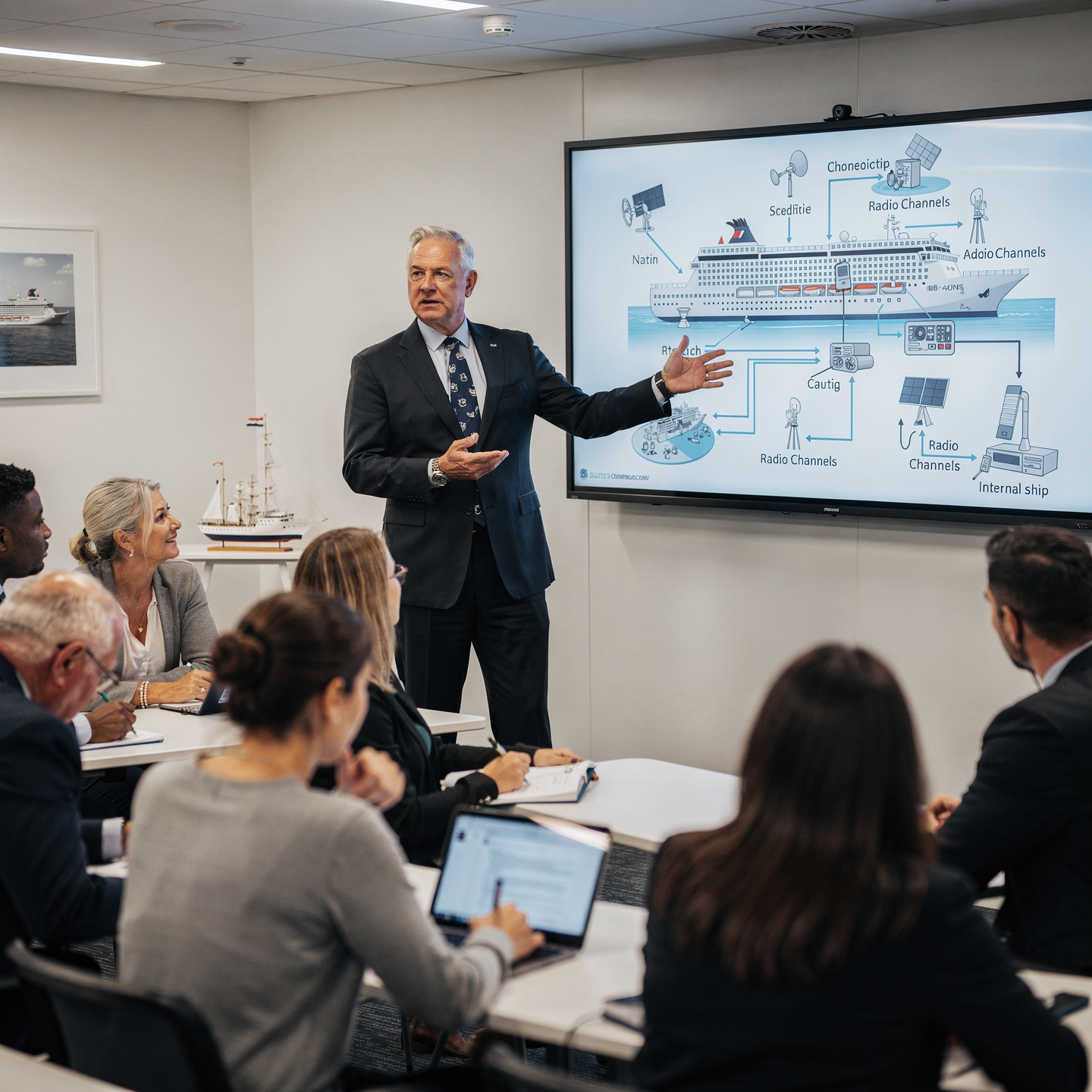
Prioritize clarity and conciseness in communication, using the appropriate channel (radio, telephone, visual signals) and standardized language (IMO, SMCP), reporting the situation, position, course, speed and assistance needs, following the guidelines of the ship’s emergency plan and the instructions of the competent authorities.

Use intercultural communication to provide exceptional customer service:
“Adapting communication to cultural differences, using clear, respectful language and validating mutual understanding to overcome linguistic and cultural barriers.”

Adapting language and communication style to the individual needs of each passenger:
Use active listening and adapt the speech according to the passenger’s age, culture, emotional state and level of understanding.
Collaborate with the team to ensure the accurate and timely transmission of relevant information:
“Maintain clear and proactive communication with the bridge and other stakeholders (internal and external) using the appropriate channels.”
Proficiently operate maritime communication systems to ensure safety and operational efficiency:
“Operate radio equipment (VHF/MF/HF/INMARSAT) and GMDSS, complying with protocols and regulations, in emergency and routine situations.”
Curriculum - Modules
- Comprehensive Maritime Incident Management: protocols, roles, and chain of command for coordinated response
- Operational Planning and Execution: briefing, routes, weather windows, and go/no-go criteria
- Rapid Risk Assessment: criticality matrix, scene control, and decision-making under pressure
- Operational Communication: VHF/GMDSS, standardized reports, and inter-agency liaison
- Tactical Mobility and Safe Boarding: RHIB maneuvers, approach, mooring, and recovery
- Equipment and Technologies: PPE, signaling, satellite tracking, and field data logging
- Immediate Care of the Affected: primary assessment, hypothermia, trauma, and stabilization for evacuation
- Adverse Environmental Conditions: swell, Visibility, flows, and operational mitigation
Simulation and training: critical scenarios, use of VR/AR, and exercises with performance metrics
Documentation and continuous improvement: lessons learned, indicators (MTTA/MTTR), and SOP updates
- Fundamentals of Premium Communication: Key elements, barriers, and facilitators.
- The Premium Client: Needs, expectations, and motivations.
- Effective Verbal Communication: Tone, language, and voice modulation.
- Nonverbal Communication: Body language, facial expressions, and gestures.
- Active and Empathetic Listening: Techniques for understanding and connecting with the client.
- Premium Greeting and Welcome Protocol: First impressions and courtesy.
- Information Management and Resolution of Premium Inquiries: Clarity, precision, and efficiency.
- Handling Complaints and Difficult Situations: Techniques for containment, apology, and solutions.
- Follow-up and Premium customer loyalty: Post-service actions and personalization.
Premium written communication: Emails, letters, and messages.
‘
- Introduction to the Cruise Industry: History, Evolution, and Current Trends
- The Cruise Customer: Profiles, Expectations, and Specific Needs
- Effective Communication: Verbal, Nonverbal, and Written Skills
- In-Person Customer Service: Welcome, Assistance, and Farewell Protocols
- Complaint and Claim Management: Conflict Resolution and Customer Loyalty Techniques
- Telephone and Online Customer Service: Response Protocols and Information Management
- Personal and Professional Image: Attire, Hygiene, and Behavior in the Workplace
- Social Protocol: Rules of Courtesy and Etiquette in Different Situations
- Onboard Protocol: Hierarchy, Roles, and Responsibilities of Staff
- Safety and Emergencies: Procedures for evacuation and basic first aid.
‘
- Introduction to customer service in the transport sector: specific characteristics of the onboard environment.
- Effective communication: active listening, empathy, and assertiveness with passengers and crew.
- Passenger typology: identifying needs and expectations according to profiles.
- Protocol and courtesy: service standards, greetings, farewells, and personalized service.
- Complaint and claim management: internal procedures, registration, and resolution.
- Common onboard incidents: delays, cancellations, baggage problems, etc.
- Psychological first aid: emotional support in stressful or crisis situations.
- Safety regulations and procedures: passenger information, evacuation, and emergencies.
- Hygiene and cleaning: onboard standards, prevention of health risks, and control of pests.
- Multilingual and intercultural communication: adapting to the cultural and linguistic diversity of passengers.
‘
- Introduction to Customer Service: Importance and Evolution.
- Effective Communication: Verbal, Non-verbal, and Written.
- Types of Customers: Identifying Needs and Expectations.
- Professional Protocol and Etiquette: Personal and Corporate Image.
- In-Person Customer Service: Reception, Greeting, and Assistance.
- Telephone Customer Service: Communication Techniques and Call Management.
- Online Customer Service: Email, Chat, and Social Media.
- Handling Complaints and Claims: Conflict Resolution and Customer Satisfaction.
- Customer Loyalty: Strategies and Loyalty Programs.
- Onboard Protocol: Rules of Courtesy and Safety for Passengers and Crew.
‘
- System Architecture and Components: Structural design, materials, and subsystems (mechanical, electrical, electronic, and fluid) with selection and assembly criteria for marine environments
- Fundamentals and Principles of Operation: Physical and engineering foundations (thermodynamics, fluid mechanics, electricity, control, and materials) that explain performance and operating limits
- Safety and Environmental (SHE): Risk analysis, PPE, LOTO, hazardous atmospheres, spill and waste management, and emergency response plans
- Applicable Regulations and Standards: IMO/ISO/IEC requirements and local regulations;
- Conformance criteria, certification, and best practices for operation and maintenance
- Inspection, testing, and diagnostics: Visual/dimensional inspection, functional testing, data analysis, and predictive techniques (vibration, thermography, fluid analysis) to identify root causes
- Preventive and predictive maintenance: Hourly/cycle/seasonal plans, lubrication, adjustments, calibrations, consumable replacement, post-service verification, and operational reliability
- Instrumentation, tools, and metrology: Measuring and testing equipment, diagnostic software, calibration and traceability; selection criteria, safe use, and storage
- Onboard integration and interfaces: Mechanical, electrical, fluid, and data compatibility; Sealing and watertightness, EMC/EMI, corrosion protection, and interoperability testing.
Quality, acceptance testing, and commissioning: process and materials control, FAT/SAT, bench and sea trials, go/no-go criteria, and evidence documentation.
Technical documentation and integrated practice: logs, checklists, reports, and a complete case study (safety ā diagnosis ā intervention ā verification ā report) applicable to any system.
Plan de estudio - Módulos
- Comprehensive Maritime Incident Management: protocols, roles, and chain of command for coordinated response
- Operational Planning and Execution: briefing, routes, weather windows, and go/no-go criteria
- Rapid Risk Assessment: criticality matrix, scene control, and decision-making under pressure
- Operational Communication: VHF/GMDSS, standardized reports, and inter-agency liaison
- Tactical Mobility and Safe Boarding: RHIB maneuvers, approach, mooring, and recovery
- Equipment and Technologies: PPE, signaling, satellite tracking, and field data logging
- Immediate Care of the Affected: primary assessment, hypothermia, trauma, and stabilization for evacuation
- Adverse Environmental Conditions: swell, Visibility, flows, and operational mitigation
Simulation and training: critical scenarios, use of VR/AR, and exercises with performance metrics
Documentation and continuous improvement: lessons learned, indicators (MTTA/MTTR), and SOP updates
- Fundamentals of Premium Communication: Key elements, barriers, and facilitators.
- The Premium Client: Needs, expectations, and motivations.
- Effective Verbal Communication: Tone, language, and voice modulation.
- Nonverbal Communication: Body language, facial expressions, and gestures.
- Active and Empathetic Listening: Techniques for understanding and connecting with the client.
- Premium Greeting and Welcome Protocol: First impressions and courtesy.
- Information Management and Resolution of Premium Inquiries: Clarity, precision, and efficiency.
- Handling Complaints and Difficult Situations: Techniques for containment, apology, and solutions.
- Follow-up and Premium customer loyalty: Post-service actions and personalization.
Premium written communication: Emails, letters, and messages.
‘
- Introduction to the Cruise Industry: History, Evolution, and Current Trends
- The Cruise Customer: Profiles, Expectations, and Specific Needs
- Effective Communication: Verbal, Nonverbal, and Written Skills
- In-Person Customer Service: Welcome, Assistance, and Farewell Protocols
- Complaint and Claim Management: Conflict Resolution and Customer Loyalty Techniques
- Telephone and Online Customer Service: Response Protocols and Information Management
- Personal and Professional Image: Attire, Hygiene, and Behavior in the Workplace
- Social Protocol: Rules of Courtesy and Etiquette in Different Situations
- Onboard Protocol: Hierarchy, Roles, and Responsibilities of Staff
- Safety and Emergencies: Procedures for evacuation and basic first aid.
‘
- Introduction to customer service in the transport sector: specific characteristics of the onboard environment.
- Effective communication: active listening, empathy, and assertiveness with passengers and crew.
- Passenger typology: identifying needs and expectations according to profiles.
- Protocol and courtesy: service standards, greetings, farewells, and personalized service.
- Complaint and claim management: internal procedures, registration, and resolution.
- Common onboard incidents: delays, cancellations, baggage problems, etc.
- Psychological first aid: emotional support in stressful or crisis situations.
- Safety regulations and procedures: passenger information, evacuation, and emergencies.
- Hygiene and cleaning: onboard standards, prevention of health risks, and control of pests.
- Multilingual and intercultural communication: adapting to the cultural and linguistic diversity of passengers.
‘
- Introduction to Customer Service: Importance and Evolution.
- Effective Communication: Verbal, Non-verbal, and Written.
- Types of Customers: Identifying Needs and Expectations.
- Professional Protocol and Etiquette: Personal and Corporate Image.
- In-Person Customer Service: Reception, Greeting, and Assistance.
- Telephone Customer Service: Communication Techniques and Call Management.
- Online Customer Service: Email, Chat, and Social Media.
- Handling Complaints and Claims: Conflict Resolution and Customer Satisfaction.
- Customer Loyalty: Strategies and Loyalty Programs.
- Onboard Protocol: Rules of Courtesy and Safety for Passengers and Crew.
‘
- System Architecture and Components: Structural design, materials, and subsystems (mechanical, electrical, electronic, and fluid) with selection and assembly criteria for marine environments
- Fundamentals and Principles of Operation: Physical and engineering foundations (thermodynamics, fluid mechanics, electricity, control, and materials) that explain performance and operating limits
- Safety and Environmental (SHE): Risk analysis, PPE, LOTO, hazardous atmospheres, spill and waste management, and emergency response plans
- Applicable Regulations and Standards: IMO/ISO/IEC requirements and local regulations;
- Conformance criteria, certification, and best practices for operation and maintenance
- Inspection, testing, and diagnostics: Visual/dimensional inspection, functional testing, data analysis, and predictive techniques (vibration, thermography, fluid analysis) to identify root causes
- Preventive and predictive maintenance: Hourly/cycle/seasonal plans, lubrication, adjustments, calibrations, consumable replacement, post-service verification, and operational reliability
- Instrumentation, tools, and metrology: Measuring and testing equipment, diagnostic software, calibration and traceability; selection criteria, safe use, and storage
- Onboard integration and interfaces: Mechanical, electrical, fluid, and data compatibility; Sealing and watertightness, EMC/EMI, corrosion protection, and interoperability testing.
Quality, acceptance testing, and commissioning: process and materials control, FAT/SAT, bench and sea trials, go/no-go criteria, and evidence documentation.
Technical documentation and integrated practice: logs, checklists, reports, and a complete case study (safety ā diagnosis ā intervention ā verification ā report) applicable to any system.
- Introduction to cruise tourism: history, typology, and trends.
- Roles and responsibilities of passenger service staff on board.
- Quality standards and passenger expectations on cruises.
- Effective communication: verbal and nonverbal skills, and active listening.
- General protocol in the cruise industry: hierarchy, greetings, and introductions.
- Handling complaints and claims: conflict resolution techniques and empathy.
- Serving passengers with special needs: functional, cultural, and linguistic diversity.
- Safety and emergencies: basic procedures and the role of passenger service staff.
- Knowledge of the cruise product: itineraries, Services, excursions, and onboard activities.
- Personal and professional image: attire, hygiene, and attitude in the workplace.
‘
- Introduction to the Customer Service Protocol: Concept, Importance, and Evolution.
- Effective Communication: Verbal and Non-Verbal Skills in Customer Service.
- Customer Typology: Identifying Different Profiles and Their Needs.
- Active Listening and Empathy Techniques in Customer Interaction.
- Handling Difficult Situations: Strategies for Addressing Angry or Frustrated Customers.
- Complaint Management Process: Reception, Registration, Analysis, and Resolution.
- Communication Tools and Channels: Telephone, Email, Chat, Social Media.
- Developing Effective and Personalized Responses to Complaints.
- Monitoring and Controlling Customer Satisfaction: Surveys, Indicators, and Analysis of Results.
- Continuous improvement of the customer service and complaint management protocol.
‘
- Fundamentals of Customer Service: service quality, expectations, and perception.
- Effective Communication: active listening, verbal and non-verbal language, empathy.
- Customer Typologies on Cruise Ships: profiles, needs, and motivations.
- Complaint and Claim Management: action protocol, conflict resolution, negotiation techniques.
- Special Situations: customers with special needs, medical emergencies, security.
- Customer Management Tools: CRM, booking systems, databases.
- Service Culture: hospitality, proactivity, and continuous improvement.
- Time Management and Organization: task prioritization, efficiency in customer service.
- Working in Teamwork: Interdepartmental collaboration, internal communication.
Cruise protocol and etiquette: Social norms, dress code, and behavior.
‘
- Introduction to the Customer Service Protocol: Definition, Importance, and Evolution.
- Effective Communication: Verbal and Non-Verbal Skills in Customer Service.
- Customer Typology: Identifying Different Profiles and Their Needs.
- Active Listening and Empathy Techniques: Understanding and Connecting with the Customer.
- Emotional Management: Managing Stress and Frustration in Difficult Situations.
- The Customer Service Cycle: From Welcome to Post-Sales Follow-up.
- Legal and Regulatory Framework: Consumer Rights and Data Protection.
- Receiving and Registering Complaints: Procedures and Tools.
- Complaint Analysis and Classification: Identifying Patterns and Root Causes.
- Conflict Resolution: Negotiation Techniques and Solution-Seeking.
‘
Career opportunities
- Customer Service Agent: resolving inquiries, managing reservations, and troubleshooting issues onboard and ashore.
- Public Relations Specialist: managing the cruise line’s image, organizing events, and media relations.
- Activities and Entertainment Coordinator: planning and promoting onboard events, and communicating with artists and suppliers.
- Social Media and Digital Content Manager: creating and managing content for digital platforms and interacting with the online community.
- Internal Communications Manager: managing communication among the crew, producing newsletters, and organizing internal events.
- Translator/Interpreter: facilitating communication between passengers and crew of different nationalities.
- Marketing and Sales Specialist: promoting cruise line services and designing marketing and sales strategies.
- Complaints and claims manager: conflict resolution and customer satisfaction management.
Advertising campaigns and management of relationships with travel agencies.
“`
Admission requirements

Academic/professional profile:
Degree/Bachelor's degree in Nautical Science/Maritime Transport, Naval/Marine Engineering, or a related field; or proven professional experience in bridge/operations.

Language proficiency:
Recommended functional maritime English (SMCP) for simulations and technical materials.

5. Induction
Updated resume, copy of degree or seaman's book, ID card/passport, letter of motivation.

Technical requirements (for online):
Equipment with camera/microphone, stable connection, ā„ 24ā monitor recommended for ECDIS/Radar-ARPA.
Admission process and dates

1. Online
application
(form + documents).

2. Academic review and interview
(profile/objectives/schedule compatibility).

3. Admission decision
(+ scholarship proposal if applicable).

4. Reservation of place
(deposit) and registration.

5. Induction
(access to campus, calendars, simulator guides).
Scholarships and grants
- Effective Communication: Master interpersonal communication techniques to interact with passengers from diverse cultures and manage challenging situations professionally.
- Exceptional Customer Service: Learn to exceed passenger expectations by providing personalized and memorable service that fosters loyalty and positive word-of-mouth.
- Conflict Resolution: Acquire skills to identify, address, and resolve conflicts effectively, remaining calm and ensuring customer satisfaction.
- Nonverbal Communication: Discover the power of body language and nonverbal communication to establish genuine connections and inspire confidence in passengers.
- Emergency Communication: Be prepared to communicate Communicate clearly and concisely in emergency situations, prioritizing the safety and well-being of passengers. Boost your career in the cruise industry with communication skills that make a difference.
Testimonials
During my training in Cruise Services Communication, I developed crucial customer service skills in a multicultural environment. I applied these skills during an onboard crisis simulation, where I successfully mediated a conflict between passengers of different nationalities, achieving a peaceful and satisfactory resolution for everyone. This success demonstrated the effectiveness of the training and my ability to handle complex situations professionally, reaffirming my commitment to customer service in the cruise industry.
I mastered intercultural communication strategies for the tourism sector, successfully designing and presenting a cultural tourism project that received the highest rating, standing out for its inclusive and sustainable approach, and its potential to attract international tourism to the region.
I mastered intercultural communication strategies, successfully resolving a conflict between an Italian guest and a Filipino staff member by mediating with empathy and clarity, resulting in a positive experience for both parties and praise from my supervisor for my handling of the situation.
“Thanks to the Cruise Service Communication course, I was able to advance from cabin attendant to supervisor in less than a year. The intercultural communication and customer service skills I learned allowed me to excel and provide exceptional service, even under high pressure. Now I feel much more confident and capable of leading teams and delivering a memorable experience for passengers.”

Frequently asked questions
The English language.
Yes. The itinerary includes ECDIS/Radar-ARPA/BRM with harbor, ocean, fog, storm, and SAR scenarios.
Online with live sessions; hybrid option for simulator/practical placements through agreements.
Overcoming linguistic and cultural barriers to ensure that important information about safety, entertainment and logistics is understood by all passengers and crew.
Recommended functional SMCP. We offer support materials for standard phraseology.
Yes, with a relevant degree or experience in maritime/port operations. The admissions interview will confirm suitability.
Optional (3ā6 months) through Companies & Collaborations and the Alumni Network.
Simulator practice (rubrics), defeat plans, SOPs, checklists, micro-tests and applied TFM.
A degree from Navalis Magna University + operational portfolio (tracks, SOPs, reports and KPIs) useful for audits and employment.
- Introduction to the Customer Service Protocol: Definition, Importance, and Evolution.
- Effective Communication: Verbal and Non-Verbal Skills in Customer Service.
- Customer Typology: Identifying Different Profiles and Their Needs.
- Active Listening and Empathy Techniques: Understanding and Connecting with the Customer.
- Emotional Management: Managing Stress and Frustration in Difficult Situations.
- The Customer Service Cycle: From Welcome to Post-Sales Follow-up.
- Legal and Regulatory Framework: Consumer Rights and Data Protection.
- Receiving and Registering Complaints: Procedures and Tools.
- Complaint Analysis and Classification: Identifying Patterns and Root Causes.
- Conflict Resolution: Negotiation Techniques and Solution-Seeking.
‘
Request information
- Complete the Application Form
- Attach your CV/Qualifications (if you have them to hand).
- Indicate your preferred cohort (January/May/September) and whether you want the hybrid option with simulator sessions.
Teachers
Eng. TomƔs Riera
Full Professor
Eng. TomƔs Riera
Full Professor
Eng. SofĆa Marquina
Full Professor
Eng. SofĆa Marquina
Full Professor
Eng. Javier BaƱuls
Full Professor
Eng. Javier BaƱuls
Full Professor
Dr. Nuria Llobregat
Full Professor
Dr. Nuria Llobregat
Full Professor
Dr. Pau Ferrer
Full Professor
Dr. Pau Ferrer
Full Professor
Cap. Javier Abaroa (MCA)
Full Professor
Cap. Javier Abaroa (MCA)
Full Professor