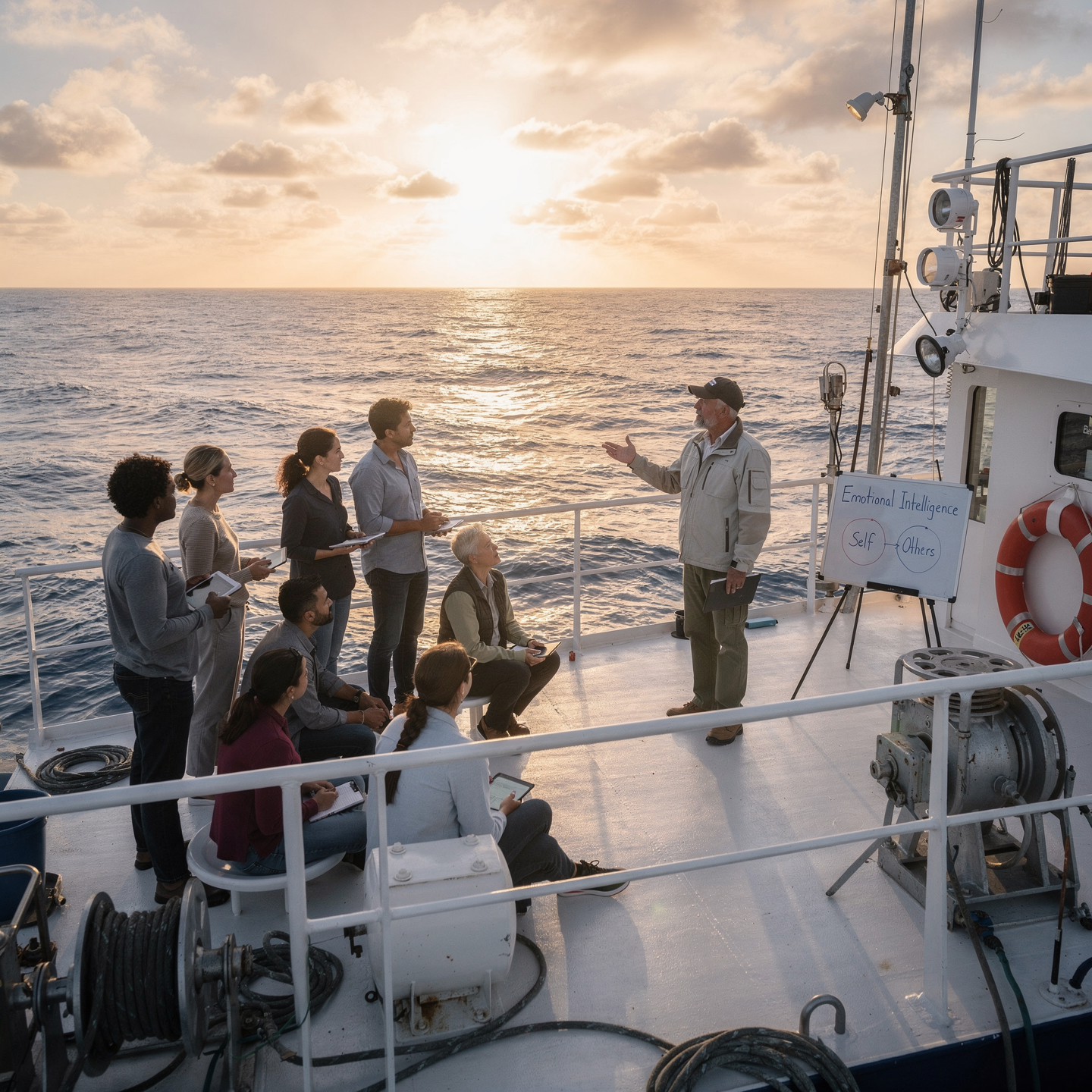
Emotional intelligence course at sea

Why this course?

The Emotional Intelligence at Sea Course

This course is designed to enhance your interpersonal and self-management skills in the demanding maritime environment. Learn to manage stress, effective communication, and decision-making under pressure, improving team dynamics and safety on board. This program addresses identifying and managing emotions, developing empathy, and applying conflict resolution techniques, adapted to the unique context of life at sea.

Differentiating Advantages

  • Practical Strategies: for managing stress and anxiety in critical situations.
  • Assertive Communication: improves interpersonal relationships and team coordination.
  • Emotional Leadership: boosts crew motivation and commitment.
  • Resilience: strengthens your ability to adapt to the challenges of the maritime environment.
  • Real-world Application: exercises and simulations based on real maritime scenarios.
Inteligencia

Emotional intelligence course at sea

Availability: 1 in stock

Who is it aimed at?

  • Bridge officers and crew seeking to improve communication, stress management, and decision-making in critical situations.
  • Fleet superintendents and managers interested in reducing conflict, fostering teamwork, and optimizing onboard performance.
  • Maritime instructors and trainers wishing to incorporate emotional intelligence tools into their training programs.
  • HR and recruitment personnel in the maritime sector seeking to identify and develop soft skills in their candidates.
  • Nautical and maritime transport students aspiring to lead with empathy and build strong professional relationships in the maritime environment.

Professional Adaptability
 Training adaptable to the Maritime life: accessible online content, individual practical exercises and discussion forums to share experiences.

Inteligencia

Objectives and competencies

Anticipating and modulating reactions to marine adversity:

Analyze the situation, prioritize actions, and communicate effectively (internal/external).

Navigating one's own and others' emotions to optimize communication and teamwork in challenging maritime environments:

“Developing emotional resilience to cope with stress, fatigue, and isolation, fostering empathy and active listening among the crew to build an environment of trust and mutual support.”

Cultivating emotional resilience to overcome challenges and remain calm in the face of the ocean's uncertainty:

Accepting vulnerability as part of the learning process, reframing failures as opportunities for growth, and developing personalized coping strategies to maintain equanimity under pressure.

Promoting emotional self-awareness to make informed and strategic decisions in critical situations at sea:

“Identify and manage your own and the team’s emotions (stress, fatigue, fear) for effective communication and optimal judgment under pressure.”

Transforming fear and anxiety into productive energy to deal with maritime emergencies:

“Develop mental and physical resilience through realistic simulations and stress management techniques, optimizing decision-making under pressure in critical scenarios.”

Developing empathy and interpersonal understanding to strengthen relationships and prevent conflicts within the crew:

“Practice active listening, assertive communication, and emotional intelligence to understand diverse perspectives and foster an environment of respect and collaboration.”

Curriculum - Modules

  1. Comprehensive Maritime Incident Management: protocols, roles, and chain of command for coordinated response
  2. Operational Planning and Execution: briefing, routes, weather windows, and go/no-go criteria
  3. Rapid Risk Assessment: criticality matrix, scene control, and decision-making under pressure
  4. Operational Communication: VHF/GMDSS, standardized reports, and inter-agency liaison
  5. Tactical Mobility and Safe Boarding: RHIB maneuvers, approach, mooring, and recovery
  6. Equipment and Technologies: PPE, signaling, satellite tracking, and field data logging
  7. Immediate Care of the Affected: primary assessment, hypothermia, trauma, and stabilization for evacuation
  8. Adverse Environmental Conditions: swell, Visibility, flows, and operational mitigation

    Simulation and training: critical scenarios, use of VR/AR, and exercises with performance metrics

    Documentation and continuous improvement: lessons learned, indicators (MTTA/MTTR), and SOP updates

  1. Introduction to Self-Awareness: Definition, importance, and benefits.
  2. Identifying Emotions: Recognizing and labeling one’s own and others’ emotions.
  3. Personal Values: Discovering and aligning with core values.
  4. Strengths and Weaknesses: Personal SWOT analysis and areas for improvement.
  5. Cognitive and Emotional Empathy: Differences and applications in leadership.
  6. Active Listening: Techniques and practice for effective communication.
  7. Situational Leadership: The four leadership styles (Directing, Coaching, Supporting, Delegating).
  8. Team Maturity Assessment: Evaluating the readiness and capabilities of team members.
  9. Adaptation of the Leadership Style: Strategies for positively influencing different situations.

    Developing a Personal Action Plan: Integrating self-awareness, empathy, and situational leadership.

  1. Fundamentals of Emotional Awareness: self-knowledge, self-regulation, motivation, empathy, and social skills.
  2. Identifying and Managing Emotions in Stressful Situations: anxiety, frustration, fear, and how they affect decision-making.
  3. Verbal and Nonverbal Communication: active listening, body language, tone of voice, and their impact on interaction.
  4. Assertive Communication Skills: clear and respectful expression of needs, opinions, and boundaries.
  5. Conflict Resolution: identifying causes, negotiation techniques, and finding collaborative solutions.
  6. Empathy and Intercultural Understanding: adapting to different communication styles and cultures in a diverse environment.
  7. Effective Communication in Emergency Situations: clarity, conciseness, and coordination in critical moments.
  8. Constructive Feedback: How to give and receive feedback to improve performance and strengthen relationships.
  9. Emotional Intelligence in Leadership: How to inspire, motivate, and guide others through emotional understanding.
  10. Tools and Techniques for Developing Emotional Awareness and Effective Communication: Practical exercises and role-playing.

  1. Stress Fundamentals: Definition, types, causes, and consequences.
  2. Identifying Your Own Stress: Self-assessment and recognition of physical and emotional symptoms.
  3. Stress Management Techniques: Mindfulness, conscious breathing, muscle relaxation, and visualization.
  4. Assertive Communication: Principles, techniques, and skills for expressing needs and opinions effectively.
  5. Active Listening and Empathy: Understanding others’ perspectives and responding appropriately.
  6. Conflict Management: Strategies for resolving disagreements constructively and collaboratively.
  7. Situational Leadership: Adapting leadership style to team needs and circumstances.
  8. Team Needs Assessment: Evaluation of skills, motivation, and Team members’ disposition.
  9. Effective delegation: Clear and motivating assignment of tasks and responsibilities.

    Motivation and recognition: Strategies to foster team commitment and performance.

  1. Introduction to Emotional Awareness: Definition, Components, and its Importance in Navigation.
  2. Identifying and Expressing Emotions: Recognizing One’s Own Emotions and Those of Others in Stressful Situations.
  3. Stress in Navigation: Triggers, Physical and Psychological Symptoms, and its Impact on Performance.
  4. Relaxation and Breathing Techniques: Applying Methods to Reduce Anxiety and Maintain Calm in Critical Situations.
  5. Mindfulness and Full Attention: Developing the Ability to Be Present and Aware in the Present Moment to Improve Decision-Making.
  6. Assertive Communication: Skills to Express Needs and Opinions Clearly and Respectfully, Even Under Pressure.
  7. Time Management and Task Prioritization: Strategies to Optimize Efficiency and Reduce Workload-Related Stress.
  8. Resilience and Coping Adaptive: Developing the capacity to recover from adverse situations and learn from experiences.

    Social support and teamwork: The importance of collaboration and establishing supportive relationships to reduce stress and improve well-being.

    Self-care and personal well-being: Strategies for maintaining a healthy work-life balance, including rest, nutrition, and exercise.

  1. System Architecture and Components: Structural design, materials, and subsystems (mechanical, electrical, electronic, and fluid) with selection and assembly criteria for marine environments
  2. Fundamentals and Principles of Operation: Physical and engineering foundations (thermodynamics, fluid mechanics, electricity, control, and materials) that explain performance and operating limits
  3. Safety and Environmental (SHE): Risk analysis, PPE, LOTO, hazardous atmospheres, spill and waste management, and emergency response plans
  4. Applicable Regulations and Standards: IMO/ISO/IEC requirements and local regulations;
  5. Conformance criteria, certification, and best practices for operation and maintenance
  6. Inspection, testing, and diagnostics: Visual/dimensional inspection, functional testing, data analysis, and predictive techniques (vibration, thermography, fluid analysis) to identify root causes
  7. Preventive and predictive maintenance: Hourly/cycle/seasonal plans, lubrication, adjustments, calibrations, consumable replacement, post-service verification, and operational reliability
  8. Instrumentation, tools, and metrology: Measuring and testing equipment, diagnostic software, calibration and traceability; selection criteria, safe use, and storage
  9. Onboard integration and interfaces: Mechanical, electrical, fluid, and data compatibility; Sealing and watertightness, EMC/EMI, corrosion protection, and interoperability testing.

    Quality, acceptance testing, and commissioning: process and materials control, FAT/SAT, bench and sea trials, go/no-go criteria, and evidence documentation.

    Technical documentation and integrated practice: logs, checklists, reports, and a complete case study (safety → diagnosis → intervention → verification → report) applicable to any system.

Plan de estudio - Módulos

  1. Comprehensive Maritime Incident Management: protocols, roles, and chain of command for coordinated response
  2. Operational Planning and Execution: briefing, routes, weather windows, and go/no-go criteria
  3. Rapid Risk Assessment: criticality matrix, scene control, and decision-making under pressure
  4. Operational Communication: VHF/GMDSS, standardized reports, and inter-agency liaison
  5. Tactical Mobility and Safe Boarding: RHIB maneuvers, approach, mooring, and recovery
  6. Equipment and Technologies: PPE, signaling, satellite tracking, and field data logging
  7. Immediate Care of the Affected: primary assessment, hypothermia, trauma, and stabilization for evacuation
  8. Adverse Environmental Conditions: swell, Visibility, flows, and operational mitigation

    Simulation and training: critical scenarios, use of VR/AR, and exercises with performance metrics

    Documentation and continuous improvement: lessons learned, indicators (MTTA/MTTR), and SOP updates

  1. Introduction to Self-Awareness: Definition, importance, and benefits.
  2. Identifying Emotions: Recognizing and labeling one’s own and others’ emotions.
  3. Personal Values: Discovering and aligning with core values.
  4. Strengths and Weaknesses: Personal SWOT analysis and areas for improvement.
  5. Cognitive and Emotional Empathy: Differences and applications in leadership.
  6. Active Listening: Techniques and practice for effective communication.
  7. Situational Leadership: The four leadership styles (Directing, Coaching, Supporting, Delegating).
  8. Team Maturity Assessment: Evaluating the readiness and capabilities of team members.
  9. Adaptation of the Leadership Style: Strategies for positively influencing different situations.

    Developing a Personal Action Plan: Integrating self-awareness, empathy, and situational leadership.

  1. Fundamentals of Emotional Awareness: self-knowledge, self-regulation, motivation, empathy, and social skills.
  2. Identifying and Managing Emotions in Stressful Situations: anxiety, frustration, fear, and how they affect decision-making.
  3. Verbal and Nonverbal Communication: active listening, body language, tone of voice, and their impact on interaction.
  4. Assertive Communication Skills: clear and respectful expression of needs, opinions, and boundaries.
  5. Conflict Resolution: identifying causes, negotiation techniques, and finding collaborative solutions.
  6. Empathy and Intercultural Understanding: adapting to different communication styles and cultures in a diverse environment.
  7. Effective Communication in Emergency Situations: clarity, conciseness, and coordination in critical moments.
  8. Constructive Feedback: How to give and receive feedback to improve performance and strengthen relationships.
  9. Emotional Intelligence in Leadership: How to inspire, motivate, and guide others through emotional understanding.
  10. Tools and Techniques for Developing Emotional Awareness and Effective Communication: Practical exercises and role-playing.

  1. Stress Fundamentals: Definition, types, causes, and consequences.
  2. Identifying Your Own Stress: Self-assessment and recognition of physical and emotional symptoms.
  3. Stress Management Techniques: Mindfulness, conscious breathing, muscle relaxation, and visualization.
  4. Assertive Communication: Principles, techniques, and skills for expressing needs and opinions effectively.
  5. Active Listening and Empathy: Understanding others’ perspectives and responding appropriately.
  6. Conflict Management: Strategies for resolving disagreements constructively and collaboratively.
  7. Situational Leadership: Adapting leadership style to team needs and circumstances.
  8. Team Needs Assessment: Evaluation of skills, motivation, and Team members’ disposition.
  9. Effective delegation: Clear and motivating assignment of tasks and responsibilities.

    Motivation and recognition: Strategies to foster team commitment and performance.

  1. Introduction to Emotional Awareness: Definition, Components, and its Importance in Navigation.
  2. Identifying and Expressing Emotions: Recognizing One’s Own Emotions and Those of Others in Stressful Situations.
  3. Stress in Navigation: Triggers, Physical and Psychological Symptoms, and its Impact on Performance.
  4. Relaxation and Breathing Techniques: Applying Methods to Reduce Anxiety and Maintain Calm in Critical Situations.
  5. Mindfulness and Full Attention: Developing the Ability to Be Present and Aware in the Present Moment to Improve Decision-Making.
  6. Assertive Communication: Skills to Express Needs and Opinions Clearly and Respectfully, Even Under Pressure.
  7. Time Management and Task Prioritization: Strategies to Optimize Efficiency and Reduce Workload-Related Stress.
  8. Resilience and Coping Adaptive: Developing the capacity to recover from adverse situations and learn from experiences.

    Social support and teamwork: The importance of collaboration and establishing supportive relationships to reduce stress and improve well-being.

    Self-care and personal well-being: Strategies for maintaining a healthy work-life balance, including rest, nutrition, and exercise.

  1. System Architecture and Components: Structural design, materials, and subsystems (mechanical, electrical, electronic, and fluid) with selection and assembly criteria for marine environments
  2. Fundamentals and Principles of Operation: Physical and engineering foundations (thermodynamics, fluid mechanics, electricity, control, and materials) that explain performance and operating limits
  3. Safety and Environmental (SHE): Risk analysis, PPE, LOTO, hazardous atmospheres, spill and waste management, and emergency response plans
  4. Applicable Regulations and Standards: IMO/ISO/IEC requirements and local regulations;
  5. Conformance criteria, certification, and best practices for operation and maintenance
  6. Inspection, testing, and diagnostics: Visual/dimensional inspection, functional testing, data analysis, and predictive techniques (vibration, thermography, fluid analysis) to identify root causes
  7. Preventive and predictive maintenance: Hourly/cycle/seasonal plans, lubrication, adjustments, calibrations, consumable replacement, post-service verification, and operational reliability
  8. Instrumentation, tools, and metrology: Measuring and testing equipment, diagnostic software, calibration and traceability; selection criteria, safe use, and storage
  9. Onboard integration and interfaces: Mechanical, electrical, fluid, and data compatibility; Sealing and watertightness, EMC/EMI, corrosion protection, and interoperability testing.

    Quality, acceptance testing, and commissioning: process and materials control, FAT/SAT, bench and sea trials, go/no-go criteria, and evidence documentation.

    Technical documentation and integrated practice: logs, checklists, reports, and a complete case study (safety → diagnosis → intervention → verification → report) applicable to any system.

  1. Introduction to Conscious Leadership: Self-Awareness, Values, and Purpose.
  2. Emotional Intelligence: Recognizing and Managing One’s Own and Others’ Emotions.
  3. Assertive Communication: Principles, Active Listening Techniques, and Clear Expression.
  4. Stress Management in High-Pressure Situations: Identifying Stressors and Coping Techniques.
  5. Mindfulness and Resilience: Tools for Staying Calm and Recovering from Adversity.
  6. Empathy and Building Strong Interpersonal Relationships in the Maritime Environment.
  7. Conflict Resolution and Effective Decision-Making under Stress.
  8. Situational Leadership: Adapting Leadership Styles to Different Contexts and Teams.
  9. Prevention of Burnout and promoting crew well-being.
  10. Ethics and responsibility in leadership at sea.

  1. Introduction to Emotional Awareness in the Maritime Environment: Importance and Benefits.
  2. Identifying and Recognizing Emotions: Our Own and Others’.
  3. Stress in the Maritime Environment: Triggers and Consequences.
  4. Emotional Self-Regulation Techniques: Mindfulness, Breathing, and Relaxation.
  5. Assertive Communication and Active Listening: Keys to a Positive Work Environment.
  6. Conflict Management: Strategies for Effective Problem Resolution.
  7. Resilience and Adaptation: Strengthening the Capacity to Cope with Adversity.
  8. Emotional Intelligence in Decision-Making: Ethical and Practical Considerations.
  9. Emotional Support and Well-being on Board: Creating of a safe and healthy environment.
  10. Prevention of burnout and promotion of mental health in maritime life.

  1. Introduction to Emotional Intelligence: Self-awareness, self-regulation, motivation, empathy, and social skills.
  2. Emotional Awareness in Sailing: Identifying and managing one’s own and others’ emotions in sailing situations.
  3. Emotional Self-Regulation: Techniques for managing stress, frustration, and anxiety in the maritime environment.
  4. Empathy and Effective Communication: Active listening, assertiveness, and conflict resolution within the crew.
  5. Emotional Leadership in Sailing: Inspiring, motivating, and guiding the crew through emotional intelligence.
  6. Decision-Making Under Pressure: Emotional control and objective analysis in emergency situations.
  7. Team Management: Fostering cohesion, trust, and mutual respect among team members crew.
  8. Emotional resilience: Adapting to and overcoming challenges and adversities at sea.
  9. Nonverbal communication: Interpreting and using body language in interactions with the crew.
  10. Ethics and emotional responsibility in sailing: Promoting a safe, respectful, and collaborative work environment.

  1. Introduction to Emotional Awareness: Definition, components, and its impact on the environment.
  2. Self-Awareness: Identifying and understanding one’s own emotions, values, and strengths.
  3. Self-Regulation: Managing disruptive emotions and adapting to challenging situations.
  4. Empathy: Recognizing and understanding the emotions of others, fostering connection and collaboration.
  5. Social Skills: Effective communication, conflict resolution, and building strong relationships.
  6. Assertive Communication: Clear and respectful expression of needs and opinions.
  7. Active Listening: Techniques for thoroughly understanding the messages and perspectives of others.
  8. Situational Leadership: Adapting leadership style to the needs and maturity of the group. team.
  9. Leadership Models: Exploring different approaches and their application in diverse contexts.
  10. Developing High-Performance Teams: Fostering trust, collaboration, and shared responsibility.

Career opportunities

  • Merchant Marine Officer: Onboard team management, conflict resolution, and improvement of the work environment.
  • Master/Captain: Effective leadership, emergency management, and assertive decision-making under pressure.
  • Cruise Ship Personnel: Improved customer service, complaint management, and interpersonal problem resolution.
  • Fishing Personnel: Optimized communication within work teams and stress management in high-pressure situations.
  • Offshore Platform Personnel: Improved workplace safety, management of multidisciplinary teams, and conflict prevention.
  • Maritime Trainers: Development of communication, empathy, and motivation skills in the training of future maritime professionals.
  • Human Resources Managers in Shipping Companies: Improvements in personnel selection, talent management, and labor dispute resolution.

    Marine Accident Investigators: Analysis of human factors, communication, and decision-making in critical situations.

    “`

Admission requirements

Academic/professional profile:

Degree/Bachelor's degree in Nautical Science/Maritime Transport, Naval/Marine Engineering, or a related field; or proven professional experience in bridge/operations.

Language proficiency:

Recommended functional maritime English (SMCP) for simulations and technical materials.

5. Induction

Updated resume, copy of degree or seaman's book, ID card/passport, letter of motivation.

Technical requirements (for online):

Equipment with camera/microphone, stable connection, ≥ 24” monitor recommended for ECDIS/Radar-ARPA.

Admission process and dates

1. Online
application

(form + documents).

2. Academic review and interview

(profile/objectives/schedule compatibility).

3. Admission decision

(+ scholarship proposal if applicable).

4. Reservation of place

(deposit) and registration.

5. Induction

(access to campus, calendars, simulator guides).

Scholarships and grants

  • Emotional Mastery: Learn to manage your emotions and those of your crew in high-pressure situations.
  • Effective Communication: Develop assertive communication skills to avoid conflicts and foster a positive work environment on board.
  • Conscious Leadership: Enhance your leadership through empathy and understanding, inspiring trust and motivation in your team.
  • Resilience and Adaptation: Strengthen your ability to adapt to the challenges of the maritime environment and recover quickly from adverse situations.
  • Holistic Well-being: Prioritize your emotional well-being and that of your team, promoting a healthy work-life balance at sea.
Transform your interactions and improve your professional performance with a solid foundation in Emotional Intelligence.

Testimonials

Frequently asked questions

It improves the ability to manage stress, uncertainty, and interpersonal relationships in high-pressure and isolated situations, which is crucial for safety, performance, and well-being on board.

Yes. The itinerary includes ECDIS/Radar-ARPA/BRM with harbor, ocean, fog, storm, and SAR scenarios.

Online with live sessions; hybrid option for simulator/practical placements through agreements.

By recognizing and managing one’s own emotions and those of others in the crew, resilience, effective communication, and mutual support can be fostered to cope with the stress of isolation, uncertainty, and the difficulties inherent in the maritime environment.

Recommended functional SMCP. We offer support materials for standard phraseology.

Yes, with a relevant degree or experience in maritime/port operations. The admissions interview will confirm suitability.

Optional (3–6 months) through Companies & Collaborations and the Alumni Network.

Simulator practice (rubrics), defeat plans, SOPs, checklists, micro-tests and applied TFM.

A degree from Navalis Magna University + operational portfolio (tracks, SOPs, reports and KPIs) useful for audits and employment.

  1. Introduction to Emotional Awareness: Definition, components, and its impact on the environment.
  2. Self-Awareness: Identifying and understanding one’s own emotions, values, and strengths.
  3. Self-Regulation: Managing disruptive emotions and adapting to challenging situations.
  4. Empathy: Recognizing and understanding the emotions of others, fostering connection and collaboration.
  5. Social Skills: Effective communication, conflict resolution, and building strong relationships.
  6. Assertive Communication: Clear and respectful expression of needs and opinions.
  7. Active Listening: Techniques for thoroughly understanding the messages and perspectives of others.
  8. Situational Leadership: Adapting leadership style to the needs and maturity of the group. team.
  9. Leadership Models: Exploring different approaches and their application in diverse contexts.
  10. Developing High-Performance Teams: Fostering trust, collaboration, and shared responsibility.

Request information

  1. Complete the Application Form
  2. Attach your CV/Qualifications (if you have them to hand).
  3. Indicate your preferred cohort (January/May/September) and whether you want the hybrid option with simulator sessions.
An academic advisor will contact you within 24–48 hours to guide you through the admission process, scholarships, and compatibility with your professional schedule. Translated with DeepL.com (free version)
Please enable JavaScript in your browser to complete this form.
Click or drag a file to this area to upload.

Teachers

0
    0
    Tu carrito
    Tu carrito esta vacíoRegresar a la tienda
    Scroll to Top


