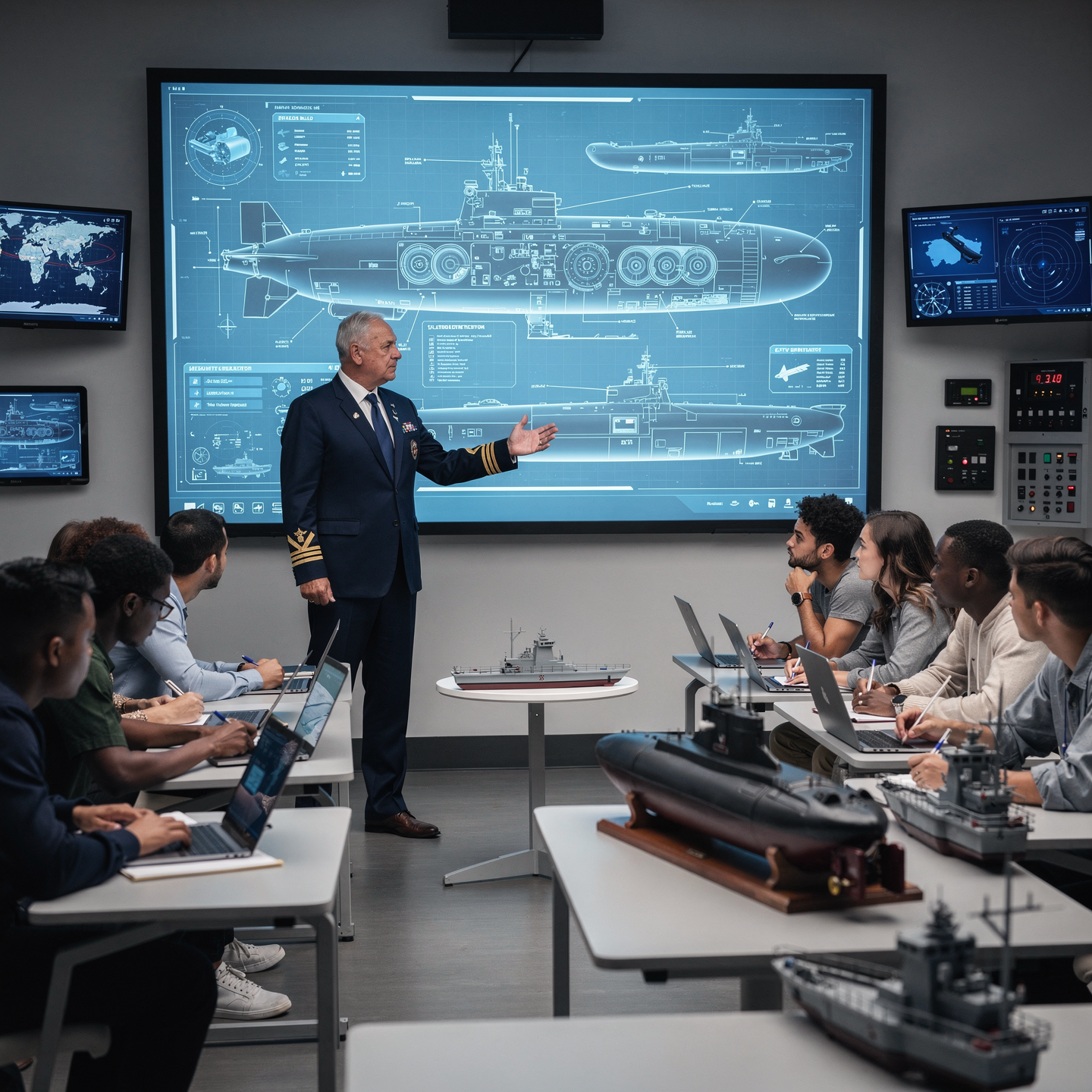
Master’s Degree in Submarine Defense and Naval Warfare Technologies
Why this master’s programme?
The Master’s Degree in Submarine Defense and Naval Warfare Technologies
Offers comprehensive training in the design, operation, and maintenance of advanced submarine systems. Acquire specialized knowledge in sonar, underwater communications, naval propulsion, and submarine weaponry. Master anti-submarine warfare (ASW) strategies and cutting-edge technologies for the detection, classification, and neutralization of submarine threats. This program prepares you to lead innovation and development projects in the naval and defense industry.
Differentiating Advantages
- Advanced Simulations: Realistic tactical scenarios for decision-making in complex underwater environments.
- Specialized Laboratories: Hands-on experimentation with state-of-the-art equipment and systems.
- Industry Collaboration: Joint projects with leading companies in the naval and defense sector.
- Multidisciplinary Approach: Integration of knowledge from engineering, physics, electronics, and materials science.
- Expert Faculty: Renowned professionals in the field of submarine defense and naval technology.
- Modality: Online
- Level: Masters
- Hours: 1600 H
- Start date:
Availability: 1 in stock
Who is it aimed at?
- Navy and Naval Forces Officers seeking to specialize in submarine defense strategies, advanced sonar systems, and countermeasures.
- Naval Engineers and Technicians wishing to deepen their knowledge of the design, maintenance, and operation of submarines and unmanned underwater vehicles (UUVs).
- Maritime Intelligence and Security Analysts requiring comprehensive knowledge of submarine threats and modern naval warfare.
- Defense Sector and Technology Companies interested in developing innovative solutions for the detection, tracking, and neutralization of submarines.
- Graduates in Engineering, Physics, Mathematics, or Naval Sciences seeking a boost in their Career with specialized training in the underwater field.
Flexibility and applicability
Adapted to working professionals: flexible online format, real-world case studies, and personalized mentoring with industry experts.
Objectives and skills

Managing advanced submarine combat systems:
“Operate detection systems (active/passive sonar, interceptors) autonomously to classify threats and optimize range.”

Develop and implement defense strategies against underwater threats:
Actively employ sensors (sonar, radar, visual) and countermeasures, interpreting information to discriminate real threats from false alarms and responding proportionately.

Leading teams in naval warfare operations with high efficiency:
“Implement flexible command and control doctrine, fostering subordinate initiative within mission limits and adapting to dynamic scenarios with minimal delay in decision-making.”

Designing and evaluating innovative underwater platforms:
“Implement materials and designs resistant to corrosion and extreme pressures, considering energy efficiency and environmental impact.”

Assessing and mitigating risks in submarine warfare environments:
“Identify asymmetric threats, prioritize countermeasures, and adapt tactics to available intelligence.”

Mastering the application of acoustics in anti-submarine warfare:
“Interpret active/passive sonar data, discriminate sources, and accurately estimate the range/heading of submerged contacts.”
Study plan – Modules
- Fundamentals of Submarine Warfare: Historical Evolution, Contemporary Doctrines, and Future Projections
- Architecture and Capabilities of Modern Submarines: Classes, Stealth Technologies, and Advanced Propulsion Systems
- Acoustic and Passive Sensors: Hydrophones, Signal Processing, and Target Detection and Classification Techniques
- Active Sonar and Evasion Tactics: Modes of Operation, Countermeasures, and Adaptability in Complex Oceanic Environments
- Electronic Warfare in the Submarine Environment: Jamming, Interference, and Decoy Warfare to Confuse Enemy Systems
- Tactical Employment of Advanced Weapons: Cruise Missiles, Smart Torpedoes, and Naval Mines
- Planning and Execution of Submarine Patrols: Routes, Exclusion Zones, Prohibited Areas, and the Use of Maritime Intelligence
- Integrated Naval Defense Operations: Interoperability Between Submarines, Surface forces and naval aviation in multidomain scenarios
Encrypted communications and secure underwater networks: protocols, limitations, and contingencies in hostile environments
Advanced simulation and post-mission analysis: tactics evaluation, strategy redesign, and training in immersive virtual systems
- Fundamentals of Submarine Weapon Systems: Classification, Physical and Operational Principles
- Propulsion and Stealth Technologies: Reduction of Acoustic, Thermal, and Electromagnetic Signatures
- Design and Operation of Modern Torpedoes: Active, Passive, and Hybrid Guidance, Attack Modes, and Countermeasures
- Vertical Launching Systems (VLS) and Horizontal Launching Systems: Launchers, Capsules, and Strategic Compatibility
- Advanced Acoustic Sensor Networks: Hydrophones, Active and Passive Sonars, Integration into Combat Systems
- Electronic Countermeasures in Submarine Warfare: Jamming, Saturation, and Electronic Deception Techniques
- Electronic Counterintelligence: Detection, Analysis, and Neutralization of Threats in Hostile Aquatic Environments
- Integration of C4ISR Systems into Submarines:
- Encrypted communications, data link, and electronic warfare
- Tactical scenario analysis: simulation of underwater engagements and real-time information management
- Safety and emergency protocols for the use of underwater weapons: maintenance, testing, and safe handling
- Innovations in naval weaponry: supercavitating torpedoes, underwater drones, and non-kinetic weapons
- Impact of electroacoustics on submarine defense: wave propagation, remote sensing, and natural interference
- Defense strategies against asymmetric threats and autonomous underwater drones
- International regulations applicable to submarine warfare and the use of electronic systems in armed conflicts
- Study of historical cases and modern doctrines for the employment of underwater weapon systems in the current decade
- Fundamentals of Modern Submarine Warfare: Historical Evolution, Current Doctrines, and Future Trends in the Underwater Theater
- Advanced Tactical Analysis: Scenario Modeling and Simulation, Decision-Making Under Uncertainty, and the Use of Artificial Intelligence in Submarine Operations
- Operations in Complex Marine Environments: Adaptation to Deep Oceans, Continental Shelves, and Littoral Zones with Multiple Threats
- Acoustic and Electromagnetic Countermeasures: Detection, Classification, and Concealment Against Active and Passive Sonar Systems, and Naval Electronic Warfare
- Advanced Submarine Weapon Systems: Smart Torpedoes, Controlled Mines, and the Integrated Use of UCAVs and UUVs in Naval Warfare Environments
- Sensor and Information Network Management: Multisensor Fusion, Secure Submarine Communication Networks, and liaison protocols for coordinated operations
Naval Counterintelligence and Cyber Warfare: Data protection techniques, intrusion detection, and mitigation of cyberattacks against submarine platforms and related surfaces
Strategic Planning and Logistics in Submarine Campaigns: Storage, maintenance, and provisioning at sea, and coordination with surface and air forces
Crisis Management and Operational Resilience: Emergency protocols, crew rescue, and platform recovery in hostile scenarios and adverse environmental conditions
Real-world case studies and practical exercises: Detailed study of successful operations and historical failures, with advanced simulation for developing tactical and strategic competencies
- Fundamentals and Historical Evolution of Submarine Defense: From the Cold War to the Digital Age
- Integration of Unmanned Vehicles (UUVs): Classification, Operational Capabilities, Tactical Deployment, and Energy Autonomy
- Advanced Hydroacoustic Sensor Systems: Physical Principles, Passive and Active Arrays, Signal Processing, and Noise Reduction
- Architecture and Design of Underwater Sensor Networks: Acoustic Communication, Integration Protocols, and Time Synchronization
- Anti-Submarine Warfare (ASW) Techniques: Tactics, Techniques, and Procedures for Detection, Location, and Neutralization
- Strategic Naval Warfare Platforms: Conventional and Nuclear Submarines, Destroyers, and Frigates Equipped with ASW Capabilities
- Integration of Artificial Intelligence and Machine Learning in Submarine Defense Systems: Real-Time Data Analysis Real-world and automated decision-making
Acoustic and electronic countermeasures: design, implementation, and deployment for evasion and protection against enemy threats
Computational simulation and modeling for advanced submarine defense training and tactical scenario assessment
International regulations, legal aspects, and operational ethics in the development and use of submarine defense technologies
- Advanced Fundamentals of Submarine Propulsion: Thermodynamic and Mechanical Principles Applied to High-Pressure Environments
- Nuclear Propulsion in Submarines: Design of Compact Reactors, Cooling Systems, and Power Control for Submerged Platforms
- Electric and Hybrid Propulsion Systems: Integration of High-Capacity Batteries, Fuel Cells, and Permanent Magnet Synchronous Motors
- Hydrodynamic Optimization of Hulls and Propellers: CFD (Computational Fluid Dynamics) Techniques for Acoustic Signature Reduction and Energy Performance Improvement
- Advances in Composite Materials and Coatings to Increase the Efficiency and Durability of Submarine Propulsion Systems
- Modular Architectures for Interchangeable Propulsion Systems: Operational and Logistical Advantages in Extended Missions
- Secure Underwater Communication Networks and Protocols: Ultra-low frequency, optics, and acoustics for confidential transmission in hostile environments
Quantum cryptography applied to naval communication systems: design and challenges for securing submarine channels
Implementation of anti-interference and anti-jamming protocols: ensuring link security in advanced electronic warfare conditions
Integration of submarine C4ISR systems: synchronization and management of communications with surface platforms and defense satellites
Emerging technologies in submarine laser communications: range, modulation, and adaptability to dynamic environmental conditions
Simulation and modeling of signal propagation in complex aquatic media: temperature, salinity, and turbulence variables
Risk and contingency assessment in propulsion and communication failures: emergency protocols and critical redundancy
Regulatory aspects and current international standards for energy and communication systems in Military underwater platforms
Case studies and practical application: detailed analyses of recent incidents and technological developments in naval propulsion and ICT
- Fundamentals of sensing systems on subsea platforms: physical principles, typologies, and technical specifications
- Acoustic sensor architectures: hydrophones, active and passive sonar, linear and volumetric arrays, and their integration into multistatic detection systems
- Acoustic propagation in subsea environments: mathematical modeling, thermocline effects, stratification, and marine dynamics for signal optimization
- Inertial navigation systems and subsea navigation sensors: gyroscopic sensors, accelerometers, Doppler Velocity Logs (DVL), and their data fusion with surface GNSS systems
- Advanced cryptographic protocols for secure communications in subsea environments: symmetric and asymmetric encryption, key management, and post-quantum algorithms
- Subsea communication networks: network topologies, optical cabling Submarine acoustic modulation and very low frequency (VLF) radio frequency acoustic communication networks
Implementation of anti-jamming systems and electromagnetic interference detection and mitigation techniques in submarine channels
Integration of artificial intelligence for real-time processing of sensor signals: automatic detection, classification, and tracking of targets using supervised and unsupervised learning
Submarine data traffic management and link protocols: adaptation of TCP/IP protocols for low latency and high integrity in submerged communications
Interoperability and cybersecurity applied to multisensor and communication systems: secure architectures, intrusion detection, and protection against internal and external threats
Analysis of real-world operational cases and advanced simulations for system validation and testing under mission conditions in modern naval warfare scenarios
International regulations and technical standards applicable to submarine sensor and communication systems: NATO and IMO recommendations
Development of contingency plans and recovery protocols for system failures in high-precision, high-criticality missions
Integration of C4ISR (Command, Control, Communications, Computers, Intelligence, Surveillance, and Reconnaissance) systems on underwater platforms and their impact on naval warfare
Emerging trends in underwater sensing and communications technologies: quantum sensors, autonomous underwater networks, and underwater free-space optical communication
- Fundamentals of Submarine Warfare: Historical Evolution, Strategic Principles, and Contemporary Doctrines
- Analysis of Modern Submarine Threats: Conventional and Nuclear Submarines, Autonomous Vehicles, and Unmanned Systems
- Advanced Detection and Concealment Tactics: Active and Passive Sonar, Acoustic Warfare, Signature Reduction, and Stealth Technologies
- Integrated Command and Control (C2) Systems in Submarine Operations: Architecture, Secure Communication Protocols, and Response Times
- Combined Operations of Submarine and Surface Fleets: Synchronization, Interoperability, and Leveraging Multipurpose Capabilities
- Employment of Hypersonic and Advanced Propulsion Technologies in Submarine Tactical Mobility
- Electronic and Cyber Countermeasures for Protection and Neutralization in Highly Saturated Navalized Environments
- Planning and Execution of Naval Warfare Campaigns
Asymmetric: Use of artificial intelligence for simulation and real-time decision-making
Logistics and operational support in extended underwater scenarios: Supply, repair, and maintenance under hostile conditions
Risk assessment and management in integrated operations: Vulnerability analysis, contingency scenarios, and strategic resilience
- Fundamentals of Hydrodynamics Applied to Subsea Platforms: Principles of Flow, Drag, and Lift in Liquid Media
- Advanced Design of Subsea Hulls: Composite Materials, Optimized Shapes for Minimizing Acoustic Signature and Hydrodynamic Drag
- Propulsion and Maneuverability Systems: Electric Thrusters, Vector Control Systems, and Noise Reduction Technologies
- Computational Fluid Dynamics (CFD): Numerical Simulation for Performance Optimization and Experimental Validation
- Integration of Sensors and Autonomous Navigation Systems: Multifrequency Sonars, Inertial Systems, and Subsea GNSS
- Architecture and Control of Unmanned Underwater Vehicles (UUVs): Artificial Intelligence for Autonomous Decision-Making in Complex Environments
- Advanced Subsea Communication: Acoustic, Optical, and Electromagnetic Techniques for Secure, Long-Range Links
- Subsea Sensor Networks and distributed systems: collection, processing, and real-time transmission of operational data
Development and deployment of autonomous swarms: coordination, collective autonomy, and tactical applications in naval warfare operations
Assessment of vulnerabilities and technological countermeasures: electronic warfare, acoustic camouflage, and active protection systems
International regulations and technological standards for autonomous systems in naval defense: certification, interoperability, and cybersecurity
Case studies and analysis of strategic missions: practical implementation of hydrodynamic and autonomous technologies in underwater conflict scenarios
Disruptive innovation and future trends: multimodal propulsion, collaborative intelligence, and quantum technologies applied to underwater operations
Research and technological development methodologies: rapid prototyping, controlled environment testing, and industrial scalability
Logistical optimization and predictive maintenance for autonomous platforms: condition sensors, data analysis, and real-time remote support real
- Fundamentals of Naval Intelligence in Submarine Operations: Sources, Collection, Analysis, and Validation of Data in Multidimensional Environments
- Command and Control (C2) Systems: Architecture, Interoperability, Data Links, and Secure Protocols on Submersible Platforms
- Advanced Integration of Acoustic and Non-Acoustic Sensors: Passive/Active Sonar, Magnetic Sonar, and Electromagnetic Systems for Reconnaissance and Surveillance
- Information Processing and Fusion: Real-Time Analysis Algorithms, Machine Learning, and Expert Systems Applied to Decision-Making
- Strategies for High-Precision Operations: Planning Interdiction, Evasion, and Sabotage Missions in High-Threat Scenarios
- Tactical Link Networks: Submarine Radio Frequency, Acoustic, and Optical Communications; Resilience and protection against interference and cyberattacks
Implementation of automated platform control systems: monitoring of critical propulsion, navigation, and weapons system parameters
Simulation and modeling of operational scenarios: use of digital tools for training and evaluation of underwater tactics
Real-time information management: multifunction displays, automatic alerts, and protocols for the efficient distribution of intelligence throughout the chain of command
Analysis and counterintelligence in naval warfare: threat detection, electronic warfare, and strategies to ensure information superiority in the underwater environment
- Design and Structure of the Master’s Thesis: objectives, scope, thematic delimitation, and applied methodology
- Comprehensive review of specialized literature on submarine defense: critical analysis of academic sources, strategic and technical documents
- Formulation of hypotheses and research questions related to advanced naval warfare technologies and submarine tactics
- Quantitative and qualitative methodologies for research in submarine defense: mathematical modeling, computer simulations, and case studies
- Techniques for collecting and analyzing operational data: naval intelligence, acoustic sensors, and advanced detection systems
- Development of innovative proposals to improve the stealth and survivability capabilities of submarine platforms
- Evaluation of propulsion systems and alternative energy sources applied to next-generation submarines
- Design and optimization of electronic countermeasures and electronic warfare in the underwater environment
- International regulations and current rules related to underwater operations and the use of military technologies
- Presentation and defense of the research project before a multidisciplinary panel of experts in naval warfare and strategic defense
Career prospects
“`html
- Submarine Systems Engineer: Design, development, testing, and maintenance of sonar, communications, navigation, and control systems for submarine platforms.
- Naval Intelligence Analyst: Collection, analysis, and evaluation of information related to submarine threats, naval capabilities, and naval warfare strategies.
- Anti-Submarine Warfare (ASW) Officer: Planning and execution of ASW operations, using sensors, weapons, and tactics to detect, track, and neutralize enemy submarines.
- Defense Technology Consultant: Advising companies and governments on the latest innovations in submarine defense, naval warfare, and maritime security.
- Researcher and Developer at Naval Research Centers: Participation in research and development projects to enhance submarine defense and naval warfare capabilities.
- Project Manager in the Defense Industry: Direction and coordination of projects related to the design, construction, and deployment of submarine systems and naval warfare equipment.
Naval Cybersecurity Expert: Protection of submarine systems and naval networks against cyber threats, development of defense strategies, and response to attacks.
Naval Officer specializing in submarine defense: Professional career within the Navy, leading teams and managing operations related to submarine warfare and maritime security.
“`
Entry requirements

Academic/professional profile:
Bachelor’s degree in Nautical Science/Maritime Transport, Naval/Marine Engineering or a related qualification; or proven professional experience on the bridge/in operations.

Language proficiency:
Functional Maritime English (SMCP) recommended for simulations and technical materials.

Documentation:
Updated CV, copy of qualification or seaman’s book, national ID/passport, motivation letter.

Technical requirements (for online):
Device with camera/microphone, stable internet connection, monitor ≥ 24” recommended for ECDIS/Radar-ARPA.
Admissions process and dates

Online
application
(form + documents).

Academic review and interview
Admissions decision

Admissions decision
(+ scholarship offer if applicable).

Place reservation
(deposit) and enrolment.

Induction
(access to the virtual campus, calendars, simulator guides).
Scholarships and financial support
- Strategic Analysis: Master the undersea geopolitical environment and emerging threats.
- Advanced Technologies: Delve into state-of-the-art sensors, sonar, propulsion systems, and naval weaponry.
- Naval Warfare: Learn about undersea naval tactics, strategies, and operations, including anti-submarine warfare (ASW).
- Simulation and Modeling: Use advanced simulation tools for scenario planning and assessment.
- Maritime Security and Cybersecurity: Understand vulnerabilities and countermeasures in the digital environment naval.
Testimonials
I applied the knowledge gained in the Master’s program in Submarine Defense and Naval Warfare Technologies to develop a new algorithm for detecting acoustic anomalies. This algorithm, implemented in a passive sonar system, increased the detection capability of enemy submarines by 32% during field tests, exceeding the Navy’s expectations and significantly contributing to improved maritime security.
I applied the knowledge from my master’s degree in naval cybersecurity to design an intrusion detection system that reduced false alerts on the onboard network by 80%, optimizing the response to real threats.
I applied the knowledge acquired in the Master’s program to develop a new algorithm for detecting acoustic anomalies, which increased the effectiveness of our unit’s sonar system by 18%, allowing for faster and more accurate identification of underwater threats during multinational naval exercises.
I applied the knowledge I gained from my Master’s degree in Submarine Defense and Naval Warfare Technologies to develop an algorithm for predicting enemy submarine trajectories, which increased the effectiveness of our detection system by 32% during simulations. This earned me recognition from the Admiralty and a proposal to lead the development team for the next generation of passive sonars.

Frequently asked questions
Yes. The itinerary includes ECDIS/Radar-ARPA/BRM with harbor, ocean, fog, storm, and SAR scenarios.
Online with live sessions; hybrid option for simulator/practical placements through agreements.
It addresses both defensive strategies and offensive submarine tactics.
Recommended functional SMCP. We offer support materials for standard phraseology.
Yes, with a relevant degree or experience in maritime/port operations. The admissions interview will confirm suitability.
Optional (3–6 months) through Companies & Collaborations and the Alumni Network.
Simulator practice (rubrics), defeat plans, SOPs, checklists, micro-tests and applied TFM.
A degree from Navalis Magna University + operational portfolio (tracks, SOPs, reports and KPIs) useful for audits and employment.
- Design and Structure of the Master’s Thesis: objectives, scope, thematic delimitation, and applied methodology
- Comprehensive review of specialized literature on submarine defense: critical analysis of academic sources, strategic and technical documents
- Formulation of hypotheses and research questions related to advanced naval warfare technologies and submarine tactics
- Quantitative and qualitative methodologies for research in submarine defense: mathematical modeling, computer simulations, and case studies
- Techniques for collecting and analyzing operational data: naval intelligence, acoustic sensors, and advanced detection systems
- Development of innovative proposals to improve the stealth and survivability capabilities of submarine platforms
- Evaluation of propulsion systems and alternative energy sources applied to next-generation submarines
- Design and optimization of electronic countermeasures and electronic warfare in the underwater environment
- International regulations and current rules related to underwater operations and the use of military technologies
- Presentation and defense of the research project before a multidisciplinary panel of experts in naval warfare and strategic defense
Request information
Complete the Application Form.
Attach your CV/degree certificate (if you have it to hand).
Indicate your preferred cohort (January/May/September) and whether you would like the hybrid option with simulator sessions.
An academic advisor will contact you within 24–48 hours to guide you through the admission process, scholarships, and compatibility with your professional schedule.
Faculty
Eng. Tomás Riera
Full Professor
Eng. Tomás Riera
Full Professor
Eng. Sofía Marquina
Full Professor
Eng. Sofía Marquina
Full Professor
Eng. Javier Bañuls
Full Professor
Eng. Javier Bañuls
Full Professor
Dr. Nuria Llobregat
Full Professor
Dr. Nuria Llobregat
Full Professor
Dr. Pau Ferrer
Full Professor
Dr. Pau Ferrer
Full Professor
Cap. Javier Abaroa (MCA)
Full Professor
Cap. Javier Abaroa (MCA)
Full Professor

