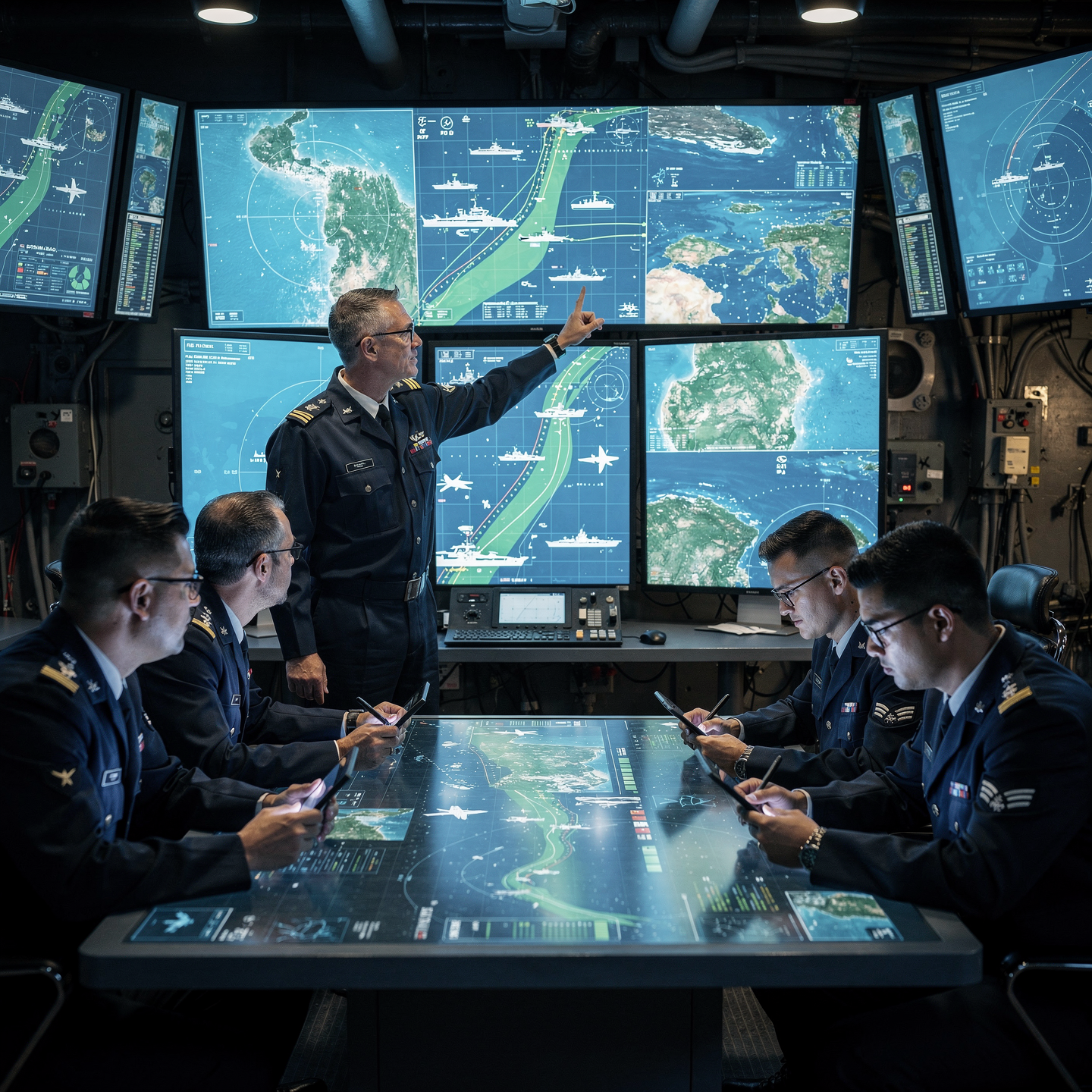
Master’s Degree in Naval Strategy and Military Operations
Why this master’s programme?
The Master’s in Naval Strategy and Military Operations
This program provides you with a comprehensive understanding of the challenges and opportunities in the contemporary global maritime environment. It is designed for professionals seeking to lead and manage complex naval operations, combining the study of maritime geopolitics, naval strategy, resource management, and emerging technologies. You will learn to make informed strategic decisions and execute operations effectively in a constantly evolving security and defense context.
Differentiating Advantages
- Comprehensive Approach: from military doctrine to logistics management and naval cybersecurity.
- Real-World Case Studies: study of historical and contemporary operations to extract lessons learned.
- Simulations and Tactical Exercises: practical application of acquired knowledge in realistic scenarios.
- Strategic Networking: connection with leaders and experts in the naval military sector internationally.
- Flexibility: online format with multimedia resources and interactive sessions to adapt to your learning pace.
- Modality: Online
- Level: Masters
- Hours: 1600 H
- Start date:
Availability: 1 in stock
Who is it aimed at?
- Naval officers seeking to advance and lead in demanding environments, mastering strategic planning and the conduct of naval operations.
- Defense and Security Analysts requiring a deep understanding of maritime geopolitics, emerging threats, and modern naval capabilities.
- Maritime-military professionals interested in collaborating and contributing to national security, understanding the dynamics of naval defense and its impact on trade and stability.
- Graduates in Political Science, International Relations, or Engineering aspiring to a specialized career in defense, naval strategy, and crisis management.
- Defense company executives needing to understand the operational environment Naval, the needs of the Navy, and opportunities for technological innovation in the sector.
Academic Flexibility
Adapted to the demands of active service: flexible online methodology, 24/7 access to resources, and personalized tutoring to balance training and professional responsibilities.
Objectives and skills

Leading and optimizing naval resources in complex scenarios:
“Efficiently manage the crew, assessing risks and optimizing task allocation according to skills and experience, fostering effective communication and collaborative decision-making.”

Develop and implement innovative and effective naval strategies:
“Analyze emerging geopolitical and technological scenarios to adapt naval doctrine and anticipate future maritime threats.”

Managing and mitigating risks in demanding maritime operations:
“To assess the weather and sea state, anticipating their impact on navigational safety and the stability of the vessel.”

Coordinate and supervise the deployment and sustainment of naval forces:
“To effectively manage the assigned resources (human, material and financial), optimizing the availability and efficiency of naval units.”
Mastering naval doctrine and tactics for strategic superiority:
“Plan and execute combined naval operations with allied forces, integrating electronic warfare and cyber defense capabilities to deny the adversary the initiative.”

Analyze and anticipate maritime threats to national defense:
“To assess vulnerabilities in critical coastal infrastructure and propose protection measures, considering scenarios of asymmetric attack and hybrid warfare.”
Study plan – Modules
- Fundamentals of Naval Strategic Planning: Conceptualization, Mission Objectives, and Operational Environment Assessment
- Naval Intelligence Analysis: Integrating Information from Multiple Sources to Develop an Accurate Tactical Picture
- Advanced Decision-Making Models in Naval Operations: Use of Support Systems and Computer Simulations
- Design and Coordination of Combined Naval Operations: Integrating Maritime, Air, and Land Forces in Asymmetric Scenarios
- Formation and Execution of Tactical Concepts: Offensive, Defensive, and Containment Maneuvers in Maritime Space
- Implementation of Electronic Warfare and Cyber Operations in Support of Naval Strategies
- Logistics Planning and Operational Sustainability: Supply, Maintenance at Sea, and Critical Resource Management
- Advanced Use of Command and Control (C2) Systems: Interoperability, Secure Communication, and Real-Time Crisis Management
- Strategies for Counterintelligence and protection of naval assets against hybrid and cyber threats
Post-operational analysis: evaluation of results, adjustment of tactics, and updating of naval doctrine
- Fundamentals of Maritime Intelligence: Definition, Scope, and Sources of Information in Naval Contexts
- Data Collection and Analysis Processes: SIGINT, HUMINT, IMINT, and OSINT Applied to Military Scenarios
- Assessment of Asymmetric and Conventional Threats in the Maritime Domain: Adversary Tactics, Capabilities, and Vulnerabilities
- Naval Electronic Warfare: Key Concepts, Electromagnetic Spectrum, and its Management in Maritime Operations
- Electronic Countermeasures (ECM) and Electronic Support (ESM): Technologies, Tactical Employment, and International Regulations
- Integration of Intelligence Systems on Naval Platforms: Sensors, Radars, Sonars, and Data Links
- Analysis of Electromagnetic Signals: Detection, Identification, and Location of Enemy Emitters in Real Time
- Modeling and Simulation of Electronic Warfare Scenarios: Advanced Tools for Operational Planning
- Protection of own assets against cyberattacks and electronic interference in hostile maritime environments
- Planning and execution of joint operations based on integrated intelligence and electronic warfare: inter-arms and interagency coordination
- Naval counterintelligence procedures and the importance of the human factor in operational security
- International regulations and conventions applicable to the use of electronic warfare in maritime zones
- Case studies: analysis of recent naval conflicts with a focus on intelligence and electronic warfare
- Emerging technological trends: artificial intelligence, machine learning, and their application in naval electronic warfare
- Development of maritime intelligence reports: preparation, validation, and dissemination for strategic and tactical decision-making
- Fundamentals of Naval Strategic Planning: Processes, Decision-Making Cycles, and the Establishment of Operational Objectives in Complex Maritime Scenarios
- Advanced Methodologies for the Design and Execution of Combined Naval Operations: Integration of Surface, Submarine, Air, and Special Forces
- Maritime Intelligence Analysis: Techniques for Gathering, Processing, and Evaluating Information to Anticipate Threats and Opportunities
- Implementation of Electronic Warfare Systems in Dynamic Naval Environments: Detection, Jamming, and Countermeasures
- Modeling and Simulation of Tactical Scenarios in Joint Naval Operations: Risk Assessment and Resource Optimization
- Advanced Use of GIS Tools and Digital Platforms for the Real-Time Planning and Monitoring of Naval Maneuvers
- Interarms Coordination and Interagency: Protocols and Secure Communication for Effective Synchronization in Combined Missions
Information Management and Cyber Countermeasures in the Maritime Electromagnetic Space
Key Indicators for Comprehensive Operational Intelligence Analysis and Their Application in Strategic Decision-Making
Case Studies and Field Studies on Electronic Warfare and Naval Strategy in Contemporary and Future Conflicts
- Fundamentals of Command, Control, Communications, Computers, Intelligence, Surveillance, and Reconnaissance (C4ISR) in the naval military sphere: historical evolution and contemporary doctrines
- Architecture and integrated technologies in C4ISR systems: platforms, sensors, data links, and distributed command systems
- Interoperability models for multinational joint operations: standards, protocols, and challenges in shipboard and land-based environments
- Processes and tools for naval intelligence management: collection, analysis, dissemination, and feedback in the intelligence cycle
- Strengthening naval cyber defense: strategies, tactics, and countermeasures against asymmetric threats and cyberattacks on critical maritime infrastructure
- Integration of maritime and real-time space-based surveillance systems: use of radars, acoustic sensors, satellites, and drones for advanced situational awareness
- Protocols Command and control in crisis situations and hybrid conflicts: interagency coordination, decision-making under pressure, and resource management in dynamic scenarios.
Advanced simulation and modeling of C4ISR operational scenarios for training and evaluation of tactical and strategic capabilities.
International regulations and cooperation agreements for joint naval operations: impact on interoperability and global maritime security.
Case studies of C4ISR application in modern naval missions: conflict analysis, humanitarian operations, and disaster management in complex maritime environments.
- Fundamentals of Advanced Naval Logistics: Concepts, Scope, and Doctrinal Evolution in Multidomain Operations
- Strategic Supply Chain Planning in the Naval Context: Inter-Service Integration and Coordination with Allies
- Management of Material Resources: Warehousing, Predictive Maintenance, and Assurance of Critical Equipment in Hostile Environments
- Optimization of Military Maritime Transport: Load Models, Capacities of Logistics Vessels, and Secure Supply Routes
- Logistics Information Systems: Digital Platforms, Automation, and Real-Time Analysis for Decision Support
- Combat Logistics and Replenishment in Multidomain Operations: Procedures, Critical Times, and Risk Management
- Application of Artificial Intelligence and Big Data in Logistics Forecasting and Maintenance of Naval Fleets
- Medical Support and Evacuation in a Naval Context: Planning, Resources, and Coordination with Joint Operations
- Efficient Fuel and Energy Management: Technologies, storage, distribution, and reducing the operational footprint
Legal and regulatory aspects in naval military logistics: regulatory compliance, international treaties, and operational ethics
Impact of emerging threats on naval logistics: cybersecurity, electronic warfare, and supply chain resilience
Training and leadership in naval logistics: building multidisciplinary teams and talent management in complex environments
Case studies: analysis of successful logistics operations in multidomain scenarios and lessons learned for future missions
- Fundamentals of Naval Strategic Planning: Environmental Analysis, Target Identification, and Prioritization in Multidomain Scenarios
- Advanced Methodologies for Operational Risk Assessment: Maritime Intelligence, Electronic Warfare, and Asymmetric Threats in Joint Operations
- Integration of Multidomain Capabilities: Coordination Among Naval, Air, Land, and Cyber Forces for Operational Superiority
- Development and Application of Advanced Naval Tactics: Anti-air, Anti-submarine, Surface, and Littoral Warfare in Modern Conflict Contexts
- Simulation Models and Tools for Planning and Training in Combined and Multinational Naval Operations
- Command and Control (C2) Procedures in Complex Environments: Secure Communication Systems, Integrated Networks, and Protocols Command
Comprehensive Resource Management: Allocation and optimization of human, material, and logistical resources in prolonged missions
Planning and coordination of joint and combined operations: Interoperability, standardization, and allied doctrine
Advanced tactical analysis of threats and vulnerabilities: Cyber warfare, electronic warfare, and defense against next-generation missiles
Monitoring, evaluation, and continuous adaptation during the execution of naval operations: Use of real-time intelligence, decision-making, and operational feedback
Drafting and presentation of detailed operational plans (OPLANs) and contingency plans under international military standards and regulations
Study of historical and contemporary case studies of successful naval campaigns and lessons learned for continuous improvement
Legal aspects and ethical considerations in multi-domain naval operations: international maritime law, legislation on the use of force, and human rights
Environmental and civil impact assessment and management in areas of military naval operations
Technological innovations applied to naval management and planning: artificial intelligence, big data, and predictive analytics for effective operations
- Fundamental Concepts and Doctrine of Joint Naval Operations: Inter-arms Integration and Inter-agency Coordination
- Naval Deployment and Maneuver Strategies in Highly Complex Geostrategic Scenarios
- Advanced Naval Cyber Defense: Defense-in-Depth Architecture, Network Segmentation, and Resilience Protocols Against Sophisticated Attacks
- Detection and Mitigation of Specific Cyber Threats in Maritime Command and Control (C2) Systems, Radars, and Satellite Communications
- Multi-Source Maritime Intelligence: Real-Time Data Collection, Fusion, and Analysis from SIGINT, HUMINT, IMINT, and OSINT for Tactical and Strategic Decision-Making
- Advanced Application of SIGINT in Electronic Signals Intelligence and Spectrum Warfare in Hostile Naval Environments
- Multi-Domain Logistics in Operations Naval operations: planning and optimization of the combined maritime, air, and land supply chain
Predictive models and simulation to anticipate logistical vulnerabilities and maximize the operational availability of naval units
Integration of emerging technologies in joint naval operations: Artificial Intelligence, Big Data, and autonomous systems
Case studies and real-time simulations of joint naval operations that combine cyber capabilities, intelligence, and logistical support for asymmetric and conventional conflict scenarios
- Structure and Foundations of Integrated Command and Control in Multinational Naval Environments: Interoperable Doctrines and Standards
- Design and Management of Secure Communication Networks: Cryptographic Protocols, End-to-End Encryption, and Traffic Segmentation
- Implementation of Command and Control (C2) Systems: Architectures, Digital Platforms, and Automation of Operational Flows
- Advanced Cyber Defense: Early Detection, Threat Analysis, and Incident Response in Maritime Environments
- Integration of Artificial Intelligence and Machine Learning for Real-Time Decision Support
- Decision-Making Models Under Pressure: Risk Analysis, Uncertainty Management, and Tactical Prioritization
- Simulation and Training in Environments Virtual environments for complex and coordinated multinational scenarios
Interoperability protocols between allied naval forces: standardization of data, languages, and systems
Crisis management and coordination in joint maritime operations: practical exercises and historical case studies
International regulations and their impact on multinational naval operations: maritime laws, rules of engagement, and collaborative security agreements
- Fundamentals of Naval Strategic Planning: Objectives, Doctrinal Framework, and Contextual Analysis in the Maritime Military Environment
- Advanced Methodologies for the Development of Operational Plans: Joint Operations Planning, OODA Models, and the MDMP (Military Decision Making Process) Cycle
- Intelligence Assessment and Management in Naval Operations: Sources, Tactical Interpretation, and Secure Information Distribution
- Design and Execution of Advanced Multi-Domain Tactics: Synchronization of Maritime, Air, Submarine, and Cyber Assets for Maritime Space Dominance
- Interoperable Coordination Among Units and Allied Forces: Secure Communication Systems, Standard NATO Protocols, and Technological Interoperability Mechanisms
- Planning and Management of Amphibious and Special Operations: Force Deployment, Integrated Logistics, and Adaptation to Complex and Variable Environments
- Advanced use of C4ISR (Command, Control, Communications, Computers, Intelligence, Surveillance, and Reconnaissance) systems for real-time decision-making
- Risk and contingency management in naval operations: identification, mitigation, and rapid response to asymmetric threats and hostile environments
- Integration of cyber and electronic capabilities for support and protection of multi-domain naval operations
- Post-operational analysis and strategic feedback: performance evaluation, lessons learned, and continuous process optimization
- Advanced Methodologies for the Integration of Naval and Air-Naval Forces in Joint Operations
- Strategic Analysis: Theater of Operations Assessment, Maritime Intelligence, and Enemy Capabilities Assessment
- Design and Planning of Naval Campaigns: Phases, Resources, Logistics, and Force Deployment
- Simulation Models for Predicting and Optimizing Operations in Multi-Domain Scenarios
- Interagency and Multinational Coordination: Procedures, Protocols, and Secure Communication Management
- Implementation of Command and Control (C2) Doctrines Adapted to Integrated Naval Operations
- Weapons Systems Management and Tactical Deployment for Maximizing Combat Effect
- Optimization of Naval Routes and Maneuvers Using Geospatial Information Systems (GIS) and Real-Time Analysis
- Assessment and Mitigation Risks in maritime operations: asymmetric threats, weather, and electronic warfare
Preparation of final operational reports, lessons learned, and recommendations for the continuous improvement of the strategic cycle
Career prospects
“`html
- Staff Officer in Naval Units: Planning and execution of naval operations, resource management, and coordination with other armed forces.
- Naval Intelligence Analyst: Collection, analysis, and dissemination of strategic information for decision-making.
- Naval Logistics Officer: Supply chain management, equipment maintenance, and operational support.
- Naval Warfare Specialist: Development of tactics, strategies, and technologies for naval combat.
- Naval Exercise Planner: Design and direction of drills and exercises to improve force readiness.
- Maritime Security Advisor: Risk assessment, development of security plans, and threat response.
- Instructor at Military Academies: Training of future officers in Naval strategy and operations.
Naval Attaché at Embassies: Representation of the Navy and liaison with foreign military authorities.
“`
Entry requirements

Academic/professional profile:
Bachelor’s degree in Nautical Science/Maritime Transport, Naval/Marine Engineering or a related qualification; or proven professional experience on the bridge/in operations.

Language proficiency:
Functional Maritime English (SMCP) recommended for simulations and technical materials.

Documentation:
Updated CV, copy of qualification or seaman’s book, national ID/passport, motivation letter.

Technical requirements (for online):
Device with camera/microphone, stable internet connection, monitor ≥ 24” recommended for ECDIS/Radar-ARPA.
Admissions process and dates

Online
application
(form + documents).

Academic review and interview
Admissions decision

Admissions decision
(+ scholarship offer if applicable).

Place reservation
(deposit) and enrolment.

Induction
(access to the virtual campus, calendars, simulator guides).
Scholarships and financial support
- Maritime Strategic Analysis: Master the tools for decision-making in complex naval environments.
- Advanced Operational Planning: Learn to design and execute effective and coordinated naval operations.
- Naval Resource Management: Optimize the allocation and use of critical resources for mission success.
- Naval Leadership and Command: Develop leadership skills to direct and motivate teams in challenging situations.
- Simulations and Case Studies: Apply the knowledge acquired to real-world scenarios and improve your responsiveness.
Testimonials
My time in the Master’s Program in Naval Strategy and Operations provided me with the analytical tools and in-depth knowledge necessary to successfully lead the complex “Amber Horizon” rescue operation in the South China Sea. The strategic planning I developed, based on the principles learned during the program, enabled the safe extraction of civilians in a high-risk situation, minimizing casualties and ensuring the integrity of our forces. The understanding of regional geopolitics, naval logistics, and communication tactics, acquired in the program, were fundamental to the mission’s success.
I applied the knowledge from my master’s degree in naval cybersecurity to design an intrusion detection system that reduced false alerts on my frigate’s network by 80%, significantly improving our security posture.
I applied the logistics and planning principles I learned in the Master’s program to optimize the deployment of a fleet in a multinational exercise. We reduced response time by 15% and increased fuel efficiency by 8%, which was recognized by senior management and contributed significantly to the operation’s success.
The Master’s degree in Naval Strategy and Operations provided me with the analytical tools and in-depth understanding of maritime geopolitical dynamics to successfully lead the planning and execution of Operation Blue Shield, ensuring the protection of critical infrastructure in a complex and hostile maritime environment. The knowledge I gained in logistics, intelligence, and naval weapons systems was crucial to the operation’s effectiveness and the minimization of casualties.

Frequently asked questions
Yes. The itinerary includes ECDIS/Radar-ARPA/BRM with harbor, ocean, fog, storm, and SAR scenarios.
Online with live sessions; hybrid option for simulator/practical placements through agreements.
It combines naval theory with practical components, including simulations, exercises, and case studies to apply knowledge to real-life situations.
Recommended functional SMCP. We offer support materials for standard phraseology.
Yes, with a relevant degree or experience in maritime/port operations. The admissions interview will confirm suitability.
Optional (3–6 months) through Companies & Collaborations and the Alumni Network.
Simulator practice (rubrics), defeat plans, SOPs, checklists, micro-tests and applied TFM.
A degree from Navalis Magna University + operational portfolio (tracks, SOPs, reports and KPIs) useful for audits and employment.
- Advanced Methodologies for the Integration of Naval and Air-Naval Forces in Joint Operations
- Strategic Analysis: Theater of Operations Assessment, Maritime Intelligence, and Enemy Capabilities Assessment
- Design and Planning of Naval Campaigns: Phases, Resources, Logistics, and Force Deployment
- Simulation Models for Predicting and Optimizing Operations in Multi-Domain Scenarios
- Interagency and Multinational Coordination: Procedures, Protocols, and Secure Communication Management
- Implementation of Command and Control (C2) Doctrines Adapted to Integrated Naval Operations
- Weapons Systems Management and Tactical Deployment for Maximizing Combat Effect
- Optimization of Naval Routes and Maneuvers Using Geospatial Information Systems (GIS) and Real-Time Analysis
- Assessment and Mitigation Risks in maritime operations: asymmetric threats, weather, and electronic warfare
Preparation of final operational reports, lessons learned, and recommendations for the continuous improvement of the strategic cycle
Request information
Complete the Application Form.
Attach your CV/degree certificate (if you have it to hand).
Indicate your preferred cohort (January/May/September) and whether you would like the hybrid option with simulator sessions.
An academic advisor will contact you within 24–48 hours to guide you through the admission process, scholarships, and compatibility with your professional schedule.
Faculty
Eng. Tomás Riera
Full Professor
Eng. Tomás Riera
Full Professor
Eng. Sofía Marquina
Full Professor
Eng. Sofía Marquina
Full Professor
Eng. Javier Bañuls
Full Professor
Eng. Javier Bañuls
Full Professor
Dr. Nuria Llobregat
Full Professor
Dr. Nuria Llobregat
Full Professor
Dr. Pau Ferrer
Full Professor
Dr. Pau Ferrer
Full Professor
Cap. Javier Abaroa (MCA)
Full Professor
Cap. Javier Abaroa (MCA)
Full Professor