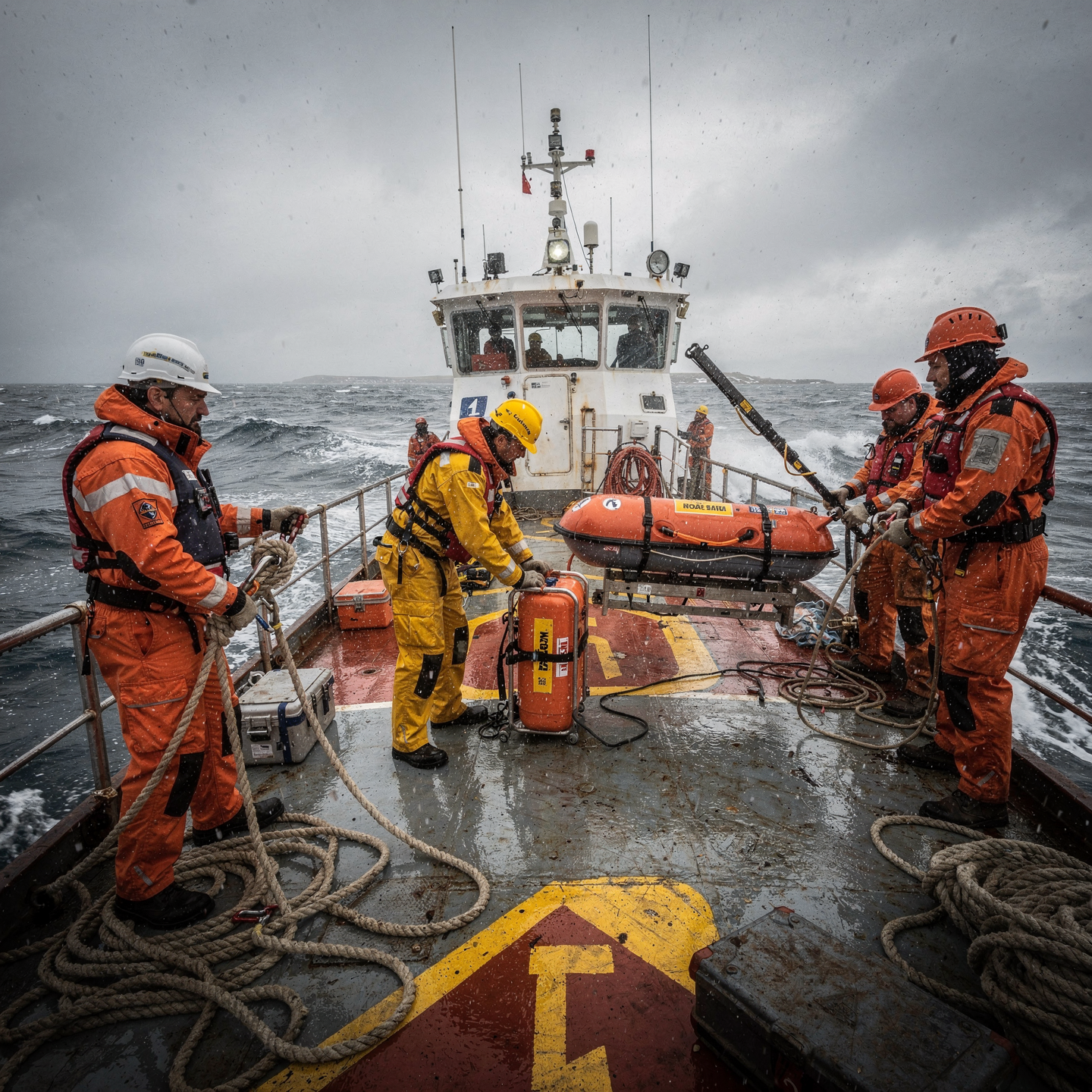
Diploma in Survival at Sea

Why this certificate program?

The Diploma in Survival at Sea

This program prepares you to face emergency situations in the maritime environment, providing the essential skills and knowledge for safety and rescue. This intensive program covers everything from risk prevention to individual and collective survival, including the use of lifesaving equipment and first aid techniques in extreme conditions. You will learn to respond effectively to shipwrecks, fires, and other emergencies, maximizing your chances of survival and rescue.

Differential Advantages

  • Practical Training: exercises in abandoning ship, use of life rafts, and signaling equipment.
  • Realistic Simulations: immersion in emergency scenarios to develop the ability to respond under pressure.
  • Expert Instructors: professionals with extensive experience in maritime safety and rescue operations.
  • Recognized Certification: meets the international standards for survival training at sea (STCW).
  • Comprehensive Approach: covers the physical, psychological, and technical aspects of survival at sea.
Supervivencia

Diploma in Survival at Sea

Availability: 1 in stock

Who is it aimed at?

  • Merchant mariners, cruise ship crew members, and fishermen who wish to acquire crucial knowledge and skills to face emergency situations at sea.
  • Oil platform and offshore wind farm personnel who need comprehensive training in survival and safe evacuation techniques.
  • Members of maritime rescue teams and coast guards who seek to perfect their skills in saving lives in extreme conditions.
  • Offshore and marine renewable energy professionals interested in complying with international maritime safety and security regulations.
  • Sailing and offshore motoring enthusiasts who wish to prepare for ocean voyages and increase their response capabilities unforeseen events.

Learning Flexibility
 Adapted for professionals with demanding schedules: 24/7 accessible online modules, simulated practical exercises, and personalized tutoring to answer questions.

Supervivencia

Objectives and competencies

Apply personal survival techniques:

“Stay calm, assess the situation, prioritize needs (water, shelter, signage) and use available resources resourcefully.”

Operate rescue and safety equipment:

“Implement water rescue techniques (fast boats, rescue swimmers) and provide first aid.”

Managing emergency situations and ship abandonment:

“Assess damage, prioritize the safety of the crew and passengers, and execute ship abandonment procedures in accordance with the Emergency Plan.”

Coordinate and lead search and rescue operations:

“Establish a Unified Command Post (UCP), prioritizing the safety of the teams and optimizing available resources based on continuous situation assessment.”

Navigating and maneuvering survival craft:

Assess the condition of the vessel, safety equipment and provisions, prioritizing crew safety and maximizing survivability.

Provide first aid and basic medical care:

Assess the situation, prioritize care, and apply cardiopulmonary resuscitation (CPR) and hemorrhage control techniques.

Curriculum - Modules

  1. Comprehensive Maritime Incident Management: protocols, roles, and chain of command for coordinated response
  2. Operational Planning and Execution: briefing, routes, weather windows, and go/no-go criteria
  3. Rapid Risk Assessment: criticality matrix, scene control, and decision-making under pressure
  4. Operational Communication: VHF/GMDSS, standardized reports, and inter-agency liaison
  5. Tactical Mobility and Safe Boarding: RHIB maneuvers, approach, mooring, and recovery
  6. Equipment and Technologies: PPE, signaling, satellite tracking, and field data logging
  7. Immediate Care of the Affected: primary assessment, hypothermia, trauma, and stabilization for evacuation
  8. Adverse Environmental Conditions: swell, Visibility, flows, and operational mitigation

    Simulation and training: critical scenarios, use of VR/AR, and exercises with performance metrics

    Documentation and continuous improvement: lessons learned, indicators (MTTA/MTTR), and SOP updates

  1. Basic principles of survival at sea
  2. Emergency equipment: life rafts, immersion suits, and life jackets
  3. Escape techniques: abandoning ship, safe evacuation
  4. Lifeboats: handling, launching, steering, and maintenance
  5. Firefighting: fire theory, fire classes, and extinguishing methods
  6. Personal protective equipment (PPE) for firefighting
  7. Use of portable fire extinguishers and fixed fire suppression systems
  8. Organization of firefighting on board: brigades, roles, and communications
  9. Basic first aid in emergency situations
  10. International legislation and regulations on maritime safety

  1. Standards and Regulations: SOLAS, LSA Code, MSC.81(70)
  2. Types of lifeboats: open, closed, partially closed, self-righting
  3. Types of liferafts: inflatable, rigid, capacities and equipment
  4. Emergency Equipment: EPIRBs, SARTs, flares, smoke signals
  5. Abandonment Procedures: alarm signals, crew lists, role assignments
  6. Launching and Launching Techniques: davits, free-fall systems
  7. Survival at Sea: first aid, water purification, food scavenging
  8. Boat and Raft Handling: Basic navigation, rowing, motor operation (if applicable)
  9. Maintenance and Inspection: Routines, checklists, component replacement
  10. Drills and Training: Practical exercises, skills assessment

  1. Legislation and regulations: SOLAS, IMO, national and international conventions
  2. Types of abandonment: planned, immediate, controlled, uncontrolled
  3. Danger and emergency signals: identification and use
  4. Emergency equipment: EPIRB, SART, portable VHF radio
  5. Lifeboats: types, construction, operation, maintenance
  6. Liferafts: types, deployment, operation, maintenance
  7. Boat and raft equipment: water, food, first aid kit, tools
  8. Survival techniques at sea: flotation, shelter, signaling, first aid
  9. Boat and raft launching and recovery maneuvers
  10. Abandonment simulations: organization, execution, evaluation

  1. International and national maritime legislation on salvage and abandonment.
  2. Rescue equipment: life rafts, life jackets, immersion suits, EPIRB, SART.
  3. Abandon ship techniques: preparation, equipment deployment, procedures.
  4. Survival at sea: first aid, water purification, signaling.
  5. Search and rescue: organization, communications, location techniques.
  6. Risks in salvage operations: fires, explosions, spills, pollution.
  7. Emergency communications: GMDSS, VHF, distress call procedures.
  8. First aid in maritime emergencies: hypothermia, drowning, burns.
  9. Psychology of survival: stress management, decision-making in extreme situations.
  10. Abandonment and rescue drills: planning, execution, evaluation, and continuous improvement.

  1. System Architecture and Components: Structural design, materials, and subsystems (mechanical, electrical, electronic, and fluid) with selection and assembly criteria for marine environments
  2. Fundamentals and Principles of Operation: Physical and engineering foundations (thermodynamics, fluid mechanics, electricity, control, and materials) that explain performance and operating limits
  3. Safety and Environmental (SHE): Risk analysis, PPE, LOTO, hazardous atmospheres, spill and waste management, and emergency response plans
  4. Applicable Regulations and Standards: IMO/ISO/IEC requirements and local regulations;
  5. Conformance criteria, certification, and best practices for operation and maintenance
  6. Inspection, testing, and diagnostics: Visual/dimensional inspection, functional testing, data analysis, and predictive techniques (vibration, thermography, fluid analysis) to identify root causes
  7. Preventive and predictive maintenance: Hourly/cycle/seasonal plans, lubrication, adjustments, calibrations, consumable replacement, post-service verification, and operational reliability
  8. Instrumentation, tools, and metrology: Measuring and testing equipment, diagnostic software, calibration and traceability; selection criteria, safe use, and storage
  9. Onboard integration and interfaces: Mechanical, electrical, fluid, and data compatibility; Sealing and watertightness, EMC/EMI, corrosion protection, and interoperability testing.

    Quality, acceptance testing, and commissioning: process and materials control, FAT/SAT, bench and sea trials, go/no-go criteria, and evidence documentation.

    Technical documentation and integrated practice: logs, checklists, reports, and a complete case study (safety → diagnosis → intervention → verification → report) applicable to any system.

  1. Types of Abandonment: Emergency preparedness, situation assessment, abandonment signals.
  2. Emergency Equipment: Emergency Radio Beacons (EPIRBs), Search and Rescue Arrays (SARTs), communication equipment.
  3. Lifeboats: Types, operation, boarding and launching procedures, survival in the boat.
  4. Life Rafts: Types, manual and automatic deployment, equipment, basic maintenance.
  5. Personal Protective Equipment: Immersion suits, life jackets, thermal protective clothing.
  6. Launch Procedures: Safe launching in different weather and sea conditions.
  7. Survival at Sea: Survival techniques, first aid, water purification, obtaining food.
  8. Emergency Communications: Use of radio equipment, visual and audible distress signals.
  9. Boat and Raft Maintenance: Inspections, minor repairs, equipment checks.
  10. Legislation and Regulations: SOLAS Conventions, national and international regulations.

Career opportunities

  • Crew Member of Commercial or Recreational Vessels: Proficiency in survival techniques for emergency situations.
  • Oil Platform and Offshore Wind Farm Personnel: Training in accident response and evacuation procedures.
  • Member of Maritime Rescue Teams: Skills in search, rescue, and assistance at sea.
  • Instructor at Maritime Training Centers: Teaching survival protocols and procedures.
  • Maritime Safety Consultant: Advising companies and organizations on risk prevention and emergency management.
  • Cruise Ship and Passenger Ship Personnel: Preparation to ensure passenger safety in critical situations.
  • Fishing Industry Worker: Knowledge of survival techniques for dealing with challenging conditions adverse.
  • Professional Water Sports Athlete: Self-protection skills in high-risk activities at sea.

“`

Admission requirements

Academic/professional profile:

Degree/Bachelor's degree in Nautical Science/Maritime Transport, Naval/Marine Engineering, or a related field; or proven professional experience in bridge/operations.

Language proficiency:

Recommended functional maritime English (SMCP) for simulations and technical materials.

Documentation:

Updated resume, copy of degree or seaman's book, ID card/passport, letter of motivation.

Technical requirements (for online):

Equipment with camera/microphone, stable connection, ≥ 24” monitor recommended for ECDIS/Radar-ARPA.

Admission process and dates

1. Online
application

(form + documents).

2. Academic review and interview

(profile/objectives/schedule compatibility).

3. Admission decision

(+ scholarship proposal if applicable).

4. Reservation of place

(deposit) and registration.

5. Induction

(access to campus, calendars, simulator guides).

Scholarships and grants

  • Survival Techniques: Master crucial skills for dealing with emergency situations at sea, including the use of rescue equipment and strategies.
  • Safety Equipment: Learn how to properly use and maintain maritime safety equipment, such as life rafts, immersion suits, and communication systems.
  • First Aid at Sea: Acquire basic first aid knowledge adapted to the maritime environment, including the treatment of hypothermia, dehydration, and common injuries.
  • Marine Meteorology: Understand the basic principles of marine meteorology and how to interpret forecasts to make informed decisions and mitigate risks.
  • Maritime Legislation: Familiarize yourself with international regulations and standards related to safety and survival at sea.
Prepare to face the challenges of maritime environment and ensure your safety and that of your crew.

Testimonials

Frequently asked questions

Yes. The itinerary includes ECDIS/Radar-ARPA/BRM with harbor, ocean, fog, storm, and SAR scenarios.

Online with live sessions; hybrid option for simulator/practical placements through agreements.

Recommended functional SMCP. We offer support materials for standard phraseology.

Yes, with a relevant degree or experience in maritime/port operations. The admissions interview will confirm suitability.

Optional (3–6 months) through Companies & Collaborations and the Alumni Network.

Simulator practice (rubrics), defeat plans, SOPs, checklists, micro-tests and applied TFM.

A degree from Navalis Magna University + operational portfolio (tracks, SOPs, reports and KPIs) useful for audits and employment.

  1. Types of abandonment: preparation, signals, communication, and roles.
  2. Emergency equipment: life jackets, survival suits, emergency beacons.
  3. Lifeboats: types, launching, maneuvering, and steering.
  4. Life rafts: deployment, inflation, entry, and survival on board.
  5. Survival at sea: first aid, hydration, nutrition, and thermal protection.
  6. Distress signals: visual, acoustic, pyrotechnic, and radio.
  7. Emergency communications: VHF, MF/HF, GMDSS.
  8. Rescue procedures: coordination, helicopters, and rescue vessels.
  9. Legislation and Regulations: SOLAS, LSA Code, and local regulations.

    Drills and training: abandonment drills, equipment use, and survival.

Request information

  1. Complete the Application Form.

  2. Attach your CV/degree certificate (if you have it to hand).

  3. Indicate your preferred cohort (January/May/September) and whether you would like the hybrid option with simulator sessions.

    An academic advisor will contact you within 24–48 hours to guide you through the admission process, scholarships, and compatibility with your professional schedule.

Please enable JavaScript in your browser to complete this form.
Click or drag a file to this area to upload.

Faculty

0
    0
    Tu carrito
    Tu carrito esta vacíoRegresar a la tienda
    Scroll to Top


