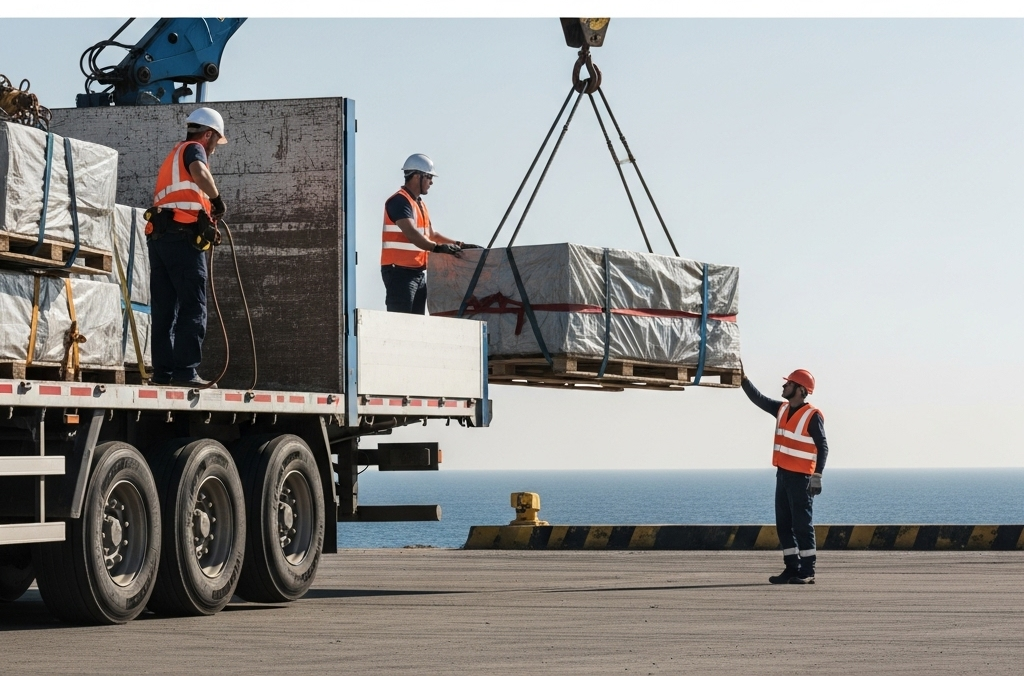
Safety course in loading maneuvers

Why this course?

The Safety in Loading Operations

This course provides you with the essential tools and knowledge to minimize risks and optimize efficiency in loading operations. It trains you in hazard identification, the application of safe procedures, and the correct use of lifting equipment, in compliance with current regulations. You will learn to prevent accidents, ensure the integrity of the load, and protect your team.

Differential Advantages

  • Practical Simulations: Realistic exercises to master lashing, stowage, and unstowage techniques.
  • Real-Life Case Studies: Incident studies to understand causes and apply preventive measures.
  • Professional Certification: Validate your skills and improve your job opportunities.
  • Focus on Prevention: Strategies to avoid damage to cargo, equipment, and personnel.
  • Regulatory Updates: Up-to-date knowledge of national and international regulations.
Seguridad

Safety course in loading maneuvers

Availability: 1 in stock

Who is it aimed at?

  • Terminal and cargo yard operators looking to optimize their processes, reduce downtime, and improve operational efficiency.
  • Loading supervisors and stevedores wanting to deepen their knowledge of securing and lashing techniques, as well as cargo damage prevention.
  • Occupational health and safety managers needing to update their knowledge of regulations and best practices in cargo handling.
  • Maintenance and logistics personnel interested in understanding the operation of lifting and cargo handling equipment and its preventive maintenance.
  • Engineers and technicians seeking specialization in safety applied to cargo handling, with a focus on accident prevention and Regulatory compliance.

Training flexibility
 Adapted to professionals with demanding schedules: 24/7 online platform, downloadable materials, and personalized tutoring on demand.

Seguridad

Objectives and competencies

Apply safe slinging techniques:

“By selecting appropriate slings, inspecting them, and ensuring a balanced load distribution.”

Inspect and maintain lifting equipment:

“Identify and correct anomalies in hydraulic, mechanical and electrical systems, ensuring compliance with safety and efficiency regulations.”

Identify and mitigate risks in loading areas:

“Implement specific safety protocols for handling hazardous goods and ensure proper stowage and securing of cargo.”

Coordinate effective communication within the loading team:

Establish clear communication protocols, including hierarchies, preferred channels, and standard terminology to ensure understanding and timely response among cargo team members.

Ensure stability and correct load distribution:

“Adjust speed and heading to minimize sudden movements and G-forces.”

Use appropriate personal protective equipment (PPE):

Select, inspect, adjust and use the specific PPE for each task correctly, complying with safety procedures and applicable regulations.

Curriculum - Modules

  1. Comprehensive Maritime Incident Management: protocols, roles, and chain of command for coordinated response
  2. Operational Planning and Execution: briefing, routes, weather windows, and go/no-go criteria
  3. Rapid Risk Assessment: criticality matrix, scene control, and decision-making under pressure
  4. Operational Communication: VHF/GMDSS, standardized reports, and inter-agency liaison
  5. Tactical Mobility and Safe Boarding: RHIB maneuvers, approach, mooring, and recovery
  6. Equipment and Technologies: PPE, signaling, satellite tracking, and field data logging
  7. Immediate Care of the Affected: primary assessment, hypothermia, trauma, and stabilization for evacuation
  8. Adverse Environmental Conditions: swell, Visibility, flows, and operational mitigation

    Simulation and training: critical scenarios, use of VR/AR, and exercises with performance metrics

    Documentation and continuous improvement: lessons learned, indicators (MTTA/MTTR), and SOP updates

  1. Introduction to Lifting: Definitions, terminology, and types of lifts.
  2. Regulations and Standards: ASME B30, OSHA, and applicable local regulations.
  3. Lifting Equipment: Cranes (mobile, tower, bridge), slings, hooks, wire rope slings, etc.
  4. Equipment Inspection: Acceptance/rejection criteria, inspection records.
  5. Lifting Hazards: Load drops, equipment failures, human error, environmental conditions.
  6. Load Calculation: Weight, center of gravity, sling angle, and safety factor.
  7. Lift Planning: Risk assessment, work permits, roles, and responsibilities.
  8. Signage and Communication: Standards for hand signals, verbal and visual communication.
  9. Emergency Procedures: Incident and accident response plans.
  10. Control and Continuous Improvement: Audits, incident analysis, lessons learned.

  1. Introduction to Safe Operations: Lifting, Stowage, and Risk Control
  2. Standards and Regulations: National and International Standards
  3. Lifting Equipment: Types, Capacities, Inspection, and Maintenance
  4. Slings and Accessories: Selection, Proper Use, and Load Limits
  5. Signals and Communication: Signal Codes and Procedures
  6. Lift Planning: Risk Assessment, Procedures, and Permits
  7. Stowage Techniques: Load Securing and Weight Distribution Methods
  8. Risk Control: Hazard Identification, Assessment, and Preventive Measures
  9. Personal Protective Equipment (PPE): Proper Use and Maintenance
  10. Emergency Procedures: Incident and Accident Response

  1. Introduction to Lifting Standards: Definitions, purposes, and scope.
  2. Applicable Legislation and Regulations: OSHA, ASME, ISO and local regulations.
  3. Lifting Equipment: Types, inspection, and maintenance (cranes, slings, hooks, wire rope slings).
  4. Signage: Hand and visual signal codes; Use of radios and other devices.
  5. Roles and Responsibilities: Crane operator, signalman, rigger, supervisor.

    Lift Planning: Risk assessment, equipment selection, load calculation.

    Risk Control: Identification, assessment, and mitigation of hazards associated with lifting.

    Emergency Procedures: Response to failures, load drops, and other incidents.

    Load Calculation: Weight, center of gravity, lifting angles, sling tension.

    Pre-Use Inspection: Checklists, rejection criteria, and documentation.

  1. Introduction to Lifting Standards: Definitions, Regulations, and Best Practices.
  2. Lifting Equipment: Types, Components, Inspection, and Maintenance.
  3. Slings and Accessories: Selection, Proper Use, Inspection, and Disposal.
  4. Lifting Signaling: Signal Codes, Communication, and Responsibilities.
  5. Rigger and Signalman: Roles, Responsibilities, and Qualifications.
  6. Lifting Plan: Risk Assessment, Load Calculations, and Procedures.
  7. Lifting Risk Control: Identification, Assessment, and Preventive Measures.
  8. Safety in the Lifting Area: Demarcation, Access Control, and Security.
  9. Emergency Procedures: Response to Incidents and Accidents.
  10. Current Legislation and Regulations: Compliance and Audits.

  1. System Architecture and Components: Structural design, materials, and subsystems (mechanical, electrical, electronic, and fluid) with selection and assembly criteria for marine environments
  2. Fundamentals and Principles of Operation: Physical and engineering foundations (thermodynamics, fluid mechanics, electricity, control, and materials) that explain performance and operating limits
  3. Safety and Environmental (SHE): Risk analysis, PPE, LOTO, hazardous atmospheres, spill and waste management, and emergency response plans
  4. Applicable Regulations and Standards: IMO/ISO/IEC requirements and local regulations;
  5. Conformance criteria, certification, and best practices for operation and maintenance
  6. Inspection, testing, and diagnostics: Visual/dimensional inspection, functional testing, data analysis, and predictive techniques (vibration, thermography, fluid analysis) to identify root causes
  7. Preventive and predictive maintenance: Hourly/cycle/seasonal plans, lubrication, adjustments, calibrations, consumable replacement, post-service verification, and operational reliability
  8. Instrumentation, tools, and metrology: Measuring and testing equipment, diagnostic software, calibration and traceability; selection criteria, safe use, and storage
  9. Onboard integration and interfaces: Mechanical, electrical, fluid, and data compatibility; Sealing and watertightness, EMC/EMI, corrosion protection, and interoperability testing.

    Quality, acceptance testing, and commissioning: process and materials control, FAT/SAT, bench and sea trials, go/no-go criteria, and evidence documentation.

    Technical documentation and integrated practice: logs, checklists, reports, and a complete case study (safety → diagnosis → intervention → verification → report) applicable to any system.

Plan de estudio - Módulos

  1. Comprehensive Maritime Incident Management: protocols, roles, and chain of command for coordinated response
  2. Operational Planning and Execution: briefing, routes, weather windows, and go/no-go criteria
  3. Rapid Risk Assessment: criticality matrix, scene control, and decision-making under pressure
  4. Operational Communication: VHF/GMDSS, standardized reports, and inter-agency liaison
  5. Tactical Mobility and Safe Boarding: RHIB maneuvers, approach, mooring, and recovery
  6. Equipment and Technologies: PPE, signaling, satellite tracking, and field data logging
  7. Immediate Care of the Affected: primary assessment, hypothermia, trauma, and stabilization for evacuation
  8. Adverse Environmental Conditions: swell, Visibility, flows, and operational mitigation

    Simulation and training: critical scenarios, use of VR/AR, and exercises with performance metrics

    Documentation and continuous improvement: lessons learned, indicators (MTTA/MTTR), and SOP updates

  1. Introduction to Lifting: Definitions, terminology, and types of lifts.
  2. Regulations and Standards: ASME B30, OSHA, and applicable local regulations.
  3. Lifting Equipment: Cranes (mobile, tower, bridge), slings, hooks, wire rope slings, etc.
  4. Equipment Inspection: Acceptance/rejection criteria, inspection records.
  5. Lifting Hazards: Load drops, equipment failures, human error, environmental conditions.
  6. Load Calculation: Weight, center of gravity, sling angle, and safety factor.
  7. Lift Planning: Risk assessment, work permits, roles, and responsibilities.
  8. Signage and Communication: Standards for hand signals, verbal and visual communication.
  9. Emergency Procedures: Incident and accident response plans.
  10. Control and Continuous Improvement: Audits, incident analysis, lessons learned.

  1. Introduction to Safe Operations: Lifting, Stowage, and Risk Control
  2. Standards and Regulations: National and International Standards
  3. Lifting Equipment: Types, Capacities, Inspection, and Maintenance
  4. Slings and Accessories: Selection, Proper Use, and Load Limits
  5. Signals and Communication: Signal Codes and Procedures
  6. Lift Planning: Risk Assessment, Procedures, and Permits
  7. Stowage Techniques: Load Securing and Weight Distribution Methods
  8. Risk Control: Hazard Identification, Assessment, and Preventive Measures
  9. Personal Protective Equipment (PPE): Proper Use and Maintenance
  10. Emergency Procedures: Incident and Accident Response

  1. Introduction to Lifting Standards: Definitions, purposes, and scope.
  2. Applicable Legislation and Regulations: OSHA, ASME, ISO and local regulations.
  3. Lifting Equipment: Types, inspection, and maintenance (cranes, slings, hooks, wire rope slings).
  4. Signage: Hand and visual signal codes; Use of radios and other devices.
  5. Roles and Responsibilities: Crane operator, signalman, rigger, supervisor.

    Lift Planning: Risk assessment, equipment selection, load calculation.

    Risk Control: Identification, assessment, and mitigation of hazards associated with lifting.

    Emergency Procedures: Response to failures, load drops, and other incidents.

    Load Calculation: Weight, center of gravity, lifting angles, sling tension.

    Pre-Use Inspection: Checklists, rejection criteria, and documentation.

  1. Introduction to Lifting Standards: Definitions, Regulations, and Best Practices.
  2. Lifting Equipment: Types, Components, Inspection, and Maintenance.
  3. Slings and Accessories: Selection, Proper Use, Inspection, and Disposal.
  4. Lifting Signaling: Signal Codes, Communication, and Responsibilities.
  5. Rigger and Signalman: Roles, Responsibilities, and Qualifications.
  6. Lifting Plan: Risk Assessment, Load Calculations, and Procedures.
  7. Lifting Risk Control: Identification, Assessment, and Preventive Measures.
  8. Safety in the Lifting Area: Demarcation, Access Control, and Security.
  9. Emergency Procedures: Response to Incidents and Accidents.
  10. Current Legislation and Regulations: Compliance and Audits.

  1. System Architecture and Components: Structural design, materials, and subsystems (mechanical, electrical, electronic, and fluid) with selection and assembly criteria for marine environments
  2. Fundamentals and Principles of Operation: Physical and engineering foundations (thermodynamics, fluid mechanics, electricity, control, and materials) that explain performance and operating limits
  3. Safety and Environmental (SHE): Risk analysis, PPE, LOTO, hazardous atmospheres, spill and waste management, and emergency response plans
  4. Applicable Regulations and Standards: IMO/ISO/IEC requirements and local regulations;
  5. Conformance criteria, certification, and best practices for operation and maintenance
  6. Inspection, testing, and diagnostics: Visual/dimensional inspection, functional testing, data analysis, and predictive techniques (vibration, thermography, fluid analysis) to identify root causes
  7. Preventive and predictive maintenance: Hourly/cycle/seasonal plans, lubrication, adjustments, calibrations, consumable replacement, post-service verification, and operational reliability
  8. Instrumentation, tools, and metrology: Measuring and testing equipment, diagnostic software, calibration and traceability; selection criteria, safe use, and storage
  9. Onboard integration and interfaces: Mechanical, electrical, fluid, and data compatibility; Sealing and watertightness, EMC/EMI, corrosion protection, and interoperability testing.

    Quality, acceptance testing, and commissioning: process and materials control, FAT/SAT, bench and sea trials, go/no-go criteria, and evidence documentation.

    Technical documentation and integrated practice: logs, checklists, reports, and a complete case study (safety → diagnosis → intervention → verification → report) applicable to any system.

  1. Fundamentals of Lifting: basic physics, center of gravity, stability
  2. Lifting Equipment: cranes, hoists, slings, wire rope slings, shackles
  3. Visual Inspection of Equipment: rejection criteria, wear, deformations
  4. Types of Slings: steel wire rope, synthetic fiber, chain, their advantages and disadvantages
  5. Load Calculation: weight, distribution, lifting angle, safety factor
  6. Slinging Techniques: direct lashing, choker sling, basket sling, double basket sling
  7. Sling Angles: effect on load capacity, load charts
  8. Lift Planning: risk assessment, selection of equipment, procedures
  9. Communication and signals: standardization, radio, sign language
  10. Legislation and regulations: OSHA, ASME, ANSI, international standards

  1. Introduction to Load Lifting: Definitions, Terminology, and Regulations.
  2. Lifting Equipment: Cranes (mobile, tower, bridge), hoists, chain hoists, and slings.
  3. Risks Associated with Lifting: Load drops, crane overturning, entrapment.
  4. Lift Planning: Risk assessment, equipment selection, and area preparation.
  5. Calculating Loads and Centers of Gravity: Determining weight, distribution, and stability.
  6. Selection and Use of Slings and Accessories: Types, capacity, inspection, and disposal.
  7. Signals and Communication: Signal codes, radios, and personnel roles.
  8. Safe Crane Operation: Pre-operational inspection, lifting techniques, and load limitations.
  9. Preventive Equipment Maintenance: Lubrication, adjustments, and component replacement.
  10. Emergency and Rescue Procedures: Response plans, safety equipment, and first aid.

  1. Introduction to Lifting Operations: Definitions and Key Concepts
  2. Safety Standards in Lifting: National and International Regulations (ASME, OSHA, etc.)
  3. Lifting Equipment: Types of Cranes, Slings, Wire Ropes, Hooks, and Other Accessories
  4. Inspection and Maintenance of Lifting Equipment: Acceptance/Rejection Criteria
  5. Rigger: Roles, Responsibilities, and Qualifications
  6. Signal Personnel: Standardized Signal Codes and Effective Communication
  7. Crane Operators: Certification, Skills, and Safe Operating Procedures
  8. Operation Planning: Risk Assessment, Load Calculations, and Equipment Selection
  9. Operation Execution: Step-by-Step Procedures Step, load control, and interference management.
  10. Incident analysis and lessons learned: Continuous improvement in lifting safety.

  1. Introduction to Safe Operations: Definitions and Key Concepts
  2. Legislation and Regulations: Applicable National and International Standards
  3. Lifting Equipment: Types, Components, Inspection, and Maintenance
  4. Load Calculation: Weight Estimation, Center of Gravity, and Distribution
  5. Slings and Accessories: Selection, Proper Use, and Load Limits
  6. Lifting Techniques: Straight, Inclined, Spreader Bar, and Crane Lifts
  7. Signals: Signal Codes, Visual and Auditory Communication
  8. Risks in Loading, Lifting, and Signaling Operations: Identification and Control
  9. Operation Planning: Risk Analysis, Work Permits and procedures.
  10. Emergencies: Response, rescue, and first aid plans.

Career opportunities

  • Stevedor/Load Operator: Safe execution of loading and unloading maneuvers in diverse environments.
  • Load Supervisor: Supervision of operations, ensuring compliance with safety protocols.
  • Occupational Risk Prevention Technician (specialized in cargo): Identification and assessment of risks associated with loading maneuvers, implementation of preventive measures.
  • Cargo Terminal Security Coordinator: Coordination of security at port, airport, or land terminals.
  • Crane/Lifting Equipment Operator: Safe operation of cranes and machinery used in cargo operations.
  • Warehouse/Logistics Manager: Safe management of the storage and transport of goods.
  • Cargo Inspector: Verification of compliance with safety regulations in cargo operations.
  • Cargo Safety Trainer: Training of personnel in safe cargo handling procedures.

“`

Admission requirements

Academic/professional profile:

Degree/Bachelor's degree in Nautical Science/Maritime Transport, Naval/Marine Engineering, or a related field; or proven professional experience in bridge/operations.

Language proficiency:

Recommended functional maritime English (SMCP) for simulations and technical materials.

5. Induction

Updated resume, copy of degree or seaman's book, ID card/passport, letter of motivation.

Technical requirements (for online):

Equipment with camera/microphone, stable connection, ≥ 24” monitor recommended for ECDIS/Radar-ARPA.

Admission process and dates

1. Online
application

(form + documents).

2. Academic review and interview

(profile/objectives/schedule compatibility).

3. Admission decision

(+ scholarship proposal if applicable).

4. Reservation of place

(deposit) and registration.

5. Induction

(access to campus, calendars, simulator guides).

Scholarships and grants

  • Master the techniques: Learn best practices in safe loading maneuvers, minimizing risks and optimizing time.
  • Comply with regulations: Know the current legislation and safety standards to avoid penalties and ensure the protection of your team.
  • Accident prevention: Identify and assess potential hazards, applying effective preventative measures for a safer work environment.
  • Specialized equipment: Familiarize yourself with the correct use and maintenance of loading equipment to maximize its lifespan and safety.
  • Professional certification: Obtain a recognized certificate that validates your knowledge and skills in safe loading maneuvers. Loading.
Increase efficiency and reduce risks in your loading operations.

Testimonials

Frequently asked questions

Yes. The itinerary includes ECDIS/Radar-ARPA/BRM with harbor, ocean, fog, storm, and SAR scenarios.

Online with live sessions; hybrid option for simulator/practical placements through agreements.

Safety footwear, gloves, helmet and high-visibility vest.

Recommended functional SMCP. We offer support materials for standard phraseology.

Yes, with a relevant degree or experience in maritime/port operations. The admissions interview will confirm suitability.

Optional (3–6 months) through Companies & Collaborations and the Alumni Network.

Simulator practice (rubrics), defeat plans, SOPs, checklists, micro-tests and applied TFM.

A degree from Navalis Magna University + operational portfolio (tracks, SOPs, reports and KPIs) useful for audits and employment.

  1. Introduction to Safe Operations: Definitions and Key Concepts
  2. Legislation and Regulations: Applicable National and International Standards
  3. Lifting Equipment: Types, Components, Inspection, and Maintenance
  4. Load Calculation: Weight Estimation, Center of Gravity, and Distribution
  5. Slings and Accessories: Selection, Proper Use, and Load Limits
  6. Lifting Techniques: Straight, Inclined, Spreader Bar, and Crane Lifts
  7. Signals: Signal Codes, Visual and Auditory Communication
  8. Risks in Loading, Lifting, and Signaling Operations: Identification and Control
  9. Operation Planning: Risk Analysis, Work Permits and procedures.
  10. Emergencies: Response, rescue, and first aid plans.

Request information

  1. Complete the Application Form
  2. Attach your CV/Qualifications (if you have them to hand).
  3. Indicate your preferred cohort (January/May/September) and whether you want the hybrid option with simulator sessions.
An academic advisor will contact you within 24–48 hours to guide you through the admission process, scholarships, and compatibility with your professional schedule. Translated with DeepL.com (free version)
Please enable JavaScript in your browser to complete this form.
Click or drag a file to this area to upload.

Teachers

0
    0
    Tu carrito
    Tu carrito esta vacíoRegresar a la tienda
    Scroll to Top


