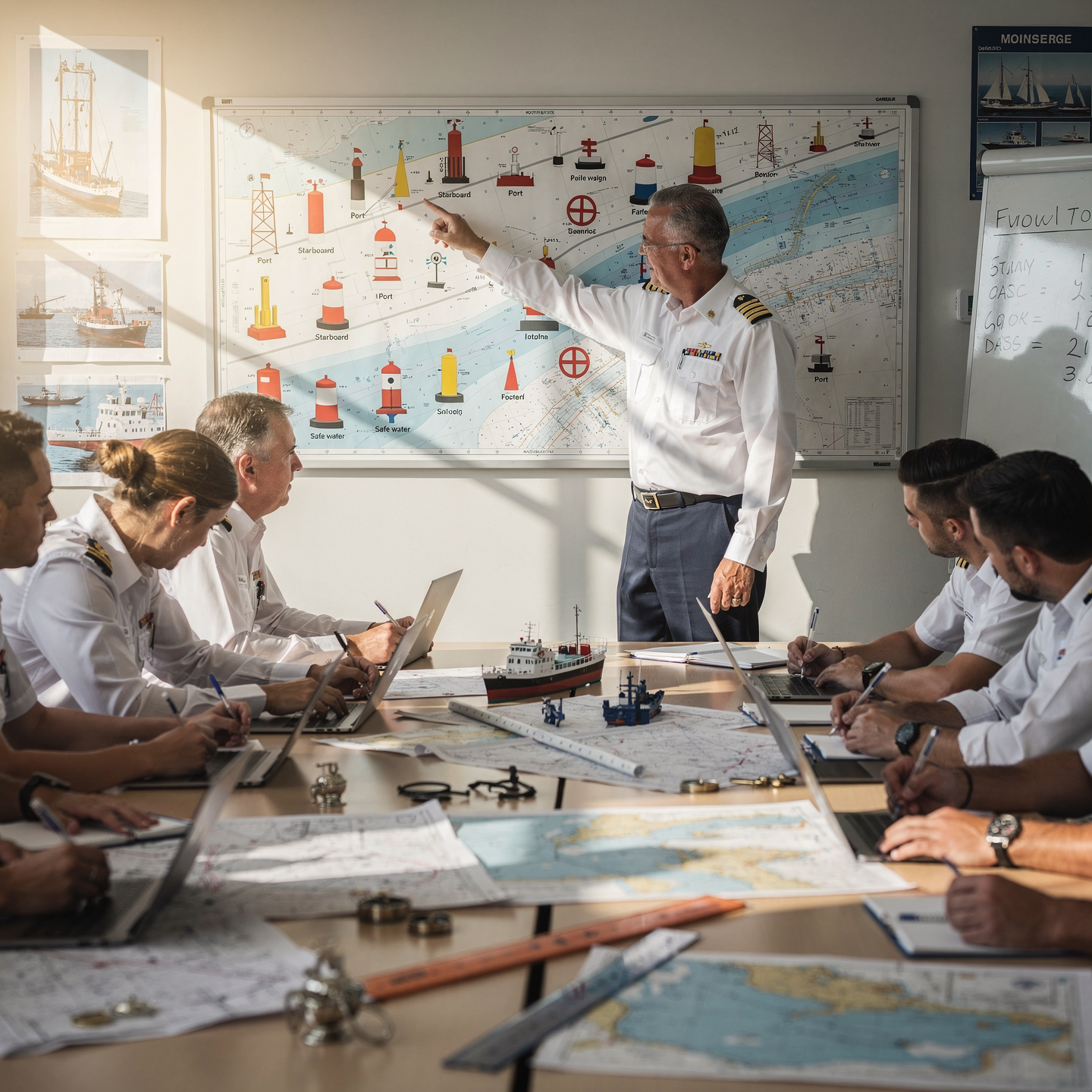
Navigation Signals and Regulations Course
Why this course?
The Navigation Signals and Regulations course
This is your essential guide to mastering maritime signals and rules, ensuring safe and efficient navigation. Learn to interpret visual and sound signals, understand maritime traffic rules, and avoid collisions. This program provides you with the critical knowledge to operate vessels responsibly and in accordance with international regulations.
Navigation Signals and Regulations
Key Benefits
- Accurate Interpretation: Identify and understand day and night navigational signals.
- Up-to-date Regulations: Know the latest amendments to the International Rules for Preventing Collisions at Sea (COLREGs).
- Maritime Safety: Apply the rules to prevent accidents and protect life at sea.
- Regulatory Compliance: Ensure compliance with regulations to avoid penalties and legal problems.
- Navigational Confidence: Develop the ability to make informed and safe decisions in any situation.
- Modality: Online
- Level: Cursos
- Hours: 150 H
- Start date: 24-07-2026
Availability: 1 in stock
Who is it aimed at?
- Recreational and professional sailors who wish to fully understand the IALA buoyage system and avoid misinterpretations.
- Candidates for nautical qualifications (PER, Yacht Skipper, Yacht Captain) who seek to strengthen their theoretical knowledge and apply it in practical navigation.
- Members of yacht clubs and sailing schools interested in updating their knowledge of the latest regulatory changes.
- Maritime professionals (fishermen, divers, tour boat operators) who need to ensure safety in their operations.
- Sailing enthusiasts who wish to sail with greater safety and confidence, correctly interpreting the signals and lights.
Learning Flexibility
Access the content at your own pace: downloadable material, practical exercises, and online Q&A to adapt the course to your schedule.
Objectives and competencies

Correctly interpreting maritime signals:
“Identify, interpret and act upon visual, acoustic and electronic signals (AIS, radio), integrating the information with radar and the tactical situation for safe navigation.”

Apply international maritime regulations to prevent collisions:
“Identify risk scenarios, apply rules of direction and governance, and communicate intentions clearly.”

Use nautical charts and publications for safe navigation:
Interpret cartographic information (depths, hazards, navigational aids) and consult relevant nautical publications (sailing directions, notices to mariners) for the planning and execution of the voyage.

Use navigation and communication equipment to ensure safety at sea:
“To efficiently use communication systems, including VHF radio and other means, to transmit and receive information relevant to maritime safety, reporting incidents and requesting assistance when necessary.”

Navigate safely in diverse conditions and environments:
“Interpret meteorological and oceanographic information, adapting navigation to the actual sea conditions.”

Comply with current regulations for responsible and safe navigation:
“Use the communications equipment (VHF/DSC) correctly for safety, distress, and coordination alerts.”
Curriculum - Modules
- Comprehensive Maritime Incident Management: protocols, roles, and chain of command for coordinated response
- Operational Planning and Execution: briefing, routes, weather windows, and go/no-go criteria
- Rapid Risk Assessment: criticality matrix, scene control, and decision-making under pressure
- Operational Communication: VHF/GMDSS, standardized reports, and inter-agency liaison
- Tactical Mobility and Safe Boarding: RHIB maneuvers, approach, mooring, and recovery
- Equipment and Technologies: PPE, signaling, satellite tracking, and field data logging
- Immediate Care of the Affected: primary assessment, hypothermia, trauma, and stabilization for evacuation
- Adverse Environmental Conditions: swell, Visibility, flows, and operational mitigation
Simulation and training: critical scenarios, use of VR/AR, and exercises with performance metrics
Documentation and continuous improvement: lessons learned, indicators (MTTA/MTTR), and SOP updates
- Definition and purpose of maritime signaling: aid to navigation, safety, and environmental protection.
- Types of maritime signals: buoys (cardinal, lateral, isolated hazards, safe waters, special), beacons, lighthouses, leading lights, and sound signals.
- IALA Marine Buoyage Systems: Regions A and B, characteristics of lights, colors, and topmarks.
- International regulations: SOLAS Convention, IMO, IMO, and national regulations on maritime signaling.
- Nautical charts and publications: importance of accurate and up-to-date information on aids to navigation.
- Operation and maintenance of maritime signals: power sources, monitoring systems, and responsibilities.
- Electronic aids to navigation
Navigation: AIS (Automatic Identification System), DGPS (Differential Global Positioning System), and radar.
Coastal navigation: Use of maritime signals to determine position and plan safe routes.
Maritime safety: Identification of hazards, collision risks, and emergency procedures.
Notifications to Mariners (NOTAMs): Information on temporary or permanent changes to maritime signaling.
‘
- Introduction to Maritime Signaling: Purpose and Classification
- IALA Marine Buoyage System: Regions A and B, Mark Characteristics
- Buoys: Cardinal, Lateral, Isolated Danger, Safe Water, Special
- Lighthouses: Light Characteristics, Sectors, Nominal and Geographic Range
- Lead Marks: Types, Use in Navigation, Position Calculation
- Radio Beacons and Radio Beacons: Operating Principles, Limitations
- Automatic Identification Systems (AIS): Base Stations, Virtual Aids to Navigation (AtoN)
- Nautical Charts: Representation of Navigational Aids, Corrections
- Publications Nautical Notices: Notices to Mariners, Sailing Directions, Lighthouse Lists
International and National Regulations: Responsibilities, Updates, and Penalties
‘
- Introduction to Maritime Signaling: History, Purpose, and Evolution
- IALA Marine Buoyage Systems: Regions A and B, Characteristics and Differences
- Buoys: Types, Shapes, Colors, Topmarks, and Light Signals
- Lateral Marks: Interpretation of Port and Starboard Marks in Channels and Passages
- Cardinal Marks: Identification and Use to Indicate Navigable Waters and Hazards
- Isolated Danger Marks: Characteristics and Meaning for Avoiding Specific Risks
- Safe Water Marks and Special Marks: Purpose and Application in Navigation
- Lighthouses: Light Characteristics, Sectors, Nominal and Geographic Range
- Radio Beacons and Differential Positioning Systems: Operation and Usefulness.
- Maintenance and updating of nautical charts and related publications.
‘
- Introduction to Maritime Signaling: Purpose, Types, and Systems
- IALA Marine Buoyage System: Regions A and B, Characteristics, and Use
- Buoys: Types, Shapes, Colors, Topmarks, and Lights
- Cardinal Marks: Identification and Meaning According to the Cardinal Point
- Late Marks: Identification and Meaning in Channels and Ports
- Isolated Danger, Safe Water, and Special Marks: Characteristics and Purpose
- Lighthouses: Light Characteristics, Sectors, and Nominal and Geographic Range
- Radio Beacons and Differential Positioning Systems: Principles and Use
- Nautical Charts and Nautical Publications: Interpretation of Symbols and Abbreviations Related to Maritime Signaling
- International and National Standards on Maritime Signaling: Conventions, Directives and Regulations
‘
- System Architecture and Components: Structural design, materials, and subsystems (mechanical, electrical, electronic, and fluid) with selection and assembly criteria for marine environments
- Fundamentals and Principles of Operation: Physical and engineering foundations (thermodynamics, fluid mechanics, electricity, control, and materials) that explain performance and operating limits
- Safety and Environmental (SHE): Risk analysis, PPE, LOTO, hazardous atmospheres, spill and waste management, and emergency response plans
- Applicable Regulations and Standards: IMO/ISO/IEC requirements and local regulations;
- Conformance criteria, certification, and best practices for operation and maintenance
- Inspection, testing, and diagnostics: Visual/dimensional inspection, functional testing, data analysis, and predictive techniques (vibration, thermography, fluid analysis) to identify root causes
- Preventive and predictive maintenance: Hourly/cycle/seasonal plans, lubrication, adjustments, calibrations, consumable replacement, post-service verification, and operational reliability
- Instrumentation, tools, and metrology: Measuring and testing equipment, diagnostic software, calibration and traceability; selection criteria, safe use, and storage
- Onboard integration and interfaces: Mechanical, electrical, fluid, and data compatibility; Sealing and watertightness, EMC/EMI, corrosion protection, and interoperability testing.
Quality, acceptance testing, and commissioning: process and materials control, FAT/SAT, bench and sea trials, go/no-go criteria, and evidence documentation.
Technical documentation and integrated practice: logs, checklists, reports, and a complete case study (safety ā diagnosis ā intervention ā verification ā report) applicable to any system.
Plan de estudio - Módulos
- Comprehensive Maritime Incident Management: protocols, roles, and chain of command for coordinated response
- Operational Planning and Execution: briefing, routes, weather windows, and go/no-go criteria
- Rapid Risk Assessment: criticality matrix, scene control, and decision-making under pressure
- Operational Communication: VHF/GMDSS, standardized reports, and inter-agency liaison
- Tactical Mobility and Safe Boarding: RHIB maneuvers, approach, mooring, and recovery
- Equipment and Technologies: PPE, signaling, satellite tracking, and field data logging
- Immediate Care of the Affected: primary assessment, hypothermia, trauma, and stabilization for evacuation
- Adverse Environmental Conditions: swell, Visibility, flows, and operational mitigation
Simulation and training: critical scenarios, use of VR/AR, and exercises with performance metrics
Documentation and continuous improvement: lessons learned, indicators (MTTA/MTTR), and SOP updates
- Definition and purpose of maritime signaling: aid to navigation, safety, and environmental protection.
- Types of maritime signals: buoys (cardinal, lateral, isolated hazards, safe waters, special), beacons, lighthouses, leading lights, and sound signals.
- IALA Marine Buoyage Systems: Regions A and B, characteristics of lights, colors, and topmarks.
- International regulations: SOLAS Convention, IMO, IMO, and national regulations on maritime signaling.
- Nautical charts and publications: importance of accurate and up-to-date information on aids to navigation.
- Operation and maintenance of maritime signals: power sources, monitoring systems, and responsibilities.
- Electronic aids to navigation
Navigation: AIS (Automatic Identification System), DGPS (Differential Global Positioning System), and radar.
Coastal navigation: Use of maritime signals to determine position and plan safe routes.
Maritime safety: Identification of hazards, collision risks, and emergency procedures.
Notifications to Mariners (NOTAMs): Information on temporary or permanent changes to maritime signaling.
‘
- Introduction to Maritime Signaling: Purpose and Classification
- IALA Marine Buoyage System: Regions A and B, Mark Characteristics
- Buoys: Cardinal, Lateral, Isolated Danger, Safe Water, Special
- Lighthouses: Light Characteristics, Sectors, Nominal and Geographic Range
- Lead Marks: Types, Use in Navigation, Position Calculation
- Radio Beacons and Radio Beacons: Operating Principles, Limitations
- Automatic Identification Systems (AIS): Base Stations, Virtual Aids to Navigation (AtoN)
- Nautical Charts: Representation of Navigational Aids, Corrections
- Publications Nautical Notices: Notices to Mariners, Sailing Directions, Lighthouse Lists
International and National Regulations: Responsibilities, Updates, and Penalties
‘
- Introduction to Maritime Signaling: History, Purpose, and Evolution
- IALA Marine Buoyage Systems: Regions A and B, Characteristics and Differences
- Buoys: Types, Shapes, Colors, Topmarks, and Light Signals
- Lateral Marks: Interpretation of Port and Starboard Marks in Channels and Passages
- Cardinal Marks: Identification and Use to Indicate Navigable Waters and Hazards
- Isolated Danger Marks: Characteristics and Meaning for Avoiding Specific Risks
- Safe Water Marks and Special Marks: Purpose and Application in Navigation
- Lighthouses: Light Characteristics, Sectors, Nominal and Geographic Range
- Radio Beacons and Differential Positioning Systems: Operation and Usefulness.
- Maintenance and updating of nautical charts and related publications.
‘
- Introduction to Maritime Signaling: Purpose, Types, and Systems
- IALA Marine Buoyage System: Regions A and B, Characteristics, and Use
- Buoys: Types, Shapes, Colors, Topmarks, and Lights
- Cardinal Marks: Identification and Meaning According to the Cardinal Point
- Late Marks: Identification and Meaning in Channels and Ports
- Isolated Danger, Safe Water, and Special Marks: Characteristics and Purpose
- Lighthouses: Light Characteristics, Sectors, and Nominal and Geographic Range
- Radio Beacons and Differential Positioning Systems: Principles and Use
- Nautical Charts and Nautical Publications: Interpretation of Symbols and Abbreviations Related to Maritime Signaling
- International and National Standards on Maritime Signaling: Conventions, Directives and Regulations
‘
- System Architecture and Components: Structural design, materials, and subsystems (mechanical, electrical, electronic, and fluid) with selection and assembly criteria for marine environments
- Fundamentals and Principles of Operation: Physical and engineering foundations (thermodynamics, fluid mechanics, electricity, control, and materials) that explain performance and operating limits
- Safety and Environmental (SHE): Risk analysis, PPE, LOTO, hazardous atmospheres, spill and waste management, and emergency response plans
- Applicable Regulations and Standards: IMO/ISO/IEC requirements and local regulations;
- Conformance criteria, certification, and best practices for operation and maintenance
- Inspection, testing, and diagnostics: Visual/dimensional inspection, functional testing, data analysis, and predictive techniques (vibration, thermography, fluid analysis) to identify root causes
- Preventive and predictive maintenance: Hourly/cycle/seasonal plans, lubrication, adjustments, calibrations, consumable replacement, post-service verification, and operational reliability
- Instrumentation, tools, and metrology: Measuring and testing equipment, diagnostic software, calibration and traceability; selection criteria, safe use, and storage
- Onboard integration and interfaces: Mechanical, electrical, fluid, and data compatibility; Sealing and watertightness, EMC/EMI, corrosion protection, and interoperability testing.
Quality, acceptance testing, and commissioning: process and materials control, FAT/SAT, bench and sea trials, go/no-go criteria, and evidence documentation.
Technical documentation and integrated practice: logs, checklists, reports, and a complete case study (safety ā diagnosis ā intervention ā verification ā report) applicable to any system.
- Introduction to Maritime Signaling: Types, Purposes, and Historical Evolution
- Visual Aids to Navigation: Buoys, Beacons, Lighthouses, Navigation Lights
- Auditory Aids to Navigation: Fog Signals, Sirens, Fog Marks
- Global Positioning Systems (GNSS) and Their Application in Maritime Navigation
- Automatic Identification Systems (AIS): Operation, Information, and Applications
- Vessel Traffic Services (VTS): Objectives, Functions, and Procedures
- International Maritime Legislation: SOLAS, COLREG, and MARPOL Conventions
- National Maritime Legislation: Maritime Authorities, Ship Registry, and Nautical Qualifications
- Civil Liability and Maritime Insurance: P&I Clubs, Hull and Machinery Insurance
Maritime Sanctions Regime: Infringements, Sanctions and Procedures
‘
- Introduction to Maritime Signaling: Types and Purpose
- Aids to Navigation (AtoN): Buoys, Beacons, Leading Marks, Lights
- IALA Buoyage Systems: Regions A and B, Characteristics and Meanings
- Nautical Charts and Nautical Publications: Identification and Use
- International Regulations: IMO, IALA, Local Authorities
- General Regulations for Lighthouses: Demarcation and Maintenance
- Basic Maneuvers: Steering, Turning, Berthing and Unberthing
- Maneuvers in Adverse Conditions: Wind, Current, Reduced Visibility
- Maritime Communications: VHF, DSC, GMDSS, procedures
- Emergency procedures: man overboard, fire, collision
‘
- Introduction to Maritime Signaling: Purpose and Types of Signals
- IALA Marine Buoyage System: Regions A and B, Mark Characteristics
- Buoys: Cardinal, Lateral, Isolated Danger, Safe Water, Special
- Lighthouses: Light Characteristics, Sectors, Nominal and Geographic Range
- Lead Marks: Types, Use in Navigation, Maintaining the Line
- Radio Beacons and Radio Beacons: Operation, Use in Navigation, Limitations
- Automatic Identification Systems (AIS): Virtual and Real Aids to Navigation (AtoN)
- Nautical Publications: Lighthouses and Signals, Sailing Directions, Notices to the mariners
- International regulations: IMO, IALA, responsibilities of coastal States
- Maintenance and upgrading of maritime signaling: inspections and repairs
‘
- Definitions and Purposes of Maritime Signaling
- IALA Maritime Buoyage System: Regions A and B, Types of Marks
- Buoys: Cardinal, Lateral, Isolated Danger, Safe Water, Special
- Lighthouses: Characteristics, Sectors, Range, Lighthouse Charts
- Radio Beacons and Differential Positioning Systems: Operation and Use
- Automatic Identification Systems (AIS): Virtual Navigational Aids (AIS AtoN)
- International Regulations for Preventing Collisions at Sea (COLREGs): Ship’s Lights and Shapes
- National and International Regulations: Laws and Regulations on Maritime Signaling
Maintenance and Verification of Maritime Signaling
New Technologies in Maritime Signaling: Smart Buoys and Remote Systems
‘
Career opportunities
- Maritime Signaling Systems Operator: Maintenance and operation of lighthouses, buoys, and other navigational aids.
- Navigation Aids Inspector: Verification of compliance with regulations and quality standards in maritime signaling.
- Signaling Systems Design and Installation Technician: Planning, design, and implementation of new maritime signaling systems.
- Maritime Cartographer: Preparation and updating of nautical charts and publications related to navigational safety.
- Maritime Traffic Controller: Supervision and management of maritime traffic in port areas and navigation channels.
- Maritime Regulations Trainer: Instructor in training courses for mariners and personnel related to maritime safety.
- Maritime Safety Consultant: Advising on Companies and public bodies involved in navigational safety and regulatory compliance.
- Maritime Accident Investigator: Analysis of causes and contributing factors in maritime accidents related to signaling and regulatory compliance.
“`
Admission requirements

Academic/professional profile:
Degree/Bachelor's degree in Nautical Science/Maritime Transport, Naval/Marine Engineering, or a related field; or proven professional experience in bridge/operations.

Language proficiency:
Recommended functional maritime English (SMCP) for simulations and technical materials.

5. Induction
Updated resume, copy of degree or seaman's book, ID card/passport, letter of motivation.

Technical requirements (for online):
Equipment with camera/microphone, stable connection, ā„ 24ā monitor recommended for ECDIS/Radar-ARPA.
Admission process and dates

1. Online
application
(form + documents).

2. Academic review and interview
(profile/objectives/schedule compatibility).

3. Admission decision
(+ scholarship proposal if applicable).

4. Reservation of place
(deposit) and registration.

5. Induction
(access to campus, calendars, simulator guides).
Scholarships and grants
- Mastery of Signals: Learn to identify and understand maritime navigation signals, crucial for safe and efficient navigation.
- Up-to-date Regulations: Stay up-to-date with the latest international regulations and rules governing navigation to avoid penalties and ensure compliance.
- Collision Prevention: Acquire skills to apply the International Regulations for Preventing Collisions at Sea (COLREGs) and avoid accidents at sea.
- Interpretation of Nautical Charts: Develop the ability to read and interpret nautical charts, identifying hazards and safe routes.
- Practical Simulations: Participate in simulation exercises to apply your knowledge in real-life scenarios and improve your decision-making.
Testimonials
I have fully mastered day and night navigational signals, including lights, shapes, and sounds. I have successfully applied the International Regulations for Preventing Collisions at Sea (COLREGs) in various simulated scenarios, demonstrating a thorough understanding of the rules of the road and steering. This allows me to navigate safely and efficiently, prioritizing collision avoidance.
I mastered the complex nuances of security legislation, successfully applying the principles learned to develop a comprehensive compliance program that reduced security incidents by 30% and ensured full regulatory compliance, protecting the company from potential penalties and improving overall security.
I fully mastered the IALA buoyage system, correctly applying lateral, cardinal, isolated danger, safe water, and special marks in various simulated navigation scenarios, achieving safe and efficient navigation according to the International Regulations for Preventing Collisions at Sea.
I have fully mastered the IALA buoyage system, including Regions A and B, and can accurately interpret daylight lights, shapes, and signals for safe navigation. Furthermore, I understand and can apply the International Regulations for Preventing Collisions at Sea (COLREGs), including heading and steering rules, lights and shapes, sound signals, and maneuvers in reduced visibility. My ability to apply this knowledge allows me to navigate safely and efficiently, anticipating and avoiding hazardous situations.

Frequently asked questions
It indicates safe waters that can be crossed.
Yes. The itinerary includes ECDIS/Radar-ARPA/BRM with harbor, ocean, fog, storm, and SAR scenarios.
Online with live sessions; hybrid option for simulator/practical placements through agreements.
Improve navigational safety by providing information and guidance to mariners.
Recommended functional SMCP. We offer support materials for standard phraseology.
Yes, with a relevant degree or experience in maritime/port operations. The admissions interview will confirm suitability.
Optional (3ā6 months) through Companies & Collaborations and the Alumni Network.
Simulator practice (rubrics), defeat plans, SOPs, checklists, micro-tests and applied TFM.
A degree from Navalis Magna University + operational portfolio (tracks, SOPs, reports and KPIs) useful for audits and employment.
- Definitions and Purposes of Maritime Signaling
- IALA Maritime Buoyage System: Regions A and B, Types of Marks
- Buoys: Cardinal, Lateral, Isolated Danger, Safe Water, Special
- Lighthouses: Characteristics, Sectors, Range, Lighthouse Charts
- Radio Beacons and Differential Positioning Systems: Operation and Use
- Automatic Identification Systems (AIS): Virtual Navigational Aids (AIS AtoN)
- International Regulations for Preventing Collisions at Sea (COLREGs): Ship’s Lights and Shapes
- National and International Regulations: Laws and Regulations on Maritime Signaling
Maintenance and Verification of Maritime Signaling
New Technologies in Maritime Signaling: Smart Buoys and Remote Systems
‘
Request information
- Complete the Application Form
- Attach your CV/Qualifications (if you have them to hand).
- Indicate your preferred cohort (January/May/September) and whether you want the hybrid option with simulator sessions.
Teachers
Eng. TomƔs Riera
Full Professor
Eng. TomƔs Riera
Full Professor
Eng. SofĆa Marquina
Full Professor
Eng. SofĆa Marquina
Full Professor
Eng. Javier BaƱuls
Full Professor
Eng. Javier BaƱuls
Full Professor
Dr. Nuria Llobregat
Full Professor
Dr. Nuria Llobregat
Full Professor
Dr. Pau Ferrer
Full Professor
Dr. Pau Ferrer
Full Professor
Cap. Javier Abaroa (MCA)
Full Professor
Cap. Javier Abaroa (MCA)
Full Professor

