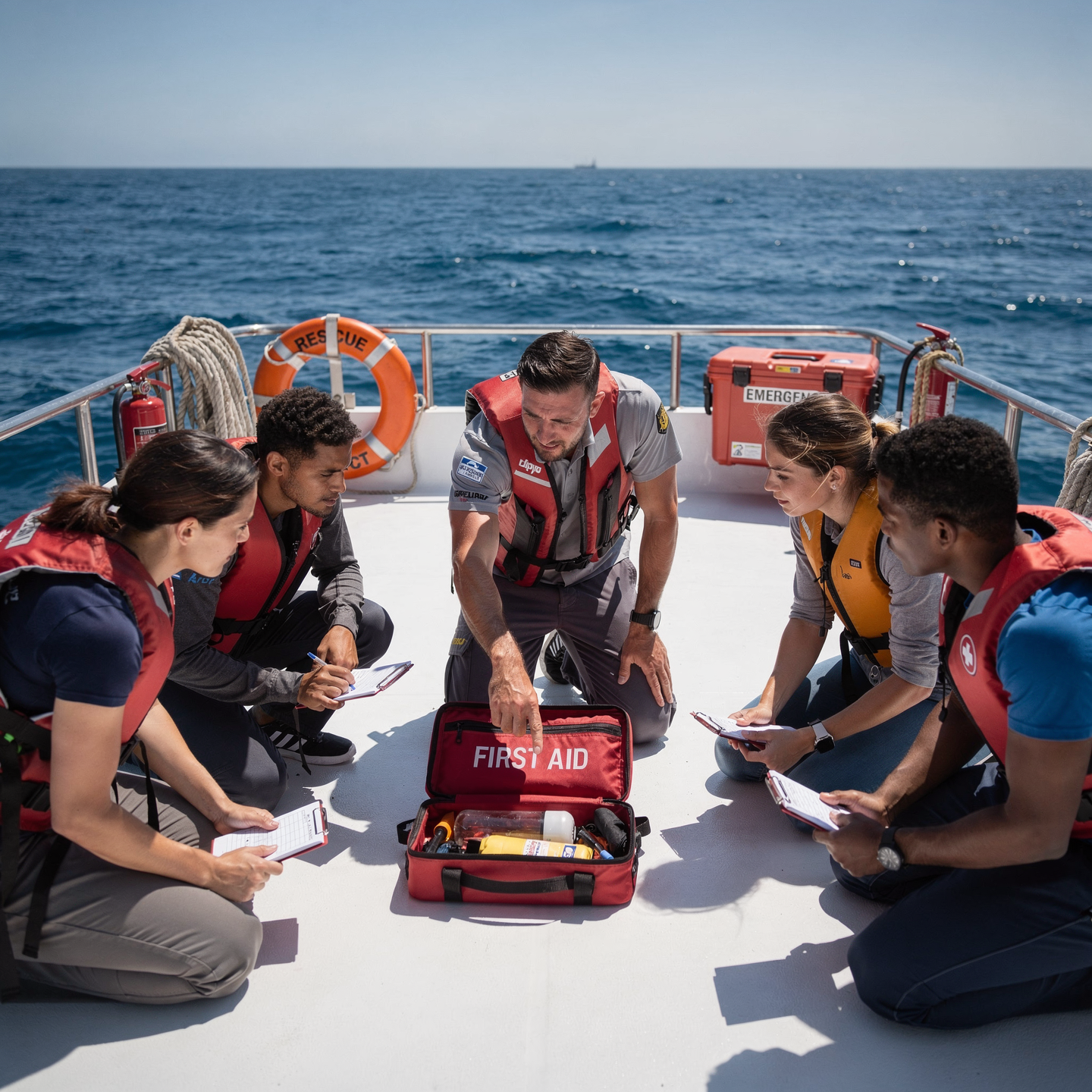
First aid course at sea

Why this course?

The First Aid at Sea

This course prepares you to respond confidently and effectively to medical emergencies in maritime environments. Learn essential techniques for stabilizing the injured, managing risk situations, and coordinating evacuation in adverse conditions. This program provides you with the knowledge and practical skills needed to save lives at sea.

Differential Advantages

  • Realistic Simulations: Practice in scenarios that replicate common emergency situations at sea.
  • Specialized Equipment: Familiarize yourself with the use of first aid equipment specifically designed for maritime environments.
  • Effective Communication: Learn to transmit crucial information to emergency services and coordinate the response.
  • Adaptation to the Environment: Develop skills to improvise and adapt first aid techniques to the limitations of the maritime environment.
  • Recognized Certification: Obtain a certification that validates your knowledge and skills in first aid at sea.
Primeros

First aid course at sea

Availability: 1 in stock

Who is it aimed at?

  • Recreational and professional vessel crew members who wish to acquire basic and advanced knowledge to respond effectively to medical emergencies at sea.
  • Fishing and sports vessel skippers who seek to strengthen their skills in the initial care of the injured and ill on board, until the arrival of professional medical assistance.
  • Maritime professionals (security, rescue, tourism) who need updated certification in first aid, CPR, and crisis management in isolated environments.
  • People who enjoy water sports (sailing, diving, kayaking) who wish to be prepared to provide immediate assistance in case of accidents or incidents on the water.
  • Residents of coastal areas who seek to acquire Practical tools for handling common medical emergencies in the maritime environment.

    Flexibility and hands-on learning.
    This course adapts to your pace: downloadable materials, explanatory videos, and realistic simulations to apply your knowledge in real-life situations.

Primeros

Objectives and competencies

Apply CPR and drowning management techniques in maritime environments:

“Effectively, prioritizing the safety of the victim and adapting techniques to the conditions of the maritime environment, using available equipment and requesting professional help.”

Identify and treat common onboard injuries, such as burns, fractures, and wounds:

“Assess the severity of the injury, apply first aid according to protocols (CPR, hemorrhage control), immobilize fractures, and coordinate medical evacuation if necessary.”

Effectively use onboard emergency and communications equipment to request and coordinate medical assistance:

“Operate VHF/HF/MF radio equipment, EPIRB radio beacons, SART responders and satellite communication systems (INMARSAT/IRIDIUM) following GMDSS procedures to transmit distress alerts, coordinate medical assistance with coastal control centers and nearby vessels, and maintain effective communications with medical personnel on land.”

Stabilizing and evacuating an injured or sick person in adverse maritime conditions:

“Prioritize the safety of the injured person and the crew, assessing environmental risks and optimizing effective communication with maritime rescue services.”

Preventing health risks and diseases arising from the specific conditions of the maritime environment:

“Implement hygiene and food safety protocols on board, controlling the quality of drinking water and managing waste according to MARPOL regulations.”

Quickly assess the medical emergency situation and prioritize care based on severity:

“Perform effective triage (START, SALT) and allocate resources appropriately according to the established protocol.”

Curriculum - Modules

  1. Comprehensive Maritime Incident Management: protocols, roles, and chain of command for coordinated response
  2. Operational Planning and Execution: briefing, routes, weather windows, and go/no-go criteria
  3. Rapid Risk Assessment: criticality matrix, scene control, and decision-making under pressure
  4. Operational Communication: VHF/GMDSS, standardized reports, and inter-agency liaison
  5. Tactical Mobility and Safe Boarding: RHIB maneuvers, approach, mooring, and recovery
  6. Equipment and Technologies: PPE, signaling, satellite tracking, and field data logging
  7. Immediate Care of the Affected: primary assessment, hypothermia, trauma, and stabilization for evacuation
  8. Adverse Environmental Conditions: swell, Visibility, flows, and operational mitigation

    Simulation and training: critical scenarios, use of VR/AR, and exercises with performance metrics

    Documentation and continuous improvement: lessons learned, indicators (MTTA/MTTR), and SOP updates

  1. Introduction to Basic Life Support (BLS) and First Aid at Sea
  2. Specific Considerations of the Maritime Environment: Unique Risks and Challenges
  3. Patient Assessment: Scene Safety, Primary and Secondary Assessment
  4. Cardiopulmonary Resuscitation (CPR) in Adults, Children, and Infants: Adaptations to the Marine Environment
  5. Use of the Automated External Defibrillator (AED): Maintenance and Application on Vessels
  6. Choking: Dislodgement Maneuvers at Different Ages
  7. Bleeding and Shock: Bleeding Control and Management of Hypovolemic Shock
  8. Common Injuries at Sea: Burns, Fractures, sprains, dislocations

    Sudden Illnesses: Heart attacks, strokes, diabetes
    Evacuation and Communication: Preparing for medical evacuation and requesting help

  1. Introduction to Life Support: Chain of Survival in the Maritime Environment
  2. Initial Patient Assessment: Safety, Consciousness, Breathing, Circulation
  3. Basic CPR in Adults, Children, and Infants: Chest Compressions, Ventilations
  4. Airway Management: Foreign Body Obstruction, Suctioning, Oropharyngeal Airways
  5. Use of the Automated External Defibrillator (AED): Safety, Indications, Contraindications
  6. Bleeding and Shock: Hemorrhage Control, Signs and Symptoms of Shock, Initial Treatment
  7. Common Traumatic Injuries in the Maritime Environment: Fractures, Sprains, Dislocations
  8. Immersion and Drowning: Pathophysiology, Resuscitation, Hypothermia

    Common medical emergencies on board: chest pain, respiratory distress, seizures, allergic reactions

    Special considerations in advanced life support in maritime environments: communication, evacuation, limited resources

  1. Introduction to Basic Life Support (BLS) and Advanced Life Support (ALS) in the maritime environment: particularities and challenges.
  2. Legal and ethical considerations in emergency medical care on board.
  3. Initial patient assessment: ABCDE (airway, breathing, circulation, disability, exposure).
  4. Airway management: manual techniques, basic devices (oropharyngeal and nasopharyngeal airways) and advanced devices (orotracheal intubation, laryngeal mask airway).
  5. Ventilation: oxygen therapy, bag-mask ventilation (Ambu bag), mechanical ventilation.
  6. Circulation: hemorrhage control, vascular access, fluid and medication administration.
  7. Basic and advanced cardiopulmonary resuscitation (CPR) Advanced: Updated algorithms, defibrillation.

    Emergency pharmacology: Essential medications in maritime BLS/ALS, routes of administration.

    Management of specific situations: Drowning, hypothermia, trauma, burns, medical emergencies (MI, stroke, anaphylaxis).

    Coordination and communication with remote emergency services and maritime control centers.

  1. Introduction to Maritime Emergencies: Types, Causes, and Consequences.
  2. Legislation and Regulations applicable to Maritime Emergencies.
  3. Personal Protective Equipment (PPE): Selection, Use, and Maintenance.
  4. Emergency Communication: Protocols, Terminology, and Equipment.
  5. Basic First Aid: Basic Life Support (BLS) and Hemorrhage Control.
  6. Water Rescue Techniques: Flotation, Towing, and Extraction.
  7. Firefighting on Board: Types of Fire, Extinguishing Agents, and Extinguishing Techniques.
  8. Damage Control: Identification, Assessment, and Temporary Repair of Damage.
  9. Hazardous Materials Incident Management (MP): Identification, risks, and procedures.

    Emergency Psychology: Stress management, communication with victims, and emotional support.

  1. System Architecture and Components: Structural design, materials, and subsystems (mechanical, electrical, electronic, and fluid) with selection and assembly criteria for marine environments
  2. Fundamentals and Principles of Operation: Physical and engineering foundations (thermodynamics, fluid mechanics, electricity, control, and materials) that explain performance and operating limits
  3. Safety and Environmental (SHE): Risk analysis, PPE, LOTO, hazardous atmospheres, spill and waste management, and emergency response plans
  4. Applicable Regulations and Standards: IMO/ISO/IEC requirements and local regulations;
  5. Conformance criteria, certification, and best practices for operation and maintenance
  6. Inspection, testing, and diagnostics: Visual/dimensional inspection, functional testing, data analysis, and predictive techniques (vibration, thermography, fluid analysis) to identify root causes
  7. Preventive and predictive maintenance: Hourly/cycle/seasonal plans, lubrication, adjustments, calibrations, consumable replacement, post-service verification, and operational reliability
  8. Instrumentation, tools, and metrology: Measuring and testing equipment, diagnostic software, calibration and traceability; selection criteria, safe use, and storage
  9. Onboard integration and interfaces: Mechanical, electrical, fluid, and data compatibility; Sealing and watertightness, EMC/EMI, corrosion protection, and interoperability testing.

    Quality, acceptance testing, and commissioning: process and materials control, FAT/SAT, bench and sea trials, go/no-go criteria, and evidence documentation.

    Technical documentation and integrated practice: logs, checklists, reports, and a complete case study (safety → diagnosis → intervention → verification → report) applicable to any system.

Plan de estudio - Módulos

  1. Comprehensive Maritime Incident Management: protocols, roles, and chain of command for coordinated response
  2. Operational Planning and Execution: briefing, routes, weather windows, and go/no-go criteria
  3. Rapid Risk Assessment: criticality matrix, scene control, and decision-making under pressure
  4. Operational Communication: VHF/GMDSS, standardized reports, and inter-agency liaison
  5. Tactical Mobility and Safe Boarding: RHIB maneuvers, approach, mooring, and recovery
  6. Equipment and Technologies: PPE, signaling, satellite tracking, and field data logging
  7. Immediate Care of the Affected: primary assessment, hypothermia, trauma, and stabilization for evacuation
  8. Adverse Environmental Conditions: swell, Visibility, flows, and operational mitigation

    Simulation and training: critical scenarios, use of VR/AR, and exercises with performance metrics

    Documentation and continuous improvement: lessons learned, indicators (MTTA/MTTR), and SOP updates

  1. Introduction to Basic Life Support (BLS) and First Aid at Sea
  2. Specific Considerations of the Maritime Environment: Unique Risks and Challenges
  3. Patient Assessment: Scene Safety, Primary and Secondary Assessment
  4. Cardiopulmonary Resuscitation (CPR) in Adults, Children, and Infants: Adaptations to the Marine Environment
  5. Use of the Automated External Defibrillator (AED): Maintenance and Application on Vessels
  6. Choking: Dislodgement Maneuvers at Different Ages
  7. Bleeding and Shock: Bleeding Control and Management of Hypovolemic Shock
  8. Common Injuries at Sea: Burns, Fractures, sprains, dislocations

    Sudden Illnesses: Heart attacks, strokes, diabetes
    Evacuation and Communication: Preparing for medical evacuation and requesting help

  1. Introduction to Life Support: Chain of Survival in the Maritime Environment
  2. Initial Patient Assessment: Safety, Consciousness, Breathing, Circulation
  3. Basic CPR in Adults, Children, and Infants: Chest Compressions, Ventilations
  4. Airway Management: Foreign Body Obstruction, Suctioning, Oropharyngeal Airways
  5. Use of the Automated External Defibrillator (AED): Safety, Indications, Contraindications
  6. Bleeding and Shock: Hemorrhage Control, Signs and Symptoms of Shock, Initial Treatment
  7. Common Traumatic Injuries in the Maritime Environment: Fractures, Sprains, Dislocations
  8. Immersion and Drowning: Pathophysiology, Resuscitation, Hypothermia

    Common medical emergencies on board: chest pain, respiratory distress, seizures, allergic reactions

    Special considerations in advanced life support in maritime environments: communication, evacuation, limited resources

  1. Introduction to Basic Life Support (BLS) and Advanced Life Support (ALS) in the maritime environment: particularities and challenges.
  2. Legal and ethical considerations in emergency medical care on board.
  3. Initial patient assessment: ABCDE (airway, breathing, circulation, disability, exposure).
  4. Airway management: manual techniques, basic devices (oropharyngeal and nasopharyngeal airways) and advanced devices (orotracheal intubation, laryngeal mask airway).
  5. Ventilation: oxygen therapy, bag-mask ventilation (Ambu bag), mechanical ventilation.
  6. Circulation: hemorrhage control, vascular access, fluid and medication administration.
  7. Basic and advanced cardiopulmonary resuscitation (CPR) Advanced: Updated algorithms, defibrillation.

    Emergency pharmacology: Essential medications in maritime BLS/ALS, routes of administration.

    Management of specific situations: Drowning, hypothermia, trauma, burns, medical emergencies (MI, stroke, anaphylaxis).

    Coordination and communication with remote emergency services and maritime control centers.

  1. Introduction to Maritime Emergencies: Types, Causes, and Consequences.
  2. Legislation and Regulations applicable to Maritime Emergencies.
  3. Personal Protective Equipment (PPE): Selection, Use, and Maintenance.
  4. Emergency Communication: Protocols, Terminology, and Equipment.
  5. Basic First Aid: Basic Life Support (BLS) and Hemorrhage Control.
  6. Water Rescue Techniques: Flotation, Towing, and Extraction.
  7. Firefighting on Board: Types of Fire, Extinguishing Agents, and Extinguishing Techniques.
  8. Damage Control: Identification, Assessment, and Temporary Repair of Damage.
  9. Hazardous Materials Incident Management (MP): Identification, risks, and procedures.

    Emergency Psychology: Stress management, communication with victims, and emotional support.

  1. System Architecture and Components: Structural design, materials, and subsystems (mechanical, electrical, electronic, and fluid) with selection and assembly criteria for marine environments
  2. Fundamentals and Principles of Operation: Physical and engineering foundations (thermodynamics, fluid mechanics, electricity, control, and materials) that explain performance and operating limits
  3. Safety and Environmental (SHE): Risk analysis, PPE, LOTO, hazardous atmospheres, spill and waste management, and emergency response plans
  4. Applicable Regulations and Standards: IMO/ISO/IEC requirements and local regulations;
  5. Conformance criteria, certification, and best practices for operation and maintenance
  6. Inspection, testing, and diagnostics: Visual/dimensional inspection, functional testing, data analysis, and predictive techniques (vibration, thermography, fluid analysis) to identify root causes
  7. Preventive and predictive maintenance: Hourly/cycle/seasonal plans, lubrication, adjustments, calibrations, consumable replacement, post-service verification, and operational reliability
  8. Instrumentation, tools, and metrology: Measuring and testing equipment, diagnostic software, calibration and traceability; selection criteria, safe use, and storage
  9. Onboard integration and interfaces: Mechanical, electrical, fluid, and data compatibility; Sealing and watertightness, EMC/EMI, corrosion protection, and interoperability testing.

    Quality, acceptance testing, and commissioning: process and materials control, FAT/SAT, bench and sea trials, go/no-go criteria, and evidence documentation.

    Technical documentation and integrated practice: logs, checklists, reports, and a complete case study (safety → diagnosis → intervention → verification → report) applicable to any system.

  1. Introduction to urgent healthcare in the maritime environment: challenges and specificities.
  2. Patient assessment: ABCDE in the maritime environment, triage, and prioritization.
  3. Basic life support (BLS): CPR in adults, children, and infants; use of an AED in maritime conditions.
  4. Trauma: management of wounds, fractures, bleeding, and burns at sea.
  5. Common illnesses at sea: seasickness, dehydration, hypothermia, and hyperthermia; Prevention and treatment.
  6. Drowning and aquatic rescue: rescue techniques, management of the drowning patient, and complications.

    Poisoning: identification and management of chemical poisonings, stings, and marine bites.

    Communications and telemedicine: requesting medical assistance, use of radio and remote communication systems.

    Medical equipment on board: first aid kit, immobilization equipment, and oxygen therapy.

    Legal and ethical aspects of emergency healthcare in the maritime environment.

  1. Introduction to Life Support: Definitions and Objectives in Maritime Environments.
  2. Patient Assessment: Recognizing Vital Signs and Level of Consciousness.
  3. Basic CPR: Chest Compressions and Mouth-to-Mouth/Mask Ventilation.
  4. Airway Management: Opening, Clearing, and Basic Devices.
  5. Automated External Defibrillation (AED): Safe and Effective Use.
  6. Foreign Body Airway Obstruction (FBAO): Heimlich Maneuvers in Adults, Children, and Infants.
  7. Advanced Life Support: Updated Algorithms and Protocols.
  8. Drug Administration: Routes of Administration and Special Considerations at Sea.
  9. Management of Arrhythmias: Recognition and initial treatment.

    Special considerations in marine environments: Hypothermia, drowning, and injuries from marine fauna.

  1. Introduction to Basic Life Support: Definition, Objectives, and Scope.
  2. Basic Anatomy and Physiology: Cardiovascular, Respiratory, and Nervous Systems.
  3. Initial Patient Assessment: ABCDE (Airway, Breathing, Circulation, Neurological Deficit, Exposure).
  4. Cardiopulmonary Resuscitation (CPR): Techniques in Adults, Children, and Infants.
  5. Airway Obstruction: Maneuvers for choking in Different Age Groups.
  6. Use of the Automated External Defibrillator (AED): Indications, Contraindications, and Procedure.
  7. Common Medical Emergencies on Board: Heart Attack, Stroke, Allergic Reactions, Hypoglycemia.
  8. Trauma In the maritime environment: Management of wounds, fractures, burns, and head injuries.

    Hypothermia and hyperthermia: Prevention, recognition, and treatment.

    Emergency communication and coordination: Distress calls, key information to transmit.

  1. Basic Anatomy and Physiology: Cardiovascular, Respiratory, and Nervous Systems
  2. Patient Assessment: Vital Signs, Level of Consciousness, ABCDEs
  3. Basic CPR: Chest Compressions, Mouth-to-Mouth/Mask Ventilation
  4. Automated External Defibrillation (AED): Indications, Safe Use
  5. Airway Obstruction: Heimlich Maneuver, Infant Protocol
  6. Hemorrhage and Shock: Bleeding Control, Management of Hypovolemic Shock
  7. Trauma: Assessment and Initial Management of Bone and Joint Injuries
  8. Burns: Classification, Initial Treatment, and Specific Considerations in the Marine Environment
  9. Common medical emergencies at sea: hypothermia, drowning, injuries from marine wildlife.
  10. Emergency communications: distress call, communication protocol with rescue centers.

Career opportunities

  • Crew Member: Cruise ships, merchant ships, fishing boats, yachts, etc.
  • Lifeguard at beaches and seaside pools: Surveillance, prevention, and emergency response.
  • Personnel of recreational craft: Sailors, skippers, maintenance and safety personnel.
  • Member of maritime rescue teams: Maritime Rescue, Red Cross at Sea, Civil Protection.
  • Instructor of maritime safety and first aid courses: Training for professionals in the sector.
  • Personnel of diving centers and water sports activities: Guides, instructors, and support staff.
  • Worker on oil platforms and offshore wind farms: Safety and emergency personnel.
  • Support staff in aquatic sporting events: Sailing competitions, open water swimming, triathlons.

    “`

Admission requirements

Academic/professional profile:

Degree/Bachelor's degree in Nautical Science/Maritime Transport, Naval/Marine Engineering, or a related field; or proven professional experience in bridge/operations.

Language proficiency:

Recommended functional maritime English (SMCP) for simulations and technical materials.

5. Induction

Updated resume, copy of degree or seaman's book, ID card/passport, letter of motivation.

Technical requirements (for online):

Equipment with camera/microphone, stable connection, ≥ 24” monitor recommended for ECDIS/Radar-ARPA.

Admission process and dates

1. Online
application

(form + documents).

2. Academic review and interview

(profile/objectives/schedule compatibility).

3. Admission decision

(+ scholarship proposal if applicable).

4. Reservation of place

(deposit) and registration.

5. Induction

(access to campus, calendars, simulator guides).

Scholarships and grants

  • Life Skills: Master CPR, hemorrhage control, and burn management techniques applied to the maritime environment.
  • Emergency Protocols: Learn to act quickly and effectively in the event of injuries, hypothermia, and dehydration on board.
  • Onboard First Aid Kit: Know the essential contents and correct use of medications and first aid supplies at sea.
  • Communications: Establish effective contact with rescue services and transmit vital information about the situation and the patient’s condition.
  • Survival: Acquire skills to ensure the stability of the injured person and optimize their chances of rescue under adverse conditions.
Be prepared to respond in the event of any eventuality and guarantees the safety and well-being of the crew.

Testimonials

Frequently asked questions

Get her out of the water as quickly and safely as possible, prioritizing the rescuer’s safety.

Yes. The itinerary includes ECDIS/Radar-ARPA/BRM with harbor, ocean, fog, storm, and SAR scenarios.

Online with live sessions; hybrid option for simulator/practical placements through agreements.

Recommended functional SMCP. We offer support materials for standard phraseology.

Yes, with a relevant degree or experience in maritime/port operations. The admissions interview will confirm suitability.

Optional (3–6 months) through Companies & Collaborations and the Alumni Network.

Simulator practice (rubrics), defeat plans, SOPs, checklists, micro-tests and applied TFM.

A degree from Navalis Magna University + operational portfolio (tracks, SOPs, reports and KPIs) useful for audits and employment.

  1. Basic Anatomy and Physiology: Cardiovascular, Respiratory, and Nervous Systems
  2. Patient Assessment: Vital Signs, Level of Consciousness, ABCDEs
  3. Basic CPR: Chest Compressions, Mouth-to-Mouth/Mask Ventilation
  4. Automated External Defibrillation (AED): Indications, Safe Use
  5. Airway Obstruction: Heimlich Maneuver, Infant Protocol
  6. Hemorrhage and Shock: Bleeding Control, Management of Hypovolemic Shock
  7. Trauma: Assessment and Initial Management of Bone and Joint Injuries
  8. Burns: Classification, Initial Treatment, and Specific Considerations in the Marine Environment
  9. Common medical emergencies at sea: hypothermia, drowning, injuries from marine wildlife.
  10. Emergency communications: distress call, communication protocol with rescue centers.

Request information

  1. Complete the Application Form
  2. Attach your CV/Qualifications (if you have them to hand).
  3. Indicate your preferred cohort (January/May/September) and whether you want the hybrid option with simulator sessions.
An academic advisor will contact you within 24–48 hours to guide you through the admission process, scholarships, and compatibility with your professional schedule. Translated with DeepL.com (free version)
Please enable JavaScript in your browser to complete this form.
Click or drag a file to this area to upload.

Teachers

0
    0
    Tu carrito
    Tu carrito esta vacíoRegresar a la tienda
    Scroll to Top


