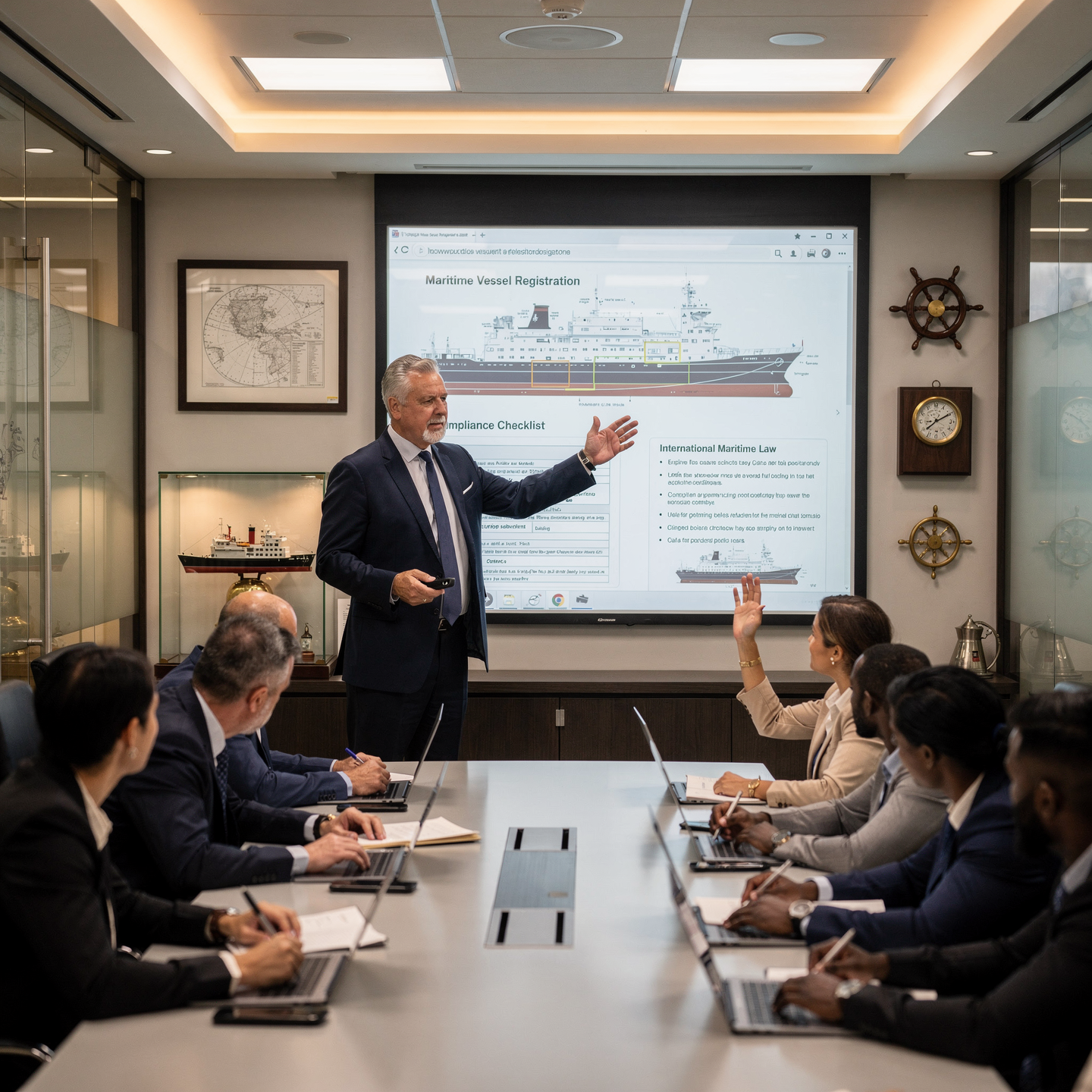
Course on legal documentation for vessels
Why this course?
The Vessel Legal Documentation
course
This course offers you a comprehensive guide to safely navigating the complex world of maritime law. You will learn to efficiently manage the registration, flag registration, permits, and licenses required to operate your vessel, avoiding penalties and ensuring regulatory compliance. This program provides you with the tools and practical knowledge to handle the documentation required by the authorities, from technical inspections to transfer of ownership.
Differential Advantages
- Case Studies: resolution of real-life situations and analysis of current legislation.
- Expert Advice: access to consultations with professionals in the maritime legal sector.
- Templates and Forms: download ready-to-use templates for your procedures.
- Continuous Updates: access to the latest legislative developments and case law.
- Online Community: networking with other owners and professionals in the sector.
- Modality: Online
- Level: Cursos
- Hours: 150 H
- Start date: 24-07-2026
Availability: 1 in stock
Who is it aimed at?
- Boat owners who want to ensure regulatory compliance and avoid penalties.
- Recreational and professional boaters who want to understand the maritime legislation applicable to their vessels.
- Marine managers who need to optimize fleet documentation and administrative processes.
- Marine insurers and brokers interested in minimizing legal risks and verifying vessel documentation.
- Nautical and maritime law students who are looking for a solid foundation in vessel legislation.
Flexibility and Accessibility
Designed for professionals and individuals: downloadable material, 24/7 online access and personalized consultations.
Objectives and competencies

Manage the registration and flagging of vessels:
“Process documentation, taxes and certificates according to current legislation (national and international).”

Comply with maritime safety and pollution prevention regulations:
“Implement waste and spill management procedures, minimizing environmental impact and reporting incidents according to international protocols.”

Interpret and apply current maritime legislation to vessels:
Identify and apply the regulations on marine pollution (MARPOL) and maritime safety (SOLAS) in operational situations.

Prepare and maintain the legal documentation necessary for the operation of vessels:
“Manage the role of dispatching and receiving ships, fulfilling the requirements of the different maritime administrations.”

Carry out vessel inspection and certification procedures:
“Verify compliance with safety regulations, equipment and technical documentation, according to current maritime legislation.”

Advise on the legal requirements for the purchase and sale of boats:
“Verify the vessel’s documentation (registration, ITB), purchase agreements, taxes and possible encumbrances.”
Curriculum - Modules
- Comprehensive Maritime Incident Management: protocols, roles, and chain of command for coordinated response
- Operational Planning and Execution: briefing, routes, weather windows, and go/no-go criteria
- Rapid Risk Assessment: criticality matrix, scene control, and decision-making under pressure
- Operational Communication: VHF/GMDSS, standardized reports, and inter-agency liaison
- Tactical Mobility and Safe Boarding: RHIB maneuvers, approach, mooring, and recovery
- Equipment and Technologies: PPE, signaling, satellite tracking, and field data logging
- Immediate Care of the Affected: primary assessment, hypothermia, trauma, and stabilization for evacuation
- Adverse Environmental Conditions: swell, Visibility, flows, and operational mitigation
Simulation and training: critical scenarios, use of VR/AR, and exercises with performance metrics
Documentation and continuous improvement: lessons learned, indicators (MTTA/MTTR), and SOP updates
- Introduction to Maritime Law: Sources, International Conventions, and National Legislation.
- United Nations Convention on the Law of the Sea (UNCLOS): Maritime Zones, Jurisdiction, and Sovereignty.
- International Maritime Organization (IMO): Key Conventions (SOLAS, MARPOL, STCW) and Their Application.
- Ship Registration: Nationality, Flag, and Their Legal Implications.
- Mandatory Ship Documentation: Certificates, Licenses, and Registrations (Including Electronic Formats).
- Charter Agreements: Types, Main Clauses, and Responsibilities of the Parties.
- Marine Insurance: Types of Policies, Coverage, and Claims.
- Civil Liability for Maritime Damage: Pollution, Collision, and Salvage.
Port State Control Inspections: procedures and consequences.
Maritime Sanctions Regime: infringements, sanctions, and administrative procedures.
‘
- Introduction to Maritime Law: Sources, International Conventions, and National Legislation.
- International Maritime Organizations: IMO, ILO, etc., and their impact.
- Ship Registry: Nationality, Flag, Classification, and Tonnage.
- Shipbuilding Contracts and Maritime Financing.
- Sale of Ships: Legal Aspects, Due Diligence, and Documentation.
- Ship Mortgages and Other Maritime Liens.
- Charter Agreements: Types (bareboat, time, voyage) and Key Clauses.
- Bill of Lading (B/L): Functions, Types, and Legal Framework.
- Marine Insurance: Policies, Covered Risks, and Claims.
- Civil liability for pollution and other maritime damage.
‘
- Introduction to Maritime Law: Sources, Jurisdiction, and International Conventions.
- Legal Regime of Ships: Nationality, Registration, Ownership, and Encumbrances.
- Mandatory Ship Documentation: Safety Certificates, Pollution Prevention Certificates, Tonnage Certificates, and Other Relevant Documents.
- SOLAS Convention: Structure, Key Chapters, and Amendments.
- MARPOL Convention: Annexes, Pollution Prevention Regulations, and Reporting Procedures.
- STCW Convention: Qualifications, Renewal of Qualifications, and Navigational Watchkeeping.
- Legislation on Collisions at Sea and Maritime Salvage: Liability, Compensation, and Procedures.
- Legislation on Chartering and Maritime Transport: Types of chartering, bills of lading, and carrier liability.
- Marine Insurance Legislation: Types of policies, risks covered, and claims procedures.
- Port State Control: Inspections, deficiencies, detentions, and vessel rights.
‘
- Introduction to Maritime Law: Sources, International Conventions, and National Legislation
- United Nations Convention on the Law of the Sea (UNCLOS): Maritime Zones, Rights and Obligations of States
- International Maritime Organization (IMO): Structure, Functions, and Key Conventions (SOLAS, MARPOL, STCW)
- Legal Regime of Ships: Nationality, Registration, Flagging, and Their Implications
- Mandatory Ship Documentation: Registration Certificate, Tonnage Certificate, Safety Certificate, etc.
- Maritime Contracts: Chartering, Carriage of Goods, Marine Insurance
- Civil Liability for Maritime Damage: Pollution, Collisions, Salvage
- Port Regime: Port Management, Port services and their regulation
- Maritime labor legislation: Maritime Labour Convention (MLC)
- Maritime criminal law: crimes and offenses in the maritime sphere
‘
- System Architecture and Components: Structural design, materials, and subsystems (mechanical, electrical, electronic, and fluid) with selection and assembly criteria for marine environments
- Fundamentals and Principles of Operation: Physical and engineering foundations (thermodynamics, fluid mechanics, electricity, control, and materials) that explain performance and operating limits
- Safety and Environmental (SHE): Risk analysis, PPE, LOTO, hazardous atmospheres, spill and waste management, and emergency response plans
- Applicable Regulations and Standards: IMO/ISO/IEC requirements and local regulations;
- Conformance criteria, certification, and best practices for operation and maintenance
- Inspection, testing, and diagnostics: Visual/dimensional inspection, functional testing, data analysis, and predictive techniques (vibration, thermography, fluid analysis) to identify root causes
- Preventive and predictive maintenance: Hourly/cycle/seasonal plans, lubrication, adjustments, calibrations, consumable replacement, post-service verification, and operational reliability
- Instrumentation, tools, and metrology: Measuring and testing equipment, diagnostic software, calibration and traceability; selection criteria, safe use, and storage
- Onboard integration and interfaces: Mechanical, electrical, fluid, and data compatibility; Sealing and watertightness, EMC/EMI, corrosion protection, and interoperability testing.
Quality, acceptance testing, and commissioning: process and materials control, FAT/SAT, bench and sea trials, go/no-go criteria, and evidence documentation.
Technical documentation and integrated practice: logs, checklists, reports, and a complete case study (safety → diagnosis → intervention → verification → report) applicable to any system.
Plan de estudio - Módulos
- Comprehensive Maritime Incident Management: protocols, roles, and chain of command for coordinated response
- Operational Planning and Execution: briefing, routes, weather windows, and go/no-go criteria
- Rapid Risk Assessment: criticality matrix, scene control, and decision-making under pressure
- Operational Communication: VHF/GMDSS, standardized reports, and inter-agency liaison
- Tactical Mobility and Safe Boarding: RHIB maneuvers, approach, mooring, and recovery
- Equipment and Technologies: PPE, signaling, satellite tracking, and field data logging
- Immediate Care of the Affected: primary assessment, hypothermia, trauma, and stabilization for evacuation
- Adverse Environmental Conditions: swell, Visibility, flows, and operational mitigation
Simulation and training: critical scenarios, use of VR/AR, and exercises with performance metrics
Documentation and continuous improvement: lessons learned, indicators (MTTA/MTTR), and SOP updates
- Introduction to Maritime Law: Sources, International Conventions, and National Legislation.
- United Nations Convention on the Law of the Sea (UNCLOS): Maritime Zones, Jurisdiction, and Sovereignty.
- International Maritime Organization (IMO): Key Conventions (SOLAS, MARPOL, STCW) and Their Application.
- Ship Registration: Nationality, Flag, and Their Legal Implications.
- Mandatory Ship Documentation: Certificates, Licenses, and Registrations (Including Electronic Formats).
- Charter Agreements: Types, Main Clauses, and Responsibilities of the Parties.
- Marine Insurance: Types of Policies, Coverage, and Claims.
- Civil Liability for Maritime Damage: Pollution, Collision, and Salvage.
Port State Control Inspections: procedures and consequences.
Maritime Sanctions Regime: infringements, sanctions, and administrative procedures.
‘
- Introduction to Maritime Law: Sources, International Conventions, and National Legislation.
- International Maritime Organizations: IMO, ILO, etc., and their impact.
- Ship Registry: Nationality, Flag, Classification, and Tonnage.
- Shipbuilding Contracts and Maritime Financing.
- Sale of Ships: Legal Aspects, Due Diligence, and Documentation.
- Ship Mortgages and Other Maritime Liens.
- Charter Agreements: Types (bareboat, time, voyage) and Key Clauses.
- Bill of Lading (B/L): Functions, Types, and Legal Framework.
- Marine Insurance: Policies, Covered Risks, and Claims.
- Civil liability for pollution and other maritime damage.
‘
- Introduction to Maritime Law: Sources, Jurisdiction, and International Conventions.
- Legal Regime of Ships: Nationality, Registration, Ownership, and Encumbrances.
- Mandatory Ship Documentation: Safety Certificates, Pollution Prevention Certificates, Tonnage Certificates, and Other Relevant Documents.
- SOLAS Convention: Structure, Key Chapters, and Amendments.
- MARPOL Convention: Annexes, Pollution Prevention Regulations, and Reporting Procedures.
- STCW Convention: Qualifications, Renewal of Qualifications, and Navigational Watchkeeping.
- Legislation on Collisions at Sea and Maritime Salvage: Liability, Compensation, and Procedures.
- Legislation on Chartering and Maritime Transport: Types of chartering, bills of lading, and carrier liability.
- Marine Insurance Legislation: Types of policies, risks covered, and claims procedures.
- Port State Control: Inspections, deficiencies, detentions, and vessel rights.
‘
- Introduction to Maritime Law: Sources, International Conventions, and National Legislation
- United Nations Convention on the Law of the Sea (UNCLOS): Maritime Zones, Rights and Obligations of States
- International Maritime Organization (IMO): Structure, Functions, and Key Conventions (SOLAS, MARPOL, STCW)
- Legal Regime of Ships: Nationality, Registration, Flagging, and Their Implications
- Mandatory Ship Documentation: Registration Certificate, Tonnage Certificate, Safety Certificate, etc.
- Maritime Contracts: Chartering, Carriage of Goods, Marine Insurance
- Civil Liability for Maritime Damage: Pollution, Collisions, Salvage
- Port Regime: Port Management, Port services and their regulation
- Maritime labor legislation: Maritime Labour Convention (MLC)
- Maritime criminal law: crimes and offenses in the maritime sphere
‘
- System Architecture and Components: Structural design, materials, and subsystems (mechanical, electrical, electronic, and fluid) with selection and assembly criteria for marine environments
- Fundamentals and Principles of Operation: Physical and engineering foundations (thermodynamics, fluid mechanics, electricity, control, and materials) that explain performance and operating limits
- Safety and Environmental (SHE): Risk analysis, PPE, LOTO, hazardous atmospheres, spill and waste management, and emergency response plans
- Applicable Regulations and Standards: IMO/ISO/IEC requirements and local regulations;
- Conformance criteria, certification, and best practices for operation and maintenance
- Inspection, testing, and diagnostics: Visual/dimensional inspection, functional testing, data analysis, and predictive techniques (vibration, thermography, fluid analysis) to identify root causes
- Preventive and predictive maintenance: Hourly/cycle/seasonal plans, lubrication, adjustments, calibrations, consumable replacement, post-service verification, and operational reliability
- Instrumentation, tools, and metrology: Measuring and testing equipment, diagnostic software, calibration and traceability; selection criteria, safe use, and storage
- Onboard integration and interfaces: Mechanical, electrical, fluid, and data compatibility; Sealing and watertightness, EMC/EMI, corrosion protection, and interoperability testing.
Quality, acceptance testing, and commissioning: process and materials control, FAT/SAT, bench and sea trials, go/no-go criteria, and evidence documentation.
Technical documentation and integrated practice: logs, checklists, reports, and a complete case study (safety → diagnosis → intervention → verification → report) applicable to any system.
- Introduction to Maritime Law: Sources, International Conventions, and Jurisdiction.
- United Nations Convention on the Law of the Sea (UNCLOS): Maritime Zones, Rights and Obligations of States.
- International Maritime Organization (IMO): Structure, Functions, and Key Conventions (SOLAS, MARPOL, STCW).
- National Legislation on Ship Registration: Requirements, Procedure, and Effects.
- Ship Documentation: Certificate of Registration, Tonnage, Safety, and Pollution Prevention.
- Ship Flagging: Nationality, Flag of Convenience, and Open Registry.
- Ship Mortgage and Other Encumbrances: Creation, Registration, and Priority.
- Sale of Ships: Contract, formalities, and transfer of ownership.
Marine civil liability: Collision, salvage, pollution, and general average.
Marine insurance: P&I, hull and machinery, and liability policies.
‘
- Introduction to Maritime Law: Sources, Conventions, and Jurisdiction
- Legal Regime of Ships: Nationality, Registration, Flagging
- Mandatory Documentation on Board: Certificates, Licenses, Manuals
- Maritime Contracts: Chartering, Carriage, Marine Insurance
- Maritime Civil Liability: Collisions, Pollution, Salvage
- International Maritime Organizations: IMO, ILO, etc.
- National and International Legislation on Maritime Safety
- Entry and Exit Formalities for Ships: Customs, Health, Immigration
- Law of the Sea: Maritime Zones, Rights of Passage, Fishing
- Marine Pollution: Prevention and Response incidents
‘
- Introduction to Maritime Law: Sources, International Conventions, and National Legislation.
- Legal Status of Ships: Nationality, Registration, Ownership, and Encumbrances.
- Mandatory Ship Documentation: Certificates, Licenses, and Manuals.
- Contracts for the Use of Ships: Chartering, Maritime Transport, and Insurance.
- Shipowner’s Liability: Limits of Liability, Pollution, and Damage.
- Collisions and Maritime Salvage: Regulations and Procedures.
- SOLAS Convention: Structure, Key Chapters, and Updates.
- MARPOL Convention: Prevention of Pollution from Ships.
- International Organizations: IMO, Classification Societies, and P&I Clubs.
- Administrative procedures: inspections, sanctions, and complaints.
‘
- Introduction to Maritime Law: Sources, International Conventions, and National Legislation
- United Nations Convention on the Law of the Sea (UNCLOS): Maritime Zones, Rights and Obligations of States
- Legal Regime of Ships: Nationality, Flag, Registry, and Flagging
- Mandatory Ship Documentation: Certificates, Licenses, and Registrations
- Contracts for the Use of Ships: Time Chartering, Voyage Chartering, and Maritime Transport
- Maritime Civil Liability: Collisions, Pollution, and Salvage
- Marine Insurance: Policies, Coverage, and Claims
- International Maritime Organization (IMO): Technical Conventions, Maritime Safety, and Environmental Protection
- National Maritime Authorities: Functions, Inspections, and Control
- Maritime Sanctions Regime: Infringements and Sanctions
‘
Career opportunities
- Vessel Documentation Manager: Responsible for filing and updating legal documentation.
- Maritime Legal Advisor: Support in the interpretation and application of regulations.
- Registration and Flagging File Processor: Management of procedures before the administration.
- Regulatory Compliance Auditor for Nautical Companies: Verification of compliance with current legislation.
- Maritime Safety and Risk Prevention Consultant: Preparation of reports and recommendations.
- Court-Appointed Expert in Vessel-Related Litigation: Preparation of technical reports and damage assessments.
- Administrative Assistant in Maritime Authorities and other public bodies: Document management and public service.
- Agent of Specialized boat insurance: advice and policy purchase.
“`
Admission requirements

Academic/professional profile:
Degree/Bachelor's degree in Nautical Science/Maritime Transport, Naval/Marine Engineering, or a related field; or proven professional experience in bridge/operations.

Language proficiency:
Recommended functional maritime English (SMCP) for simulations and technical materials.

5. Induction
Updated resume, copy of degree or seaman's book, ID card/passport, letter of motivation.

Technical requirements (for online):
Equipment with camera/microphone, stable connection, ≥ 24” monitor recommended for ECDIS/Radar-ARPA.
Admission process and dates

1. Online
application
(form + documents).

2. Academic review and interview
(profile/objectives/schedule compatibility).

3. Admission decision
(+ scholarship proposal if applicable).

4. Reservation of place
(deposit) and registration.

5. Induction
(access to campus, calendars, simulator guides).
Scholarships and grants
- Legal Compliance: Learn the current regulations for recreational and professional vessels, avoiding penalties and ensuring legality.
- Simplified Procedures: Discover the step-by-step process for registrations, transfers, and flag registrations, optimizing time and resources.
- Essential Documentation: Identify and correctly manage navigation permits, mandatory insurance, and technical certificates.
- Case Studies: Analyze real-life situations and learn to resolve common legal problems in navigation.
- Continuous Updates: Stay up-to-date with the latest changes in maritime legislation and their implications practices.
Testimonials
I successfully systematized the legal documentation for the company’s entire fishing fleet, reducing audit response times by 80% and completely eliminating fines for regulatory non-compliance in the last year. This resulted in significant resource savings and increased operational efficiency.
I mastered the key aspects of workplace safety, including current regulations and their practical application, which allowed me to implement significant improvements in my company’s safety protocols, reducing incidents by 40% in the last quarter.
I managed to reduce the processing time for legal documentation for vessels by 40% by implementing a digital management system, which resulted in greater customer satisfaction and a significant reduction in errors.
I successfully documented the entire fishing fleet of “Pesquera del Sur”, including 25 vessels, complying with all national and international legal requirements, which allowed them to operate smoothly and obtain the responsible fishing certification they were seeking.

Frequently asked questions
It depends on the size and type of vessel, as well as the waters in which it is navigated, but generally includes the registration certificate, the operator’s license or qualification, liability insurance, and safety documentation such as navigation lights, life jackets and radio communication equipment, if applicable.
Yes. The itinerary includes ECDIS/Radar-ARPA/BRM with harbor, ocean, fog, storm, and SAR scenarios.
Online with live sessions; hybrid option for simulator/practical placements through agreements.
Establish the ownership and nationality of the vessel for its legal operation.
Recommended functional SMCP. We offer support materials for standard phraseology.
Yes, with a relevant degree or experience in maritime/port operations. The admissions interview will confirm suitability.
Optional (3–6 months) through Companies & Collaborations and the Alumni Network.
Simulator practice (rubrics), defeat plans, SOPs, checklists, micro-tests and applied TFM.
A degree from Navalis Magna University + operational portfolio (tracks, SOPs, reports and KPIs) useful for audits and employment.
- Introduction to Maritime Law: Sources, International Conventions, and National Legislation
- United Nations Convention on the Law of the Sea (UNCLOS): Maritime Zones, Rights and Obligations of States
- Legal Regime of Ships: Nationality, Flag, Registry, and Flagging
- Mandatory Ship Documentation: Certificates, Licenses, and Registrations
- Contracts for the Use of Ships: Time Chartering, Voyage Chartering, and Maritime Transport
- Maritime Civil Liability: Collisions, Pollution, and Salvage
- Marine Insurance: Policies, Coverage, and Claims
- International Maritime Organization (IMO): Technical Conventions, Maritime Safety, and Environmental Protection
- National Maritime Authorities: Functions, Inspections, and Control
- Maritime Sanctions Regime: Infringements and Sanctions
‘
Request information
- Complete the Application Form
- Attach your CV/Qualifications (if you have them to hand).
- Indicate your preferred cohort (January/May/September) and whether you want the hybrid option with simulator sessions.
Teachers
Eng. Tomás Riera
Full Professor
Eng. Tomás Riera
Full Professor
Eng. Sofía Marquina
Full Professor
Eng. Sofía Marquina
Full Professor
Eng. Javier Bañuls
Full Professor
Eng. Javier Bañuls
Full Professor
Dr. Nuria Llobregat
Full Professor
Dr. Nuria Llobregat
Full Professor
Dr. Pau Ferrer
Full Professor
Dr. Pau Ferrer
Full Professor
Cap. Javier Abaroa (MCA)
Full Professor
Cap. Javier Abaroa (MCA)
Full Professor

