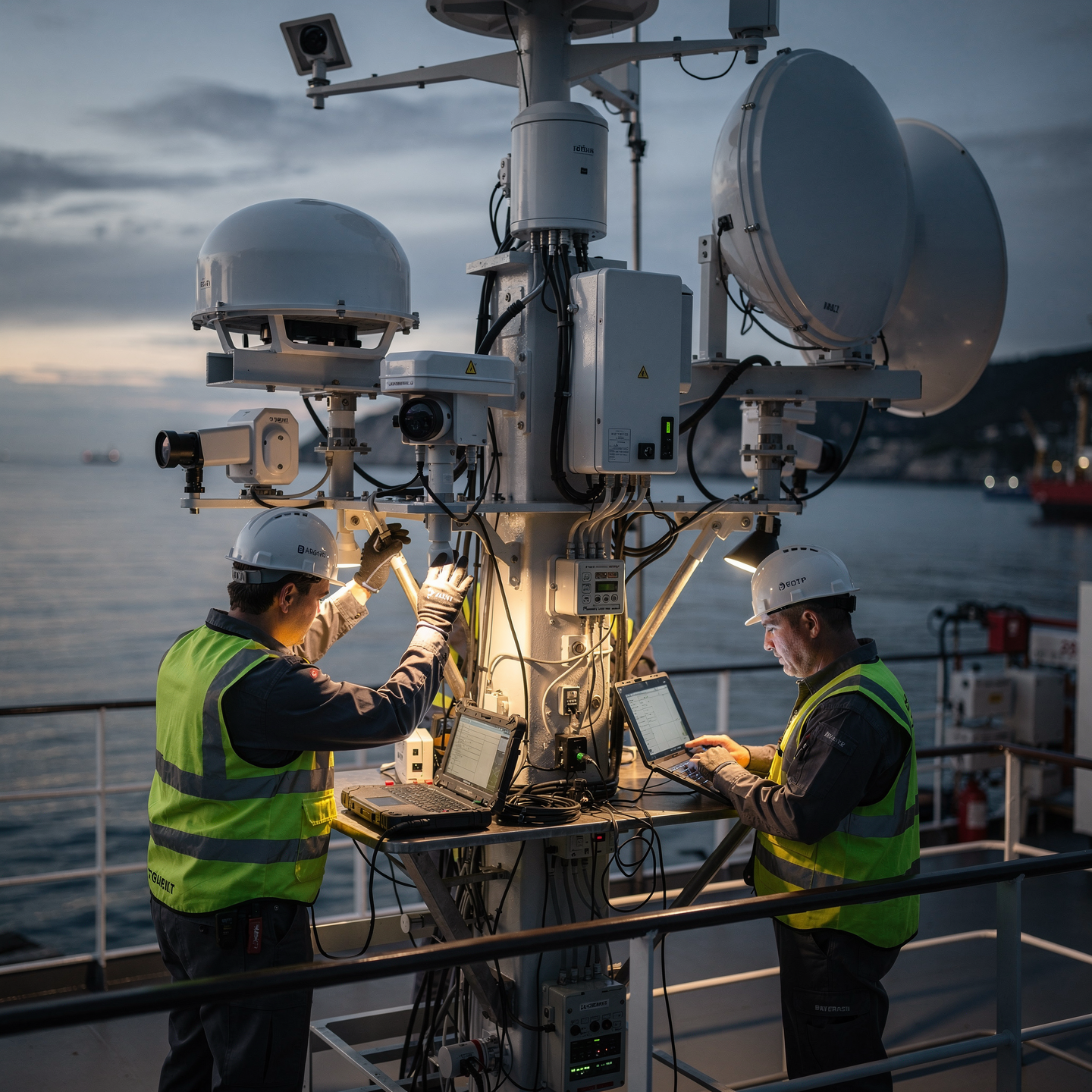
Master’s Degree in Sensors and Autonomous Navigation Systems

Why this master’s programme?

The Master in Sensors and Autonomous Navigation Systems

Prepares you to lead the future mobility revolution. Master key technologies in environmental perception, sensor fusion, localization and mapping, and planning and control for autonomous land, air, and sea vehicles. This program provides comprehensive training with practical training in simulators and real platforms, applied research projects, and a focus on the latest trends in Artificial Intelligence and Robotics.

Differentiating Advantages

  • Multidisciplinary Training: Integrates knowledge of electronics, computer science, mathematics, and control systems.
  • Specialized Laboratories: Access to state-of-the-art equipment for experimentation and development.
  • Real-World Projects: Collaboration with leading companies in the sector to solve specific challenges.
  • Expert Professors: Teaching staff with extensive experience in research and development in autonomous navigation.
  • Career Opportunities: Wide range of opportunities in automotive, aerospace, logistics, and robotics.
Sensores

Master’s Degree in Sensors and Autonomous Navigation Systems

Availability: 1 in stock

Who is it aimed at?

  • Electronic, computer, and telecommunications engineers seeking specialization in environmental perception, data fusion, and autonomous control.
  • Automotive, robotics, and aerospace professionals interested in adapting autonomous navigation technologies to new domains.
  • Researchers and academics wishing to delve deeper into the latest advances in sensors, algorithms, and autonomous system architectures.
  • Technology companies needing to train talent in the development and implementation of autonomous navigation solutions.
  • Graduates in engineering and related sciences seeking a career boost in the field of artificial intelligence and mobile robotics.

Flexibility Training

Adapted for professionals and students: flexible online format, interactive multimedia resources, and personalized tutoring.

Sensores

Objectives and skills

Design and implement advanced perception systems:

Integrate data from multiple sensors (LiDAR, cameras, radar) using sensor fusion to create a robust and accurate environmental model, adapting to varying lighting and weather conditions.

Develop robust and efficient sensor fusion algorithms:

“Implement extended Kalman filters and variants for optimal state estimation, dynamically adapting to the uncertainty and characteristics of each sensor.”

Managing and optimizing the performance of autonomous navigation systems:

“Implement risk mitigation strategies based on predictive analytics and machine learning to anticipate and avoid critical situations.”

Integrate and validate navigation systems in real-world environments:

“Interpreting sensor data (GNSS, AIS, radar) and evaluating its accuracy in real time.”

Lead R&D projects in the field of mobile robotics and navigation.

“To define robust and scalable robotic architectures, integrating perception, planning and control, with a focus on adaptability to dynamic environments and efficient management of computational resources.”

Evaluate and select the most suitable sensor technology for each application:

Considering accuracy, range, energy consumption, cost and environmental robustness, justifying the choice based on the specific needs of the project and the operating environment.

Study plan – Modules

  1. Fundamentals of Autonomous Navigation: Basic Principles and Challenges in Dynamic and Unstructured Environments
  2. Mathematical and Kinematic Modeling for Air, Land, and Marine Vehicles: Reference Systems and Key Parameters
  3. Design and Analysis of Localization Algorithms: Kalman Filters, SLAM (Simultaneous Localization and Mapping), and Multimodal Sensor Fusion Techniques
  4. Advanced Route Optimization: Heuristic and Metaheuristic Algorithms and Mathematical Programming for Efficient Generation of Safe Trajectories
  5. Real-Time Planning Under Uncertainty: Robust and Adaptive Decision-Making Methods for Highly Variable Environments
  6. Integration and Calibration of Multiscale Sensors: LiDAR, Radar, Stereo Cameras, Inertial Measurement Units (IMUs), and High-Accuracy GNSS Systems
  7. Predictive and Adaptive Control for Autonomous Navigation: Model-Based Controller Design and Machine Learning
  8. Algorithms
  9. Obstacle avoidance: detection, tracking, and evasive maneuvers with guaranteed operational safety
  10. Deep neural networks and reinforcement learning applied to autonomous decision-making in complex environments
  11. Algorithm simulation and validation: virtual environments, hardware-in-the-loop testing, and real-world marine, terrestrial, and aerial scenarios
  12. Communication and synchronization protocols between sensors and control systems for operating in mixed and collaborative fleets
  13. Performance evaluation and efficiency metrics for navigation algorithms considering energy consumption, accuracy, and response time
  14. Functional safety and cybersecurity considerations in autonomous systems: fault detection, redundancy, and error recovery
  15. International regulations and standards applicable to autonomous systems in advanced navigation
  16. Case studies and integrative projects addressing the real-world implementation of algorithms in multifunctional unmanned vehicles
  1. Theoretical foundations of inertial sensors: accelerometers, gyroscopes, and magnetometers; physical principles and dynamic characteristics.
  2. GNSS architectures: GPS, GLONASS, Galileo, and BeiDou constellations; signal protocols and message typology.
  3. Mathematical models for sensor fusion: extended Kalman filters, particle filters, and robust estimation methods for data integrity.
  4. Integration of tightly coupled vs. loosely coupled inertial sensors and GNSS: advantages, limitations, and practical implementation methods.
  5. DGPS differential correction and RTK techniques: reference bases, correction algorithms, and centimeter-level accuracy improvement.
  6. Compensation for systematic and random errors in inertial sensors and GNSS, including drift, bias, multipath, and thermal noise.
  7. Advanced algorithms for estimating attitude, position, and speed in multidomain environments: land, sea, and air.
  8. Integration of complementary sensors: lidar, Doppler radar, and inertial odometry for robustness under degraded or nonexistent GNSS signal conditions.
  9. Multidomain autonomous navigation systems: operational challenges and real-time requirements for efficient and reliable sensor fusion.
  10. Development and implementation of embedded software for processing sensor data and navigation algorithms on autonomous platforms.
  11. Simulation and validation using virtual environments and hardware-in-the-loop (HIL) test benches for performance evaluation of integrated systems.
  12. International regulations and standards applicable to the integration of autonomous navigation systems: certification, safety, and cybersecurity requirements.
  13. Case studies and real-world applications: from autonomous land vehicles to drones and non-autonomous vessels manned.
  14. Future trends in sensors and autonomous navigation systems: artificial intelligence, machine learning, and quantum sensors.

    Design of modular and scalable architectures for upgrading and maintaining autonomous navigation platforms in multi-domain environments.

  1. Fundamentals of sensors in autonomous navigation: types, operating principles, and technical characteristics
  2. Data fusion models and algorithms: Kalman filters, particle filters, and Bayesian methods applied to multisensor systems
  3. Integration of inertial measurement units (IMUs), GNSS, LiDAR, radar, and cameras to improve navigation accuracy and robustness
  4. Simultaneous localization and mapping (SLAM) algorithms: advanced techniques for unstructured and dynamic environments
  5. Error compensation and uncertainty management in sensor signals during adverse conditions and dense urban environments
  6. Redundancy and fault tolerance strategies in navigation systems to ensure reliability in continuous operation
  7. Real-time multisensor fusion implementation using distributed and edge-based architectures computing
  8. Route optimization and trajectory planning under dynamic constraints and based on fused sensor data

    Evaluation and validation of navigation algorithms through advanced simulations and field experimentation

    Case studies and practical applications in autonomous land, sea, and air vehicles

  1. Designing resilient architectures in autonomous navigation systems: fundamental principles, redundancy, and fault tolerance
  2. Multidomain integration models for heterogeneous sensors: data fusion from LiDAR, radar, GNSS, cameras, and inertial sensors
  3. Sensor validation and verification protocols in simulated and real-world environments: performance metrics and acceptance criteria
  4. Advanced dynamic and static calibration methodologies for sensors on autonomous mobile platforms
  5. Detecting and mitigating sensor reading anomalies: adaptive filtering techniques and real-time fault detection
  6. Cybersecurity architectures for sensors: threat models, vulnerability analysis, and defense in depth
  7. Implementing cryptography and secure authentication in communication between sensors and core systems
  8. International cybersecurity standards and regulations applied to sensors and multidomain autonomous navigation systems
  9. Strategies for protection against jamming and spoofing attacks on GNSS and other key sensors
  10. Case studies and attack and defense scenarios: forensic analysis and post-incident recovery in autonomous sensors
  11. Use of artificial intelligence and machine learning for predictive detection of faults and cyberattacks in sensor networks
  12. Advanced resilience testing: testing under adverse conditions, simulation of simultaneous failures, and evaluation of system recovery
  13. Integration of secure key management systems and secure firmware updates in autonomous platforms
  14. Development and application of digital twins for continuous validation and remote monitoring of sensors and systems
  15. Ethical and regulatory aspects in the management of sensitive data and privacy in sensors for multi-domain autonomous navigation
  1. Mathematical Foundations of Signal Processing: Fourier Transforms, Wavelets, and Adaptive Filtering
  2. Noise Modeling and Characterization: Spectral Analysis, White Noise, and Stochastic Processes in Sensors
  3. Advanced Sensor Fusion Algorithms: Kalman Techniques, Particle Filtering, and Bayesian Estimation Methods
  4. Dynamic Calibration of Inertial Sensors and Navigation Systems: Online and Offline Techniques, Real-Time Self-Calibration
  5. Compensation for Systematic Errors: Axis Alignment, Thermal Drift, and Bias Correction in Accelerometers and Gyroscopes
  6. Multiplatform Sensor Data Processing: Temporal Synchronization, Spatial Registration, and Optimization of Heterogeneous Data
  7. Fault Detection and Mitigation in Sensor Systems: Diagnostic Techniques, Redundancy, and Filtering Robustness

    Implementation of advanced filters for autonomous navigation: Extended Kalman Filter (EKF), Unscented Kalman Filter (UKF)

    Performance analysis and experimental validation: accuracy, sensitivity, and stability metrics, and tests in simulated and real-world environments
    Integration of LIDAR, radar, and camera sensors with IMUs for autonomous systems: technical challenges and joint calibration solutions

  1. Fundamentals of sensors for autonomous navigation: physical principles, types of sensors (inertial, optical, acoustic, electromagnetic) and their technical characteristics
  2. Mathematical modeling of sensors: equations of state, noise models, systematic error, calibration and signal linearization
  3. Filtering and fusion of multisensor data: extended Kalman filters, particles, Bayesian estimation algorithms for improved accuracy and robustness
  4. Integration of inertial sensors and GNSS: knocking techniques for time synchronization, drift compensation and improved positioning
  5. Design and implementation of multidomain navigation system architectures: maritime, air and land; Modular and distributed approaches

    Protocols and standards for sensor communication and interoperability: CAN, SPI, I2C, vehicular and maritime protocols

    Advanced synchronization and timestamping strategies in systems with variable latencies and multi-platform environments

    Experimental validation and simulation: creation of virtual test benches, digital twin environments, and real-world field testing for calibration and verification

    Diagnostic methodologies and continuous monitoring of sensor health: fault detection, self-correction, and active redundancy

    Practical application cases and integration studies in next-generation autonomous systems: unmanned vehicles, UAVs, UUVs, and mobile robotic systems

  1. Mathematical and statistical foundations for data fusion: probability theory, Bayesian estimation, Kalman filters and their variants (EKF, UKF, SKF)
  2. Sensor models and physical characteristics: inertial sensors, GNSS, LiDAR, stereo cameras, radar, ultrasound, and their error profiles
  3. Multi-modal sensor fusion algorithms: integration techniques at the data, feature, and decision levels
  4. Design and optimization of autonomous navigation system architectures: task distribution, redundancy, and fault tolerance
  5. Data fusion in adverse and dynamic environments: handling interference, occlusions, and environmental variability
  6. Advanced simultaneous localization and mapping (SLAM): probabilistic algorithms, graph optimization, and real-time applications
  7. Integration of machine learning algorithms for improved prediction and fault detection in sensors
  8. Uncertainty and reliability management in autonomous systems: confidence metrics, diagnostics, and fault recovery
  9. Hardware and software implementation: real-time processing, parallelization, embedded systems, and edge computing
  10. Case studies and comparative analysis of navigation systems in autonomous land, air, and sea vehicles
  11. Regulations, standards, and cybersecurity aspects applied to data management and fusion in autonomous systems
  1. Fundamentals of Advanced Adaptive Control: Theory and Application in Multi-Robot Systems
  2. Mathematical Modeling for Autonomous Navigation Systems under Environmental Uncertainty
  3. Heuristic and Metaheuristic Optimization Algorithms Applied to Real-Time Control
  4. Implementation of Robust Estimation Filters (EKF, UKF, PF) for Navigation in Dynamic Environments
  5. Design and Tuning of Model Predictive Controllers (MPCs) for Heterogeneous Mobile Platforms
  6. Experimental Validation through High-Reality Simulations: Urban, Maritime, and Aerial Environments
  7. Communication and Synchronization Protocols in Multi-Platform Fleets for Collaborative Control
  8. Performance Evaluation and Stability Criteria in Multiscale Autonomous Navigation Systems
  9. Incorporation of Machine Learning for Adaptive Improvement of Control Algorithms
  10. International Standards and Regulations for Certification and homologation of autonomous navigation systems
  1. Advanced Fundamentals of Autonomous Navigation Systems: Physical and Mathematical Principles of Multidomain Sensors (Inertial, Optical, Acoustic, Electromagnetic)
  2. Design and Modeling of Sensor Fusion Algorithms: Extended Kalman Filtering Techniques, Particle Filters, and Machine Learning for Heterogeneous Data Integration
  3. Hardware-Software Architectures for Embedded Systems: Selection, Calibration, and Synchronization of Sensors, Embedded Processors, and Distributed Control Units
  4. Development of Reliability and Fault Tolerance Models in Complex Systems: FMEA Analysis, Risk Analysis, and Active and Passive Redundancy Strategies
  5. Validation and Verification Methodologies for Algorithms in Simulated and Real Environments: Robustness Testing, Critical Scenarios, and Cross-Validation with Experimental Data
  6. Implementation of Advanced Self-Calibration and Self-Diagnostic Techniques for Real-Time Multisensors
  7. Integration Multidomain inertial sensors, GNSS, LiDAR, stereo cameras, and high-resolution radars: challenges and technical solutions

    Route optimization and positioning with adaptive algorithms: online learning, stochastic optimization, and predictive control

    Impact of electromagnetic interference and ambient noise on the accuracy and robustness of autonomous systems and mitigation strategies

    Applicable industry standards and regulations for the safe and reliable design of autonomous systems, including certification and regulatory compliance

    Advanced case studies: integration and testing of sensors in autonomous aerial and maritime vehicles with laboratory and field demonstrations

    Recent innovations in quantum sensors and MEMS technology applied to autonomous navigation and their impact on the next generation of systems

    Life cycle assessment and predictive maintenance of sensors and associated hardware using data analysis and machine learning techniques

    Interface development Human-machine interface for real-time monitoring and control of autonomous navigation systems.

    Failure and recovery case studies: post-mortem analysis and strategies to ensure operational continuity in critical environments.

  1. Advanced Sensor Fundamentals for Autonomous Navigation: Inertial Sensors, LiDAR, Stereoscopic Cameras, Synthetic Aperture Radar (SAR), and Ultrasonic Sensors
  2. Multisensor Integration: Real-time Data Fusion using Kalman Algorithms, Particle Filters, and Neural Networks to Increase the Accuracy and Robustness of Autonomous Navigation
  3. Development and Architecture of Integrated Validation Platforms: Modular Design for Simulation, Testing, and Analysis of Autonomous Systems in Multidomain Environments
  4. Communication and Synchronization Protocols in Distributed Systems: Use of DDS Middleware, ROS2, and Time-Sensitive Networking (TSN) to Ensure Coherence and Low Latency in Sensor Networks
  5. Advanced Sensor Calibration and Self-Tuning Methods: Machine Learning-Based Techniques to Compensate for Systematic and Dynamic Errors During Field Operation
  6. Safety and Resilience in Systems Autonomous systems: threat modeling, analysis of specific vulnerabilities in sensors and navigation systems, including spoofing and jamming attacks.

    Implementation of cryptographic strategies for cybersecurity: use of quantum cryptography, digital signatures, and authentication protocols to ensure the integrity and confidentiality of sensor-fusion data.

    Design of cybersecure validation and verification (V&V) environments: integration of hardware-in-the-loop (HIL) and software-in-the-loop (SIL) simulators with layers of protection against intrusions and malicious manipulation.

    Applicable regulations, standards, and frameworks: detailed analysis of ISO/SAE 21434, IEC 62443, and NATO recommendations to ensure compliance and interoperability in multi-domain autonomous systems.

    Advanced methodologies for generating technical reports and cybersecurity audits: comprehensive documentation of validation results, mitigated risks, and continuous improvement plans for platforms. autonomous

Career prospects

“`html

  • Sensor Development Engineer: Design, prototyping, and validation of sensors for autonomous navigation.
  • Navigation Systems Engineer: Integration of sensors, sensor fusion algorithms, and control systems.
  • Mobile Robotics Specialist: Development of navigation algorithms, route planning, and control of autonomous robots.
  • Test and Validation Engineer: Test design, data analysis, and performance evaluation of autonomous systems.
  • Computer Perception Data Scientist: Development of computer vision algorithms, machine learning, and signal processing.
  • Autonomous Driving R&D Engineer: Development of perception, planning, and control systems for autonomous vehicles.
  • Autonomous Systems Consultant: Technical consulting in the implementation of autonomous navigation solutions in various sectors.

    Technology Entrepreneur: Creating innovative companies in the field of robotics and autonomous navigation.

    “`

Entry requirements

Academic/professional profile:

Bachelor’s degree in Nautical Science/Maritime Transport, Naval/Marine Engineering or a related qualification; or proven professional experience on the bridge/in operations.

Language proficiency:

Functional Maritime English (SMCP) recommended for simulations and technical materials.

Documentation:

Updated CV, copy of qualification or seaman’s book, national ID/passport, motivation letter.

Technical requirements (for online):

Device with camera/microphone, stable internet connection, monitor ≥ 24” recommended for ECDIS/Radar-ARPA.

Admissions process and dates

Online
application

(form + documents).

Academic review and interview

Admissions decision

Admissions decision

(+ scholarship offer if applicable).

Place reservation

(deposit) and enrolment.

Induction

(access to the virtual campus, calendars, simulator guides).

Scholarships and financial support

  • Cutting-edge technology: Master the most advanced sensors and state-of-the-art autonomous navigation techniques.
  • Real-world applications: Learn to design and implement systems in robotics, autonomous vehicles, drones, and more, solving real-world challenges.
  • Hands-on experience: Develop innovative projects with advanced simulations and specialized equipment in our laboratories.
  • Expert faculty: Learn from industry and academic leaders with extensive experience in research and development of autonomous systems.
  • Career opportunities: Boost your career in high-demand sectors such as automotive, Aerospace, logistics, and software development. Become an expert in autonomous navigation and lead the next technological revolution.

Testimonials

Frequently asked questions

Sensor systems and autonomous navigation.

Yes. The itinerary includes ECDIS/Radar-ARPA/BRM with harbor, ocean, fog, storm, and SAR scenarios.

Online with live sessions; hybrid option for simulator/practical placements through agreements.

Robotics engineering, specifically autonomous navigation.

Recommended functional SMCP. We offer support materials for standard phraseology.

Yes, with a relevant degree or experience in maritime/port operations. The admissions interview will confirm suitability.

Optional (3–6 months) through Companies & Collaborations and the Alumni Network.

Simulator practice (rubrics), defeat plans, SOPs, checklists, micro-tests and applied TFM.

A degree from Navalis Magna University + operational portfolio (tracks, SOPs, reports and KPIs) useful for audits and employment.

  1. Advanced Sensor Fundamentals for Autonomous Navigation: Inertial Sensors, LiDAR, Stereoscopic Cameras, Synthetic Aperture Radar (SAR), and Ultrasonic Sensors
  2. Multisensor Integration: Real-time Data Fusion using Kalman Algorithms, Particle Filters, and Neural Networks to Increase the Accuracy and Robustness of Autonomous Navigation
  3. Development and Architecture of Integrated Validation Platforms: Modular Design for Simulation, Testing, and Analysis of Autonomous Systems in Multidomain Environments
  4. Communication and Synchronization Protocols in Distributed Systems: Use of DDS Middleware, ROS2, and Time-Sensitive Networking (TSN) to Ensure Coherence and Low Latency in Sensor Networks
  5. Advanced Sensor Calibration and Self-Tuning Methods: Machine Learning-Based Techniques to Compensate for Systematic and Dynamic Errors During Field Operation
  6. Safety and Resilience in Systems Autonomous systems: threat modeling, analysis of specific vulnerabilities in sensors and navigation systems, including spoofing and jamming attacks.

    Implementation of cryptographic strategies for cybersecurity: use of quantum cryptography, digital signatures, and authentication protocols to ensure the integrity and confidentiality of sensor-fusion data.

    Design of cybersecure validation and verification (V&V) environments: integration of hardware-in-the-loop (HIL) and software-in-the-loop (SIL) simulators with layers of protection against intrusions and malicious manipulation.

    Applicable regulations, standards, and frameworks: detailed analysis of ISO/SAE 21434, IEC 62443, and NATO recommendations to ensure compliance and interoperability in multi-domain autonomous systems.

    Advanced methodologies for generating technical reports and cybersecurity audits: comprehensive documentation of validation results, mitigated risks, and continuous improvement plans for platforms. autonomous

Request information

  1. Complete the Application Form.

  2. Attach your CV/degree certificate (if you have it to hand).

  3. Indicate your preferred cohort (January/May/September) and whether you would like the hybrid option with simulator sessions.

    An academic advisor will contact you within 24–48 hours to guide you through the admission process, scholarships, and compatibility with your professional schedule.

Please enable JavaScript in your browser to complete this form.
Click or drag a file to this area to upload.

Faculty

0
    0
    Tu carrito
    Tu carrito esta vacíoRegresar a la tienda
    Scroll to Top


