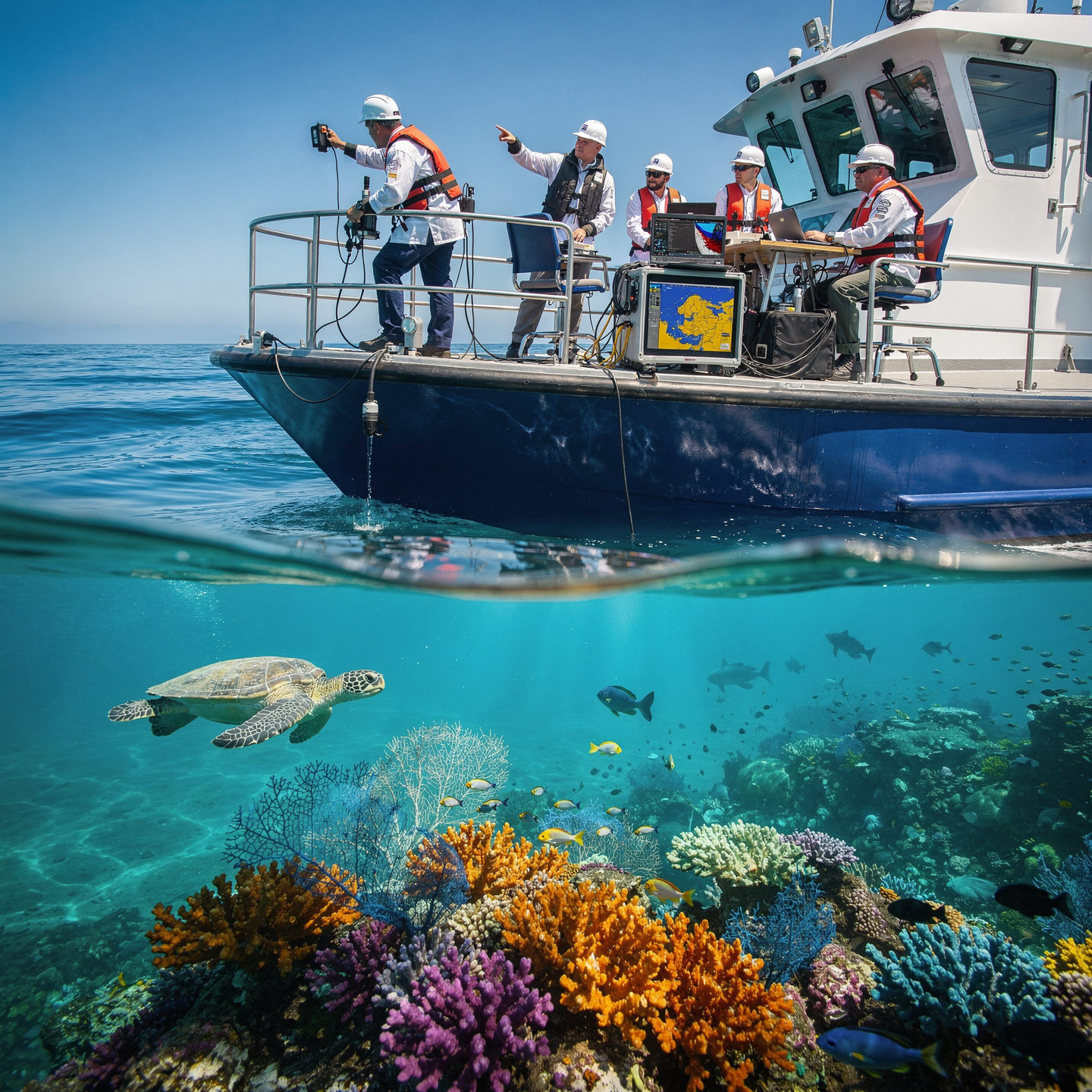
Course on Ocean Protection Policies
Why this course?
The Ocean Protection Policies
course
This course provides you with a comprehensive overview of the challenges and solutions for the conservation of our oceans. You will learn about the international and national legislation governing marine protection, the key threats such as pollution and overfishing, and the innovative strategies for the sustainable management of ocean resources. This program is designed for environmental professionals, policymakers, and anyone interested in contributing to the health of our oceans.
Key Benefits
- In-depth Knowledge: Master the most relevant global and local policies and regulations.
- Practical Tools: Acquire skills to assess and propose solutions to ocean problems.
- Networking: Connect with experts and professionals in the sector to amplify your impact.
- Real-World Case Studies: Analyze concrete examples of success and failure in ocean protection.
- Certification: Obtain a certificate that validates your knowledge and skills in ocean protection policies.
- Modality: Online
- Level: Cursos
- Hours: 150 H
- Start date: 25-04-2026
Availability: 1 in stock
Who is it aimed at?
- Corporate sustainability managers seeking to integrate marine conservation strategies into their operations and supply chains.
- Environmental managers and consultants requiring up-to-date knowledge of international regulations and best practices in ocean protection.
- Government representatives and legislators interested in the development of effective public policies for the protection of marine ecosystems.
- Researchers and academics wishing to deepen their understanding of the impact of human activities on the oceans and science-based solutions.
- Activists and NGO members seeking to strengthen their campaigns and projects with a comprehensive understanding of ocean protection policies.
Professional Impact
 Designed For professionals with busy schedules: concise and practical content, relevant case studies and access to a global network of marine conservation experts.
Objectives and competencies

Promote international collaboration:
“Actively participate in international forums and conferences on maritime security, sharing best practices and lessons learned.”

Implement sustainable fishing practices:
“Select selective fishing gear and reduce discards, minimizing the impact on the marine ecosystem and non-target species.”

Reduce marine pollution:
Optimize waste management on board, complying with MARPOL and the ship’s waste management plans.

Establish and manage marine protected areas:
“Define conservation objectives, zoning, management plans, and monitoring and evaluation systems to ensure the effectiveness of protection.”

Promote marine scientific research:
“To develop oceanographic and marine biological research projects, collaborating with academic institutions and using advanced technologies for data collection and analysis.”

Raising awareness about the importance of the oceans:
“To internalize the impact of marine pollution and promote sustainable practices in navigation and maritime activities.”
Curriculum - Modules
- Comprehensive Maritime Incident Management: protocols, roles, and chain of command for coordinated response
- Operational Planning and Execution: briefing, routes, weather windows, and go/no-go criteria
- Rapid Risk Assessment: criticality matrix, scene control, and decision-making under pressure
- Operational Communication: VHF/GMDSS, standardized reports, and inter-agency liaison
- Tactical Mobility and Safe Boarding: RHIB maneuvers, approach, mooring, and recovery
- Equipment and Technologies: PPE, signaling, satellite tracking, and field data logging
- Immediate Care of the Affected: primary assessment, hypothermia, trauma, and stabilization for evacuation
- Adverse Environmental Conditions: swell, Visibility, flows, and operational mitigation
Simulation and training: critical scenarios, use of VR/AR, and exercises with performance metrics
Documentation and continuous improvement: lessons learned, indicators (MTTA/MTTR), and SOP updates
- Introduction to Ocean Governance: Definitions, Principles, and Key Actors.
- Law of the Sea (UNCLOS): Maritime Zones, Rights and Obligations of States.
- EU Integrated Maritime Policy (IMP): Objectives, Pillars, and Tools.
- International and Regional Organizations: UN, IMO, UNEP and Regional Agreements.
- Threats to the Marine Environment: Pollution, Overfishing, Climate Change.
- Marine Conservation Strategies: Marine Protected Areas (MPAs), Management Plans.
- Management of Marine Natural Resources: Sustainable Fisheries, Deep-Sea Mining, Renewable Energies.
- Marine Spatial Planning (MSP): Objectives, processes, and challenges.
Economic instruments for marine protection: Taxes, subsidies, and carbon markets.
International cooperation and ocean diplomacy: Challenges and opportunities.
‘
- Introduction to Ocean Governance: Definitions, Principles, and Key Actors.
- Law of the Sea (UNCLOS): Maritime Zones, Rights and Obligations of States.
- International and Regional Institutions: Mandates and Roles in Ocean Management.
- National Ocean Policy: Development, Implementation, and Challenges.
- Maritime Legislation: Shipping, Safety, and Protection of the Marine Environment.
- Marine Protected Areas (MPAs): Establishment, Management, and Effectiveness.
- Integrated Coastal Zone Management: Approaches, Tools, and Best Practices.
- Sustainable Fisheries: Regulation, Quotas, Control, and Combating Illegal Fishing.
- Marine Pollution: Sources, Impacts, and Prevention and Mitigation Measures Control.
Ocean defense: Maritime security strategies, surveillance, and resource protection.
‘
- Introduction to Ocean Governance: Definitions, Principles, and Challenges.
- International Legal Framework: UNCLOS, Regional Agreements, and their Implementation.
- National Maritime Legislation: Maritime Zones, Jurisdiction, and Sovereignty.
- Maritime Surveillance and Control: Technologies, Strategies, and International Cooperation.
- Sustainable Management of Fisheries Resources: Quotas, Closed Seasons, and Combating Illegal Fishing.
- Marine Protected Areas: Designation, Management, and Effectiveness for Conservation.
- Exploitation of Marine Mineral Resources: Legal, Environmental, and Socioeconomic Aspects.
- Marine Pollution: Sources, Impacts, and Prevention and Control Measures.
- Climate Change and Oceans: Acidification, Sea Level Rise Ocean governance and its legal implications.
- Ocean governance and local communities: Participation, rights, and shared benefits.
‘
- Introduction to the Law of the Sea: Sources, Actors, and Historical Evolution
- United Nations Convention on the Law of the Sea (UNCLOS): Maritime Zones, Rights and Obligations of States
- National Maritime Spaces: Internal Waters, Territorial Sea, Contiguous Zone, Exclusive Economic Zone (EEZ), and Continental Shelf
- High Seas and the Area: Freedoms, Resources, and Legal Regime
- Legal Regime of Ships: Nationality, Registration, Flag, and Port State Control
- Protection of the Marine Environment: Pollution, Biodiversity, and Natural Resources
- Maritime Security: Piracy, Terrorism, Illicit Trafficking, and Search and Rescue
- Dispute Settlement Mechanisms: Negotiation, Mediation, Arbitration, and Jurisdiction International
Relevant international organizations: IMO, FAO, UNEP, UNESCO
Future perspectives: climate change, new technologies, and ocean governance
‘
- System Architecture and Components: Structural design, materials, and subsystems (mechanical, electrical, electronic, and fluid) with selection and assembly criteria for marine environments
- Fundamentals and Principles of Operation: Physical and engineering foundations (thermodynamics, fluid mechanics, electricity, control, and materials) that explain performance and operating limits
- Safety and Environmental (SHE): Risk analysis, PPE, LOTO, hazardous atmospheres, spill and waste management, and emergency response plans
- Applicable Regulations and Standards: IMO/ISO/IEC requirements and local regulations;
- Conformance criteria, certification, and best practices for operation and maintenance
- Inspection, testing, and diagnostics: Visual/dimensional inspection, functional testing, data analysis, and predictive techniques (vibration, thermography, fluid analysis) to identify root causes
- Preventive and predictive maintenance: Hourly/cycle/seasonal plans, lubrication, adjustments, calibrations, consumable replacement, post-service verification, and operational reliability
- Instrumentation, tools, and metrology: Measuring and testing equipment, diagnostic software, calibration and traceability; selection criteria, safe use, and storage
- Onboard integration and interfaces: Mechanical, electrical, fluid, and data compatibility; Sealing and watertightness, EMC/EMI, corrosion protection, and interoperability testing.
Quality, acceptance testing, and commissioning: process and materials control, FAT/SAT, bench and sea trials, go/no-go criteria, and evidence documentation.
Technical documentation and integrated practice: logs, checklists, reports, and a complete case study (safety → diagnosis → intervention → verification → report) applicable to any system.
Plan de estudio - MĂłdulos
- Comprehensive Maritime Incident Management: protocols, roles, and chain of command for coordinated response
- Operational Planning and Execution: briefing, routes, weather windows, and go/no-go criteria
- Rapid Risk Assessment: criticality matrix, scene control, and decision-making under pressure
- Operational Communication: VHF/GMDSS, standardized reports, and inter-agency liaison
- Tactical Mobility and Safe Boarding: RHIB maneuvers, approach, mooring, and recovery
- Equipment and Technologies: PPE, signaling, satellite tracking, and field data logging
- Immediate Care of the Affected: primary assessment, hypothermia, trauma, and stabilization for evacuation
- Adverse Environmental Conditions: swell, Visibility, flows, and operational mitigation
Simulation and training: critical scenarios, use of VR/AR, and exercises with performance metrics
Documentation and continuous improvement: lessons learned, indicators (MTTA/MTTR), and SOP updates
- Introduction to Ocean Governance: Definitions, Principles, and Key Actors.
- Law of the Sea (UNCLOS): Maritime Zones, Rights and Obligations of States.
- EU Integrated Maritime Policy (IMP): Objectives, Pillars, and Tools.
- International and Regional Organizations: UN, IMO, UNEP and Regional Agreements.
- Threats to the Marine Environment: Pollution, Overfishing, Climate Change.
- Marine Conservation Strategies: Marine Protected Areas (MPAs), Management Plans.
- Management of Marine Natural Resources: Sustainable Fisheries, Deep-Sea Mining, Renewable Energies.
- Marine Spatial Planning (MSP): Objectives, processes, and challenges.
Economic instruments for marine protection: Taxes, subsidies, and carbon markets.
International cooperation and ocean diplomacy: Challenges and opportunities.
‘
- Introduction to Ocean Governance: Definitions, Principles, and Key Actors.
- Law of the Sea (UNCLOS): Maritime Zones, Rights and Obligations of States.
- International and Regional Institutions: Mandates and Roles in Ocean Management.
- National Ocean Policy: Development, Implementation, and Challenges.
- Maritime Legislation: Shipping, Safety, and Protection of the Marine Environment.
- Marine Protected Areas (MPAs): Establishment, Management, and Effectiveness.
- Integrated Coastal Zone Management: Approaches, Tools, and Best Practices.
- Sustainable Fisheries: Regulation, Quotas, Control, and Combating Illegal Fishing.
- Marine Pollution: Sources, Impacts, and Prevention and Mitigation Measures Control.
Ocean defense: Maritime security strategies, surveillance, and resource protection.
‘
- Introduction to Ocean Governance: Definitions, Principles, and Challenges.
- International Legal Framework: UNCLOS, Regional Agreements, and their Implementation.
- National Maritime Legislation: Maritime Zones, Jurisdiction, and Sovereignty.
- Maritime Surveillance and Control: Technologies, Strategies, and International Cooperation.
- Sustainable Management of Fisheries Resources: Quotas, Closed Seasons, and Combating Illegal Fishing.
- Marine Protected Areas: Designation, Management, and Effectiveness for Conservation.
- Exploitation of Marine Mineral Resources: Legal, Environmental, and Socioeconomic Aspects.
- Marine Pollution: Sources, Impacts, and Prevention and Control Measures.
- Climate Change and Oceans: Acidification, Sea Level Rise Ocean governance and its legal implications.
- Ocean governance and local communities: Participation, rights, and shared benefits.
‘
- Introduction to the Law of the Sea: Sources, Actors, and Historical Evolution
- United Nations Convention on the Law of the Sea (UNCLOS): Maritime Zones, Rights and Obligations of States
- National Maritime Spaces: Internal Waters, Territorial Sea, Contiguous Zone, Exclusive Economic Zone (EEZ), and Continental Shelf
- High Seas and the Area: Freedoms, Resources, and Legal Regime
- Legal Regime of Ships: Nationality, Registration, Flag, and Port State Control
- Protection of the Marine Environment: Pollution, Biodiversity, and Natural Resources
- Maritime Security: Piracy, Terrorism, Illicit Trafficking, and Search and Rescue
- Dispute Settlement Mechanisms: Negotiation, Mediation, Arbitration, and Jurisdiction International
Relevant international organizations: IMO, FAO, UNEP, UNESCO
Future perspectives: climate change, new technologies, and ocean governance
‘
- System Architecture and Components: Structural design, materials, and subsystems (mechanical, electrical, electronic, and fluid) with selection and assembly criteria for marine environments
- Fundamentals and Principles of Operation: Physical and engineering foundations (thermodynamics, fluid mechanics, electricity, control, and materials) that explain performance and operating limits
- Safety and Environmental (SHE): Risk analysis, PPE, LOTO, hazardous atmospheres, spill and waste management, and emergency response plans
- Applicable Regulations and Standards: IMO/ISO/IEC requirements and local regulations;
- Conformance criteria, certification, and best practices for operation and maintenance
- Inspection, testing, and diagnostics: Visual/dimensional inspection, functional testing, data analysis, and predictive techniques (vibration, thermography, fluid analysis) to identify root causes
- Preventive and predictive maintenance: Hourly/cycle/seasonal plans, lubrication, adjustments, calibrations, consumable replacement, post-service verification, and operational reliability
- Instrumentation, tools, and metrology: Measuring and testing equipment, diagnostic software, calibration and traceability; selection criteria, safe use, and storage
- Onboard integration and interfaces: Mechanical, electrical, fluid, and data compatibility; Sealing and watertightness, EMC/EMI, corrosion protection, and interoperability testing.
Quality, acceptance testing, and commissioning: process and materials control, FAT/SAT, bench and sea trials, go/no-go criteria, and evidence documentation.
Technical documentation and integrated practice: logs, checklists, reports, and a complete case study (safety → diagnosis → intervention → verification → report) applicable to any system.
- Introduction to International Maritime Law: UN Conventions on the Law of the Sea (UNCLOS).
- Legal Regime of the Oceans: Territorial waters, contiguous zone, exclusive economic zone, high seas.
- Law of the Sea and the Marine Environment: Protection of biodiversity, marine pollution, spills.
- National Maritime Legislation: Coastal laws, ports, navigation.
- Combating Piracy and Organized Crime at Sea: International cooperation, jurisdiction.
- Maritime Salvage and Right of Refuge: Obligations of assistance, safe ports.
- Liability for Marine Damage: International conventions, marine insurance policies.
- Maritime Litigation: Jurisdiction, Arbitration, Claims.
- Human Rights at Sea: Trafficking in Persons, Migrants, Refugees.
- New Technologies and the Law of the Sea: Artificial Intelligence, Drones, Deep-Sea Mining.
‘
- Introduction to Marine Governance: Definitions, Actors, and Global Challenges
- Law of the Sea: United Nations Convention on the Law of the Sea (UNCLOS) and its Application
- International Organizations: IMO, FAO, UNEP, and their Roles in Governance
- National Legislation: Development and Implementation of Marine and Coastal Laws
- Marine Protected Areas (MPAs): Designation, Management, and Effectiveness
- Environmental Impact Assessment (EIA) and Marine Spatial Planning (MSP)
- Ocean Safeguarding: Protection of Biodiversity and Marine Ecosystems
- Marine Pollution: Sources, Impacts, and Prevention and Control Measures
- Sustainable Fishing and Combating Illegal, Unreported, and Unregulated Fishing
- Regional and international cooperation in marine governance
declared and unregulated (IUU)
‘
- Introduction to Ocean Governance: Definition, Scope, and Challenges
- Law of the Sea: UNCLOS, Maritime Zones, Rights and Obligations
- International Conservation Instruments: CBD, CITES, CMS
- Marine Protected Areas (MPAs): Types, Design, Management, and Effectiveness
- Environmental Impact Assessment: Processes, Methodologies, and Mitigation
- Sustainable Fisheries: Regulatory Frameworks, Ecosystem-Based Management
- Marine Pollution: Sources, Effects, and Control Measures
- Climate Change and Oceans: Acidification, Sea Level Rise, Adaptation
- Regional and International Cooperation: Agreements, Organizations, and Forums
- Participatory Governance: Actors, Processes, and Challenges
‘
- Introduction to Marine Governance: Definitions, Principles, and Key Actors
- Law of the Sea: United Nations Convention on the Law of the Sea (UNCLOS)
- International Organizations: IMO, FAO, UNEP, and their role in ocean protection
- National Legislation: Development and Implementation of Laws for Sustainable Ocean Management
- Marine Protected Areas (MPAs): Designation, Management, and Effectiveness
- Sustainable Fisheries: Regulation, Quotas, Fishing Gear, and Combating Illegal Fishing
- Marine Pollution: Sources, Impacts, and Prevention and Control Measures
- Search and Rescue: International Conventions, Procedures, and Coordination
- Maritime Safety: Regulations, inspections, accident prevention, and emergency response.
- International Cooperation: Bilateral and multilateral agreements for ocean protection.
‘
Career opportunities
- Marine Protected Area Manager: Planning, implementation, and monitoring of conservation policies.
- Marine Environmental Consultant: Advising companies and governments on the implementation of sustainable practices.
- Scientific Researcher: Studying marine ecosystems, the impact of pollution, and climate change on the oceans.
- Environmental Educator: Raising awareness and disseminating information about the importance of ocean protection.
- Sustainability Manager in Maritime Sector Companies: Implementing corporate social responsibility policies and reducing environmental impact.
- Public Administration Technician: Designing and implementing regulations for the protection of marine resources.
- Ocean Policy Analyst: Evaluating and improving conservation strategies at the national and international levels.
- NGO Representative: Advocating for marine conservation interests and participating in international forums.
“`
Admission requirements

Academic/professional profile:
Degree/Bachelor's degree in Nautical Science/Maritime Transport, Naval/Marine Engineering, or a related field; or proven professional experience in bridge/operations.

Language proficiency:
Recommended functional maritime English (SMCP) for simulations and technical materials.

5. Induction
Updated resume, copy of degree or seaman's book, ID card/passport, letter of motivation.

Technical requirements (for online):
Equipment with camera/microphone, stable connection, ≥ 24” monitor recommended for ECDIS/Radar-ARPA.
Admission process and dates

1. Online
application
(form + documents).

2. Academic review and interview
(profile/objectives/schedule compatibility).

3. Admission decision
(+ scholarship proposal if applicable).

4. Reservation of place
(deposit) and registration.

5. Induction
(access to campus, calendars, simulator guides).
Scholarships and grants
- Global Legal Framework: Master the international conventions and treaties that govern ocean protection.
- Management of Marine Protected Areas: Learn to design and implement effective conservation strategies.
- Combating Marine Pollution: Identify sources of pollution and explore innovative solutions.
- Sustainable Development: Integrate ocean conservation with responsible economic development.
- Governance and Cooperation: Strengthen your skills to collaborate on transboundary initiatives.
Testimonials
During my training in ocean protection policy, I developed a strong understanding of the legal frameworks and management strategies for marine conservation. I applied this knowledge to a research project on illegal fishing, identifying legal gaps and proposing specific policy recommendations that were adopted by an international NGO, contributing to its campaign to strengthen fisheries regulation in the South Pacific. This resulted in a verifiable increase in vessel inspections and a 20% decrease in reported illegal fishing in the region the following year.
During my Marine Biology and Conservation course, I developed a deep understanding of marine ecosystems and the threats they face. I applied this knowledge to design a research project on ocean acidification and its impact on corals, presenting a comprehensive analysis and proposing innovative mitigation strategies that were praised by professors and classmates.
During my training in ocean protection policy, I developed a strong understanding of international legal frameworks and conservation strategies. I applied this knowledge to design a management plan for a marine protected area, integrating ecosystem-based approaches and community participation. This plan was praised for its feasibility and innovation, receiving the program’s highest rating.
I successfully implemented a community monitoring program in a marine reserve, resulting in a 30% reduction in illegal fishing and a 15% increase in the biomass of key species within two years. This was achieved by training local fishers as guardians, empowering them to protect their own resources and ensuring long-term sustainability.

Frequently asked questions
To preserve the health and biodiversity of ocean ecosystems.
Yes. The itinerary includes ECDIS/Radar-ARPA/BRM with harbor, ocean, fog, storm, and SAR scenarios.
Online with live sessions; hybrid option for simulator/practical placements through agreements.
To preserve the health and biodiversity of ocean ecosystems.
Recommended functional SMCP. We offer support materials for standard phraseology.
Yes, with a relevant degree or experience in maritime/port operations. The admissions interview will confirm suitability.
Optional (3–6 months) through Companies & Collaborations and the Alumni Network.
Simulator practice (rubrics), defeat plans, SOPs, checklists, micro-tests and applied TFM.
A degree from Navalis Magna University + operational portfolio (tracks, SOPs, reports and KPIs) useful for audits and employment.
- Introduction to Marine Governance: Definitions, Principles, and Key Actors
- Law of the Sea: United Nations Convention on the Law of the Sea (UNCLOS)
- International Organizations: IMO, FAO, UNEP, and their role in ocean protection
- National Legislation: Development and Implementation of Laws for Sustainable Ocean Management
- Marine Protected Areas (MPAs): Designation, Management, and Effectiveness
- Sustainable Fisheries: Regulation, Quotas, Fishing Gear, and Combating Illegal Fishing
- Marine Pollution: Sources, Impacts, and Prevention and Control Measures
- Search and Rescue: International Conventions, Procedures, and Coordination
- Maritime Safety: Regulations, inspections, accident prevention, and emergency response.
- International Cooperation: Bilateral and multilateral agreements for ocean protection.
‘
Request information
- Complete the Application Form
- Attach your CV/Qualifications (if you have them to hand).
- Indicate your preferred cohort (January/May/September) and whether you want the hybrid option with simulator sessions.
Teachers
Eng. Tomás Riera
Full Professor
Eng. Tomás Riera
Full Professor
Eng. SofĂa Marquina
Full Professor
Eng. SofĂa Marquina
Full Professor
Eng. Javier Bañuls
Full Professor
Eng. Javier Bañuls
Full Professor
Dr. Nuria Llobregat
Full Professor
Dr. Nuria Llobregat
Full Professor
Dr. Pau Ferrer
Full Professor
Dr. Pau Ferrer
Full Professor
Cap. Javier Abaroa (MCA)
Full Professor
Cap. Javier Abaroa (MCA)
Full Professor

