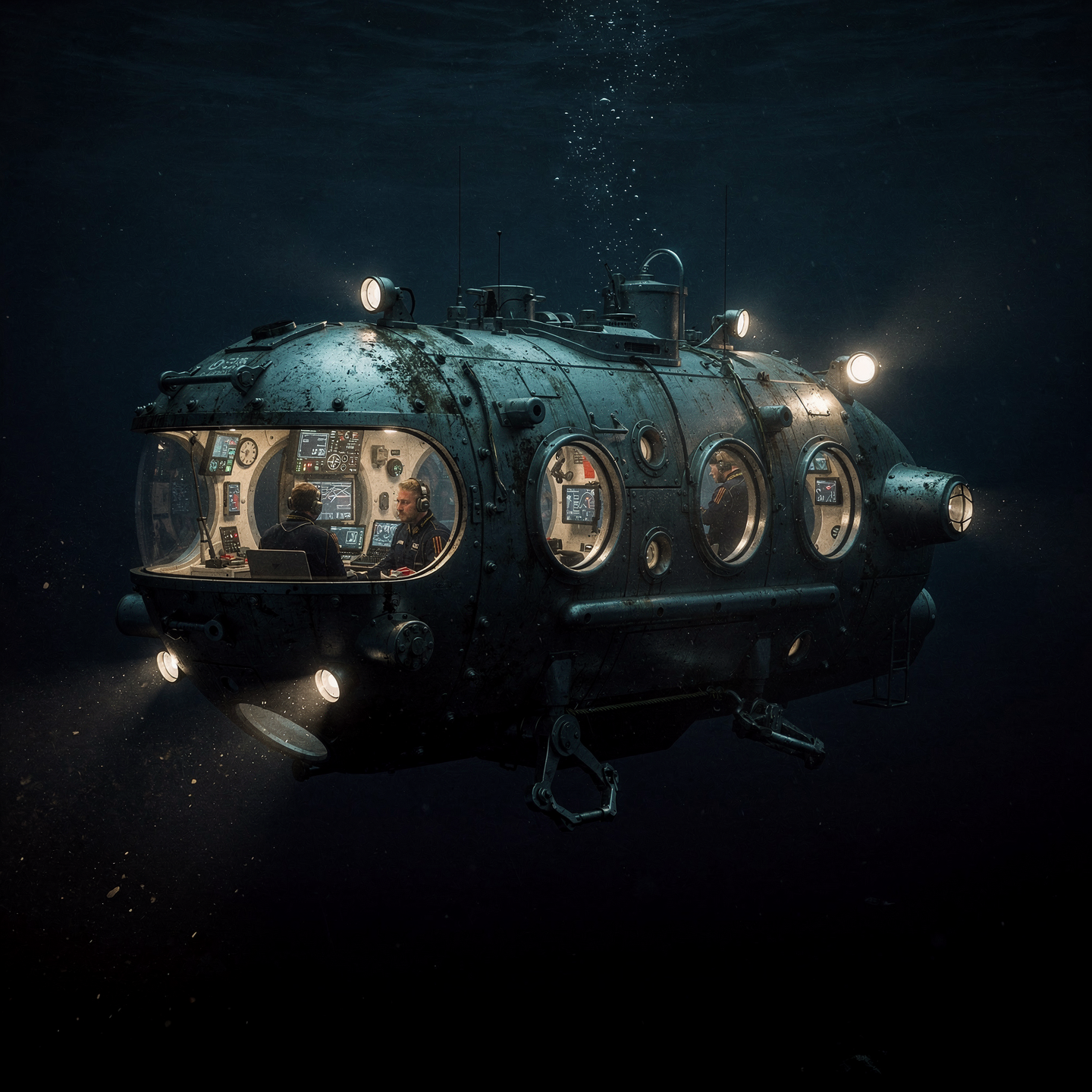
Course on Innovations in Deep Exploration

Why this course?

Deep Exploration Innovations Course

That are revolutionizing science and industry. This intensive course immerses you in the latest technologies and methodologies used to unravel the mysteries of the deep sea and Earth. Learn about autonomous underwater vehicles (AUVs), advanced high-resolution sensors, and geospatial data processing techniques. Master the strategies for complex mission planning and geophysical data interpretation, preparing you to lead cutting-edge exploration projects.

Key Benefits

  • State-of-the-art technology: Experiment with AUV simulations and real-time data analysis.
  • Leading experts: Learn from internationally recognized engineers, geologists, and oceanographers.
  • Real-world case studies: Analyze successful projects and challenges overcome in exploration.
  • Hands-on skills: Develop proficiency in using specialized software and analytical tools.
  • Global networking: Connect with industry professionals and expand your opportunities.

Course on Innovations in Deep Exploration

Availability: 1 in stock

Who is it aimed at?

  • Geologists and geophysicists seeking to master the latest technologies for acquiring and interpreting deep-water seismic data.
  • Petroleum and gas engineers needing to understand the challenges of drilling and production in high-pressure, high-temperature environments.
  • Marine scientists and oceanographers interested in studying the unique ecosystems and geology of the deep ocean.
  • Marine renewable energy specialists exploring the geothermal and mineral resource potential of the deep seabed.
  • Subsea industry professionals seeking to update their knowledge of ROVs, AUVs, and other inspection and maintenance technologies submarine.

Professional Applicability:
Intensive course with practical cases and simulations, adaptable to professionals with demanding schedules: downloadable material and access to the content for 6 months.

Objectives and competencies

Implement and optimize advanced seismic technologies:

“Evaluate and integrate 4D/3C seismic data to optimize well placement and maximize hydrocarbon recovery.”

Develop accurate predictive models for prospect identification:

“Implement Machine Learning algorithms, evaluating accuracy and recall metrics, adjusting thresholds to optimize conversion.”

Integrate geospatial data analysis and machine learning:

“Develop high-precision predictive models to optimize natural resource management, urban planning, and emergency response, integrating data from diverse geospatial sources and machine learning algorithms.”

Assess and mitigate geological and geotechnical risks in complex environments:

“To accurately identify and model failure scenarios and propose innovative stabilization solutions considering soil-structure interaction and inherent uncertainty.”

Design drilling strategies that minimize environmental impact:

“Implement waste and drilling fluid management systems with treatment and reuse technologies, minimizing spills and soil contamination.”

Manage exploration projects efficiently and profitably:

“Optimize resource allocation, controlling costs and time, without compromising data security or quality.”

Curriculum - Modules

1.1. Hadal and abyssal environments: extreme pressure, darkness, deep currents, and physical limitations of the system
1.2. Mission typologies in deep exploration: mapping, inspection, sampling, intervention, and technical search
1.3. Design requirements by depth: safety margins, redundancies, fault tolerance, and degraded modes
1.4. Exploration platforms: AUV/ROV/HOV, landers, gliders, and hybrid systems with surface support
1.5. Logistics and offshore operations: weather-ocean windows, deployment/retrieval and deck coordination
1.6. Ethics, sustainability and impact management: operational footprint, habitat protection and verifiable good practices

2.1. High-performance materials: titanium, special steels, ceramics, composites, and electrochemical compatibility
2.2. Structural design for pressure: spherical shells, reinforced cylindrical shells, frames, and buckling control
2.3. Sealing and connectivity: wet/dry connectors, gaskets, cable glands, and watertightness strategies
2.4. Corrosion and galvanism: anodes, coatings, insulation, and preservation in long campaigns
2.5. Pressure testing and verification: hyperbaric chambers, acceptance criteria and test traceability
2.6. Reliability and maintainability: modularity, accessibility, critical spare parts and life cycle management

3.1. Energy Architectures: Advanced Batteries, BMS, Distribution, Protections, and Mission Profile Sizing
3.2. High-Efficiency Propulsion: Thrusters, Thrust Curves, Vector Control, and Cavitation/Particle Mitigation
3.3. In-Depth Thermal Management: Dissipation, Insulation, Electronics Limits, and Operational Stability
3.4. Autonomy and Energy Budget: Duty Cycles, Load Prioritization, and Safe Return Planning
3.5. Energy Security: Charging, Transport, Storage, and Thermal Event Response Protocols
3.6. Power consumption optimization: control strategies, speed profiles and “low-power” operation by scenarios

4.1. Deep Navigation Sensors: IMU, DVL, Altimeters, Pressure, and Drift Compensation
4.2. Advanced Sonar: Multibeam, Side-Scan, Imaging Sonar, and Selection by Turbidity, Range, and Target
4.3. Low-Light Underwater Imaging: Illumination, Backscatter, Optics, and Visibility Enhancement Techniques
4.4. Geochemical and Biogeochemical Sensors: CTD, Oxygen, pH/ORP, Turbidity, and Biofouling Control
4.5. Data acquisition and synchronization: timestamping, calibration, metadata, and quality control
4.6. Exploration deliverables: bathymetry, mosaics, point clouds, photolog/videolog, and technical reports

5.1. Mission planning: waypoints, geofences, constraints, operational windows, and abort criteria
5.2. Sensor fusion and state estimation: filters, consistency, anomaly detection, and controlled degradation
5.3. Adaptive autonomy: replanning, uncertainty management, and goal-directed exploration
5.4. Obstacle avoidance and proximity navigation: margins, risk models, and maneuvering safety
5.5. AI for rapid interpretation: basic object classification, finding prioritization, and operational labeling
5.6. Simulation and validation: SIL/HIL, critical scenarios, performance metrics and lessons learned

6.1. Submarine Communications: Acoustics, Delayed Links, Compression, and Windowing Transfer Strategies
6.2. Control Station and Telemetry: Alarms, Logging, Packet Integrity, and Link Continuity
6.3. Data Governance: Repositories, Versioning, Lineage, Retention, and Evidence for Scientific and Technical Audits
6.4. Risk and Security Management: Matrices, Go/No-Go Thresholds, Emergencies, and Inter-Team Coordination
6.5. Compliance and Operational Permits: Restricted Areas, Coordination with Authorities, and Campaign Documentation
6.6. Final applied project: in-depth mission design, technology selection, data plan, simulated execution, and documented technical delivery

Plan de estudio - Módulos

1.1. Hadal and abyssal environments: extreme pressure, darkness, deep currents, and physical limitations of the system
1.2. Mission typologies in deep exploration: mapping, inspection, sampling, intervention, and technical search
1.3. Design requirements by depth: safety margins, redundancies, fault tolerance, and degraded modes
1.4. Exploration platforms: AUV/ROV/HOV, landers, gliders, and hybrid systems with surface support
1.5. Logistics and offshore operations: weather-ocean windows, deployment/retrieval and deck coordination
1.6. Ethics, sustainability and impact management: operational footprint, habitat protection and verifiable good practices

2.1. High-performance materials: titanium, special steels, ceramics, composites, and electrochemical compatibility
2.2. Structural design for pressure: spherical shells, reinforced cylindrical shells, frames, and buckling control
2.3. Sealing and connectivity: wet/dry connectors, gaskets, cable glands, and watertightness strategies
2.4. Corrosion and galvanism: anodes, coatings, insulation, and preservation in long campaigns
2.5. Pressure testing and verification: hyperbaric chambers, acceptance criteria and test traceability
2.6. Reliability and maintainability: modularity, accessibility, critical spare parts and life cycle management

3.1. Energy Architectures: Advanced Batteries, BMS, Distribution, Protections, and Mission Profile Sizing
3.2. High-Efficiency Propulsion: Thrusters, Thrust Curves, Vector Control, and Cavitation/Particle Mitigation
3.3. In-Depth Thermal Management: Dissipation, Insulation, Electronics Limits, and Operational Stability
3.4. Autonomy and Energy Budget: Duty Cycles, Load Prioritization, and Safe Return Planning
3.5. Energy Security: Charging, Transport, Storage, and Thermal Event Response Protocols
3.6. Power consumption optimization: control strategies, speed profiles and “low-power” operation by scenarios

4.1. Deep Navigation Sensors: IMU, DVL, Altimeters, Pressure, and Drift Compensation
4.2. Advanced Sonar: Multibeam, Side-Scan, Imaging Sonar, and Selection by Turbidity, Range, and Target
4.3. Low-Light Underwater Imaging: Illumination, Backscatter, Optics, and Visibility Enhancement Techniques
4.4. Geochemical and Biogeochemical Sensors: CTD, Oxygen, pH/ORP, Turbidity, and Biofouling Control
4.5. Data acquisition and synchronization: timestamping, calibration, metadata, and quality control
4.6. Exploration deliverables: bathymetry, mosaics, point clouds, photolog/videolog, and technical reports

5.1. Mission planning: waypoints, geofences, constraints, operational windows, and abort criteria
5.2. Sensor fusion and state estimation: filters, consistency, anomaly detection, and controlled degradation
5.3. Adaptive autonomy: replanning, uncertainty management, and goal-directed exploration
5.4. Obstacle avoidance and proximity navigation: margins, risk models, and maneuvering safety
5.5. AI for rapid interpretation: basic object classification, finding prioritization, and operational labeling
5.6. Simulation and validation: SIL/HIL, critical scenarios, performance metrics and lessons learned

6.1. Submarine Communications: Acoustics, Delayed Links, Compression, and Windowing Transfer Strategies
6.2. Control Station and Telemetry: Alarms, Logging, Packet Integrity, and Link Continuity
6.3. Data Governance: Repositories, Versioning, Lineage, Retention, and Evidence for Scientific and Technical Audits
6.4. Risk and Security Management: Matrices, Go/No-Go Thresholds, Emergencies, and Inter-Team Coordination
6.5. Compliance and Operational Permits: Restricted Areas, Coordination with Authorities, and Campaign Documentation
6.6. Final applied project: in-depth mission design, technology selection, data plan, simulated execution, and documented technical delivery

#VALUE!

#VALUE!

#VALUE!

#VALUE!

Career opportunities

  • Exploration Geologist: Identification and evaluation of mineral resources at depth.
  • Geophysicist: Analysis of seismic, gravimetric, and magnetic data for subsurface characterization.
  • Mining Engineer: Design and optimization of innovative extraction methods for deep deposits.
  • Geotechnical Engineer: Evaluation of the stability of deep excavations and design of support systems.
  • Geospatial Data Scientist: Processing and analysis of large volumes of data for resource modeling.
  • Directional Drilling Specialist: Planning and execution of complex drilling in underground environments.
  • Exploration Technology Researcher: Development of new tools and techniques for the detection and characterization of resources.
  • Mining Exploration Consultant: Technical and strategic advice on deep exploration projects.

“`

Admission requirements

Academic/professional profile:

Degree/Bachelor's degree in Nautical Science/Maritime Transport, Naval/Marine Engineering, or a related field; or proven professional experience in bridge/operations.

Language proficiency:

Recommended functional maritime English (SMCP) for simulations and technical materials.

5. Induction

Updated resume, copy of degree or seaman's book, ID card/passport, letter of motivation.

Technical requirements (for online):

Equipment with camera/microphone, stable connection, ≥ 24” monitor recommended for ECDIS/Radar-ARPA.

Admission process and dates

1. Online
application

(form + documents).

2. Academic review and interview

(profile/objectives/schedule compatibility).

3. Admission decision

(+ scholarship proposal if applicable).

4. Reservation of place

(deposit) and registration.

5. Induction

(access to campus, calendars, simulator guides).

Scholarships and grants

  • Advanced Seismic Techniques: Master the interpretation of 3D and 4D data for accurate visualization of the subsurface.
  • Cutting-Edge Geophysics: Learn to apply electromagnetic and gravimetric methods to identify hidden reservoirs.
  • Predictive Geological Modeling: Use specialized software to simulate scenarios and optimize drilling.
  • Risk Analysis and Mitigation: Evaluate and manage the challenges associated with exploration in complex environments.
  • Global Case Studies: Examine successful projects and learn from industry mistakes.
Boost your career with the latest tools and strategies in deep exploration.

Testimonials

Frequently asked questions

The extreme pressure and hostile temperatures of the deep environment.

Yes. The itinerary includes ECDIS/Radar-ARPA/BRM with harbor, ocean, fog, storm, and SAR scenarios.

Online with live sessions; hybrid option for simulator/practical placements through agreements.

Extreme pressure, extreme temperatures, and lack of sunlight create a hostile environment that hinders technological development and human survival.

Recommended functional SMCP. We offer support materials for standard phraseology.

Yes, with a relevant degree or experience in maritime/port operations. The admissions interview will confirm suitability.

Optional (3–6 months) through Companies & Collaborations and the Alumni Network.

Simulator practice (rubrics), defeat plans, SOPs, checklists, micro-tests and applied TFM.

A degree from Navalis Magna University + operational portfolio (tracks, SOPs, reports and KPIs) useful for audits and employment.

#VALUE!

Request information

  1. Complete the Application Form
  2. Attach your CV/Qualifications (if you have them to hand).
  3. Indicate your preferred cohort (January/May/September) and whether you want the hybrid option with simulator sessions.
An academic advisor will contact you within 24–48 hours to guide you through the admission process, scholarships, and compatibility with your professional schedule. Translated with DeepL.com (free version)
Please enable JavaScript in your browser to complete this form.
Click or drag a file to this area to upload.

Teachers

0
    0
    Tu carrito
    Tu carrito esta vacíoRegresar a la tienda
    Scroll to Top


