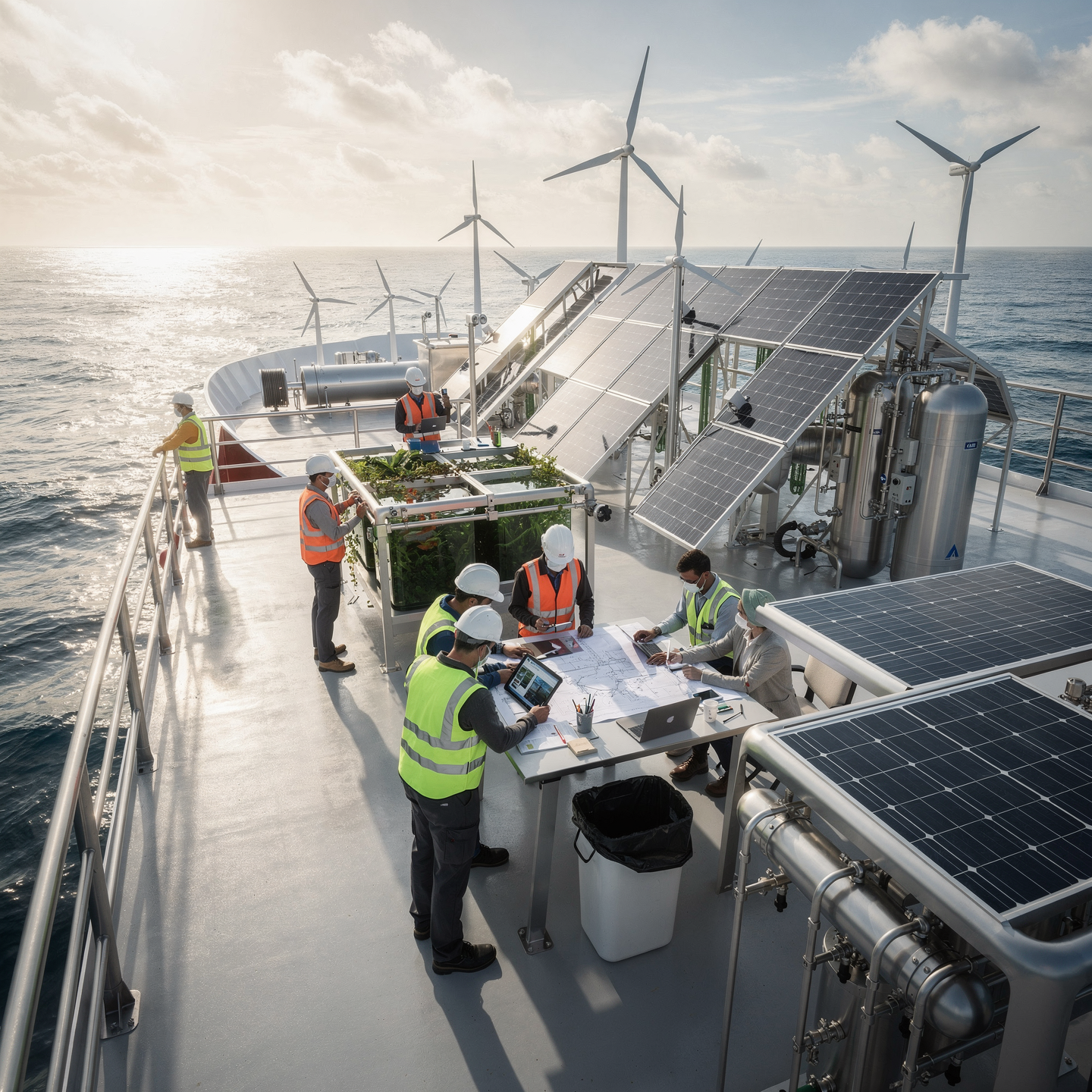
Course on Innovations in Ecological Design
Why this course?
The Innovations in Ecological Design
course
Immerse yourself in the latest trends and technologies for a sustainable future. Learn to integrate circular economy principles, low-environmental-impact materials, and energy-efficiency strategies into your projects. Master Life Cycle Assessment (LCA) tools and discover how to obtain LEED certifications and other green accreditations. This program will empower you to create innovative designs that minimize the ecological footprint and maximize long-term value.
Differential Advantages
- Real-world case studies: analysis of successful projects in building, product, and landscape design.
- Specialized software: use of tools for energy modeling and environmental impact assessment.
- Expert network: access to leading professionals in sustainable design and environmental consulting.
- Practical approach: development of your own project applying the knowledge acquired.
- Professional certificate: recognition of your skills in ecological design.
- Modality: Online
- Level: Cursos
- Hours: 150 H
- Start date: 26-07-2026
Availability: 1 in stock
Who is it aimed at?
- Architects and urban designers focused on sustainability and reducing the environmental impact of their projects.
- Civil and environmental engineers seeking to integrate innovative solutions into the construction and management of green infrastructure.
- Construction and real estate development companies interested in adopting eco-efficient practices and obtaining environmental certifications.
- Students and recent graduates in architecture, engineering, or design who aspire to specialize in ecological design.
- Public administrations and urban policymakers seeking to promote sustainable development and improve the urban environment.
Learning flexibility
Adapted to your pace: 24/7 accessible online content, interactive discussion forums and personalized tutoring to answer your questions.
Objectives and competencies

Implement regenerative design methodologies:
Integrating nature as a fundamental part of the design, optimizing resources, minimizing negative impacts and maximizing the long-term ecological resilience of the project.

Evaluate the complete life cycle of products and services:
“Identify opportunities for continuous improvement in each phase (design, production, use, end of life) minimizing environmental impact and maximizing economic efficiency.”

Develop prototypes of sustainable materials and production processes:
“To investigate and experiment with biopolymers, recycled materials and low environmental impact manufacturing processes, evaluating their technical and economic viability.”

Integrate circular economy principles into product design:
“Select recycled/biodegradable materials, design for durability/repair, and facilitate disassembly/reuse at the end of its useful life.”

Minimize the carbon footprint at all stages of design:
“Select materials with low environmental impact and optimize the energy efficiency of the design.”

Promote interdisciplinary collaboration to optimize eco-innovative solutions:
“Integrating engineering, design, and sustainability perspectives to develop products/services with lower environmental impact and higher economic value.”
Curriculum - Modules
- Comprehensive Maritime Incident Management: protocols, roles, and chain of command for coordinated response
- Operational Planning and Execution: briefing, routes, weather windows, and go/no-go criteria
- Rapid Risk Assessment: criticality matrix, scene control, and decision-making under pressure
- Operational Communication: VHF/GMDSS, standardized reports, and inter-agency liaison
- Tactical Mobility and Safe Boarding: RHIB maneuvers, approach, mooring, and recovery
- Equipment and Technologies: PPE, signaling, satellite tracking, and field data logging
- Immediate Care of the Affected: primary assessment, hypothermia, trauma, and stabilization for evacuation
- Adverse Environmental Conditions: swell, Visibility, flows, and operational mitigation
Simulation and training: critical scenarios, use of VR/AR, and exercises with performance metrics
Documentation and continuous improvement: lessons learned, indicators (MTTA/MTTR), and SOP updates
- Introduction to Eco-design: Definitions, Principles, and Benefits
- Sustainable Materials: Types, Properties, and Applications
- Life Cycle Assessment (LCA): Methodology and Tools
- Eco-labeling and Environmental Certifications: Types, Standards, and Relevance
- Design for Disassembly and Reuse: Strategies and Examples
- Strategies for Reducing Environmental Impact in Design
- Circular Economy: Principles, Business Models, and Applications in Eco-design
- Eco-design in the Packaging Industry: Materials, Design, and Regulations
- Case Studies: Product Analysis Eco-designed
- Innovation and Future of Eco-design: Trends and Challenges
‘
- Introduction to Sustainable Design: Definitions, principles, and objectives.
- Life Cycle of Materials: Extraction, production, use, and end-of-life.
- Sustainable Building Materials: Certified wood, bamboo, recycled and recyclable materials.
- Ecodesign: Strategies for minimizing environmental impact in design.
- Carbon Footprint Analysis: Methodologies and tools for assessment.
- Energy Efficiency in Buildings: Passive design, insulation, natural ventilation.
- Water Management: Rainwater harvesting, greywater treatment systems.
- Modular and Prefabricated Construction: Advantages and applications in design sustainable.
- Sustainable Building Certifications (LEED, BREEAM, Passivhaus): Requirements and processes.
- Circular Economy: Business models and strategies for reuse and recycling.
‘
- Introduction to Sustainability: Definitions, principles, and historical evolution.
- Bioclimatism: Fundamentals of bioclimatic architecture and its importance.
- Ecodesign: Principles of ecodesign and its application in building construction.
- Site and Microclimate Analysis: Assessment tools and methodologies.
- Passive Design Strategies: Orientation, natural ventilation, and solar protection.
- Sustainable Materials: Selection criteria, life cycle, and ecotoxicity.
- Energy Efficiency in Buildings: Insulation and efficient heating and cooling systems.
- Water Management: Rainwater harvesting, treatment systems, and reuse.
- Renewable Energies: Integration of Solar, wind, and geothermal systems.
- Environmental certifications: LEED, BREEAM, Passivhaus, and other standards.
‘
- Introduction to Regenerative Design: Principles, Ethics, and Worldview.
- Biomimicry: Definition, History, Levels of Abstraction, and Methodologies.
- Natural Systems: Understanding Ecosystems, Cycles, and Patterns.
- Principles of Ecology: Resilience, Interconnectedness, Diversity, and Adaptation.
- Nature’s Strategies: Functional Analysis and Translation into Design Solutions.
- Bio-Inspired Materials: Exploring Natural Materials and Their Application.
- Closed-System Design: Product Life Cycle and Resource Management.
- Disruptive Innovation: Biomimicry as a Catalyst for Sustainability.
- Case Studies: Examples of Applied Regenerative Design and Biomimicry.
- Tools for Regenerative Design and Biomimetics: Methodologies and software.
‘
- System Architecture and Components: Structural design, materials, and subsystems (mechanical, electrical, electronic, and fluid) with selection and assembly criteria for marine environments
- Fundamentals and Principles of Operation: Physical and engineering foundations (thermodynamics, fluid mechanics, electricity, control, and materials) that explain performance and operating limits
- Safety and Environmental (SHE): Risk analysis, PPE, LOTO, hazardous atmospheres, spill and waste management, and emergency response plans
- Applicable Regulations and Standards: IMO/ISO/IEC requirements and local regulations;
- Conformance criteria, certification, and best practices for operation and maintenance
- Inspection, testing, and diagnostics: Visual/dimensional inspection, functional testing, data analysis, and predictive techniques (vibration, thermography, fluid analysis) to identify root causes
- Preventive and predictive maintenance: Hourly/cycle/seasonal plans, lubrication, adjustments, calibrations, consumable replacement, post-service verification, and operational reliability
- Instrumentation, tools, and metrology: Measuring and testing equipment, diagnostic software, calibration and traceability; selection criteria, safe use, and storage
- Onboard integration and interfaces: Mechanical, electrical, fluid, and data compatibility; Sealing and watertightness, EMC/EMI, corrosion protection, and interoperability testing.
Quality, acceptance testing, and commissioning: process and materials control, FAT/SAT, bench and sea trials, go/no-go criteria, and evidence documentation.
Technical documentation and integrated practice: logs, checklists, reports, and a complete case study (safety → diagnosis → intervention → verification → report) applicable to any system.
Plan de estudio - Módulos
- Comprehensive Maritime Incident Management: protocols, roles, and chain of command for coordinated response
- Operational Planning and Execution: briefing, routes, weather windows, and go/no-go criteria
- Rapid Risk Assessment: criticality matrix, scene control, and decision-making under pressure
- Operational Communication: VHF/GMDSS, standardized reports, and inter-agency liaison
- Tactical Mobility and Safe Boarding: RHIB maneuvers, approach, mooring, and recovery
- Equipment and Technologies: PPE, signaling, satellite tracking, and field data logging
- Immediate Care of the Affected: primary assessment, hypothermia, trauma, and stabilization for evacuation
- Adverse Environmental Conditions: swell, Visibility, flows, and operational mitigation
Simulation and training: critical scenarios, use of VR/AR, and exercises with performance metrics
Documentation and continuous improvement: lessons learned, indicators (MTTA/MTTR), and SOP updates
- Introduction to Eco-design: Definitions, Principles, and Benefits
- Sustainable Materials: Types, Properties, and Applications
- Life Cycle Assessment (LCA): Methodology and Tools
- Eco-labeling and Environmental Certifications: Types, Standards, and Relevance
- Design for Disassembly and Reuse: Strategies and Examples
- Strategies for Reducing Environmental Impact in Design
- Circular Economy: Principles, Business Models, and Applications in Eco-design
- Eco-design in the Packaging Industry: Materials, Design, and Regulations
- Case Studies: Product Analysis Eco-designed
- Innovation and Future of Eco-design: Trends and Challenges
‘
- Introduction to Sustainable Design: Definitions, principles, and objectives.
- Life Cycle of Materials: Extraction, production, use, and end-of-life.
- Sustainable Building Materials: Certified wood, bamboo, recycled and recyclable materials.
- Ecodesign: Strategies for minimizing environmental impact in design.
- Carbon Footprint Analysis: Methodologies and tools for assessment.
- Energy Efficiency in Buildings: Passive design, insulation, natural ventilation.
- Water Management: Rainwater harvesting, greywater treatment systems.
- Modular and Prefabricated Construction: Advantages and applications in design sustainable.
- Sustainable Building Certifications (LEED, BREEAM, Passivhaus): Requirements and processes.
- Circular Economy: Business models and strategies for reuse and recycling.
‘
- Introduction to Sustainability: Definitions, principles, and historical evolution.
- Bioclimatism: Fundamentals of bioclimatic architecture and its importance.
- Ecodesign: Principles of ecodesign and its application in building construction.
- Site and Microclimate Analysis: Assessment tools and methodologies.
- Passive Design Strategies: Orientation, natural ventilation, and solar protection.
- Sustainable Materials: Selection criteria, life cycle, and ecotoxicity.
- Energy Efficiency in Buildings: Insulation and efficient heating and cooling systems.
- Water Management: Rainwater harvesting, treatment systems, and reuse.
- Renewable Energies: Integration of Solar, wind, and geothermal systems.
- Environmental certifications: LEED, BREEAM, Passivhaus, and other standards.
‘
- Introduction to Regenerative Design: Principles, Ethics, and Worldview.
- Biomimicry: Definition, History, Levels of Abstraction, and Methodologies.
- Natural Systems: Understanding Ecosystems, Cycles, and Patterns.
- Principles of Ecology: Resilience, Interconnectedness, Diversity, and Adaptation.
- Nature’s Strategies: Functional Analysis and Translation into Design Solutions.
- Bio-Inspired Materials: Exploring Natural Materials and Their Application.
- Closed-System Design: Product Life Cycle and Resource Management.
- Disruptive Innovation: Biomimicry as a Catalyst for Sustainability.
- Case Studies: Examples of Applied Regenerative Design and Biomimicry.
- Tools for Regenerative Design and Biomimetics: Methodologies and software.
‘
- System Architecture and Components: Structural design, materials, and subsystems (mechanical, electrical, electronic, and fluid) with selection and assembly criteria for marine environments
- Fundamentals and Principles of Operation: Physical and engineering foundations (thermodynamics, fluid mechanics, electricity, control, and materials) that explain performance and operating limits
- Safety and Environmental (SHE): Risk analysis, PPE, LOTO, hazardous atmospheres, spill and waste management, and emergency response plans
- Applicable Regulations and Standards: IMO/ISO/IEC requirements and local regulations;
- Conformance criteria, certification, and best practices for operation and maintenance
- Inspection, testing, and diagnostics: Visual/dimensional inspection, functional testing, data analysis, and predictive techniques (vibration, thermography, fluid analysis) to identify root causes
- Preventive and predictive maintenance: Hourly/cycle/seasonal plans, lubrication, adjustments, calibrations, consumable replacement, post-service verification, and operational reliability
- Instrumentation, tools, and metrology: Measuring and testing equipment, diagnostic software, calibration and traceability; selection criteria, safe use, and storage
- Onboard integration and interfaces: Mechanical, electrical, fluid, and data compatibility; Sealing and watertightness, EMC/EMI, corrosion protection, and interoperability testing.
Quality, acceptance testing, and commissioning: process and materials control, FAT/SAT, bench and sea trials, go/no-go criteria, and evidence documentation.
Technical documentation and integrated practice: logs, checklists, reports, and a complete case study (safety → diagnosis → intervention → verification → report) applicable to any system.
- Introduction to Eco-Design: Definition, principles, and benefits
- Life Cycle Assessment (LCA): Methodology, stages, and tools
- Selection of Eco-Friendly Materials: Criteria, databases, and examples
- Design for Dematerialization and Durability
- Design Strategies for Reuse and Recycling: Circular Economy
- Optimization of Production Processes: Reduction of waste and energy consumption
- Eco-Labeling and Environmental Certifications: Types, requirements, and applications
- Environmental Impact Analysis: Carbon, water, and ecological footprint
- Software Tools for Eco-Design: Modeling and simulation
- Case Studies and Best Practices in Eco-Design
‘
- Introduction to Regenerative Design: Principles, Ethics, and Transformative Potential
- Biomimicry as a Design Tool: Extracting Strategies from Nature
- Cradle to Cradle (C2C): Fundamentals, Categories, and Certification
- C2C Materials: Selection, Evaluation, and Optimization for Closed Loops
- Design for Dematerialization and Reuse: Reduction, Repair, and Remanufacturing
- Closed Loop Systems: Business Models and Material Flows
- Renewable Energy and Regenerative Design: Integrating Clean Sources and Energy Efficiency
- Water and Regenerative Design: Efficient Management, Harvesting, and Natural Treatment
- Case Studies: Design Examples Regenerative, biomimetic, and C2C in different sectors.
- Implementation of Regenerative Projects: Methodology, metrics, and impact assessment.
‘
- Introduction to Ecodesign: Key Concepts, History, and Benefits
- Life Cycle Assessment (LCA): Methodology, Stages, and Tools
- Sustainable Materials: Types, Properties, Environmental Impact, and Selection Criteria
- Ecodesign Strategies: Reduction, Reuse, Recycling, and Rethinking
- Design for Durability and Repairability: Extending Product Lifespans
- Circular Economy: Principles, Business Models, and Success Stories
- Product Ecodesign: Methodologies and Tools for Sustainable Innovation
- Service Ecodesign: Process Optimization, Waste Reduction, and Energy Efficiency
- Environmental Regulations and Legislation: Directives, Standards, and Certifications
- Environmental Performance Assessment and Communication: Indicators, Reports, and Green Marketing
‘
- Introduction to Bioclimatic Design: Principles, History, and Evolution
- Site Climate Analysis: Tools, Data, and Interpretation
- Passive Design Strategies: Orientation, Form, Envelope, and Natural Ventilation
- Sustainable Materials: Life Cycle, Environmental Impact, and Selection
- Passive Solar Design: Direct and Indirect Heat Gain, Thermal Mass, and Solar Protection
- Natural Ventilation and Evaporative Cooling: Strategies and Design
- Natural Lighting: Strategies, Design, and Glare Control
- Basic Energy Modeling: Simulation and Optimization Tools
- Efficient Active Systems: Renewable Energy and High-Efficiency HVAC
- Sustainability Certification and Standards: LEED, BREEAM and other standards
‘
Career opportunities
- Eco-friendly Product Designer: Creating innovative and sustainable products using environmentally friendly materials and processes.
- Sustainability Design Consultant: Advising companies and organizations on implementing eco-design practices and reducing their environmental impact.
- Sustainable Space Architect/Designer: Designing and constructing buildings and urban spaces that minimize the consumption of energy, water, and other natural resources.
- Eco-friendly Materials Specialist: Researching and developing new sustainable materials and their application in different sectors.
- Eco-design Project Manager: Planning, coordinating, and monitoring projects that integrate sustainability criteria from the design phase to commercialization.
- Eco-design Educator/Trainer: Delivering courses, workshops, and seminars on sustainable design and its importance. Ecological innovation.
- Ecodesign Researcher: Developing new methodologies, tools, and technologies to promote ecological design and the circular economy.
- Sustainable Design Entrepreneur: Creating companies that offer innovative and environmentally friendly products and services.
“`
Admission requirements

Academic/professional profile:
Degree/Bachelor's degree in Nautical Science/Maritime Transport, Naval/Marine Engineering, or a related field; or proven professional experience in bridge/operations.

Language proficiency:
Recommended functional maritime English (SMCP) for simulations and technical materials.

5. Induction
Updated resume, copy of degree or seaman's book, ID card/passport, letter of motivation.

Technical requirements (for online):
Equipment with camera/microphone, stable connection, ≥ 24” monitor recommended for ECDIS/Radar-ARPA.
Admission process and dates

1. Online
application
(form + documents).

2. Academic review and interview
(profile/objectives/schedule compatibility).

3. Admission decision
(+ scholarship proposal if applicable).

4. Reservation of place
(deposit) and registration.

5. Induction
(access to campus, calendars, simulator guides).
Scholarships and grants
- Principles of Ecological Design: Learn to integrate sustainability from the conception of your projects.
- Eco-friendly Materials: Discover the latest trends in low-environmental-impact materials and their applications.
- Product Life Cycle: Master life cycle analysis to minimize your ecological footprint.
- Innovation and Creativity: Boost your creativity with innovative and planet-friendly design solutions.
- Certifications and Regulations: Familiarize yourself with key certifications and compliance with environmental regulations.
Testimonials
During my training in Innovations in Ecological Design, I developed a greywater filtration system for domestic use that reduces potable water consumption by 40%. This project, notable for its viability and low implementation cost, was selected to be presented at the International Sustainability Fair, generating interest from several companies in the sector.
I applied the principles of hydrodynamics learned in the course to optimize the design of a racing catamaran, achieving a 12% reduction in drag and an 8% increase in top speed, validated in simulations and subsequently confirmed in sea trials.
I applied the principles of ecological design learned in this training to reduce a building’s energy consumption by 30%. I implemented strategies for natural ventilation, optimization of sunlight, and selection of sustainable materials, resulting in significant cost savings and a smaller carbon footprint.
During my training in Ecological Design Innovations, I developed a greywater irrigation system for a small urban garden, reducing potable water consumption by 60% and increasing food production by 25% according to my pilot tests. This project allowed me to apply the principles of the circular economy and permaculture, demonstrating the viability of sustainable solutions in urban environments.

Frequently asked questions
Ecological design is a practice that seeks to create sustainable products, services, and systems that minimize their environmental impact throughout their entire life cycle, from raw material extraction to end-of-life.
Yes. The itinerary includes ECDIS/Radar-ARPA/BRM with harbor, ocean, fog, storm, and SAR scenarios.
Online with live sessions; hybrid option for simulator/practical placements through agreements.
It reduces the environmental impact of products and processes throughout their life cycle.
Recommended functional SMCP. We offer support materials for standard phraseology.
Yes, with a relevant degree or experience in maritime/port operations. The admissions interview will confirm suitability.
Optional (3–6 months) through Companies & Collaborations and the Alumni Network.
Simulator practice (rubrics), defeat plans, SOPs, checklists, micro-tests and applied TFM.
A degree from Navalis Magna University + operational portfolio (tracks, SOPs, reports and KPIs) useful for audits and employment.
- Introduction to Bioclimatic Design: Principles, History, and Evolution
- Site Climate Analysis: Tools, Data, and Interpretation
- Passive Design Strategies: Orientation, Form, Envelope, and Natural Ventilation
- Sustainable Materials: Life Cycle, Environmental Impact, and Selection
- Passive Solar Design: Direct and Indirect Heat Gain, Thermal Mass, and Solar Protection
- Natural Ventilation and Evaporative Cooling: Strategies and Design
- Natural Lighting: Strategies, Design, and Glare Control
- Basic Energy Modeling: Simulation and Optimization Tools
- Efficient Active Systems: Renewable Energy and High-Efficiency HVAC
- Sustainability Certification and Standards: LEED, BREEAM and other standards
‘
Request information
- Complete the Application Form
- Attach your CV/Qualifications (if you have them to hand).
- Indicate your preferred cohort (January/May/September) and whether you want the hybrid option with simulator sessions.
Teachers
Eng. Tomás Riera
Full Professor
Eng. Tomás Riera
Full Professor
Eng. Sofía Marquina
Full Professor
Eng. Sofía Marquina
Full Professor
Eng. Javier Bañuls
Full Professor
Eng. Javier Bañuls
Full Professor
Dr. Nuria Llobregat
Full Professor
Dr. Nuria Llobregat
Full Professor
Dr. Pau Ferrer
Full Professor
Dr. Pau Ferrer
Full Professor
Cap. Javier Abaroa (MCA)
Full Professor
Cap. Javier Abaroa (MCA)
Full Professor

