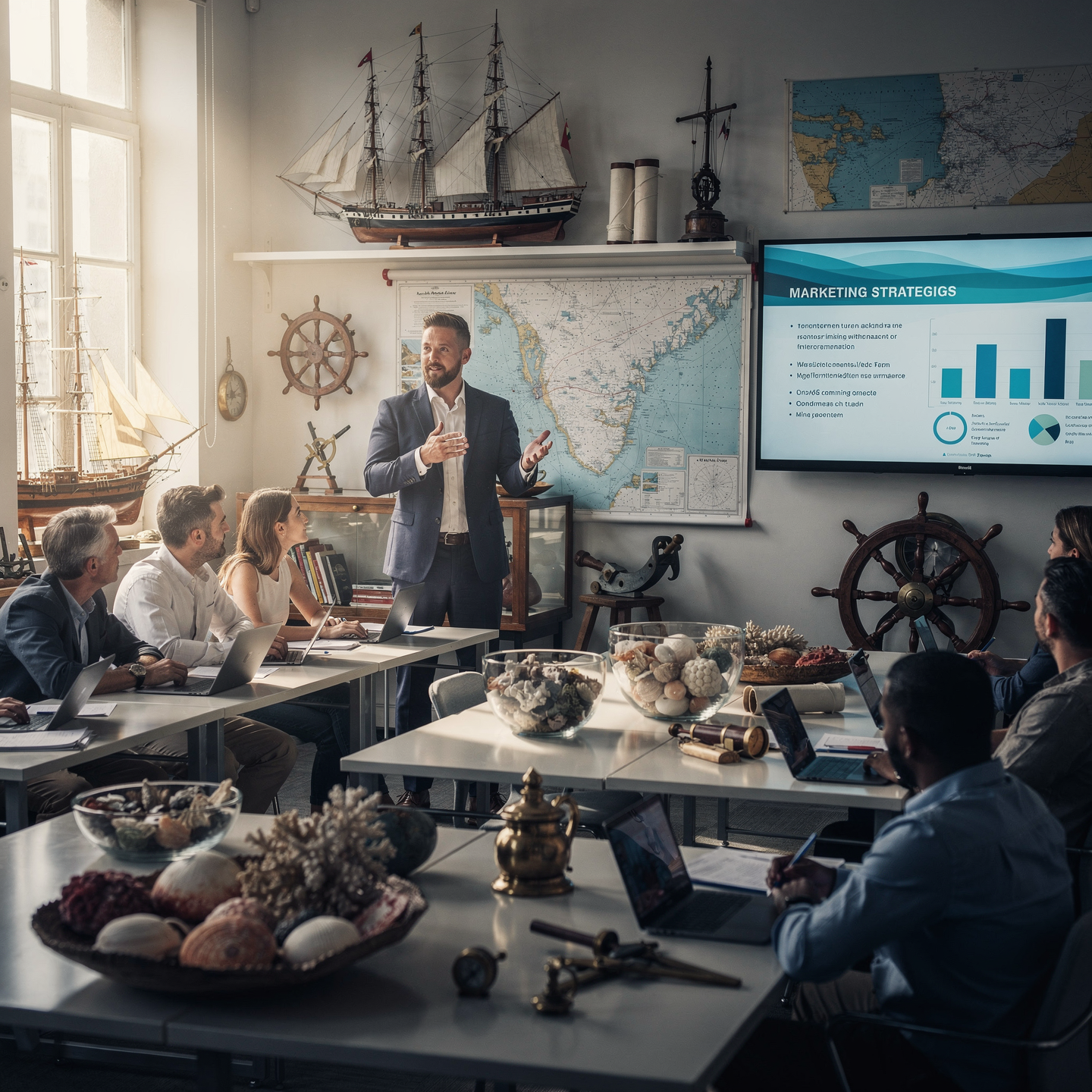
Maritime Cultural Marketing Course
Why this course?
The Maritime Cultural Marketing Course
Immerses you in the intersection of maritime heritage and digital marketing strategies. Learn to transform maritime history and culture into engaging experiences for today’s audiences. Master the tools to create impactful narratives, manage online reputation, and promote maritime events and destinations. This program equips you with the skills needed to connect the past with the present and build a sustainable future for maritime heritage.
Differential Advantages
- Real-world case studies: analysis of successful campaigns and challenges overcome in the sector.
- Digital tools: SEO, social media, email marketing, and web analytics applied to the maritime context.
- Networking: connection with professionals in the maritime cultural and tourism sector.
- Project development: creation of customized marketing strategies for institutions and companies.
- Flexibility: online format with multimedia resources and personalized tutoring.
- Modality: Online
- Level: Cursos
- Hours: 150 H
- Start date: 26-07-2026
Availability: 1 in stock
Who is it aimed at?
- Marketing and communications professionals interested in expanding their knowledge into the maritime cultural sector.
- Cultural managers and directors of maritime museums seeking innovative strategies to connect with new audiences.
- Tourism entrepreneurs and travel agencies wishing to create authentic and differentiated experiences based on maritime heritage.
- Students of marketing, communications, tourism, and cultural management aspiring to specialize in the maritime field.
- Sea and maritime culture enthusiasts wanting to turn their passion into a professional opportunity.
Training flexibility
Adapted to your pace: content accessible 24/7, discussion forums with experts, and practical exercises to apply what you’ve learned.
Objectives and competencies

Navigating coastal identity:
Interpret coastal signals (buoys, beacons, marks) and accurately update position (GPS, radar, visual) by integrating meteorological and current information.

Anchoring stories in collective memory:
“Collecting testimonies, digitizing historical archives, and creating interactive narratives accessible on educational and cultural platforms.”

Mapping authentic tourist experiences:
Identify and value the local, cultural and natural resources that differentiate each destination in order to build unique and meaningful tourism offerings.

Setting sail towards the enhancement of maritime heritage:
“To investigate, document and promote the historical, cultural and natural wealth linked to the sea, fostering its conservation and responsible enjoyment.”

Funding innovation in cultural tourism:
“Identify sources of public and private, national and international financing adapted to innovative cultural tourism projects, and develop solid proposals that maximize investment opportunities.”

Marking cultural-tourist connection routes:
“Identify and mark points of cultural and historical interest using standardized signage that is respectful of the environment.”
Curriculum - Modules
- Comprehensive Maritime Incident Management: protocols, roles, and chain of command for coordinated response
- Operational Planning and Execution: briefing, routes, weather windows, and go/no-go criteria
- Rapid Risk Assessment: criticality matrix, scene control, and decision-making under pressure
- Operational Communication: VHF/GMDSS, standardized reports, and inter-agency liaison
- Tactical Mobility and Safe Boarding: RHIB maneuvers, approach, mooring, and recovery
- Equipment and Technologies: PPE, signaling, satellite tracking, and field data logging
- Immediate Care of the Affected: primary assessment, hypothermia, trauma, and stabilization for evacuation
- Adverse Environmental Conditions: swell, Visibility, flows, and operational mitigation
Simulation and training: critical scenarios, use of VR/AR, and exercises with performance metrics
Documentation and continuous improvement: lessons learned, indicators (MTTA/MTTR), and SOP updates
- Introduction to maritime cultural heritage: definition, typologies, and social value.
- Cultural patronage: historical evolution, models, and current trends.
- Legal framework for cultural patronage in the maritime sector: tax incentives and legal structures.
- Cultural marketing: promotion strategies, audience segmentation, and communication channels.
- Maritime cultural branding: identity, values, and storytelling.
- Development of maritime cultural projects: design, planning, and resource management.
- Financing maritime cultural projects: crowdfunding, grants, and sponsorships.
- Public relations and communication with stakeholders: media, institutions, and the community.
- Evaluation of the impact of maritime cultural promotion and patronage activities.
- Case studies of Success and best practices in promoting maritime cultural heritage.
‘
- Introduction to Maritime Cultural Heritage: Definition, typologies, and social value.
- Cultural Marketing for the Maritime Sector: Fundamentals, strategies, and tools.
- Design of Maritime Cultural Tourism Products: Creating attractive and sustainable experiences.
- Cultural Communication in the Digital Environment: Social networks, blogs, and online platforms.
- Organization of Maritime Cultural Events: Festivals, exhibitions, and historical reenactments.
- Storytelling Techniques for Disseminating Maritime Heritage: Narratives, characters, and contexts.
- Collaboration with Stakeholders: Partnerships with institutions, businesses, and local communities.
- Evaluating the Impact of Cultural Promotion Actions: Indicators, metrics, and analysis of Results.
- Legislation and public policies on maritime cultural heritage: Regulatory framework and funding opportunities.
- Success stories in the promotion and dissemination of maritime culture: Analysis of best practices at the national and international levels.
‘
- Introduction to Maritime Cultural Heritage: Definition, Typologies, and Value.
- Maritime History: Trade Routes, Naval Battles, and Explorations.
- Underwater Archaeology: Research Methodologies and In-Situ Conservation.
- Traditional Shipbuilding: Techniques, Materials, and Traditional Boatbuilding.
- Intangible Maritime Culture: Crafts, Knowledge, Rituals, and Gastronomy.
- Legislation and Protection of Heritage: International Conventions and National Regulations.
- Management of Heritage Sites: Planning, Interpretation, and Sustainability.
- Maritime Cultural Tourism: Product Design, Promotion, and Impact Management.
- Communication and Dissemination: Strategies for Raising awareness and educating the public.
Project funding: fundraising, sponsorships, and business models.
‘
- Introduction to Maritime Cultural Promotion: Concept, Scope, and Importance.
- Maritime Heritage as a Cultural Resource: Types, Conservation, and Enhancement.
- Publics and Audiences: Identification, Segmentation, and Engagement Strategies.
- Communication Tools: Cultural Marketing, Public Relations, and Advertising.
- Maritime Cultural Events: Design, Organization, Management, and Evaluation.
- New Technologies and Digital Media: Social Networks, Online Platforms, and Virtual Reality.
- Content Creation: Storytelling, Audiovisual Formats, and Graphic Design.
- Financing and Sustainability: Grants, Sponsorships, and Business Models.
- Legislation and Regulations: Intellectual Property, Image Rights, and Protection of data.
- Impact Assessment: Indicators, Methodologies, and Best Practices.
‘
- System Architecture and Components: Structural design, materials, and subsystems (mechanical, electrical, electronic, and fluid) with selection and assembly criteria for marine environments
- Fundamentals and Principles of Operation: Physical and engineering foundations (thermodynamics, fluid mechanics, electricity, control, and materials) that explain performance and operating limits
- Safety and Environmental (SHE): Risk analysis, PPE, LOTO, hazardous atmospheres, spill and waste management, and emergency response plans
- Applicable Regulations and Standards: IMO/ISO/IEC requirements and local regulations;
- Conformance criteria, certification, and best practices for operation and maintenance
- Inspection, testing, and diagnostics: Visual/dimensional inspection, functional testing, data analysis, and predictive techniques (vibration, thermography, fluid analysis) to identify root causes
- Preventive and predictive maintenance: Hourly/cycle/seasonal plans, lubrication, adjustments, calibrations, consumable replacement, post-service verification, and operational reliability
- Instrumentation, tools, and metrology: Measuring and testing equipment, diagnostic software, calibration and traceability; selection criteria, safe use, and storage
- Onboard integration and interfaces: Mechanical, electrical, fluid, and data compatibility; Sealing and watertightness, EMC/EMI, corrosion protection, and interoperability testing.
Quality, acceptance testing, and commissioning: process and materials control, FAT/SAT, bench and sea trials, go/no-go criteria, and evidence documentation.
Technical documentation and integrated practice: logs, checklists, reports, and a complete case study (safety → diagnosis → intervention → verification → report) applicable to any system.
Plan de estudio - Módulos
- Comprehensive Maritime Incident Management: protocols, roles, and chain of command for coordinated response
- Operational Planning and Execution: briefing, routes, weather windows, and go/no-go criteria
- Rapid Risk Assessment: criticality matrix, scene control, and decision-making under pressure
- Operational Communication: VHF/GMDSS, standardized reports, and inter-agency liaison
- Tactical Mobility and Safe Boarding: RHIB maneuvers, approach, mooring, and recovery
- Equipment and Technologies: PPE, signaling, satellite tracking, and field data logging
- Immediate Care of the Affected: primary assessment, hypothermia, trauma, and stabilization for evacuation
- Adverse Environmental Conditions: swell, Visibility, flows, and operational mitigation
Simulation and training: critical scenarios, use of VR/AR, and exercises with performance metrics
Documentation and continuous improvement: lessons learned, indicators (MTTA/MTTR), and SOP updates
- Introduction to maritime cultural heritage: definition, typologies, and social value.
- Cultural patronage: historical evolution, models, and current trends.
- Legal framework for cultural patronage in the maritime sector: tax incentives and legal structures.
- Cultural marketing: promotion strategies, audience segmentation, and communication channels.
- Maritime cultural branding: identity, values, and storytelling.
- Development of maritime cultural projects: design, planning, and resource management.
- Financing maritime cultural projects: crowdfunding, grants, and sponsorships.
- Public relations and communication with stakeholders: media, institutions, and the community.
- Evaluation of the impact of maritime cultural promotion and patronage activities.
- Case studies of Success and best practices in promoting maritime cultural heritage.
‘
- Introduction to Maritime Cultural Heritage: Definition, typologies, and social value.
- Cultural Marketing for the Maritime Sector: Fundamentals, strategies, and tools.
- Design of Maritime Cultural Tourism Products: Creating attractive and sustainable experiences.
- Cultural Communication in the Digital Environment: Social networks, blogs, and online platforms.
- Organization of Maritime Cultural Events: Festivals, exhibitions, and historical reenactments.
- Storytelling Techniques for Disseminating Maritime Heritage: Narratives, characters, and contexts.
- Collaboration with Stakeholders: Partnerships with institutions, businesses, and local communities.
- Evaluating the Impact of Cultural Promotion Actions: Indicators, metrics, and analysis of Results.
- Legislation and public policies on maritime cultural heritage: Regulatory framework and funding opportunities.
- Success stories in the promotion and dissemination of maritime culture: Analysis of best practices at the national and international levels.
‘
- Introduction to Maritime Cultural Heritage: Definition, Typologies, and Value.
- Maritime History: Trade Routes, Naval Battles, and Explorations.
- Underwater Archaeology: Research Methodologies and In-Situ Conservation.
- Traditional Shipbuilding: Techniques, Materials, and Traditional Boatbuilding.
- Intangible Maritime Culture: Crafts, Knowledge, Rituals, and Gastronomy.
- Legislation and Protection of Heritage: International Conventions and National Regulations.
- Management of Heritage Sites: Planning, Interpretation, and Sustainability.
- Maritime Cultural Tourism: Product Design, Promotion, and Impact Management.
- Communication and Dissemination: Strategies for Raising awareness and educating the public.
Project funding: fundraising, sponsorships, and business models.
‘
- Introduction to Maritime Cultural Promotion: Concept, Scope, and Importance.
- Maritime Heritage as a Cultural Resource: Types, Conservation, and Enhancement.
- Publics and Audiences: Identification, Segmentation, and Engagement Strategies.
- Communication Tools: Cultural Marketing, Public Relations, and Advertising.
- Maritime Cultural Events: Design, Organization, Management, and Evaluation.
- New Technologies and Digital Media: Social Networks, Online Platforms, and Virtual Reality.
- Content Creation: Storytelling, Audiovisual Formats, and Graphic Design.
- Financing and Sustainability: Grants, Sponsorships, and Business Models.
- Legislation and Regulations: Intellectual Property, Image Rights, and Protection of data.
- Impact Assessment: Indicators, Methodologies, and Best Practices.
‘
- System Architecture and Components: Structural design, materials, and subsystems (mechanical, electrical, electronic, and fluid) with selection and assembly criteria for marine environments
- Fundamentals and Principles of Operation: Physical and engineering foundations (thermodynamics, fluid mechanics, electricity, control, and materials) that explain performance and operating limits
- Safety and Environmental (SHE): Risk analysis, PPE, LOTO, hazardous atmospheres, spill and waste management, and emergency response plans
- Applicable Regulations and Standards: IMO/ISO/IEC requirements and local regulations;
- Conformance criteria, certification, and best practices for operation and maintenance
- Inspection, testing, and diagnostics: Visual/dimensional inspection, functional testing, data analysis, and predictive techniques (vibration, thermography, fluid analysis) to identify root causes
- Preventive and predictive maintenance: Hourly/cycle/seasonal plans, lubrication, adjustments, calibrations, consumable replacement, post-service verification, and operational reliability
- Instrumentation, tools, and metrology: Measuring and testing equipment, diagnostic software, calibration and traceability; selection criteria, safe use, and storage
- Onboard integration and interfaces: Mechanical, electrical, fluid, and data compatibility; Sealing and watertightness, EMC/EMI, corrosion protection, and interoperability testing.
Quality, acceptance testing, and commissioning: process and materials control, FAT/SAT, bench and sea trials, go/no-go criteria, and evidence documentation.
Technical documentation and integrated practice: logs, checklists, reports, and a complete case study (safety → diagnosis → intervention → verification → report) applicable to any system.
- Introduction to Nautical Cultural Heritage: definition, typologies (tangible and intangible), and valorization.
- Analysis of the Target Audience: segmentation, motivations, expectations, and interests.
- Cultural Marketing: principles, tools, and strategies applied to the nautical sector.
- Cultural Communication: design of messages, channels, and formats for the dissemination of nautical heritage.
- Online Promotion Strategies: social networks, blogs, websites, and specialized platforms.
- Offline Promotion Strategies: events, festivals, exhibitions, publications, and public relations.
- Brand Image Management: visual identity, storytelling, and online reputation.
- Collaboration with Stakeholders: institutions, associations, companies, and media outlets.
Impact assessment of promotional and outreach activities: indicators, metrics, and analytical tools.
Success stories: analysis of nautical cultural promotion and outreach strategies at the national and international levels.
‘
- Introduction to nautical culture: history, heritage, and social relevance
- Fundamentals of cultural marketing: principles, objectives, and strategies
- Identifying and segmenting the target audience: profiles, interests, and needs
- Developing key messages and compelling narratives for nautical cultural promotion
- Digital communication tools: social media, blogs, podcasts, video marketing
- Public relations and media management: press releases, interviews, events
- Design and production of promotional materials: brochures, posters, audiovisuals
- Organization and management of nautical cultural events: festivals, exhibitions, regattas
- Impact and return on investment assessment of the return on investment (ROI) of cultural promotion activities
- Collaboration and strategic alliances: institutions, businesses, and local communities
‘
- Introduction to Maritime Cultural Heritage: Definition, Typologies, and Value
- Maritime History: Routes, Explorations, Naval Battles, and Trade
- Underwater Archaeology: Surveying, Excavation, Conservation, and Legislation
- Maritime Ethnography: Communities, Trades, Traditional Knowledge, and Festivals
- Intangible Heritage: Work Songs, Legends, Gastronomy, and Traditional Shipbuilding
- National and International Legislation on Maritime Cultural Heritage
- Cultural and Heritage Tourism: Planning, Management, and Sustainability
- Heritage Interpretation: Communication Techniques, Route Design, and Interpretation Centers
- Maritime Museography: Exhibition Design, Collection Conservation, and Dissemination
- Financing and management of projects for the enhancement of maritime-cultural heritage
‘
- Introduction to Maritime-Cultural Heritage: Definition, Typologies, and Value
- Legal and Regulatory Framework: Protection, Conservation, and Dissemination of Heritage
- Inventory and Cataloging Preparation: Methodologies and Tools
- Design of Cultural Tourism Routes and Products: Planning and Management
- Cultural Marketing: Promotion and Communication Strategies
- Use of Digital Technologies: Augmented Reality, Virtual Reality, and Apps
- Heritage Interpretation: Techniques and Resources for Dissemination
- Visitor Management: Accessibility, Sustainability, and Quality
- Collaboration and Partnerships: Stakeholders, Local Communities, and the Private Sector
- Evaluation and Continuous Improvement: Impact and Satisfaction Indicators
‘
Career opportunities
- Maritime Cultural Project Manager: Design, planning, and execution of cultural events and programs related to the sea.
- Maritime Tourism Promotion Specialist: Development of marketing strategies to promote coastal and maritime tourism.
- Communications Officer in Maritime Institutions: Content creation and management of the public image of museums, aquariums, or maritime interpretation centers.
- Marketing Consultant for Companies in the Nautical Sector: Advising on marketing strategies for shipbuilding companies, marinas, or water sports activities.
- Nautical Event Organizer: Planning and management of regattas, maritime festivals, and other celebrations related to the sea.
- Digital Content Creator specializing in Maritime Culture: Production of videos, podcasts, and articles for online platforms about the history and traditions of maritime culture.
and maritime heritage.
Marketing Manager in Maritime Museums: Designing marketing campaigns to attract visitors and increase museum visibility.
Market Researcher in the Maritime Tourism Sector: Analyzing trends and opportunities in the maritime tourism market.
“`
Admission requirements

Academic/professional profile:
Degree/Bachelor's degree in Nautical Science/Maritime Transport, Naval/Marine Engineering, or a related field; or proven professional experience in bridge/operations.

Language proficiency:
Recommended functional maritime English (SMCP) for simulations and technical materials.

5. Induction
Updated resume, copy of degree or seaman's book, ID card/passport, letter of motivation.

Technical requirements (for online):
Equipment with camera/microphone, stable connection, ≥ 24” monitor recommended for ECDIS/Radar-ARPA.
Admission process and dates

1. Online
application
(form + documents).

2. Academic review and interview
(profile/objectives/schedule compatibility).

3. Admission decision
(+ scholarship proposal if applicable).

4. Reservation of place
(deposit) and registration.

5. Induction
(access to campus, calendars, simulator guides).
Scholarships and grants
- Discover the ocean of opportunities: Learn to apply innovative marketing strategies to the maritime cultural sector.
- Connect culture and commerce: Master the tools to promote museums, events, heritage, and experiences related to the sea.
- Stand out from the competition: Acquire skills to create impactful campaigns and connect with specific audiences.
- Boost maritime cultural tourism: Learn to develop attractive and sustainable tourism products and services.
- Master the latest trends: Immerse yourself in digital marketing, social media, and storytelling applied to the maritime world.
Testimonials
I implemented a digital marketing strategy for the Cartagena Maritime Museum, focusing on promoting its exhibits on the history of navigation. Through targeted social media campaigns and the creation of interactive content, we achieved a 35% increase in online ticket sales and a 20% increase in in-person attendance within three months, exceeding the museum’s expectations and positioning it as a cultural landmark in the region.
During the Communication, Tourism, and Culture course, I developed crucial skills for creating engaging content and effectively managing social media, achieving a 20% increase in engagement on the tourism website I managed as my final project. Understanding cultural dynamics and applying communication strategies tailored to different audiences were fundamental to this success.
I implemented a digital marketing campaign for the National Maritime Museum, achieving a 35% increase in online ticket sales and a 20% increase in in-person visits in three months, exceeding initial expectations and positioning the museum as a cultural landmark in the city.
I implemented a digital marketing strategy for the Maritime Museum of [City/Region], focusing on local maritime culture. In six months, we achieved a 45% increase in visits, a 30% increase in online ticket sales, and a 20% increase in social media engagement, exceeding the museum’s initial expectations and positioning it as a cultural landmark in the community.

Frequently asked questions
People interested in maritime culture, including enthusiasts of sailing, maritime history, underwater archaeology, marine biology, and coastal tourism.
Yes. The itinerary includes ECDIS/Radar-ARPA/BRM with harbor, ocean, fog, storm, and SAR scenarios.
Online with live sessions; hybrid option for simulator/practical placements through agreements.
People interested in maritime history, culture, heritage and traditions, as well as aquatic recreational activities.
Recommended functional SMCP. We offer support materials for standard phraseology.
Yes, with a relevant degree or experience in maritime/port operations. The admissions interview will confirm suitability.
Optional (3–6 months) through Companies & Collaborations and the Alumni Network.
Simulator practice (rubrics), defeat plans, SOPs, checklists, micro-tests and applied TFM.
A degree from Navalis Magna University + operational portfolio (tracks, SOPs, reports and KPIs) useful for audits and employment.
- Introduction to Maritime-Cultural Heritage: Definition, Typologies, and Value
- Legal and Regulatory Framework: Protection, Conservation, and Dissemination of Heritage
- Inventory and Cataloging Preparation: Methodologies and Tools
- Design of Cultural Tourism Routes and Products: Planning and Management
- Cultural Marketing: Promotion and Communication Strategies
- Use of Digital Technologies: Augmented Reality, Virtual Reality, and Apps
- Heritage Interpretation: Techniques and Resources for Dissemination
- Visitor Management: Accessibility, Sustainability, and Quality
- Collaboration and Partnerships: Stakeholders, Local Communities, and the Private Sector
- Evaluation and Continuous Improvement: Impact and Satisfaction Indicators
‘
Request information
- Complete the Application Form
- Attach your CV/Qualifications (if you have them to hand).
- Indicate your preferred cohort (January/May/September) and whether you want the hybrid option with simulator sessions.
Teachers
Eng. Tomás Riera
Full Professor
Eng. Tomás Riera
Full Professor
Eng. Sofía Marquina
Full Professor
Eng. Sofía Marquina
Full Professor
Eng. Javier Bañuls
Full Professor
Eng. Javier Bañuls
Full Professor
Dr. Nuria Llobregat
Full Professor
Dr. Nuria Llobregat
Full Professor
Dr. Pau Ferrer
Full Professor
Dr. Pau Ferrer
Full Professor
Cap. Javier Abaroa (MCA)
Full Professor
Cap. Javier Abaroa (MCA)
Full Professor

