Course on Robotics Projects Applied to the Ocean
Why this course?
The Ocean Robotics Projects
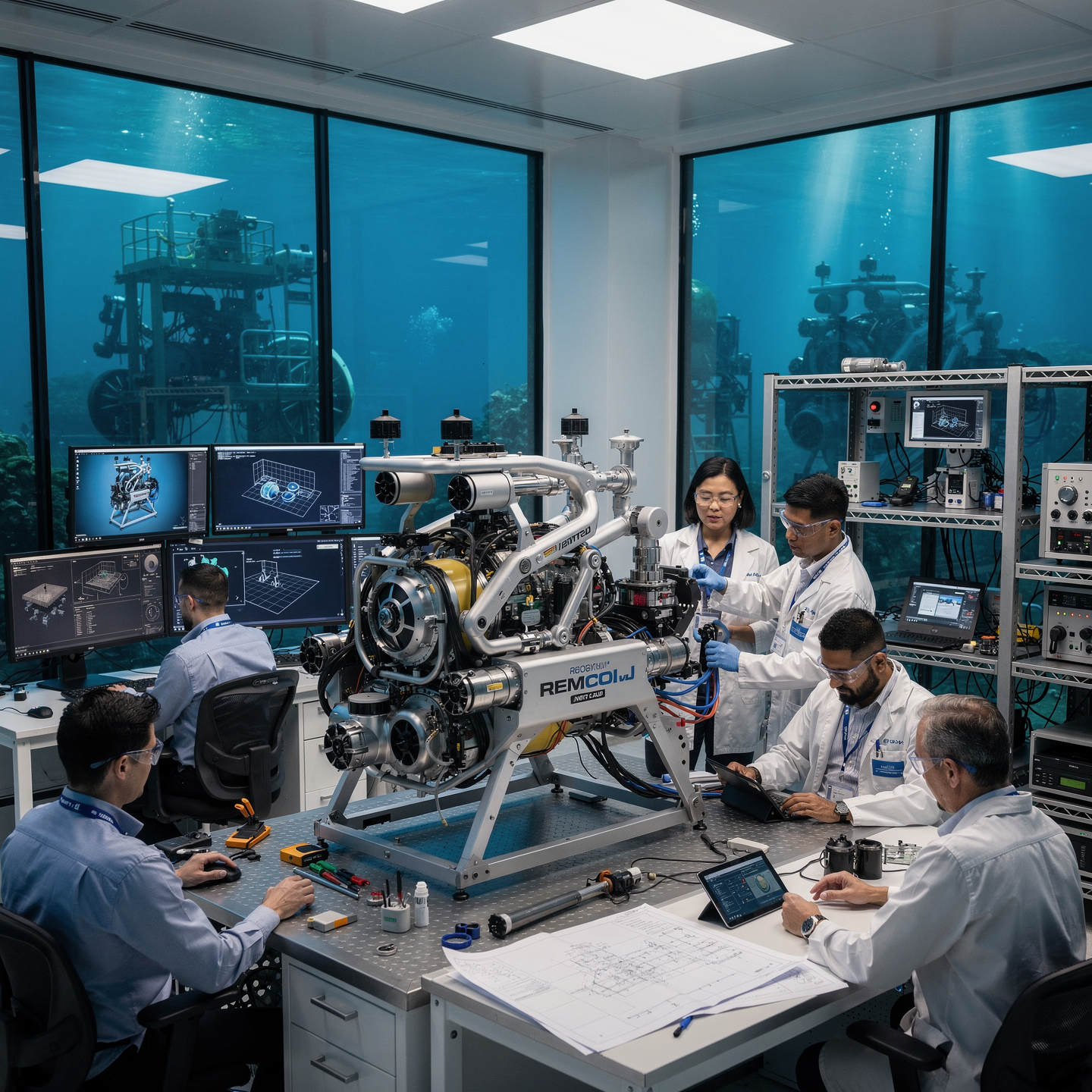
Immerse yourself in the fascinating world of marine exploration and conservation through robotics. Learn to design, build, and program remotely operated vehicles (ROVs) and autonomous underwater vehicles (AUVs) to tackle real-world challenges in ocean environments. From inspecting underwater infrastructure to monitoring marine life, this program provides you with the skills needed to innovate in ocean engineering. This course addresses this scenario with a combination of theory and practice, end-to-end project planning, underwater sensors and actuators, and advanced programming, with assessment based on real-world projects.
Differential Advantages
- Practical Projects: Construction and testing of ROVs and AUVs in simulated and real environments.
- Cutting-edge Tools: Use of simulation and design software, 3D printing, and marine electronics.
- Interdisciplinary Collaboration: Teamwork with experts in marine biology, oceanography, and engineering.
- In-depth Knowledge: Understanding the challenges and opportunities of robotics in the ocean.
- Flexibility: Online format with synchronous sessions and the option of practical training in specialized laboratories.
- Modality: Online
- Level: Cursos
- Hours: 150 H
- Start date: 25-04-2026
Availability: 1 in stock
Who is it aimed at?
- Engineering, oceanography, and marine science students who wish to apply their theoretical knowledge to practical challenges in ocean exploration and monitoring.
- Maritime, energy, and aquaculture professionals interested in automating processes, improving efficiency, and reducing costs through robotic solutions.
- Researchers and scientists seeking advanced tools for data collection, ecosystem observation, and experimentation in marine environments.
- Entrepreneurs and startups who want to develop new technologies and innovative solutions for the ocean industry.
- Robotics and underwater technology enthusiasts eager to learn about the design, construction, and programming of robots for various applications.
Oceanic.
Learning Flexibility
Designed to adapt to your pace: 24/7 accessible online content, practical projects with personalized feedback, and a forum for questions with experts.
Objectives and competencies

Develop robotic prototypes for marine environmental monitoring:
“Implement robust autonomous navigation systems with redundancy and optimized power management for extended missions.”

Implementing autonomous navigation systems for underwater robots:
“Integrating SLAM (Simultaneous Localization and Mapping) with advanced sensors for 3D environment mapping and robust route planning.”

Designing robotic arms with selective sampling capabilities in complex marine environments:
Implement computer vision and machine learning systems to accurately identify and select samples of interest in real time.

Building efficient and durable underwater charging stations:
“Select materials resistant to marine corrosion and apply design techniques that minimize environmental impact and ensure long-term operability.”
Creating robots capable of identifying and neutralizing microplastics in water:
“Implementing machine vision algorithms and precise handling systems for the selective collection of microplastics, optimizing energy efficiency and minimizing environmental impact.”

Develop robots capable of performing high-resolution three-dimensional mapping of coral reefs:
Implement robust SLAM algorithms, optimizing accuracy and minimizing accumulated drift through multisensor data fusion (cameras, sonar, IMU).
Curriculum - Modules
- Comprehensive Maritime Incident Management: protocols, roles, and chain of command for coordinated response
- Operational Planning and Execution: briefing, routes, weather windows, and go/no-go criteria
- Rapid Risk Assessment: criticality matrix, scene control, and decision-making under pressure
- Operational Communication: VHF/GMDSS, standardized reports, and inter-agency liaison
- Tactical Mobility and Safe Boarding: RHIB maneuvers, approach, mooring, and recovery
- Equipment and Technologies: PPE, signaling, satellite tracking, and field data logging
- Immediate Care of the Affected: primary assessment, hypothermia, trauma, and stabilization for evacuation
- Adverse Environmental Conditions: swell, Visibility, flows, and operational mitigation
Simulation and training: critical scenarios, use of VR/AR, and exercises with performance metrics
Documentation and continuous improvement: lessons learned, indicators (MTTA/MTTR), and SOP updates
- Introduction to Marine Robotics: History, Applications, and Challenges
- Marine Sensors: Types, Operation, Calibration, and Integration
- Marine Actuators: Thrusters, Manipulators, Hydraulic and Pneumatic Systems
- Underwater Communication: Acoustics, Optics, Umbilical and Wireless ROVs
- Power and Energy: Batteries, Fuel Cells, Solar and Wind Power
- Structural Design: Materials, Hydrodynamics, Corrosion Resistance
- ROV and AUV Control: Control Loops, Stability, Autonomous Navigation
- Control Software: Architectures, Simulation, User Interfaces
- Deployment and Recovery: Procedures, Safety, Logistics
- Maintenance and repair of marine robotic systems
‘
- Introduction to marine robotics: history, applications, and challenges.
- Marine sensors: types, operation, calibration, and limitations (IMU, GPS, DVL, sonar).
- Marine actuators: propellers (propellers, thrusters), buoyancy control systems, and manipulators.
- Underwater communications: acoustic, optical, and wired; Protocols and restrictions.
- Onboard electronics: microcontrollers, development boards (Arduino, Raspberry Pi), and communication buses (CAN, Ethernet).
- Power supply: batteries, power supplies, and power management in marine environments.
- Structures and materials: hydrodynamic design, selection of corrosion-resistant and watertight materials.
- Basic control: PID systems, depth, heading, and position control.
- Autonomous navigation: trajectory planning, obstacle avoidance, and SLAM (Simultaneous Localization and Mapping).
- Ethics and regulations in marine robotics: environmental impact, safety, and legal aspects.
‘
- Introduction to Underwater Robotics: history, applications, challenges.
- Remotely Operated Vehicles (ROVs): types, components, operation.
- Propulsion and Control Systems: propellers, thrusters, hydraulics, electronics.
- Underwater Sensors: cameras, sonar, altimeters, depth sensors, CTD.
- Underwater Communications: cables, acoustics, limitations, and solutions.
- Underwater Navigation and Positioning: USBL, LBL, INS, DVL.
- Manipulation and Tools: robotic arms, actuators, grippers.
- Underwater Power Sources: batteries, umbilicals, stacks Fuel.
- ROV Maintenance and Repair: Procedures, Troubleshooting, Safety.
- Environmental and Ethical Considerations in Underwater Robotics.
‘
- Introduction to Marine Robotics: History, Trends, and Challenges
- Remotely Operated Underwater Vehicles (ROVs): Types, Components, and Applications
- Autonomous Underwater Vehicles (AUVs): Design, Navigation, and Control
- Marine Propulsion Systems: Propellers, Thrusters, and Thrust Vectors
- Marine Sensors: Cameras, Sonar, IMU, GPS, and Environmental Sensors
- Underwater Communications: Acoustics, Optics, and Tethered Cables
- ROV and AUV Control: PID, Adaptive Control, and Robust Control
- Navigation Submarine Robotics: Position Estimation, Mapping, and SLAM
Mechanical and Electrical Design of Marine Robots: Materials, Watertightness, and Power
Oceanic Applications of Marine Robotics: Inspection, Maintenance, Science, and Exploration
‘
- System Architecture and Components: Structural design, materials, and subsystems (mechanical, electrical, electronic, and fluid) with selection and assembly criteria for marine environments
- Fundamentals and Principles of Operation: Physical and engineering foundations (thermodynamics, fluid mechanics, electricity, control, and materials) that explain performance and operating limits
- Safety and Environmental (SHE): Risk analysis, PPE, LOTO, hazardous atmospheres, spill and waste management, and emergency response plans
- Applicable Regulations and Standards: IMO/ISO/IEC requirements and local regulations;
- Conformance criteria, certification, and best practices for operation and maintenance
- Inspection, testing, and diagnostics: Visual/dimensional inspection, functional testing, data analysis, and predictive techniques (vibration, thermography, fluid analysis) to identify root causes
- Preventive and predictive maintenance: Hourly/cycle/seasonal plans, lubrication, adjustments, calibrations, consumable replacement, post-service verification, and operational reliability
- Instrumentation, tools, and metrology: Measuring and testing equipment, diagnostic software, calibration and traceability; selection criteria, safe use, and storage
- Onboard integration and interfaces: Mechanical, electrical, fluid, and data compatibility; Sealing and watertightness, EMC/EMI, corrosion protection, and interoperability testing.
Quality, acceptance testing, and commissioning: process and materials control, FAT/SAT, bench and sea trials, go/no-go criteria, and evidence documentation.
Technical documentation and integrated practice: logs, checklists, reports, and a complete case study (safety → diagnosis → intervention → verification → report) applicable to any system.
Plan de estudio - Módulos
- Comprehensive Maritime Incident Management: protocols, roles, and chain of command for coordinated response
- Operational Planning and Execution: briefing, routes, weather windows, and go/no-go criteria
- Rapid Risk Assessment: criticality matrix, scene control, and decision-making under pressure
- Operational Communication: VHF/GMDSS, standardized reports, and inter-agency liaison
- Tactical Mobility and Safe Boarding: RHIB maneuvers, approach, mooring, and recovery
- Equipment and Technologies: PPE, signaling, satellite tracking, and field data logging
- Immediate Care of the Affected: primary assessment, hypothermia, trauma, and stabilization for evacuation
- Adverse Environmental Conditions: swell, Visibility, flows, and operational mitigation
Simulation and training: critical scenarios, use of VR/AR, and exercises with performance metrics
Documentation and continuous improvement: lessons learned, indicators (MTTA/MTTR), and SOP updates
- Introduction to Marine Robotics: History, Applications, and Challenges
- Marine Sensors: Types, Operation, Calibration, and Integration
- Marine Actuators: Thrusters, Manipulators, Hydraulic and Pneumatic Systems
- Underwater Communication: Acoustics, Optics, Umbilical and Wireless ROVs
- Power and Energy: Batteries, Fuel Cells, Solar and Wind Power
- Structural Design: Materials, Hydrodynamics, Corrosion Resistance
- ROV and AUV Control: Control Loops, Stability, Autonomous Navigation
- Control Software: Architectures, Simulation, User Interfaces
- Deployment and Recovery: Procedures, Safety, Logistics
- Maintenance and repair of marine robotic systems
‘
- Introduction to marine robotics: history, applications, and challenges.
- Marine sensors: types, operation, calibration, and limitations (IMU, GPS, DVL, sonar).
- Marine actuators: propellers (propellers, thrusters), buoyancy control systems, and manipulators.
- Underwater communications: acoustic, optical, and wired; Protocols and restrictions.
- Onboard electronics: microcontrollers, development boards (Arduino, Raspberry Pi), and communication buses (CAN, Ethernet).
- Power supply: batteries, power supplies, and power management in marine environments.
- Structures and materials: hydrodynamic design, selection of corrosion-resistant and watertight materials.
- Basic control: PID systems, depth, heading, and position control.
- Autonomous navigation: trajectory planning, obstacle avoidance, and SLAM (Simultaneous Localization and Mapping).
- Ethics and regulations in marine robotics: environmental impact, safety, and legal aspects.
‘
- Introduction to Underwater Robotics: history, applications, challenges.
- Remotely Operated Vehicles (ROVs): types, components, operation.
- Propulsion and Control Systems: propellers, thrusters, hydraulics, electronics.
- Underwater Sensors: cameras, sonar, altimeters, depth sensors, CTD.
- Underwater Communications: cables, acoustics, limitations, and solutions.
- Underwater Navigation and Positioning: USBL, LBL, INS, DVL.
- Manipulation and Tools: robotic arms, actuators, grippers.
- Underwater Power Sources: batteries, umbilicals, stacks Fuel.
- ROV Maintenance and Repair: Procedures, Troubleshooting, Safety.
- Environmental and Ethical Considerations in Underwater Robotics.
‘
- Introduction to Marine Robotics: History, Trends, and Challenges
- Remotely Operated Underwater Vehicles (ROVs): Types, Components, and Applications
- Autonomous Underwater Vehicles (AUVs): Design, Navigation, and Control
- Marine Propulsion Systems: Propellers, Thrusters, and Thrust Vectors
- Marine Sensors: Cameras, Sonar, IMU, GPS, and Environmental Sensors
- Underwater Communications: Acoustics, Optics, and Tethered Cables
- ROV and AUV Control: PID, Adaptive Control, and Robust Control
- Navigation Submarine Robotics: Position Estimation, Mapping, and SLAM
Mechanical and Electrical Design of Marine Robots: Materials, Watertightness, and Power
Oceanic Applications of Marine Robotics: Inspection, Maintenance, Science, and Exploration
‘
- System Architecture and Components: Structural design, materials, and subsystems (mechanical, electrical, electronic, and fluid) with selection and assembly criteria for marine environments
- Fundamentals and Principles of Operation: Physical and engineering foundations (thermodynamics, fluid mechanics, electricity, control, and materials) that explain performance and operating limits
- Safety and Environmental (SHE): Risk analysis, PPE, LOTO, hazardous atmospheres, spill and waste management, and emergency response plans
- Applicable Regulations and Standards: IMO/ISO/IEC requirements and local regulations;
- Conformance criteria, certification, and best practices for operation and maintenance
- Inspection, testing, and diagnostics: Visual/dimensional inspection, functional testing, data analysis, and predictive techniques (vibration, thermography, fluid analysis) to identify root causes
- Preventive and predictive maintenance: Hourly/cycle/seasonal plans, lubrication, adjustments, calibrations, consumable replacement, post-service verification, and operational reliability
- Instrumentation, tools, and metrology: Measuring and testing equipment, diagnostic software, calibration and traceability; selection criteria, safe use, and storage
- Onboard integration and interfaces: Mechanical, electrical, fluid, and data compatibility; Sealing and watertightness, EMC/EMI, corrosion protection, and interoperability testing.
Quality, acceptance testing, and commissioning: process and materials control, FAT/SAT, bench and sea trials, go/no-go criteria, and evidence documentation.
Technical documentation and integrated practice: logs, checklists, reports, and a complete case study (safety → diagnosis → intervention → verification → report) applicable to any system.
- Introduction to Underwater Robotics: History, Applications, and Future
- Principles of Underwater Propulsion: Types of Thrusters, Control, and Efficiency
- Underwater Sensors: Types, Operation, Calibration, and Integration (Sonar, Cameras, Environmental Sensors)
- Control and Autonomous Navigation Systems in ROVs and AUVs
- Underwater Communications: Acoustics, Optical, Radio, and Wired Communications, Protocols, and Limitations
- Materials and Structures for Deep-Sea Environments: Corrosion, Pressure, and Strength
- Marine Environmental Legislation and Regulations: Impact of Underwater Operations, Permits, and Best Practices
- Marine Conservation: Challenges and Solutions (Pollution, Overfishing, Climate Change) climate)
- Design and Construction of ROVs and AUVs: Process, Tools, and Considerations
- Ethics in Underwater Robotics and Marine Conservation: Responsibility and Sustainability
‘
- Introduction to Marine Robotics: History, Evolution, and Current State
- ROVs and AUVs: Classification, Main Components, Differences, and Applications
- Marine Sensors: IMU, GPS, Sonar, Cameras, Pressure, Temperature, and Conductivity Sensors
- Marine Actuators: Propulsion, Manipulators, Mooring and Deployment Systems
- Underwater Communication: Acoustics, Optics, Umbilical ROVs, and Autonomous AUVs
- Hydrodynamic Design: Shape Optimization, Drag, Stability, and Maneuverability
- Materials for Marine Robotics: Resistance to Corrosion, Pressure, and Biofouling
- Power Systems: Batteries, Fuel Cells, and Renewable Energy Sources
- ROV Control: teleoperation, human-machine interfaces, ergonomics
- AUV Control: autonomous navigation, route planning, obstacle avoidance
‘
- Introduction to Underwater Robotics: ROVs, AUVs, and Their Applications
- Underwater Sensors: Cameras, Sonar, LiDAR, CTD Profiles
- Actuators and Propulsion Systems: Motors, Propellers, Thrusters
- Underwater Communications: Acoustics, Optical Communications, Tethered Communications
- Artificial Intelligence Applied to Ocean Exploration: Computer Vision, Machine Learning, Route Planning
- Underwater Image Processing: Color Correction, Noise Reduction, Quality Enhancement
- Underwater Localization and Mapping: SLAM, Inertial Navigation, Acoustic GPS
- Autonomous Control of Underwater Robots: Control Algorithms, Obstacle Avoidance, Tracking Objectives
- Applications of underwater robotics in oceanography: biodiversity studies, infrastructure inspection, environmental monitoring
- Ethics and sustainability in ocean exploration with robots and AI
‘
- Introduction to Marine Robotics: History, Types of ROVs and AUVs
- Basic Hydrodynamics: Drag, Lift, and Buoyancy Forces in Marine Environments
- Materials and Structural Design: Selection of Corrosion- and Pressure-Resistant Materials
- Propulsion Systems: Propellers, Thrusters, and Their Efficiency Under Different Conditions
- Power Sources: Batteries, Umbilicals, and Autonomous Generation
- Onboard Electronics: Sensors, Microcontrollers, and Communication Systems
- Position and Orientation Control: PID, Fuzzy Logic, and Adaptive Control
- Underwater Navigation and Localization: INS, USBL, DVL, and SLAM
- Underwater Machine Vision: Image Processing and Detection of objects and tracking
- Applications of marine robotics: inspection, maintenance, research and exploration
‘
Career opportunities
- Underwater Robot Design and Development Engineer: Creation and improvement of robots for ocean exploration, maintenance, and monitoring.
- Underwater Robot Maintenance and Repair Technician: Diagnosis, repair, and performance optimization of robots in marine environments.
- Underwater Robot (ROV/AUV) Operator: Control and operation of robots for inspections, sampling, and specific underwater tasks.
- Marine Robotics Researcher: Development of new robotic technologies and applications for ocean research and marine conservation.
- Ocean Robotics Project Consultant: Technical and strategic advice for companies, institutions, and projects related to marine robotics.
- Underwater Robotics Project Manager: Planning, coordination, and supervision of robotics projects applied to the ocean, ensuring Meeting objectives and deadlines.
- Specialist in sensors and control systems for marine robotics: Development and integration of sensors and control systems to improve the autonomy and capabilities of underwater robots.
- Entrepreneur in the ocean robotics sector: Creation of innovative companies that offer robotic solutions for the exploration, conservation, and sustainable exploitation of marine resources.
“`
Admission requirements

Academic/professional profile:
Degree/Bachelor's degree in Nautical Science/Maritime Transport, Naval/Marine Engineering, or a related field; or proven professional experience in bridge/operations.

Language proficiency:
Recommended functional maritime English (SMCP) for simulations and technical materials.

5. Induction
Updated resume, copy of degree or seaman's book, ID card/passport, letter of motivation.

Technical requirements (for online):
Equipment with camera/microphone, stable connection, ≥ 24” monitor recommended for ECDIS/Radar-ARPA.
Admission process and dates

1. Online
application
(form + documents).

2. Academic review and interview
(profile/objectives/schedule compatibility).

3. Admission decision
(+ scholarship proposal if applicable).

4. Reservation of place
(deposit) and registration.

5. Induction
(access to campus, calendars, simulator guides).
Scholarships and grants
- Explore the future of the ocean: Immerse yourself in the world of marine robotics and learn to design innovative solutions for exploration and conservation.
- Master the key tools: Acquire practical skills in the construction, programming, and operation of remotely operated vehicles (ROVs) and autonomous underwater vehicles (AUVs).
- Apply your knowledge: Develop real-world projects focused on challenges such as environmental monitoring, underwater infrastructure inspection, and scientific research.
- Connect with experts: Learn from leading professionals in the field and make valuable contacts for your career.
- Boost your professional profile: Stand out in a constantly growing job market and contribute to the sustainable development of the oceans.
Testimonials
I led the development of an autonomous robotic system for monitoring coral reefs, integrating multispectral imaging sensors and machine learning algorithms for the early detection of bleaching. The resulting prototype exceeded project expectations, achieving 95% accuracy in identifying affected coral and providing crucial data for the timely intervention of marine biologists.
I applied the robotics and control knowledge I gained in the course to develop an autonomous navigation system for an ROV, improving the efficiency of underwater inspections by 30% and reducing operating time by 20% in my final project. This success allowed me to obtain a scholarship to research the application of AI in deep-sea exploration.
I led the development of an autonomous robotic system for monitoring coral reefs, integrating multispectral sensors and machine vision algorithms. The system successfully mapped a 2km² reef area, identifying areas of coral bleaching with 95% accuracy—crucial information for local conservation efforts.
I led the development of a low-cost robotic system for monitoring coral health, using a custom-built ROV equipped with multispectral sensors. The system successfully collected crucial data on coral bleaching, enabling local researchers to implement more effective conservation strategies.

Frequently asked questions
Yes. The itinerary includes ECDIS/Radar-ARPA/BRM with harbor, ocean, fog, storm, and SAR scenarios.
Online with live sessions; hybrid option for simulator/practical placements through agreements.
Pollution monitoring, inspection of underwater infrastructure, study of marine biodiversity and mapping of the ocean floor.
Recommended functional SMCP. We offer support materials for standard phraseology.
Yes, with a relevant degree or experience in maritime/port operations. The admissions interview will confirm suitability.
Optional (3–6 months) through Companies & Collaborations and the Alumni Network.
Simulator practice (rubrics), defeat plans, SOPs, checklists, micro-tests and applied TFM.
A degree from Navalis Magna University + operational portfolio (tracks, SOPs, reports and KPIs) useful for audits and employment.
- Introduction to Marine Robotics: History, Types of ROVs and AUVs
- Basic Hydrodynamics: Drag, Lift, and Buoyancy Forces in Marine Environments
- Materials and Structural Design: Selection of Corrosion- and Pressure-Resistant Materials
- Propulsion Systems: Propellers, Thrusters, and Their Efficiency Under Different Conditions
- Power Sources: Batteries, Umbilicals, and Autonomous Generation
- Onboard Electronics: Sensors, Microcontrollers, and Communication Systems
- Position and Orientation Control: PID, Fuzzy Logic, and Adaptive Control
- Underwater Navigation and Localization: INS, USBL, DVL, and SLAM
- Underwater Machine Vision: Image Processing and Detection of objects and tracking
- Applications of marine robotics: inspection, maintenance, research and exploration
‘
Request information
- Complete the Application Form
- Attach your CV/Qualifications (if you have them to hand).
- Indicate your preferred cohort (January/May/September) and whether you want the hybrid option with simulator sessions.
Teachers
Eng. Tomás Riera
Full Professor
Eng. Tomás Riera
Full Professor
Eng. Sofía Marquina
Full Professor
Eng. Sofía Marquina
Full Professor
Eng. Javier Bañuls
Full Professor
Eng. Javier Bañuls
Full Professor
Dr. Nuria Llobregat
Full Professor
Dr. Nuria Llobregat
Full Professor
Dr. Pau Ferrer
Full Professor
Dr. Pau Ferrer
Full Professor
Cap. Javier Abaroa (MCA)
Full Professor
Cap. Javier Abaroa (MCA)
Full Professor