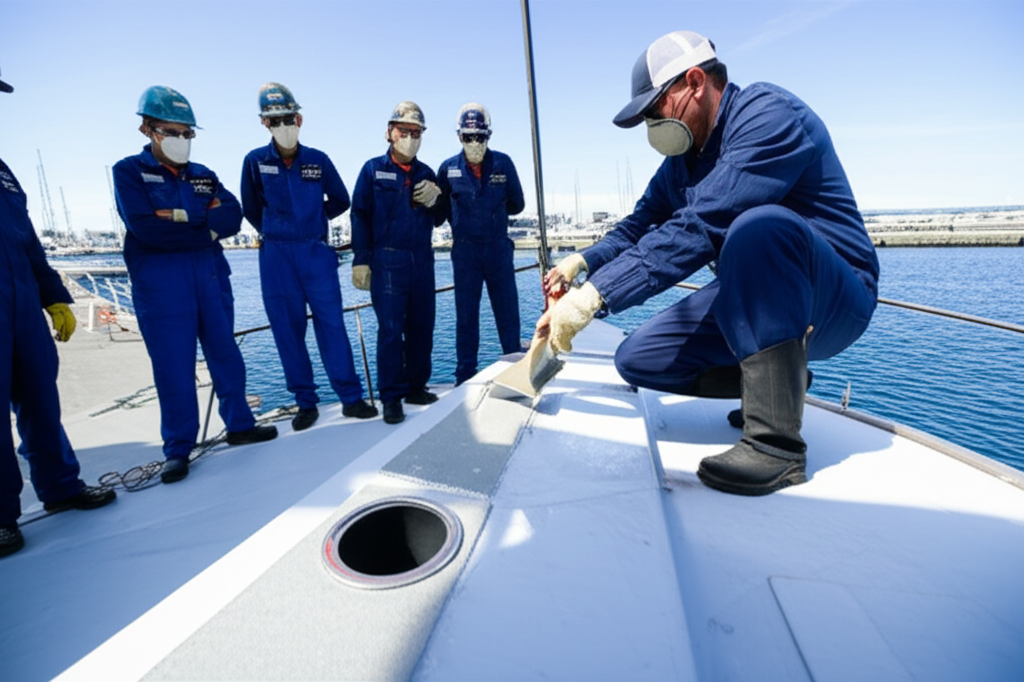
Diploma in Fiberglass and Naval Composites
Why this certificate program?
The Diploma in Fiberglass and Naval Composites
This program provides you with the essential tools and knowledge to master the manufacturing, repair, and maintenance of modern vessels. Learn everything from material selection to the most advanced lamination and molding techniques, ensuring the durability and performance of structures. This program prepares you to face the challenges of the naval industry with a practical and up-to-date approach.
This program provides you with the essential tools and knowledge to master the manufacturing, repair, and maintenance of modern vessels.
Differential Advantages
- Practical Application: Real-world projects for the construction and repair of naval components.
- Cutting-Edge Materials: Experimentation with epoxy resins, vinyl esters, and fiberglass and carbon fiber reinforcements.
- Specialized Techniques: Infusion, vacuum, and pre-impregnation (prepreg) to optimize structural performance.
- Regulations and Safety: Compliance with international standards and best practices in materials handling.
- Professional Networking: Connection with industry experts and career development opportunities.
- Modality: Online
- Level: Diplomado
- Hours: 800 H
- Start date: 29-09-2026
Availability: 1 in stock
Who is it aimed at?
- Technicians and professionals seeking to specialize in the repair and manufacturing of fiberglass naval components.
- Naval engineers and designers requiring advanced knowledge of composite materials to optimize vessel performance and durability.
- Shipyard and nautical workshop personnel wishing to implement innovative techniques in handling fiberglass and composites.
- Entrepreneurs and boat owners interested in mastering the repair and maintenance of their own vessels, reducing costs and improving safety.
- Students and recent graduates in technical fields seeking specialized certification in a high-demand sector work.
Study Flexibility
Advance at your own pace with learning materials available 24/7, consultation forums with experts, and practical exercises to apply the knowledge acquired.
Objectives and competencies

Mastering the manufacture and repair of fiberglass boats:
Interpret technical drawings, select materials and apply lamination, molding and finishing techniques to build and repair hulls, decks and components of boats, ensuring watertightness and structural strength.

Applying advanced lamination and infusion techniques to optimize naval structures:
“Achieving maximum structural efficiency by minimizing weight and optimizing resin distribution, considering innovative materials and shipbuilding regulations.”

Select suitable composite materials for each naval component:
“Considering mechanical properties, resistance to marine corrosion, weight, cost and availability, and applying current naval regulations and standards.”

Inspecting and diagnosing structural failures in naval composites:
“Using non-destructive testing (NDT) such as ultrasound, thermography or radiography and comparing results with technical specifications and applicable regulations.”

Design and build precise molds for the production of parts in naval composites:
“Select materials and manufacturing techniques, optimizing the weight, strength, and cost of the mold.”

Implementing quality control strategies in the manufacture of naval composites:
“Define and implement visual, dimensional and non-destructive (NDT) inspection protocols to ensure structural integrity and compliance with applicable regulations.”
Curriculum - Modules
- Comprehensive Maritime Incident Management: protocols, roles, and chain of command for coordinated response
- Operational Planning and Execution: briefing, routes, weather windows, and go/no-go criteria
- Rapid Risk Assessment: criticality matrix, scene control, and decision-making under pressure
- Operational Communication: VHF/GMDSS, standardized reports, and inter-agency liaison
- Tactical Mobility and Safe Boarding: RHIB maneuvers, approach, mooring, and recovery
- Equipment and Technologies: PPE, signaling, satellite tracking, and field data logging
- Immediate Care of the Affected: primary assessment, hypothermia, trauma, and stabilization for evacuation
- Adverse Environmental Conditions: swell, Visibility, flows, and operational mitigation
Simulation and training: critical scenarios, use of VR/AR, and exercises with performance metrics
Documentation and continuous improvement: lessons learned, indicators (MTTA/MTTR), and SOP updates
- Introduction to the shipbuilding industry: history, evolution, and current landscape.
- Shipbuilding materials: steel, alloys, composites, and their selection.
- Basic ship design: shapes, dimensions, coefficients, and initial stability.
- Propulsion systems: diesel engines, turbines, electric and hybrid systems.
- Auxiliary systems: power generation, cooling, water treatment, and compressed air.
- Welding and joining techniques: processes, filler materials, and quality control.
- Corrosion and protection: mechanisms, coatings, cathodic protection, and control.
- Regulations and safety: SOLAS, MARPOL, IMO, and other relevant regulations.
- Processes of Shipbuilding: cutting, shaping, assembly, testing, and delivery.
Ship maintenance and repair: inspections, planning, and repair techniques.
‘
- Introduction to Composite Materials: Matrix, Reinforcement, and Properties
- Chemistry of Polyester and Vinyl Ester Resins: Types, Catalysts, and Accelerators
- Fiberglass: Types (E, S, AR), Formats (Rovings, Mats, Fabrics), and Treatments
- Manufacturing Processes: Hand Lay-up, Spray-up
- Manufacturing Processes: Infusion and Vacuum Molding, RTM (Resin Transfer Molding)
- Laminate Calculations: Mixing Rules, Strength, and Stiffness
- Structural Adhesives: Types, Surface Preparation, and Application
- Mechanical Joints: Design, Fastener Selection, and Torque tightening
Quality control: non-destructive testing (NDT), visual inspection
Laminate repair: damage assessment, repair techniques
‘
- Introduction to Naval Composites: Types, Properties, and Applications
- Resins: Types (polyester, vinyl ester, epoxy), Characteristics, and Selection
- Reinforcing Fibers: Glass, Carbon, Aramid; Types, Weaves, and Properties
- Cores: Balsa, Foam, Honeycomb; Functions and Selection
- Manual Lamination Process: Lay-up, impregnation, consolidation, and curing
- Infusion Lamination Process: Mold preparation, sealing, vacuum, and resin application
- RTM Lamination Process: Resin injection, flow and pressure control
- Lamination Quality Control: Visual inspection, non-destructive testing
- Surface Finishing: Sanding, polishing, painting, gelcoating, and varnishing
- Composite Repair: Damage assessment, repair techniques, and materials
‘
- Introduction to the Shipbuilding Industry: History, Evolution, and Current Trends
- Shipbuilding Materials: Steel, Alloys, and Composites – Properties and Selection
- Basic Ship Design: Naval Architecture, Stability, and Buoyancy
- Welding and Joining Processes: Techniques, Standards, and Quality Control
- Propulsion Systems: Engines, Propellers, Steering and Maneuvering Systems
- Electrical and Electronic Systems: Generation, Distribution, and Onboard Automation
- Piping and Auxiliary Systems: Pumps, Valves, Water Treatment, and Ventilation
- Painting and Coatings: Corrosion Protection and Maintenance
- Regulations and Certification: Classification Societies, IMO and Maritime Legislation
- Safety and Environment in the Shipbuilding Industry: Risk Prevention, Waste Management and Marine Environmental Protection
‘
- System Architecture and Components: Structural design, materials, and subsystems (mechanical, electrical, electronic, and fluid) with selection and assembly criteria for marine environments
- Fundamentals and Principles of Operation: Physical and engineering foundations (thermodynamics, fluid mechanics, electricity, control, and materials) that explain performance and operating limits
- Safety and Environmental (SHE): Risk analysis, PPE, LOTO, hazardous atmospheres, spill and waste management, and emergency response plans
- Applicable Regulations and Standards: IMO/ISO/IEC requirements and local regulations;
- Conformance criteria, certification, and best practices for operation and maintenance
- Inspection, testing, and diagnostics: Visual/dimensional inspection, functional testing, data analysis, and predictive techniques (vibration, thermography, fluid analysis) to identify root causes
- Preventive and predictive maintenance: Hourly/cycle/seasonal plans, lubrication, adjustments, calibrations, consumable replacement, post-service verification, and operational reliability
- Instrumentation, tools, and metrology: Measuring and testing equipment, diagnostic software, calibration and traceability; selection criteria, safe use, and storage
- Onboard integration and interfaces: Mechanical, electrical, fluid, and data compatibility; Sealing and watertightness, EMC/EMI, corrosion protection, and interoperability testing.
Quality, acceptance testing, and commissioning: process and materials control, FAT/SAT, bench and sea trials, go/no-go criteria, and evidence documentation.
Technical documentation and integrated practice: logs, checklists, reports, and a complete case study (safety → diagnosis → intervention → verification → report) applicable to any system.
- Introduction to Composite Materials: Types, Properties, and Applications in the Shipbuilding Industry.
- Resins: Types (epoxy, polyester, vinyl ester), characteristics, additives, and catalysts.
- Reinforcing Fibers: Types (glass, carbon, aramid), weaves, properties, and selection.
- Cores: Types (balsa, foam, honeycomb), functions, properties, and selection.
- Hand Lay-up Processes: Lay-up, wet lay-up, and consolidation techniques.
- Infusion and Vacuum Processes: Principles, equipment, materials, and optimization.
- Resin Transfer Molding (RTM) Processes: Principles, equipment, materials, and automation.
- Joining and assembly of composites: Adhesives, mechanical methods, joint design.
- Non-destructive testing (NDT): Techniques (ultrasound, thermography, radiography), interpretation, and evaluation.
- Repair of damage to composites: Evaluation, preparation, repair methods, materials, and quality control.
‘
Career opportunities
- Boat Manufacturing Technician: Construction, repair, and maintenance of hulls and structures in fiberglass and composites.
- Lamination Specialist: Application of resins, fabrics, and cores for the creation of naval parts and components.
- Naval Repairer: Diagnosis and resolution of structural problems in boats, including the repair of impact or corrosion damage.
- Composite Modeler: Design and creation of molds for the manufacture of complex parts in fiberglass and other composite materials.
- Quality Inspector: Control and verification of manufacturing and repair processes, ensuring compliance with quality standards.
- Technical Salesperson: Advising on and selling products and materials for naval construction and repair in fiberglass and composites.
- Consultant Technician: Consulting on shipbuilding and repair projects, optimizing the use of materials and manufacturing techniques.
Entrepreneur: Creation of my own workshop for the repair and manufacture of fiberglass and composite boats.
“`
Admission requirements

Academic/professional profile:
Degree/Bachelor's degree in Nautical Science/Maritime Transport, Naval/Marine Engineering, or a related field; or proven professional experience in bridge/operations.

Language proficiency:
Recommended functional maritime English (SMCP) for simulations and technical materials.

Documentation:
Updated resume, copy of degree or seaman's book, ID card/passport, letter of motivation.

Technical requirements (for online):
Equipment with camera/microphone, stable connection, ≥ 24” monitor recommended for ECDIS/Radar-ARPA.
Admission process and dates

1. Online
application
(form + documents).

2. Academic review and interview
(profile/objectives/schedule compatibility).

3. Admission decision
(+ scholarship proposal if applicable).

4. Reservation of place
(deposit) and registration.

5. Induction
(access to campus, calendars, simulator guides).
Scholarships and grants
- Comprehensive Mastery: Learn everything from material selection to advanced fiberglass lamination and molding techniques.
- Naval Applications: Specialize in the repair, construction, and optimization of vessels using composite materials.
- Design and Calculation: Acquire the skills to design efficient structures and perform strength calculations for composites.
- Regulations and Safety: Understand the regulations and safety protocols for handling composite materials in the naval sector.
- Practical Projects: Apply your knowledge to real-world projects, from hull repairs to the manufacture of innovative components.
Testimonials
This diploma program exceeded my expectations. I gained solid theoretical and practical knowledge of shipbuilding and repair using fiberglass and composites. I was able to apply the techniques I learned to real-world projects, which allowed me to develop skills in lamination, vacuum infusion, and structural repair. Now I feel confident in facing the challenges of the shipbuilding industry.
The Diploma in Painting, Maintenance & Restoration exceeded my expectations. I acquired practical and theoretical skills that allowed me to restore a priceless family heirloom, applying techniques learned in the course with amazing results. The quality of instruction and the hands-on approach were key to my success.
This diploma program exceeded my expectations. I gained solid theoretical and practical knowledge of fiberglass design, construction, and repair, which I was able to immediately apply to my work at the shipyard. The quality of the instructors and the practical approach of the course were key to my success. I now feel much more confident and competent in my work.
During the Diploma in Fiberglass and Naval Composites, I acquired the necessary skills to design and build a high-performance kayak hull. I applied my knowledge of lamination, vacuum infusion, and finishing techniques, achieving a final result that exceeded my expectations in terms of strength, weight, and aesthetics. This project allowed me to solidify my understanding of composite materials and opened doors to new opportunities in the naval sector.

Frequently asked questions
Fiberglass and composites.
Yes. The itinerary includes ECDIS/Radar-ARPA/BRM with harbor, ocean, fog, storm, and SAR scenarios.
Online with live sessions; hybrid option for simulator/practical placements through agreements.
Recommended functional SMCP. We offer support materials for standard phraseology.
Yes, with a relevant degree or experience in maritime/port operations. The admissions interview will confirm suitability.
Optional (3–6 months) through Companies & Collaborations and the Alumni Network.
Simulator practice (rubrics), defeat plans, SOPs, checklists, micro-tests and applied TFM.
A degree from Navalis Magna University + operational portfolio (tracks, SOPs, reports and KPIs) useful for audits and employment.
- Introduction to the Shipbuilding Industry: History, Evolution, and Perspectives
- Shipbuilding Materials: Steels, Alloys, Composites, and Their Selection
- Basic Ship Design: Shapes, Dimensions, Coefficients, and Initial Stability
- Marine Propulsion Systems: Engines, Propellers, Thrusters, and Their Efficiency
- Auxiliary Onboard Systems: Electricity, Plumbing, Ventilation, and Refrigeration
- Welding and Joining Techniques: Processes, Qualification, and Quality Control
- Marine Painting and Coatings: Corrosion and Fouling Protection
- Naval Standards and Certification: Classification Societies, International Agreements
- Naval Repair and Maintenance: Techniques, Inspection, and Planning
- Safety and Environment in the Naval Industry: Risk Prevention and Environmental Protection
‘
Request information
Complete the Application Form.
Attach your CV/degree certificate (if you have it to hand).
Indicate your preferred cohort (January/May/September) and whether you would like the hybrid option with simulator sessions.
An academic advisor will contact you within 24–48 hours to guide you through the admission process, scholarships, and compatibility with your professional schedule.
Faculty
Eng. Tomás Riera
Full Professor
Eng. Tomás Riera
Full Professor
Eng. Sofía Marquina
Full Professor
Eng. Sofía Marquina
Full Professor
Eng. Javier Bañuls
Full Professor
Eng. Javier Bañuls
Full Professor
Dr. Nuria Llobregat
Full Professor
Dr. Nuria Llobregat
Full Professor
Dr. Pau Ferrer
Full Professor
Dr. Pau Ferrer
Full Professor
Cap. Javier Abaroa (MCA)
Full Professor
Cap. Javier Abaroa (MCA)
Full Professor

