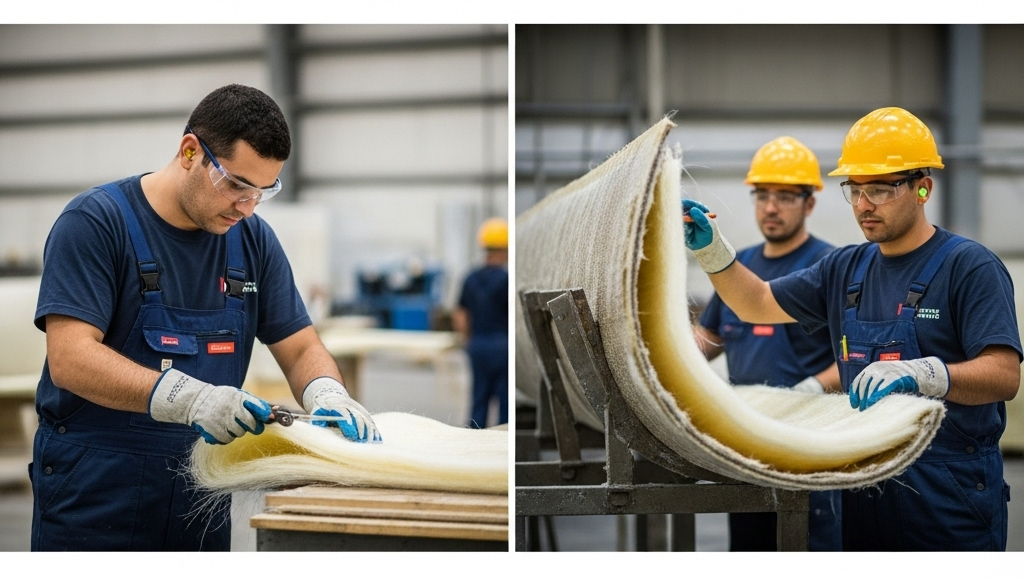
Course on Composite Materials and Fiberglass

Why this course?

The Composite Materials and Fiberglass

course

This course will immerse you in the world of the materials of the future. Learn everything from the fundamentals of composition and properties to advanced manufacturing and repair techniques. Master the use of fiberglass and other materials to create lightweight, strong, and versatile products. Ideal for engineers, designers, and technicians looking to innovate in their projects.

Differential Advantages

  • In-depth Knowledge: Understand the science behind composite materials.
  • Practical Applications: Discover how they are used in various industries (aerospace, automotive, etc.).
  • Manufacturing Techniques: Learn contact molding, infusion, pultrusion, and more.
  • Repair and Maintenance: Extend the lifespan of your composite products.
  • Real-World Projects: Apply your knowledge in case studies and practical exercises.
Materiales

Course on Composite Materials and Fiberglass

Availability: 1 in stock

Who is it aimed at?

  • Engineers and designers looking to deepen their knowledge of the design and manufacture of parts using composite materials and fiberglass.
  • Maintenance and repair technicians who need to acquire practical skills in the repair and maintenance of fiberglass structures.
  • Students and recent graduates in engineering, industrial design, or related fields who wish to specialize in composite materials.
  • Companies in the automotive, aerospace, marine, and construction sectors looking to optimize the use of composite materials in their products.
  • Entrepreneurs and manufacturers interested in developing new products utilizing the advantages of fiberglass and composite materials.

Flexibility of Learning
Access the material from anywhere, progress at your own pace, and receive personalized support to answer your questions.

Materiales

Objectives and competencies

Mastering lamination and molding techniques to create high-strength, lightweight parts:

“Selecting optimal resins and fibers, controlling polymerization, and applying vacuum/pressure techniques to maximize mechanical properties.”

Evaluate and select the most suitable composite materials and fiberglass for each specific application:

Analyze performance requirements (mechanical, thermal, chemical) and cost to optimize the choice according to the application.

Repairing and maintaining composite and fiberglass structures, ensuring their integrity and extending their useful life:

“Inspect, diagnose and repair defects according to manuals and regulations, documenting the process.”

Interpreting plans and technical specifications for the precise manufacturing of components in composite materials.

“Identify symbols, tolerances, and manufacturing processes, ensuring the quality and conformity of the final product.”

Apply industrial safety and hygiene protocols in the handling of resins, catalysts and fibers, minimizing occupational and environmental risks:

“Identify hazards, use PPE, manage waste, and act in emergencies in accordance with regulations.”

Controlling quality in the manufacture of composite material parts, ensuring compliance with standards and tolerances:

“Visually inspect and use measuring equipment to verify dimensions, finishes, and surface defects according to plans and technical specifications.”

Curriculum - Modules

1.1 Resin chemistry: polyester, vinyl ester, epoxy; curing kinetics and Tg
1.2 Glass fiber: E-glass/S-glass; Formats (roving, mat, woven, multiaxial) and selection
1.3 Laminate architectures: orientations, basis weights, waviness, crimp, and structural efficiency
1.4 Fiber-matrix interface: adhesion, wetting, sizing, compatibilities, and interlaminar failures
1.5 Laminate mechanics: anisotropy, moduli, strength, Poisson’s ratio, and failure criteria
1.6 Degradation and durability: water, UV, fatigue, temperature, and saline environments

2.1 Loads and Stresses: Bending, Shear, Local/Global Buckling, and Stress Concentrations
2.2 Applied Classical Cross-Laminate (CLT) Theory: ABD, Couplings, Symmetry, and Balance
2.3 Sandwich Design: Cores (PVC, PET, SAN, Raft), Skins, and Shear Stability
2.4 Joints and Details: Inserts, Hard Points, Transitions, Lightweighting, and Critical Radii
2.5 Structural Adhesives and Bonding: Surface Preparation, Peel/Cleavage, and Joint Design
2.6 Tolerances and Drapeability and manufacturability: DFM rules for composites

3.1 Hand Lay-up: Sequences, Deaeration, Resin/Fiber Ratio and Exudate Control
3.2 ​​Spray-up and Mixed Lay-up: Limitations, Quality Control and Typical Applications
3.3 Vacuum and Infusion: VARTM/Infusion; Flow network design, permeability, and feeding strategy
3.4 RTM/L-RTM and closed processes: injection, pressure, molds, repeatability, and productivity
3.5 Prepreg and advanced curing: OOA/autoclave, ramps, post-curing, and thermal control
3.6 Process defectology: porosity, dry spots, delamination, print-through, and prevention

4.1 Mold Engineering: Materials, Rigidity, Thermal Stability, and Design for Demolding
4.2 Surface Preparation: Sanding, Polishing, Sealers, Waxes, and Release Agents
4.3 Gelcoat and Barriers: Types, Thicknesses, Inhibition, Curing, and Aesthetic/Cracking Control
4.4 Vacuum Consumables: Peel Ply, Perforated Film, Breather, Flow Meshes, and Sealing Tapes
4.5 Vacuum System Integrity: Leaks, Testing, Flow Meters, Valves, and Procedures
4.6 Tool Maintenance: Cycles, Repair of molds, dimensional control and useful life

5.1 Composite Quality Plan: Control Points, Acceptance Criteria, and Batch Records
5.2 Mechanical Tests: Tension, Compression, Flexure, ILSS, DCB/ENF, and Fatigue
5.3 Physicochemical Tests: Tg/DSC, Fiber Content, Porosity, Hardness, and Water Absorption
5.4 Inspection and NDT: Ultrasound, Thermography, Shearography, Tap Test, and Limitations
5.5 Technical Documentation: Process Sheets, Lamination Maps, WPS/ITP, and Non-Conformities
5.6 Standardization and Requirements: Applicable ISO/ASTM, classification and audit criteria

6.1 Damage Diagnosis: Impact, Fatigue, Delamination, Microcracking, and Hydrothermal Degradation
6.2 Structural Repair: Scarping, Taper Ratios, Repair Lay-up, and Vacuum Consolidation
6.3 Osmosis and Blistering: Causes, Detection, Treatment, Epoxy Barriers, and Humidity Control
6.4 Gelcoat Repair and Finishes: Matching, Compatibility, Polishing, and Print-Through Prevention
6.5 Safety and Hygiene: Styrene, Epoxies, Fiber Dust, VOCs, PPE, and Risk Management
6.6 Circular Economy: Waste Reduction, Recycling, fiber recovery and consumables management

Plan de estudio - Módulos

1.1 Resin chemistry: polyester, vinyl ester, epoxy; curing kinetics and Tg
1.2 Glass fiber: E-glass/S-glass; Formats (roving, mat, woven, multiaxial) and selection
1.3 Laminate architectures: orientations, basis weights, waviness, crimp, and structural efficiency
1.4 Fiber-matrix interface: adhesion, wetting, sizing, compatibilities, and interlaminar failures
1.5 Laminate mechanics: anisotropy, moduli, strength, Poisson’s ratio, and failure criteria
1.6 Degradation and durability: water, UV, fatigue, temperature, and saline environments

2.1 Loads and Stresses: Bending, Shear, Local/Global Buckling, and Stress Concentrations
2.2 Applied Classical Cross-Laminate (CLT) Theory: ABD, Couplings, Symmetry, and Balance
2.3 Sandwich Design: Cores (PVC, PET, SAN, Raft), Skins, and Shear Stability
2.4 Joints and Details: Inserts, Hard Points, Transitions, Lightweighting, and Critical Radii
2.5 Structural Adhesives and Bonding: Surface Preparation, Peel/Cleavage, and Joint Design
2.6 Tolerances and Drapeability and manufacturability: DFM rules for composites

3.1 Hand Lay-up: Sequences, Deaeration, Resin/Fiber Ratio and Exudate Control
3.2 ​​Spray-up and Mixed Lay-up: Limitations, Quality Control and Typical Applications
3.3 Vacuum and Infusion: VARTM/Infusion; Flow network design, permeability, and feeding strategy
3.4 RTM/L-RTM and closed processes: injection, pressure, molds, repeatability, and productivity
3.5 Prepreg and advanced curing: OOA/autoclave, ramps, post-curing, and thermal control
3.6 Process defectology: porosity, dry spots, delamination, print-through, and prevention

4.1 Mold Engineering: Materials, Rigidity, Thermal Stability, and Design for Demolding
4.2 Surface Preparation: Sanding, Polishing, Sealers, Waxes, and Release Agents
4.3 Gelcoat and Barriers: Types, Thicknesses, Inhibition, Curing, and Aesthetic/Cracking Control
4.4 Vacuum Consumables: Peel Ply, Perforated Film, Breather, Flow Meshes, and Sealing Tapes
4.5 Vacuum System Integrity: Leaks, Testing, Flow Meters, Valves, and Procedures
4.6 Tool Maintenance: Cycles, Repair of molds, dimensional control and useful life

5.1 Composite Quality Plan: Control Points, Acceptance Criteria, and Batch Records
5.2 Mechanical Tests: Tension, Compression, Flexure, ILSS, DCB/ENF, and Fatigue
5.3 Physicochemical Tests: Tg/DSC, Fiber Content, Porosity, Hardness, and Water Absorption
5.4 Inspection and NDT: Ultrasound, Thermography, Shearography, Tap Test, and Limitations
5.5 Technical Documentation: Process Sheets, Lamination Maps, WPS/ITP, and Non-Conformities
5.6 Standardization and Requirements: Applicable ISO/ASTM, classification and audit criteria

6.1 Damage Diagnosis: Impact, Fatigue, Delamination, Microcracking, and Hydrothermal Degradation
6.2 Structural Repair: Scarping, Taper Ratios, Repair Lay-up, and Vacuum Consolidation
6.3 Osmosis and Blistering: Causes, Detection, Treatment, Epoxy Barriers, and Humidity Control
6.4 Gelcoat Repair and Finishes: Matching, Compatibility, Polishing, and Print-Through Prevention
6.5 Safety and Hygiene: Styrene, Epoxies, Fiber Dust, VOCs, PPE, and Risk Management
6.6 Circular Economy: Waste Reduction, Recycling, fiber recovery and consumables management

#VALUE!

#VALUE!

#VALUE!

#VALUE!

Career opportunities

  • Production Technician: Manufacturing of parts in composite materials and fiberglass.
  • Quality Control Technician: Inspection and verification of manufactured products.
  • Product Designer: Development of new products using composite materials.
  • Composite Repairer: Maintenance and repair of damaged parts.
  • Composite Installer: Assembly and installation of components in various industries.
  • Technical Sales Representative: Sales and technical advice on composite materials.
  • Research and Development: Participation in innovation and materials improvement projects.
  • Technical Consultant: Specialized advice on the application of composite materials.

“`

Admission requirements

Academic/professional profile:

Degree/Bachelor's degree in Nautical Science/Maritime Transport, Naval/Marine Engineering, or a related field; or proven professional experience in bridge/operations.

Language proficiency:

Recommended functional maritime English (SMCP) for simulations and technical materials.

5. Induction

Updated resume, copy of degree or seaman's book, ID card/passport, letter of motivation.

Technical requirements (for online):

Equipment with camera/microphone, stable connection, ≥ 24” monitor recommended for ECDIS/Radar-ARPA.

Admission process and dates

1. Online
application

(form + documents).

2. Academic review and interview

(profile/objectives/schedule compatibility).

3. Admission decision

(+ scholarship proposal if applicable).

4. Reservation of place

(deposit) and registration.

5. Induction

(access to campus, calendars, simulator guides).

Scholarships and grants

  • Master Composite Materials: Learn from basic theory to advanced applications of fiberglass and other materials.
  • Design and Manufacturing: Acquire the skills necessary to design and manufacture high-quality parts, optimizing performance and reducing costs.
  • Repair and Maintenance: Learn specialized techniques for repairing and maintaining composite structures, extending their lifespan.
  • Case Studies: Analyze real-world cases and participate in practical projects to solidify your knowledge and develop your experience.
  • Professional Certification: Obtain a recognized certification that validates your skills in working with composite materials and fiberglass.
Boost your career in sectors such as aerospace, automotive, shipbuilding, and wind energy.

Testimonials

Frequently asked questions

Fiberglass is a specific type of composite material. The difference is that the term “composite material” encompasses a broader category of materials consisting of two or more distinct components combined to create a material with enhanced properties, while fiberglass is a particular composite that uses glass fibers as reinforcement in a polymer matrix (usually resin).

Yes. The itinerary includes ECDIS/Radar-ARPA/BRM with harbor, ocean, fog, storm, and SAR scenarios.

Online with live sessions; hybrid option for simulator/practical placements through agreements.

Fiberglass is a component, and the composite material is the material resulting from combining fiberglass with a resin.

Recommended functional SMCP. We offer support materials for standard phraseology.

Yes, with a relevant degree or experience in maritime/port operations. The admissions interview will confirm suitability.

Optional (3–6 months) through Companies & Collaborations and the Alumni Network.

Simulator practice (rubrics), defeat plans, SOPs, checklists, micro-tests and applied TFM.

A degree from Navalis Magna University + operational portfolio (tracks, SOPs, reports and KPIs) useful for audits and employment.

#VALUE!

Request information

  1. Complete the Application Form
  2. Attach your CV/Qualifications (if you have them to hand).
  3. Indicate your preferred cohort (January/May/September) and whether you want the hybrid option with simulator sessions.
An academic advisor will contact you within 24–48 hours to guide you through the admission process, scholarships, and compatibility with your professional schedule. Translated with DeepL.com (free version)
Please enable JavaScript in your browser to complete this form.
Click or drag a file to this area to upload.

Teachers

0
    0
    Tu carrito
    Tu carrito esta vacíoRegresar a la tienda
    Scroll to Top