Diploma in Nautical Management Software
Why this certificate program?
The Diploma in Nautical Management Software
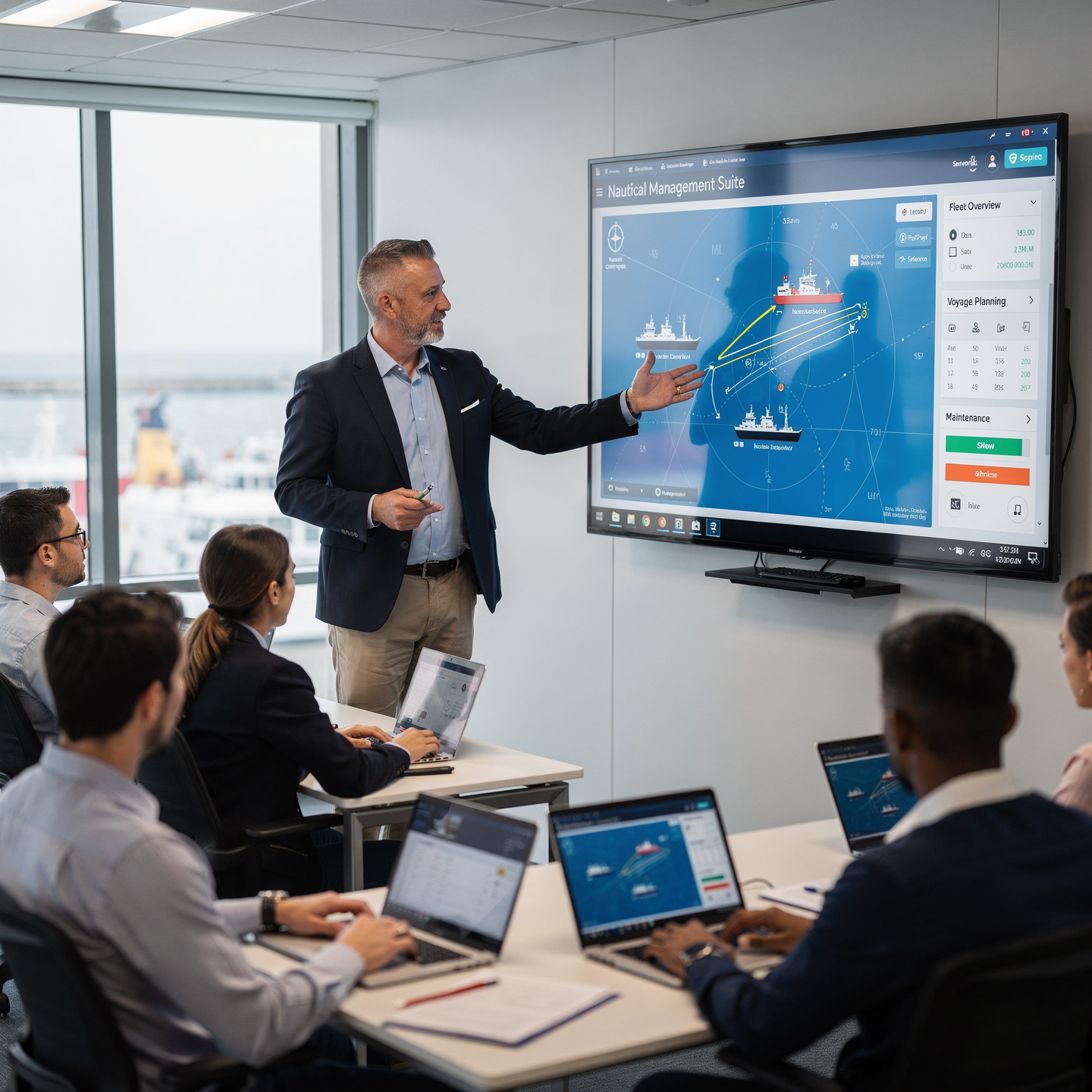
This program provides you with the tools and expert knowledge to optimize fleet management, port operations, and maritime services. Master integrated management systems, automation of key processes, and data analytics to make strategic decisions based on accurate, real-time information. This program will allow you to boost efficiency, reduce costs, and ensure safety in all your operations.
Differentiating Advantages
- Hands-on Implementation: Learn to configure and use market-leading software.
- Resource Optimization: Efficiently manage fuel, maintenance, crews, and supplies.
- Regulatory Compliance: Ensure compliance with national and international regulations.
- Continuous Improvement: Use data analytics to identify areas for improvement and optimize performance.
- Professional Networking: Connect with experts and other professionals in the maritime industry.
- Modality: Online
- Level: Diplomado
- Hours: 800 H
- Start date: 01-10-2026
Availability: 1 in stock
Who is it aimed at?
- Maritime professionals seeking to optimize fleet management, maintenance, and operations.
- Port and marina managers interested in the digitalization and automation of processes.
- Maritime service companies wishing to implement technological solutions to improve efficiency and profitability.
- Naval engineers and technicians seeking to specialize in software for nautical management.
- Students and recent graduates in related fields seeking to add value to their professional profile in the maritime sector.
Flexibility and applicability
Designed for active professionals: flexible online format, applicable practical projects to the realities of the workplace and personalized tutoring.
Objectives and competencies

Optimize vessel management and maintenance:
Implement a rigorous preventive maintenance plan, optimizing resources and minimizing unplanned downtime.

Implement software solutions for the efficient management of ports and marinas:
Develop port resource management modules (berths, warehouses, equipment) integrated with billing and access control systems.

Mastering software tools for comprehensive maritime safety management and risk prevention:
“Configure and operate Automatic Identification Systems (AIS), radars and electronic charts (ECDIS) for safe and efficient navigation, interpreting information and optimizing hazard detection.”

Efficiently manage documentation and administrative procedures related to navigation:
“Processing necessary permits, insurance and certificates, ensuring their validity and availability on board.”
Analyze vessel performance data to optimize efficiency and reduce operating costs:
“Identify patterns of fuel consumption, speed, and maintenance, implementing data-driven navigation and predictive maintenance strategies.”

Effectively coordinate the logistics and provisioning of vessels:
“Efficiently manage the supply chain, optimizing costs and delivery times with reliable suppliers and appropriate storage strategies.”
Curriculum - Modules
- Comprehensive Maritime Incident Management: protocols, roles, and chain of command for coordinated response
- Operational Planning and Execution: briefing, routes, weather windows, and go/no-go criteria
- Rapid Risk Assessment: criticality matrix, scene control, and decision-making under pressure
- Operational Communication: VHF/GMDSS, standardized reports, and inter-agency liaison
- Tactical Mobility and Safe Boarding: RHIB maneuvers, approach, mooring, and recovery
- Equipment and Technologies: PPE, signaling, satellite tracking, and field data logging
- Immediate Care of the Affected: primary assessment, hypothermia, trauma, and stabilization for evacuation
- Adverse Environmental Conditions: swell, Visibility, flows, and operational mitigation
Simulation and training: critical scenarios, use of VR/AR, and exercises with performance metrics
Documentation and continuous improvement: lessons learned, indicators (MTTA/MTTR), and SOP updates
- Introduction to Electronic Cartography: Formats, Standards, and Updates
- ECDIS: Configuration, Operation, Display Modes, and Alarms
- AIS: Operation, Message Types, Security, and Applications
- GMDSS: Principles, Frequencies, Equipment, and Distress Procedures
- VHF, MF/HF Communication Equipment: Operation, Maintenance, and Regulations
- NAVTEX: Receiving Notices to Mariners and Weather Forecasts
- EPIRB and SART: Operation, Activation, and Testing
- Integration of Sensors: GPS, Gyro, and Other Navigation Systems
- Emergency Procedures: Distress and Rescue Communications
- International regulations: SOLAS, ITU, IMO and other applicable regulations
‘
- Introduction to Digital Transformation in Maritime Operations
- IoT Sensors: Types, Applications in Ships and Ports, Connectivity
- Big Data: Collection, Storage, and Analysis of Maritime Data
- Artificial Intelligence (AI): Applications in Prediction, Optimization, and Safety
- Cloud Computing: Platforms and Services for Maritime Operations
- Cybersecurity: Threats and Protection of Digital Maritime Systems
- Digital Twins: Simulation and Optimization of Maritime Operations
- Augmented Reality (AR) and Virtual Reality (VR): Training and Maintenance
- Blockchain: Applications in the Maritime Supply Chain
- Ethics and Regulation in the Implementation of digital solutions
‘
- Introduction to Electronic Cartography: History, Evolution, and Standards
- Electronic Chart Formats: Raster (RNC) and Vector (ENC)
- Reference Systems: Datum, Projections, and Geopositioning
- Structure and Content of ENC Charts: Layers, Objects, and Attributes
- Acquisition and Updating of Electronic Charts: Sources, Methods, and Licenses
- ECDIS: Definition, Components, Functions, and Performance Requirements
- Integration of Sensors and Navigation Systems: GNSS, Radar, AIS, Gyrocompass, Log
- Route Planning in ECDIS: Configuration, Validation, and Optimization
- Navigation Monitoring in ECDIS: Alarms, alerts, and hazard detection
- Backup and contingency procedures in case of system failures
‘
- Introduction to Industry 4.0 and its impact on the maritime sector
- Sensors and actuators: Types, characteristics, and applications in maritime systems
- Industrial communication networks: Protocols, standards, and security
- Distributed control systems (DCS): Architecture, configuration, and programming
- Data acquisition and processing: Technologies, platforms, and analytics
- Maritime Internet of Things (IoT): Connectivity, platforms, and use cases
- Cybersecurity in digitized maritime systems: Threats, vulnerabilities, and protection
- Digital twins: Modeling, simulation, and optimization of maritime processes
- Integration of legacy and New: Strategies, Challenges, and Best Practices
Data Analysis and Visualization: Tools, Techniques, and Informed Decision-Making
‘
- System Architecture and Components: Structural design, materials, and subsystems (mechanical, electrical, electronic, and fluid) with selection and assembly criteria for marine environments
- Fundamentals and Principles of Operation: Physical and engineering foundations (thermodynamics, fluid mechanics, electricity, control, and materials) that explain performance and operating limits
- Safety and Environmental (SHE): Risk analysis, PPE, LOTO, hazardous atmospheres, spill and waste management, and emergency response plans
- Applicable Regulations and Standards: IMO/ISO/IEC requirements and local regulations;
- Conformance criteria, certification, and best practices for operation and maintenance
- Inspection, testing, and diagnostics: Visual/dimensional inspection, functional testing, data analysis, and predictive techniques (vibration, thermography, fluid analysis) to identify root causes
- Preventive and predictive maintenance: Hourly/cycle/seasonal plans, lubrication, adjustments, calibrations, consumable replacement, post-service verification, and operational reliability
- Instrumentation, tools, and metrology: Measuring and testing equipment, diagnostic software, calibration and traceability; selection criteria, safe use, and storage
- Onboard integration and interfaces: Mechanical, electrical, fluid, and data compatibility; Sealing and watertightness, EMC/EMI, corrosion protection, and interoperability testing.
Quality, acceptance testing, and commissioning: process and materials control, FAT/SAT, bench and sea trials, go/no-go criteria, and evidence documentation.
Technical documentation and integrated practice: logs, checklists, reports, and a complete case study (safety → diagnosis → intervention → verification → report) applicable to any system.
- Introduction to Digital Solutions for Navigation: Evolution and Current Landscape
- Global Positioning Systems (GPS, GLONASS, Galileo, BeiDou): Fundamentals, Accuracy, and Limitations
- Digital Cartography: Formats (Vector, Raster), Standards (S-57, S-100), and Providers
- Geographic Information Systems (GIS) Applied to Navigation: Spatial Analysis and Data Visualization
- Route Planning Platforms: Functionalities, Data Integration, and Trajectory Optimization
- Risk Analysis Tools: Hazard Identification, Vulnerability Assessment, and Risk Mitigation
- Fleet Management Software: Real-Time Monitoring, Communication, and Reporting
- Intelligence Applications Artificial intelligence and machine learning for navigation: weather forecasting and fuel consumption optimization
Integration of sensor data (AIS, radar, ECDIS) for a comprehensive situational awareness
Future trends: autonomous navigation, digital twins, and augmented reality
‘
Career opportunities
- Nautical Software Implementer: Configuration, customization, and support of management software for companies in the sector.
- Software Consultant for Nautical Companies: Advising on the selection, implementation, and optimization of management software.
- Nautical Software Developer: Creation and maintenance of specific modules or functionalities for nautical management software.
- Nautical Management Software Trainer: Training users in the efficient use of software tools.
- Specialized Technical Support: Troubleshooting and technical assistance for users of nautical management software.
- Data Analyst in Nautical Companies: Extraction and analysis of data generated by management software for decision-making.
- Software Project Manager
- Nautical: Planning and management of software implementation or development projects.
- Nautical Software Sales: Sales and promotion of management software solutions for companies in the sector.
“`
Admission requirements

Academic/professional profile:
Degree/Bachelor's degree in Nautical Science/Maritime Transport, Naval/Marine Engineering, or a related field; or proven professional experience in bridge/operations.

Language proficiency:
Recommended functional maritime English (SMCP) for simulations and technical materials.

Documentation:
Updated resume, copy of degree or seaman's book, ID card/passport, letter of motivation.

Technical requirements (for online):
Equipment with camera/microphone, stable connection, ≥ 24” monitor recommended for ECDIS/Radar-ARPA.
Admission process and dates

1. Online
application
(form + documents).

2. Academic review and interview
(profile/objectives/schedule compatibility).

3. Admission decision
(+ scholarship proposal if applicable).

4. Reservation of place
(deposit) and registration.

5. Induction
(access to campus, calendars, simulator guides).
Scholarships and grants
- Master Digital Nautical Management: Learn to optimize operations with the most advanced software tools.
- Expert Implementation: Acquire practical skills to configure and use management systems in record time.
- Efficiency and Profitability: Discover how to reduce costs and improve decision-making with accurate, real-time data.
- Professional Certification: Earn a recognized diploma that will boost your career in the nautical sector.
- Strategic Networking: Connect with industry experts and professionals to expand your opportunities.
Testimonials
This diploma program exceeded my expectations. I gained a solid understanding of nautical management software, from route planning and fleet management to meteorological analysis and maritime regulations. The hands-on practice with simulators was key to reinforcing what I learned, and now I feel prepared to apply these tools in my work, optimizing the efficiency and safety of operations.
The Diploma in Onboard Communications and Technology exceeded my expectations. I gained a solid understanding of satellite communication systems, onboard network management, and maritime cybersecurity, which enabled me to lead the modernization of communications in my fleet, optimizing operational efficiency and crew safety.
The Diploma in Nautical Management Software provided me with the necessary tools to optimize operations in my company. I successfully implemented a fleet management system, reducing maintenance costs by 15% and improving route scheduling efficiency by 20%. Thanks to the knowledge I gained, I can now make more informed and strategic decisions, which has significantly contributed to the growth of our business.
This diploma program provided me with the tools and knowledge necessary to optimize my fleet management. Thanks to the skills I acquired in route planning, maintenance management, and data analysis, I was able to reduce operating costs by 15% and increase efficiency by 20% in just six months.

Frequently asked questions
Maritime and nautical sector.
Yes. The itinerary includes ECDIS/Radar-ARPA/BRM with harbor, ocean, fog, storm, and SAR scenarios.
Online with live sessions; hybrid option for simulator/practical placements through agreements.
It focuses on utilization.
Recommended functional SMCP. We offer support materials for standard phraseology.
Yes, with a relevant degree or experience in maritime/port operations. The admissions interview will confirm suitability.
Optional (3–6 months) through Companies & Collaborations and the Alumni Network.
Simulator practice (rubrics), defeat plans, SOPs, checklists, micro-tests and applied TFM.
A degree from Navalis Magna University + operational portfolio (tracks, SOPs, reports and KPIs) useful for audits and employment.
- Introduction to energy efficiency in ships: key concepts and regulations.
- Fuel consumption analysis: influencing factors and measurement methods.
- Speed and route optimization: strategies to reduce consumption and emissions.
- Ballast management and stability: impact on drag and ship efficiency.
- Hull and propeller maintenance: cleaning and treatment to reduce friction.
- Efficient propulsion systems: innovative technologies and engine improvements.
- Use of renewable energy on board: solar, wind, and other alternatives.
- Waste management and water treatment: regulatory compliance and reducing environmental impact.
- Procurement planning and inventory management: resource optimization and waste reduction.
- Data monitoring and analysis: tools and techniques for continuous improvement of efficiency.
‘
Request information
Complete the Application Form.
Attach your CV/degree certificate (if you have it to hand).
Indicate your preferred cohort (January/May/September) and whether you would like the hybrid option with simulator sessions.
An academic advisor will contact you within 24–48 hours to guide you through the admission process, scholarships, and compatibility with your professional schedule.
Faculty
Eng. Tomás Riera
Full Professor
Eng. Tomás Riera
Full Professor
Eng. Sofía Marquina
Full Professor
Eng. Sofía Marquina
Full Professor
Eng. Javier Bañuls
Full Professor
Eng. Javier Bañuls
Full Professor
Dr. Nuria Llobregat
Full Professor
Dr. Nuria Llobregat
Full Professor
Dr. Pau Ferrer
Full Professor
Dr. Pau Ferrer
Full Professor
Cap. Javier Abaroa (MCA)
Full Professor
Cap. Javier Abaroa (MCA)
Full Professor